Next-Level Code. Nexuvibe Style ...
Hrs
Min
Sec

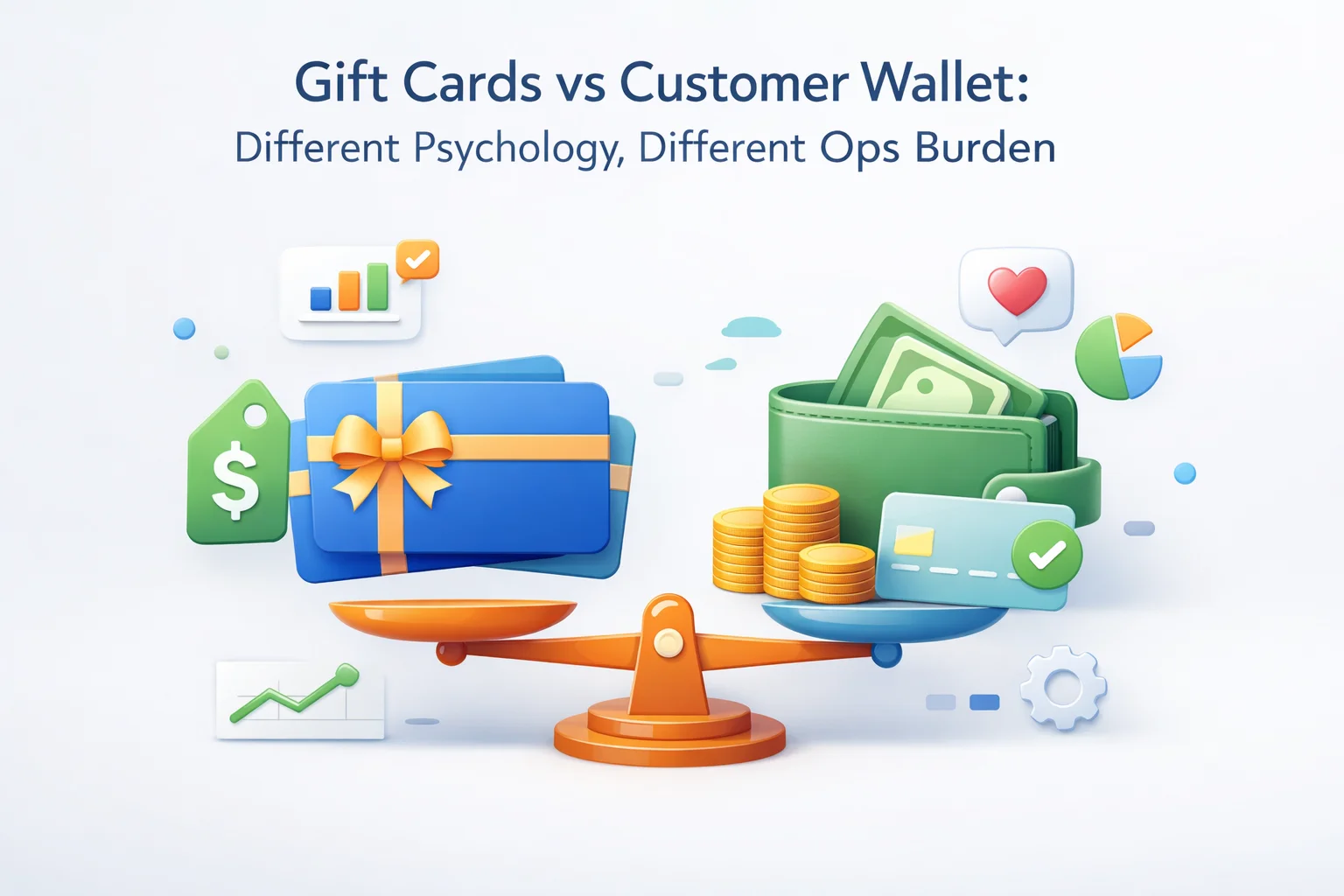
Gift cards dominate retail holidays because they package intent: I want you to enjoy this brand, but I refuse to guess your size. Customer wallets dominate retention programmes because they package continuity: your last refund, your earned cashback, and your next purchase all meet in one balance customers can monitor. Merge the two thoughtlessly and you inherit double operations: plastic or code logistics for gifts plus ledger discipline for wallet users, often without differentiated policies to explain why some balances expire and others do not.
Neither tool is morally superior; they optimise for different emotions. Gift cards monetize occasion-based attention. Wallets monetize habit and trust. Retailers stumble when they market wallet features but implement gift-card psychology—non-transferable, batch-issued codes with minimal history—or when they market gift ease but implement wallet-grade compliance without the support scripts to match.
When you intend to run ledger-backed balances with customer-visible histories, NEXU Smart Wallet and Cashback for WooCommerce delivers My Account wallet cards with top-up paths and transparent ledgers so operational reality matches wallet language instead of stretching gift-card infrastructure past its design limit.
Gift cards solve a social problem: how do I signal thoughtfulness without micromanaging someone else’s taste? The productized answer is a transferrable artifact with fixed face value and a festive presentation layer. Psychologically, success is measured at the moment of gifting. What happens afterward is inventory for the recipient, not a relationship state the giver monitors. That emotional distance explains why gift cards tolerate anonymity, breakage, and even mild frustration at redemption—the giver already left the story.
Customer wallets solve continuity problems: how do I keep purchasing from a brand I trust while smoothing cash flow, capturing promotions, or consolidating refunds into my next basket? Success is longitudinal. Customers expect histories, fairness when rules change, and responsiveness when balances look wrong. The emotional contract is intimate. If your operations team treats wallet holders like anonymous gift-card redeemers, you violate that intimacy and pay in public reviews.
Peak emotion at purchase; tolerance for redemption friction varies; anonymity is acceptable.
Peak emotion spans months; fairness and transparency dominate; identity ties strongly.
Commerce teams cite WooCommerce gift card documentation patterns when evaluating native extensions because redemption flows must coexist with coupons and tax displays. Wallet programmes borrow some of those mechanics yet demand persistent identity anchors that pure gift codes rarely require.
Gift cards create lift at point of sale yet introduce balance-sheet questions that consumer marketing slides skip. Revenue recognition rules in many regimes treat unredeemed balances as deferred liabilities, not congratulatory profit. Escheatment—unclaimed property—enters the conversation when dormant cards age out. Third-party retailers selling your brand’s cards add reconciliation layers: remittances, returns, chargebacks that are not your shopper’s fault but still hit your settlement files.
Operationsally, batch generation, code leaks, manual re-issuance after postal loss, and seasonal returns of physical cards all consume hours. Fraud teams watch for scripted balance checks that presage takeover attempts. Support must mediate tricky social situations: gifted employees who quit the job where the envelope sat, divorced partners arguing about who owns a balance, teenagers spending parents’ gifts on categories the purchaser dislikes. Those stories rarely appear in “Top five gift-card benefits” blogs, yet they define labour reality.
Gift-card merchants sometimes underestimate integration testing: WooCommerce coupons, category exclusions, stacked promotions during Black Friday, and partial redemptions across sessions. Each scenario requires scripted verification because customers treat stored value like cash even when fine print disagrees.
Channel-specific nuance piles on: corporate purchasers want consolidated invoicing while grandparent gifters want SMS delivery with zero login. Marketplace sellers face extra proof burdens when purchasers buy codes from intermediaries whose chargebacks arrive months later. None of those stresses invalidate gift cards—they simply explain why finance often owns the reconciliation calendar while marketing owns the glossy hero banner. Respect both calendars when promising simplicity to executives who never answered a ticket about escheatment thresholds.
Wallet programmes shift burden toward customer education and proactive policy clarity. Participants ask granular questions—why did my cashback move from pending to available on Thursday, why was my withdrawal rejected, why does my promotional bucket spend before my funded cash, can I transfer balance to my business unit’s sub-account? Each question is reasonable. Without crisp documentation, agents improvise answers that diverge shift to shift, creating ledger incidents that dwarf gift-card anecdotes in technical complexity.
Self-service depth separates programmes that scale from programmes that stall. FAQs listing three sentences cannot carry wallet-grade nuance; customers will open tickets anyway, now angrier because you genuinely wasted their time pretending help existed. Invest in searchable knowledge bases that mirror ledger vocabulary—pending, credited, revoked—and update them whenever cashback rules change. That discipline sounds bureaucratic until you calculate weekend overtime spent answering the same arithmetic question seventeen times because an old blog post still promises obsolete timing.
Wallet operations also intertwine with product teams because rules affect merchandising. Cashback exclusions on sale items may be margin policy, yet customers interpret them as betrayal if marketing never signposted them before enrolment. Refund-to-wallet pathways intersect with legal cooling-off regimes for digital goods. Withdrawals involve KYC instincts even when you are not a bank—you still route cash leaving the ecosystem. Any one of those vectors can swallow a week when mishandled publicly on social channels.
Gift-card fraud clusters around theft of codes, brute-force guessing on weak issuance patterns, social engineering at retail service desks, and marketplace resale of dubious provenance. Wallet fraud clusters around account takeover, phishing that harvests login plus MFA fatigue, orchestrated withdrawal requests after stolen cashback accruals, and insider manipulation if admin roles lack segregation. Defence patterns differ: rate limits on code lookups do not substitute for vaulting session integrity; chargeback playbooks written for cards do not map cleanly to wallet reversals funded from internal liability.
Dispute narratives diverge culturally: gift-card recipients complain about breakage or inability to combine balances across regions; wallet holders complain about arithmetic they can quote from mobile screenshots. Prepare evidence formats accordingly—serial-level issuance logs versus immutable ledger excerpts tied to order IDs.
Security posture references such as WordPress hardening fundamentals remain baseline obligations because wallet programmes concentrate value behind login boundaries. Gift cards partly distribute risk across opaque codes; wallets consolidate it behind identity. That consolidation is efficiency and liability simultaneously.
Incident response differs too: leaked gift-card batches rotate through issuer-level void lists and customer apologies; drained wallet balances demand account restoration timelines, MFA resets, ledger reversals coordinated with gateway captures, and culturally sensitive wording when vulnerable customers fell for phishing. Build playbooks before headlines force you to invent them overnight.
Gift-card economics famously include breakage—balances never redeemed. Accountants treat that category carefully, yet marketing sometimes whispers about it as “free money.” Ethical ambivalence aside, breakage alters incentive: product teams might lean on gift sales for upfront cash while CS understaffing quietly erodes redemption satisfaction. Wallet economics tilt toward recurring outstanding liability that moves with engagement. Instead of ageing static cards, you track velocity: funding in, spend out, cashback accrual, withdrawals requested.
Teams forecasting cash impact should pair internal dashboards with WooCommerce order lifecycle references because wallet debits ultimately journal through commerce events—not abstract loyalty points floating outside orders.
Treasury conversations improve when leadership distinguishes float from income. Gift-card sales generate cash early; redemption delays determine when revenue recognition catches up to customer benefit. Wallet top-ups generate similar dynamics but often with smaller average tickets yet higher interaction frequency. Plot both curves on one chart quarterly so nobody confuses healthy engagement with suspicious spikes that actually indicate fraud probes testing balance enumeration on sequential customer IDs.
Gift cards decouple purchaser identity from redeemer behaviour when desired, complicating personalization but protecting privacy. Wallets bind value to accounts, enriching CRM graphs: you see funding sources, category affinities, sensitivities to cashback timing. That richness enables helpful personalisation—truly tailored replenishment reminders—and risky personalisation if customers interpret your outreach as surveillance. Governance matters. Document data usage policies with the same rigour as financial policies.
Email automation that references wallet balances can lift conversion dramatically but amplifies errors. A wrong balance token in a template destroys trust faster than a generic promo. Invest in templating QA as a recurring calendar event, not a one-off launch task. Likewise, differentiate segments: first-time gifters require different vocabulary from long-tenure wallet veterans.
Product teams layering lifecycle campaigns on top of wallets often adopt WooCommerce cashback-to-wallet retention flows with event-based messaging hooks so behavioural triggers align with ledger state instead of guessing from order tags alone.
Parallel programmes succeed when terminology, policy, and tooling stay orthogonal. Sell gift cards for gifting occasions; educate that they redeem like coupons with a fixed float. Position wallets for account holders building repeat relationships; educate that balances follow account history. Collisions happen when gift cards accidentally credit wallet buckets with incompatible rules—like promotional non-withdrawable cash mingling silently with prepaid top-ups. Segregate ledgers or, at minimum, label customer-visible buckets so mixed programmes do not spawn conspiracy theories on Twitter.
Which instrument can withdraw as cash, which expires, which stacks with coupons, which funds first at checkout.
Gift-card specialists handle issuance and breakage questions; wallet specialists handle ledger arithmetic. Cross-training stays, yet triage respects expertise.
Even if instruments differ, finance should see one consolidated view of stored-value liability exit rates.
When both instruments coexist, merchants lean on full-featured WooCommerce wallet ledgers with admin exports to align gift-credit conversions with wallet buckets instead of orphaning converted values in unstructured order notes.
Emphasise gift instruments when purchase intent is gift-forward (apparel with taste risk, experiential categories, festive retail peaks) and when cross-border anonymity helps. Emphasise wallets when repeat purchase intervals are short, when refunds and rewards are frequent, when B2B buyers fund accounts, or when marketplace dynamics reward trust and speed over one-time code novelty. Geography matters: stored-value regulation, escheat thresholds, and digital gift delivery rules vary enough that copying a US playbook into the EU without counsel invites pain.
If your regulatory posture is conservative, wallets with explicit ledgers sometimes ease audit dialogue because movements map to commerce events customers initiated. Gift cards remain viable yet demand rigorous issuance controls and dormant-balance monitoring. Neither path eliminates legal review; they change which documents you produce when authorities ask fair questions about customer funds.
Anchoring evaluation in customer interviews beats trend-chasing: ask five repeat buyers whether they perceive your brand as a wallet home for their spend or as a catalogue they occasionally gift. Their language tells you which programme deserves product investment next quarter.
Benchmark cautiously against competitors whose categories differ: a premium consumable brand lives inside replenishment psychology; an occasional luxury brand lives inside gifting peaks. Copying another merchant’s wallet narrative without copying their fulfilment latency invites cynicism. Likewise, declaring gift cards outdated because Silicon Valley pundits fetishise wallets ignores retail floors where tactile gifting still outsells emailed links among key demographics.
Technical implementation should follow the emotional strategy, not precede it. WooCommerce operators who need identity-bound wallet depth with cashback, refunds, and admin oversight standardise on NEXU Smart Wallet—the WooCommerce wallet and cashback platform for stores investing in relationship liquidity beyond gift codes once the roadmap outgrows seasonal plastic.
Gift cards and wallets can coexist peacefully if you respect their psychologies and staff the operations each demands. Confuse them and you inherit the liabilities of both with the forgiveness of neither. Choose deliberately, document aggressively, reconcile monthly, and let customers feel the instrument you truly sold them. Teach merchandisers to phrase shelf talkers accurately: “Give a gift card” invites different imagination than “Fund your wallet,” even when backend rails overlap after redemption. Aligning vocabulary across ads, packaging, onboarding emails, and support snippets prevents the existential dread customers feel when marketing promises fungibility operations cannot safely deliver—especially across regions with divergent cooling-off regimes.
If your next step is implementing named wallet infrastructure with ledger discipline, adopt Smart Wallet and Cashback for WooCommerce from Nexu WP as the customer account balance engine behind your retention stack so operations, finance, and marketing share one coherent story.
NEXU Smart Wallet & Cashback delivers customer wallet cards, admin wallet oversight, cashback hooks, and exports so wallet psychology does not outpace your team’s ability to deliver fair outcomes.







The fraud detection for gift cards seriously needs work. We've had multiple times where scripted balance checks went unnoticed before account takeovers, and the dispute signatures don't even match between gift cards and wallet transactions. It's wild how the system will flag normal wallet activity but completely miss obvious gift card fraud. Really hoping this gets fixed soon it's just making extra work and stress for our finance team.
This guide totally nailed the gift card vs wallet setup.
This guide totally nailed the emotional difference between gift cards and digital wallets. As someone who writes about retail trends, I love how it breaks down stored value as two totally different mindsets not just technical details. that part about givers wanting a "wrapped certainty" while wallet users expect ongoing trust really clicked for me. Saved this for my next article on loyalty programs super helpful!