Next-Level Code. Nexuvibe Style ...
Hrs
Min
Sec

Most wallet programmes claim loyalty lift. Some deliver it. The difference is measurable repeat purchase with contribution margin intact after accounting for deferred incentives, not merely higher order counts subsidised by tomorrow’s wallet liability. Honest CAC and LTV conversations separate acquisition spend from incentive liability, attribute incremental revenue conservatively, and refuse to treat unused wallet balances as profit until behaviour proves they expire harmlessly—which they often do not when engagement rises.
WooCommerce operators already juggle coupons, affiliates, shipping promotions, and payment fees. Adding cashback creates accrual timing questions; adding wallet funding creates balance-sheet recognition questions depending on accounting policy. None of this negates programmes—it demands clarity. Standard ecommerce metrics guidance from Google Search Central’s orientation on helpful site content will not replace your finance model, but it reinforces that customer-facing explanations must match measurable reality—search engines and investors both punish contradictions, albeit on different time horizons.
The framework below walks through definitions, scenarios, dashboard discipline, governance cadence, and failure modes without pretending every store sees identical outcomes. Teams implementing wallet infrastructure often benchmark WooCommerce wallet and cashback tooling that exposes CAC-relevant cohort data alongside wallet liability for Nexu WP merchants so marketing narratives confront ledger facts early.
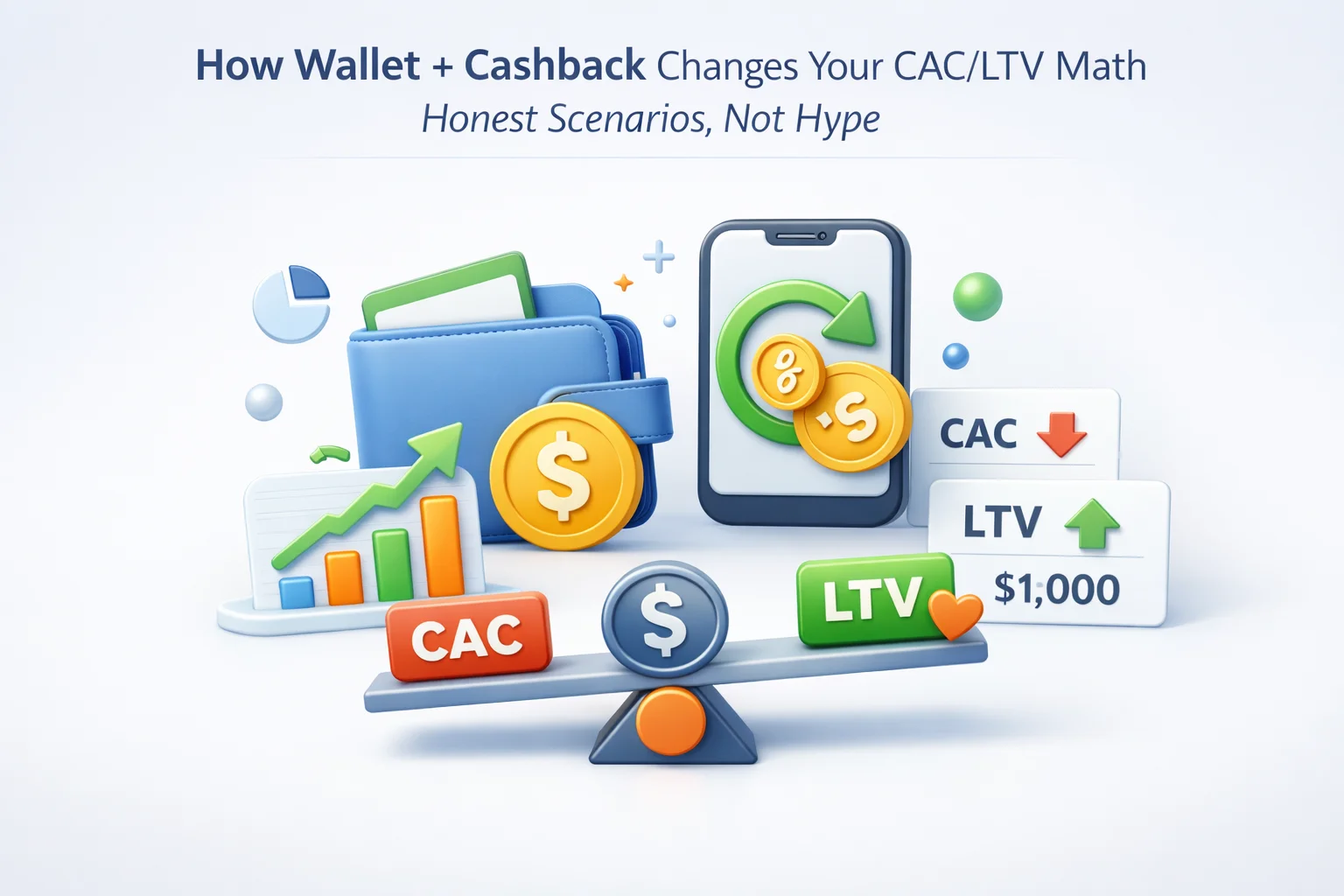
Customer acquisition cost commonly totals marketing and sales spend divided by new customers acquired in a window. Lifetime value estimates gross margin across future purchases discounted by churn. Wallet programmes interrupt both formulas because incentives may book as marketing expense, deferred revenue, or promotional liability depending on accounting conventions—and because redemption shifts cash collection relative to accrual. Before debating programme merit, agree which costs belong in CAC versus ongoing loyalty expense, and whether cashback issued counts as acquisition or retention.
LTV estimates fail quietly when they assume static margins. If cashback increases category breadth but reduces net margin per order, naive LTV rises while profit falls. Segment cohorts at least by acquisition channel, first product family, and promotion participation; compare wallet users against structurally similar non-wallet cohorts where feasible. Imperfect matching beats storytelling with blended averages.
Include payment processing and returns handling in marginal cost thinking for wallet-heavy cohorts. Small per-order fee differences compound when wallet users transact more frequently at slightly lower basket sizes; contribution dollars per session matter more than session counts alone. Similarly, if wallet users exhibit higher return rates because incentives encourage trial of unfamiliar categories, fold reverse logistics into LTV models explicitly rather than assuming returns neutrality inherited from pre-wallet history.
If we moved all wallet issuance out of the programme tomorrow, which margin line would move first—marketing, COGS absorption, or liability reserves? Your answer reveals where incentives truly live today.
Official commerce references still matter for operational vocabulary. Review WooCommerce order lifecycle documentation when tying cashback triggers to statuses your warehouse actually completes; phantom accruals based on imaginary fulfilment speeds distort LTV silently.
Document assumptions in writing: redemption latency curves, average order value shifts when wallet applies at checkout, return-rate differences for incentivised SKUs. Assumptions age; schedule semiannual revisits even when headline programme rules look unchanged.
Treat wallet-funded acquisition like any other paid channel: isolate incremental contribution, accept that some labelled “organic” returning traffic is actually incentive-driven, and refuse to double-count efficiencies. Acquisition teams measuring payback periods should harmonise timestamps with finance—cash-based versus accrual-based viewpoints diverge materially when redemption windows stretch sixty to ninety days. Naming those viewpoints in meeting agendas prevents thirty-minute debates that could have been footnotes.
Imagine cohort A receives modest cashback on replenishment SKUs. Repeat orders rise ten percent within two quarters—celebration material. Yet wallet issuance grows fifteen percent of affected revenue while gross margin after incentives falls because shoppers cluster on promoted categories with thinner contribution dollars. headline repeat rate improved; profit per active customer stagnated. This scenario is common when earn rates outpace category margin discipline.
Mitigations include SKU-level earn caps, exclusions on clearance lanes, and clawback clarity on returns. None are emotionally exciting; each protects arithmetic. Measure incremental margin, not only incremental orders, when judging success.
Contribution margin after incentives rises or holds steady while repeat participation widens category breadth responsibly.
Orders climb while wallet issuance as a percent of net sales climbs faster and return-heavy SKUs dominate incentivised baskets.
Operators modelling this scenario use Nexu WP Smart Wallet cashback accrual views that segment repeat purchasers by category margin bands before expanding earn rates portfolio-wide.
Escalate diagnostics when repeat frequency rises while wallet-funded orders exhibit higher price elasticity—customers buying only when incentives stack. That pattern suggests promotions trained deal-seeking behaviour rather than loyalty; remediation involves tightening stacks, narrowing eligible SKUs, or shifting messaging toward product outcomes instead of perpetual rebate rhetoric. Mathematics aside, brand positioning matters because perceived desperation leaks into willingness-to-pay independent of spreadsheet sophistication.
Some merchants fund wallets instead of deepening cart-wide coupons because stored value nudges return visits even when immediate discount depth stays constant. Economic effect: you may swap upfront margin erosion for staged redemption that tracks closer to intentional repeat behaviour. Risk: customers perceive wallet balances as delayed discounts and mentally combine them with existing promotions, expecting stacked savings your rules disallow.
CAC implications appear when acquisition campaigns promise wallet bonuses for first orders. Include bonus liability in blended acquisition spend for cohort ROAS calculations; omitting it flatters channel metrics temporarily. LTV implications appear when bonuses encourage second purchases sooner—positive if margin holds, negative if speed reflects pull-forward rather than incremental annual demand.
Stress-test messaging with finance sitting in the room; growth teams adopt WooCommerce wallet bonus programmes that separate acquisition grants from recurring cashback accruals for clearer CAC attribution when campaigns blur lines creatively.
Partial wallet checkout deserves explicit modelling: when customers split tender, incrementality becomes harder to attribute because the marginal payment method may correlate with intent rather than cause it. Instrument experiments that hold discount depth constant while toggling wallet availability for the same audience where ethically possible. Without experiments, anecdotes dominate—usually in favour of whichever executive spoke last.
Some programmes assume sizeable wallet balances never redeem—a quiet margin tailwind. Engagement-heavy categories often disprove that assumption; balances convert into checkout tender precisely when promotions stack during peaks. Run stress tests assuming seventy-five to ninety-five percent redemption within conservative windows when your audience skews deal-aware.
Transparent scenarios prevent leadership surprises. Boards rarely fault conservative stress tests; they fault undisclosed optimism that collides with reality mid-year.
Technical hygiene supports honesty: persist ledger events faithfully and avoid optimistic caching that temporarily hides issuance spikes. Teams standardise on auditable WooCommerce wallet ledger exports for cashback issuance and redemption timing analysis when external auditors ask uncomfortable redemption questions.
Layer regulatory humility: gift-card and stored-value regimes differ globally. Your internal stress tests should include legal constraints on expiration, dormancy, and breakage recognition where counsel flags them. Nothing erodes board confidence faster than discovering finance cannot recognise assumed breakage because jurisdiction prohibits the accounting story marketing assumed.
Treat ledger reversibility as a design constraint for models: partial refunds, split tenders, and subscription renewals interact with balances differently—slides that ignore those mechanics look elegant yet forecast incorrect cash paths.
Reports exist to answer uncomfortable questions: how much wallet liability accumulated this month, which campaigns drove it, how redemption velocity compares with issuance, and whether exclusions held during coupon surges. Treat reports as instruments of accountability, not vanity. If a metric cannot inform a decision within two weeks, deprioritise it from executive views to reduce noise.
Compare periods consistently: calendar month, trailing thirty days, and seasonal windows aligned with your peak definitions. Jumping between windows in different meetings manufactures false disagreement.
Archive snapshots after major campaigns; reconstructing intent without frozen numbers invites mythology.
When comparing cohorts across years, normalise for macro shocks—shipping cost inflation, currency swings, competitor promotions—using simple indexing rather than heroic adjustments. Imperfect normalisation still beats pretending every external factor remained constant because your brand story stayed consistent.
Finance exports should ship with short data dictionaries: column meaning, grain (order versus customer versus day), and mapping to customer-visible ledger labels. Silent mismatches between admin CSV fields and My Account history destroy trust faster than a soft quarter because they imply controls are cosmetic rather than operational.
Dashboard summaries help teams react quickly: spikes in pending cashback, unusual wallet funding volumes, sudden upticks in partial wallet checkout share. They are poor places to declare strategic victory alone because activity metrics rise when subsidisation rises. Pair dashboard signals with margin diagnostics from finance, not only revenue graphs. Operational tempo matters: daily checks during peaks, weekly synthesis during steady states, monthly reconciliation with cohort exports so leadership does not confuse pulse charts with profitability proofs.
Security and fraud shifts also surface on dashboards first—strange clusters of wallet loads from new accounts, repetitive small top-ups testing limits. Operational response affects economics directly if reflexive lockdowns frustrate legitimate bulk buyers. Cross-functional runbooks reduce panic. Hardening foundations around authentication and payment endpoints follows WordPress advanced administration security guidance so wallet anomalies reflect real behaviour rather than compromised sessions you mistook for marketing success.
Separate operational incidents from strategic conclusions: a weekend gateway outage depressing wallet redemptions should not reinterpret month-long LTV curves until volumes normalise. Maintain incident annotations directly on weekly metric summaries so future readers understand variance context. Without annotations, heroic recovery weeks look like miraculous programme gains; with them, leadership calibrates expectations sensibly.
Rising revenue alongside rising wallet issuance can still mean deteriorating profit if incremental sales concentrate in low-margin SKUs incentivised by cashback. Watch blended average order value when wallet share grows; it often masks category mix deterioration until finance closes the month. Another red flag is falling payback periods on paper while cash timing worsens because redemption accelerates—great for customers, stressful if working capital assumptions ignored liability drawdown speed.
Repeat rate up, contribution margin after incentives flat or down, support tickets citing “unexpected” wallet behaviour climbing. Investigate rules and catalogue tagging before celebrating cohort charts.
Avoid declaring LTV victories from twelve-week horizons when your product replenishment cycles run quarterly; insufficient observation windows produce upward bias. Extend measurement or segment only categories with faster cycles when you need interim reads.
Watch support ticket themes alongside economics: rising confusion about wallet balances sometimes precedes measured margin issues because mis-set expectations shift mix toward bargain-sensitive shoppers faster than dashboards update. Qualitative signals deserve seats at the metrics table, not anecdotes dismissed as soft.
Monthly forums pairing growth, finance, and operations prevent metric drift. Agenda staples: issuance versus redemption, cohort margin after incentives, wallet-funded share of checkout, return-rate deltas on incentivised SKUs, and narrative explanations for anomalies. Quarterly deeper dives examine incrementality methodology: holdouts where ethical, geo splits, channel splits. Document decisions so future leaders inherit rationale, not folklore.
Board-ready stress tests present three transparent cases—baseline, optimistic, conservative—on redemption timing and category mix. Pair numbers with operational mitigations: SKU exclusions, earn caps, coupon stack rules. Boards rarely reject wallets; they reject unexplained jumps in liability coverage. Clarity wins.
Install accountable ownership: a programme owner with authority to refuse mid-quarter acceleration when guardrails snap, supported by analytics partners who refuse vanity charts. Celebrate intellectual honesty when conservative scenarios narrowly avoid disaster—that discipline saved margin even if headlines stay quiet.
Programmes seeking unified configuration and reporting frequently consolidate on Nexu WP Smart Wallet and Cashback for WooCommerce finance-grade wallet economics and cohort reporting so discussions reference identical exports month to month.
Finally, tie incentives to capital planning. If redemption surges concentrate in weeks where working capital is tight seasonally, coordinate treasury awareness before marketing amplifies earn rates. Economics is never only a dashboard colour; it is cash timing dressed in pixels.
Wallet and cashback programmes change CAC and LTV math by moving incentive costs across time and by reshaping repeat behaviour—for better when margins hold, for worse when earn rates chase vanity repeats. Honest scenarios beat slogans: model deferred liability, stress redemption, separate acquisition grants from recurring incentives, read Reports with Dashboard context, and govern monthly with numbers finance recognises.
The uncomfortable structural reality is that a wallet can increase convenience and repeat frequency while compressing net margin percentage if earn architecture outruns contribution dollars. Enterprise value rises only when strategic intent—category expansion, attach rate growth, switching from competitors—materialises with margin discipline rather than when dashboards flash green on volume alone.
If your programme cannot survive conservative spreadsheets, it will not survive peak season either—only the spreadsheet failure arrives quietly first. Choose transparency early; customers and boards eventually align with reality. Document the model you used, not only the outcome you hoped; reproducibility separates discipline from storytelling when quarters turn noisy and leadership rotations forget oral history and slide decks age out of date.
NEXU Smart Wallet & Cashback connects issuance, redemption, reporting, and customer-visible history inside WooCommerce.

Approximate reading time: 10 minutes at typical editorial pace.






Finally, real numbers not hype
Finally a guide that gets finance and growth teams on the same page monthly no more last minute
Finally, finance and marketing are on the same