
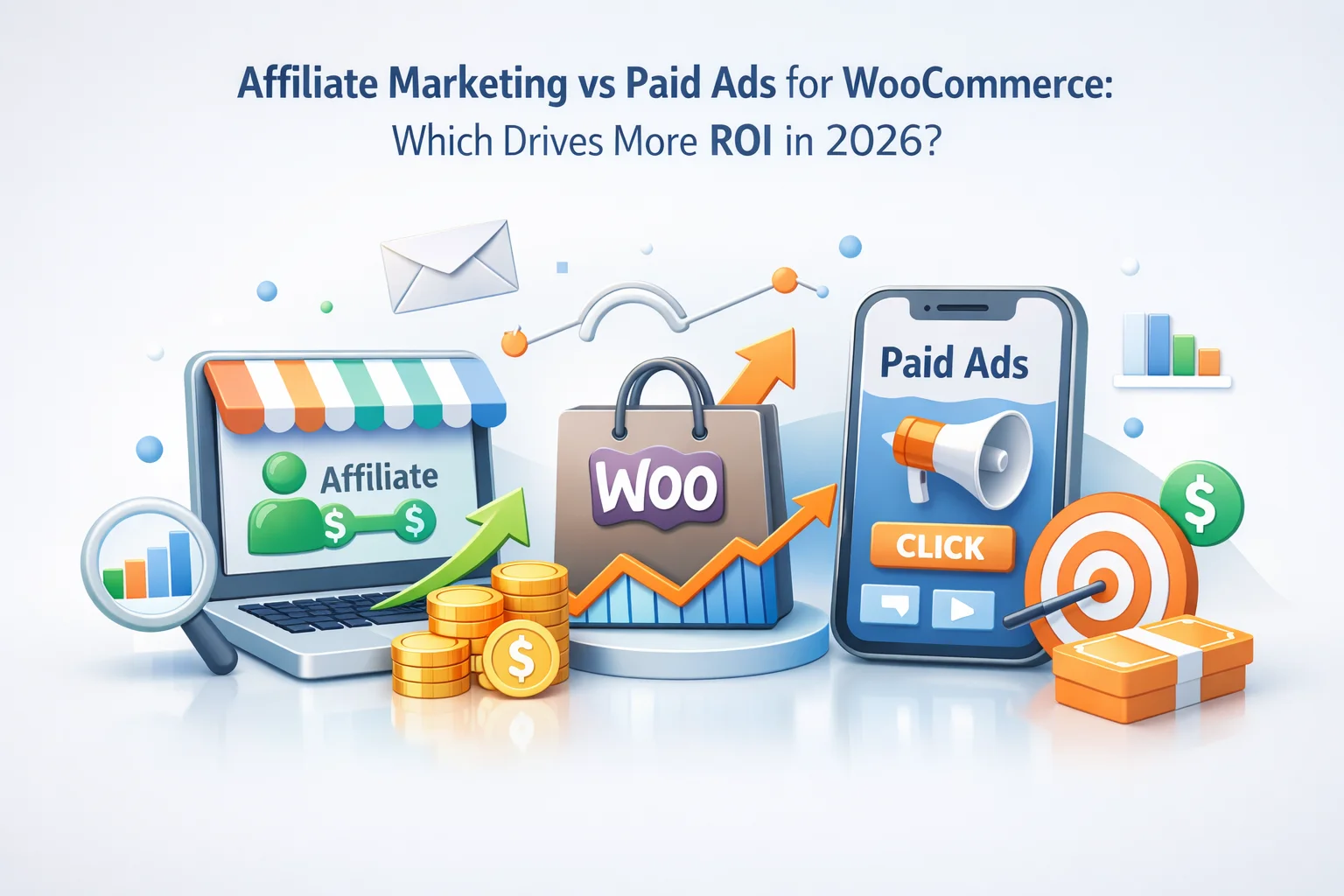
Every WooCommerce store owner allocating a marketing budget faces the same fundamental question: where does a dollar of marketing spend generate the most revenue? Paid advertising — Google Shopping, Meta ads, TikTok campaigns — offers immediate visibility and predictable scaling. Affiliate marketing offers performance-based spending, trusted recommendations, and compounding organic presence. Both channels have genuine merit. Neither is universally superior.
The ROI comparison between these two channels is more nuanced than most guides acknowledge. Paid ads have a cost structure that is obvious and measurable. Affiliate marketing has a cost structure that is often misunderstood — and when it is understood correctly, the comparison shifts significantly in affiliate marketing’s favor for most WooCommerce stores, particularly those with limited budgets and strong product-market fit.
This guide makes the direct, honest comparison across every dimension that affects marketing ROI for a WooCommerce store — cost structure, conversion rates, customer trust, scalability, risk profile, and long-term compounding effects. The conclusion is not “one is always better” — it is a framework for making the right allocation decision for your specific store, your specific stage of growth, and your specific product category. And for stores ready to launch an affiliate program, Affiliate Engine’s WooCommerce affiliate program and commission management plugin provides the infrastructure to put the affiliate side of this analysis into practice.
The fundamental cost structure difference
The most important difference between paid advertising and affiliate marketing is not the size of the cost but the relationship between cost and result. Paid advertising costs money whether or not a sale happens. Affiliate marketing only costs money when a sale happens. This distinction — pay-for-exposure vs pay-for-performance — has profound implications for risk, cash flow, and ROI at every scale.
The practical implication of this cost structure difference is significant for how each channel performs in different scenarios. When paid ads perform well — when targeting is precise, creative is strong, and the product-market fit is clear — the ROI can be excellent. When paid ads underperform — which happens frequently while campaigns are being calibrated, during algorithm changes, when competition increases, or when creative fatigue sets in — the financial waste is real and immediate.
Affiliate marketing has no equivalent waste scenario. An affiliate who does not generate any sales costs you nothing. The infrastructure cost (the plugin license) is fixed regardless of performance. The only variable cost is commission on actual sales, and that commission has a known margin impact that you controlled when you set the commission rate. This fundamental asymmetry in risk profile is the most compelling financial argument for affiliate marketing as a primary growth channel for WooCommerce stores with limited marketing budgets.
Conversion rate comparison: why affiliate traffic converts differently
The conversion rate difference between paid ad traffic and affiliate-referred traffic is one of the most consistently underestimated factors in the ROI comparison. The same product, the same landing page, and the same checkout experience generate meaningfully different conversion rates depending on where the visitor came from — and understanding why clarifies the real value differential.
A visitor who arrives at your store after clicking a Google Shopping ad knows they are looking at an advertisement. They have no prior relationship with your brand, no social proof from a trusted source, and no personal recommendation that the product is worth their money. A visitor who arrives after their favorite YouTuber said “I use this, here’s why I like it, use my code for 15% off” arrives with a pre-established trust relationship in your product that no amount of ad creative can replicate. This trust differential translates directly into conversion rate, average order value, and return purchase rate.
The real cost-per-acquisition comparison
Cost-per-acquisition (CPA) is the single most useful metric for comparing channel ROI. It is the actual cost of acquiring one paying customer from each channel, accounting for conversion rates, click costs, and all associated expenses. Running this calculation with realistic numbers for a typical WooCommerce store reveals the scale of the difference.
$1.80
50 clicks
$15–$40/sale equivalent
~$90–$130 per customer
This CPA assumes well-optimized campaigns. New campaigns in the calibration phase often see 3x–5x higher CPAs while learning. The $90–$130 is the steady-state target, not the starting point.
$80
15%
$12
<$1
~$12–$13 per customer
This assumes a commission rate you set — meaning it is a margin decision you control, not a market rate you are subject to. The CPA scales directly with sales and is capped at your commission percentage regardless of volume.
The gap between an $90–$130 paid ad CPA and a $12–$13 affiliate CPA on the same product is not a marginal difference — it is a factor of seven to ten. The absolute numbers will vary by industry, product category, and commission structure, but the directional conclusion is robust: for most WooCommerce stores, affiliate marketing generates significantly lower cost-per-acquisition than paid advertising, particularly once affiliate programs reach an operational state with active affiliates promoting consistently.
Time and resource investment: the management overhead comparison
Financial cost is not the only resource that matters. Time — particularly owner or marketer time — is equally finite and valuable. The management overhead required to run each channel meaningfully affects the total cost of each approach when time is properly valued.
Running paid ads effectively is a skill-intensive, time-consuming activity. Google Shopping campaigns require ongoing product feed management, bid strategy adjustment, negative keyword maintenance, and creative testing. Meta ads require creative production (static images, video), audience testing, and constant monitoring as iOS privacy changes and algorithm updates erode campaign performance. Meaningful paid ad management requires either 5–10 hours per week of dedicated attention or the expense of a qualified agency or freelancer at $500–$2,000+ per month. Campaigns left unmonitored quickly waste budget on underperforming placements.
A well-configured affiliate program with automated notifications, self-service dashboards, and scheduled payout processing requires roughly 2–3 hours per week of management time for most programs with fewer than 100 affiliates. This includes reviewing applications (3–5 minutes each), checking the fraud tab, responding to occasional affiliate questions, processing monthly payouts, and quarterly list maintenance. The front-loaded work of recruiting and onboarding affiliates is the most time-intensive phase; ongoing management is substantially lighter than maintaining active paid campaigns.
Risk profile: what happens when things go wrong
Every marketing channel carries risk. The nature and magnitude of the downside risk differs significantly between paid ads and affiliate marketing, and this risk profile matters for how each channel fits into a store’s overall marketing strategy.
Algorithm updates (Google’s shopping algorithm changes quarterly) can immediately reduce ad performance without any change on your side. Platform policy changes can suspend accounts with little warning. Competition increases in your category can double CPCs overnight. Creative fatigue gradually reduces conversion rates over time, requiring ongoing investment in new creative production. iOS privacy changes have already significantly degraded Meta’s targeting accuracy and will continue to evolve. Each of these external factors can sharply reduce ROI without any management failure on your part.
Affiliate marketing’s primary risks are program-side: fraud (addressed through fraud detection settings), affiliate quality decay (addressed through active list management), and commission rate competition (addressed through program value proposition). None of these are external platform risks — they are all within your control. The worst case for an affiliate program is that affiliates become less active over time, requiring renewed recruitment effort. It does not involve sudden, uncontrollable budget drain from external algorithm changes.
Which channel suits which type of WooCommerce store
The ROI advantage of affiliate marketing is real but not universal. The channel performs best in specific contexts, and paid advertising maintains genuine advantages in others. The right allocation depends on your store’s characteristics, not a universal recommendation.
The compounding effect: why affiliate ROI improves over time while paid ad ROI stays flat
One of the most underappreciated advantages of affiliate marketing over paid advertising is how the ROI trajectory of each channel differs over time. Paid ad ROI does not inherently improve with time — you pay for each click indefinitely, and the cost of clicks tends to rise as platforms become more competitive. Affiliate marketing ROI has a compounding structure that paid ads fundamentally lack.
A YouTube video that an affiliate published 18 months ago reviewing your product continues generating views, clicks, and sales today — without any additional cost to you. A blog post that ranks for “[your product] review” continues sending purchase-intent traffic every month without additional spend. This content permanence means that the affiliate marketing effort of year one continues compounding into years two, three, and beyond. Paid ad traffic stops the moment the ad budget runs out; affiliate-generated content can deliver returns indefinitely.
When affiliates publish content about your products — reviews, tutorials, comparisons — they create backlinks to your store from their websites. These backlinks accumulate over time and improve your store’s domain authority and search rankings. A store with 40 active affiliates who have each published one or two pieces of content has potentially 40–80 backlinks from relevant, authoritative domains that benefit SEO permanently. No amount of paid advertising generates this kind of compounding organic search value.
A program with a track record of paying reliably, treating affiliates well, and producing visible earnings attracts better affiliates over time through word of mouth in creator communities. As the quality of your affiliate roster improves, the program’s output improves — more conversions, higher-quality customers, more content. This positive feedback loop is the compounding dynamic that paid advertising simply does not have. Ad accounts do not tell their ad platform friends about a great advertiser and generate organic new placements as a result.
The optimal framework: using both channels strategically
The most productive framing for this comparison is not “which channel is better” but “how do these channels complement each other.” The honest conclusion of this analysis is that affiliate marketing offers superior ROI for most WooCommerce stores as a primary channel, particularly those with limited budgets, niche products, or strong existing customer bases. Paid advertising offers unique advantages for new product launches, broad audience testing, and scaling proven funnels quickly.
The ROI case for affiliate marketing is strongest at the budget levels where most WooCommerce stores actually operate — below $2,000 per month in marketing spend. At these levels, paid advertising struggles to achieve meaningful scale and requires constant optimization attention. Affiliate marketing’s performance-only cost structure means even a small budget can support a capable affiliate program infrastructure, with commission spend scaling proportionally to results rather than being consumed by the channel infrastructure itself.
For stores ready to put the affiliate marketing side of this analysis into practice, Affiliate Engine’s WooCommerce affiliate program and performance tracking plugin provides the complete infrastructure — tracking, commissions, fraud protection, payout management, affiliate dashboards, and notification automation — for a fixed one-time cost that ensures the infrastructure overhead stays minimal regardless of how the program grows.
Put the affiliate marketing ROI advantage to work — with a program that manages itself
Affiliate Engine gives you the full affiliate program infrastructure — tracking, commissions, fraud protection, payout management, and dashboards — so you can run a performance-only marketing channel that only costs money when sales happen.

Finally a no BS breakdown of affiliate vs paid ads. that risk section?
Affiliates save cash
As a librarian running a niche bookstore on WooCommerce, I was skeptical about paid ads after seeing CPAs spike to 3x 5x normal rates during the "learning phase