
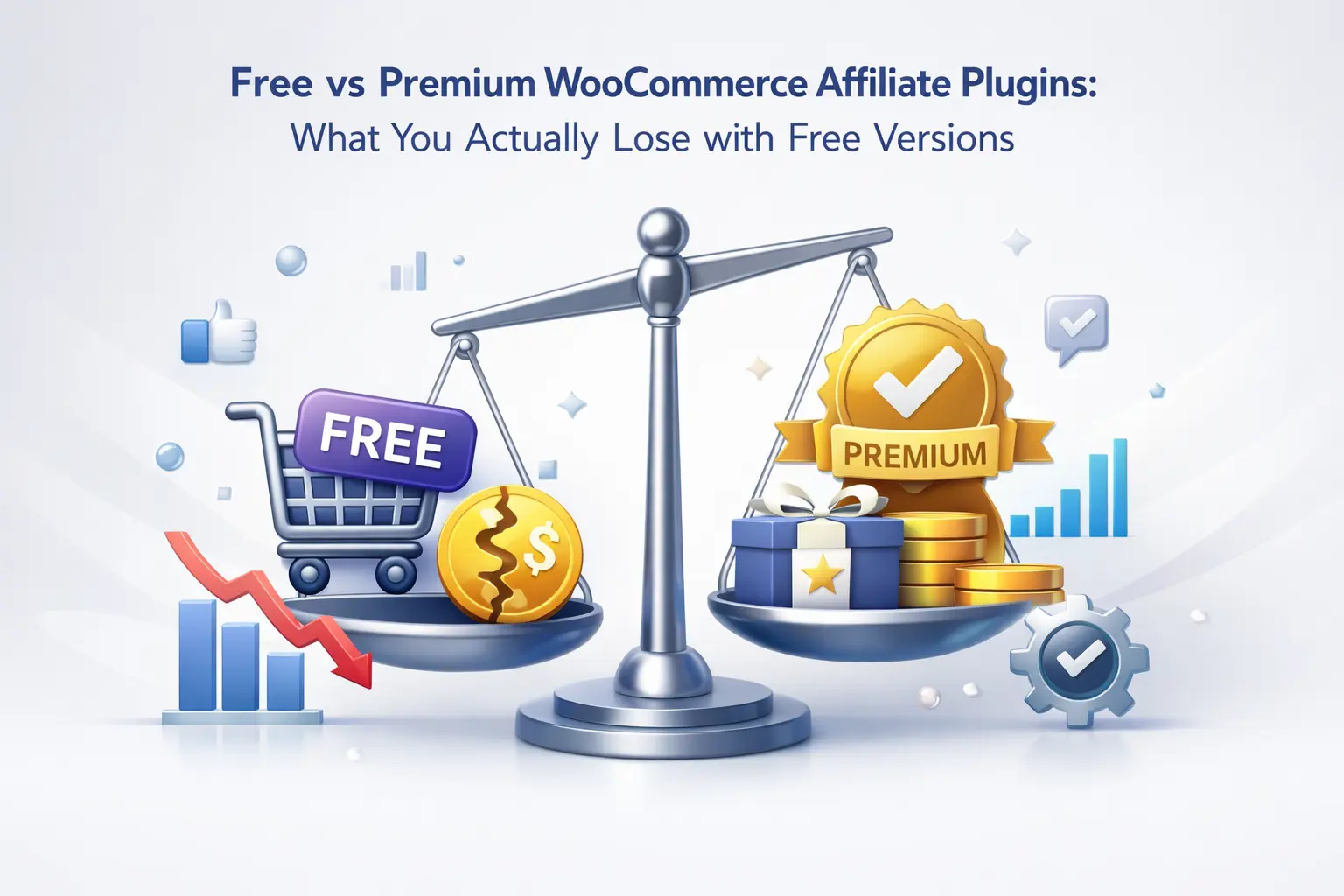
The allure of free software is undeniable. For entrepreneurs launching their first WooCommerce store, every dollar matters, and the prospect of implementing a fully functional affiliate program without spending a cent seems almost too good to pass up. The WordPress plugin ecosystem reinforces this temptation with thousands of free plugins, many of which carry impressive download numbers and four-star ratings that suggest legitimacy and reliability.
But affiliate marketing operates differently from other website functionalities. While a free contact form plugin might serve your needs adequately, a free affiliate plugin operates in a domain where accuracy, reliability, and comprehensive feature sets directly impact your revenue and your relationships with the people promoting your products. The question is not whether free plugins can track clicks, they can. The question is what happens when your program grows beyond the simplest use cases, and the limitations of free software begin to cost you real money.
This guide examines the real differences between free and premium WooCommerce affiliate plugins, not through marketing claims or feature checklists, but through the lens of operational reality. We will explore what free versions actually provide, what they deliberately withhold, and how those limitations translate into tangible costs for your business. By the end, you will understand why premium WooCommerce affiliate management solutions like Affiliate Engine represent an investment rather than an expense, and how to evaluate whether your business has outgrown its free affiliate solution.
What free WooCommerce affiliate plugins actually provide
Before criticizing free plugins, it is important to acknowledge what they genuinely offer. The developers behind free affiliate plugins for WooCommerce are not trying to deceive users, they are providing legitimate tools that serve specific purposes. Understanding these purposes helps you determine whether your needs align with what free solutions can realistically deliver.
At their core, free affiliate plugins do what they promise: they generate unique referral links for registered affiliates and count when those links are clicked. This fundamental functionality works reliably in most free plugins, providing the basic infrastructure for a referral program. If your only requirement is knowing which affiliates are driving traffic to your site, free solutions can provide that visibility without cost.
Most free plugins allow you to set a single commission percentage that applies to all referred sales. When a customer clicks an affiliate link and makes a purchase, the plugin calculates the commission based on this percentage and records it in a database. For stores with uniform product margins and simple commission structures, this basic calculation may be sufficient.
Free plugins typically implement cookie-based tracking, storing a small file on the customer’s browser when they click an affiliate link. If that customer returns to make a purchase within the cookie’s lifetime, the sale is attributed to the affiliate. Free versions usually offer basic cookie duration settings, though the range of options may be limited compared to premium alternatives.
Free WooCommerce affiliate plugins serve a valuable purpose for businesses that want to test affiliate marketing concepts before making financial commitments. If you have a small group of trusted partners willing to promote your products, a free plugin can help you understand whether affiliate marketing drives meaningful revenue for your business. The key is recognizing this as a testing phase rather than a permanent solution, and being prepared to upgrade when your program graduates from experimental to operational.
The hidden costs that make free plugins expensive
The price tag of zero dollars obscures the real costs that free plugins impose on your business. These costs do not appear on your credit card statement, but they show up in your time allocation, your affiliate relationships, and your missed revenue opportunities. Understanding these hidden costs is essential for making an informed decision about whether free plugins are truly the economical choice they appear to be.
Free plugins automate the basics but leave the complexity to you. Every commission calculation that falls outside the simple percentage rule requires manual intervention. Every refund that needs a commission reversal requires your attention. Every affiliate requesting a status update requires your response. As your program grows, these manual tasks compound, consuming hours that could be spent on activities that actually grow your business. At a modest hourly valuation of your time, even five hours per month spent managing free plugin limitations exceeds the annual cost of most premium solutions.
Free plugins often lack sophisticated attribution mechanisms. They may fail to track conversions across device switches, lose attribution when customers clear cookies, or struggle with complex checkout flows. Every tracking failure represents a commission that should have been paid but was not recorded. Affiliates who consistently see lower conversion rates on your program compared to others will eventually stop promoting your products, costing you the lifetime value of those relationships.
Affiliates are business partners who choose where to invest their promotional efforts. When your affiliate dashboard provides limited visibility, when payouts are delayed by manual processing, or when commission disputes arise from tracking ambiguities, affiliates notice. Professional affiliates have multiple programs to choose from, and they gravitate toward merchants who provide reliable infrastructure and transparent reporting. The affiliates you lose to poor experience represent ongoing revenue that flows to your competitors instead.
Critical features free plugins exclude and why they matter
The difference between free and premium WooCommerce affiliate plugins is not merely a matter of convenience features or aesthetic improvements. Premium plugins include functionality that fundamentally changes what your affiliate program can accomplish and how efficiently it operates. Understanding these feature gaps helps you evaluate whether your current free solution is limiting your program’s potential.
Free plugins typically offer a single commission rate for all products. Premium solutions allow different rates for different products, categories, or even individual affiliates. This matters because your products likely have different profit margins, and your affiliate program should reflect that reality. A 20% commission on a high-margin digital product might be sustainable, while the same rate on a low-margin physical product could eliminate your profit entirely. Without product-specific rates, you are forced to choose between underpaying affiliates on high-margin items or losing money on low-margin sales.
Free plugins often leave payout management entirely to you, requiring manual calculation of amounts owed, verification of payment details, and individual transaction processing. Premium plugins automate these workflows, allowing affiliates to request withdrawals when they reach minimum thresholds, tracking pending and completed payouts, and generating the documentation you need for accounting and tax purposes. The time savings from automated payouts alone often justify the cost of premium plugins.
Cookie-based tracking fails on social media platforms where users see content in apps and purchase later through direct navigation. Premium plugins offer coupon code attribution, allowing affiliates to share personalized discount codes that track sales even when the customer never clicked a referral link. This feature is essential for working with Instagram, TikTok, and YouTube influencers who drive significant purchasing behavior through content rather than direct links. Free plugins rarely include this capability, limiting your affiliate recruitment to link-dependent promoters.
For subscription products or businesses with high customer lifetime value, the initial sale is only the beginning. Premium plugins can track ongoing purchases from referred customers, paying commissions on subscription renewals, upsells, and cross-sells indefinitely. This transforms affiliate relationships from one-time transactions into ongoing revenue partnerships. Free plugins typically track only the initial conversion, leaving significant long-term revenue unattributed and unpaid.
As affiliate programs grow, they attract attempts at manipulation. Affiliates might create fake orders to generate commissions, use stolen credit cards to create commission-eligible transactions, or refer themselves using alternate accounts. Premium plugins include fraud detection systems that monitor for suspicious patterns and flag potentially fraudulent activity. Free plugins rarely offer these protections, leaving your program vulnerable to abuse that can cost significant money and create legal complications.
Real-world scenarios: when free plugins fail
Abstract feature comparisons only tell part of the story. The real impact of plugin limitations becomes clear when you examine specific scenarios that affiliate programs encounter regularly. These scenarios illustrate the difference between free plugins that work in theory and premium solutions that work in practice.

In a free plugin environment, you must manually identify which orders were refunded, calculate the commission that was paid on those orders, and somehow recover that amount from the affiliate or deduct it from future earnings. This process is time-consuming, creates uncomfortable conversations with affiliates, and often results in simply absorbing the loss to avoid conflict. Premium plugins automatically reverse commissions when associated orders are refunded, maintaining financial accuracy without manual intervention or awkward discussions.
A fashion influencer posts a story featuring your product, mentioning your brand name and encouraging followers to visit your site. Hundreds of viewers type your URL directly into their browsers and make purchases. With a free plugin relying solely on cookie tracking, none of these sales are attributed to the influencer. The influencer sees no commissions, concludes your program does not work, and stops promoting your brand. A premium plugin with coupon code attribution would have provided the influencer with a personalized code, capturing every sale that used that code regardless of how the customer navigated to your site.
After six months of consistent performance, one of your affiliates has generated enough sales to qualify for your VIP tier with a 25% commission rate instead of the standard 15%. In a free plugin with only single-rate support, you must manually calculate the difference for every sale this affiliate makes, track those calculations externally, and make supplemental payments. The administrative burden is significant, and the delay in receiving their enhanced rate demotivates the affiliate. Premium plugins with tiered commission structures automatically apply the higher rate once thresholds are reached, rewarding performance instantly and automatically.
Three years ago, an affiliate referred a customer who subscribed to your monthly service. That customer has now paid 36 monthly invoices, generating substantial revenue for your business. With a free plugin tracking only the initial conversion, the affiliate received a single commission on the first payment and nothing on the subsequent 35 payments. The affiliate has no visibility into this customer’s ongoing value and no incentive to refer similar high-lifetime-value customers. A premium plugin with lifetime commission tracking would have paid the affiliate on every renewal, creating alignment between their promotional efforts and your recurring revenue.
Support and reliability: the overlooked premium benefits
Beyond features and functionality, premium plugins offer something that free plugins cannot guarantee: accountability. When you pay for software, you enter a business relationship where the developer has a vested interest in your success. This relationship manifests in ways that directly impact your affiliate program’s stability and your ability to resolve issues when they arise.
The support difference becomes particularly critical when something goes wrong with your affiliate program. A tracking failure, a commission calculation error, or a compatibility issue with a WooCommerce update can cost you real money and damage affiliate relationships. With a free plugin, you are dependent on community goodwill for assistance. With a premium plugin, you have a direct line to developers who are contractually obligated to help you resolve issues. This difference in accountability is difficult to quantify but invaluable when you need it.

What premium WooCommerce affiliate management delivers
Having examined the limitations of free plugins and the scenarios where they fail, it is worth articulating what a comprehensive premium solution actually provides. Affiliate Engine represents the premium tier of WooCommerce affiliate management, offering the features, reliability, and support that professional affiliate programs require.
Affiliate Engine provides everything needed to run a professional affiliate program: affiliate registration and approval workflows, multiple commission types and calculation rules, coupon code attribution alongside cookie tracking, automated payout processing with threshold management, fraud detection and prevention systems, and comprehensive reporting for both administrators and affiliates. This is not a collection of features added for marketing bullet points, it is an integrated system designed to handle the operational reality of running affiliate programs at scale.
The affiliate dashboard in Affiliate Engine gives your partners real-time visibility into their performance: clicks, conversions, commissions earned, and payout status. Affiliates can see exactly how they are performing without waiting for your reports or wondering if tracking is working. This transparency transforms the affiliate-merchant relationship from one of suspicion and verification to one of partnership and collaboration. When affiliates trust your tracking, they promote more aggressively.
Affiliate Engine is designed to grow with your program. The same system that handles ten affiliates comfortably manages hundreds or thousands without requiring architectural changes or performance optimization. Commission calculations, payout processing, and reporting all scale automatically. This means you can focus on recruiting affiliates and growing your program rather than worrying whether your infrastructure can handle the growth.
The core Affiliate Engine plugin provides comprehensive functionality for most affiliate programs, but it also supports optional add-ons for specialized needs. The Lifetime Commissions add-on links customers to affiliates permanently, ensuring ongoing attribution for subscription businesses. The MLM Matrix add-on enables multi-level commission structures for network marketing scenarios. This modular approach means you pay only for the functionality you need while maintaining the ability to expand as your program evolves.
Making the decision: when to upgrade from free to premium
The decision to upgrade from a free to a premium affiliate plugin should not be driven by feature envy or marketing pressure. It should be a calculated business decision based on the actual costs and benefits as they apply to your specific situation. Several clear indicators suggest that the time for upgrade has arrived.
If you are spending more than three hours per month on manual affiliate program administration, you have likely reached the point where a premium plugin would pay for itself in time savings alone. If you have lost affiliates to competitors or received complaints about commission accuracy, the trust cost of your free solution has become measurable. If you are turning away potential affiliates because your program cannot support their promotional methods, you are losing revenue that premium features could capture.
Perhaps the most important indicator is your growth trajectory. If your affiliate program is growing, the limitations of free software will eventually constrain that growth. The question is not whether you will need premium features, but whether you will recognize the need before the limitations have cost you significant opportunities. Upgrading proactively, before operational problems reach crisis levels, allows for a smoother transition and preserves the affiliate relationships you have worked to build.
The true cost of free WooCommerce affiliate plugins is not the price you avoid paying, it is the value you fail to capture. Commission tracking that misses conversions, administrative workflows that consume your time, and affiliate experiences that erode trust all represent real costs that accumulate silently until they become impossible to ignore. Premium plugins like Affiliate Engine’s comprehensive WooCommerce affiliate management system transform affiliate marketing from a source of operational stress into a scalable revenue channel that grows with your business.
Stop losing commissions to plugin limitations
Affiliate Engine delivers the complete infrastructure your affiliate program needs: accurate tracking, automated workflows, and professional affiliate experiences that drive growth.





As a fashion designer running an online boutique, I thought I could get by with a free affiliate plugin for my WooCommerce store. Big mistake. the moment my program started gaining traction, the limitations became painfully clear missed commissions, manual payouts, and affiliates jumping ship because the experience felt unprofessional.
Hey y'all, grabbed this for my buddy's shop.
Got this plugin at a great price, but I'm still figuring out how the affiliate tracking works compared to my site's normal functions. my dental practice website isn't massive yet, but I also don't want to get blindsided if referrals start picking up. has anyone hit limits with the free version before deciding to upgrade? just trying to plan ahead.
Finally worth the upgrade. No more manual payouts!