
When you search for a WooCommerce affiliate plugin in 2026, four names come up repeatedly: AffiliateWP, YITH WooCommerce Affiliates, Coupon Affiliates, and Affiliate Engine by NEXU WP. Each has its advocates, each has its critics, and each has a different story about what kind of store it is best suited for. Most comparison articles either read like the author picked a winner before writing a single word, or they treat every plugin as equally capable in ways that fall apart the moment you actually try to configure and run a real program.
This comparison is different. We go through each plugin on the dimensions that actually matter for running a WooCommerce affiliate program — pricing structure (including renewals), WooCommerce integration depth, commission flexibility, affiliate-facing experience, fraud tools, and setup complexity. We tell you plainly which scenarios each plugin handles best and where each one falls short.
For Affiliate Engine we have first-hand knowledge of the feature set. For AffiliateWP, YITH, and Coupon Affiliates we draw on published documentation, verified user reviews from G2, Capterra, and WordPress.org, and publicly available pricing pages as of April 2026.
Quick overview: what each plugin actually is
Before comparing features, it is worth establishing what each plugin fundamentally is and where it comes from. The origin of a plugin explains its design priorities, its pricing philosophy, and its likely long-term support trajectory.
Originally built in 2014, now owned by Awesome Motive — the group behind WPForms, MonsterInsights, and several other major WordPress plugins. Over 30,000 active installs. It is a mature, full-featured affiliate management plugin built for WordPress broadly, with WooCommerce as one of several supported integrations. Its pricing has shifted significantly since acquisition, and first-year promotional rates are substantially lower than actual renewal costs.
Built by YITH, one of the most established independent WooCommerce plugin developers in the ecosystem with over 2 million users across their catalog. Their affiliate plugin benefits from tight WooCommerce integration and compatibility with their other plugins. It has a free version with limited functionality and a premium at $179.99/year. Known for stable code and reliable support, though the interface feels dated relative to newer tools. Full payout functionality requires purchasing additional YITH plugins separately.
A UK-based independently developed plugin celebrating 10 years in 2025, trusted by over 5,800 businesses. Unlike the others, Coupon Affiliates was designed from the ground up around coupon-code-first affiliate tracking — a deliberate architectural choice reflecting how influencer and social media promotion actually works in 2026. A major redesign (v7.0 admin, v6.0 Affiliate Portal) completed in 2025 gives it the most visually modern affiliate experience of the four. Priced at approximately $12.99/month billed annually.
Built by NEXU WP as a WooCommerce-native affiliate and referral program plugin. Designed around the operational realities of running a WooCommerce affiliate program: a structured admin workflow with dedicated tabs for affiliates, referrals, payouts, visits, tiers, creatives, and fraud — plus a clean customer-facing dashboard inside the WooCommerce My Account area. Licensed per-site with no transaction fees, unlimited affiliates, and a fixed cost that does not scale with program performance.
Pricing: what you actually pay — including renewals
Pricing comparisons for WordPress plugins are almost always misleading when they show only first-year promotional rates. The number that matters for long-term operational planning is what you pay in year two and every year after that. Here is the honest picture for all four.
AffiliateWP’s promotional first-year pricing of ~$149 renews at the full rate of ~$299/year for the Personal (1-site) plan. The Professional plan — which unlocks fraud protection, the REST API, and affiliate portal customization — runs $599/year at full renewal pricing. Reviews on G2 and Capterra specifically flag this renewal price jump as unexpected. If you budget on the promotional rate and plan to run this for multiple years, the financial picture changes significantly in year two.
WooCommerce integration depth
How a plugin integrates with WooCommerce determines how reliably it tracks orders, how accurately it calculates commissions, and how much you can trust the data in your dashboard. There is a real difference between a plugin built for WordPress broadly (with WooCommerce as one of many integrations) and one built specifically for WooCommerce as the only target platform.
AffiliateWP treats WooCommerce as one of many supported platforms through a dedicated integration module. This works well for standard WooCommerce setups. WooCommerce-specific nuances — order status flows, coupon interactions, subscription billing — are handled through the integration layer rather than natively. For most stores this is fine. For stores with complex WooCommerce configurations, edge cases occasionally surface that require support intervention.
As a YITH product, it integrates tightly with WooCommerce order statuses, coupon systems, and the My Account area. One notable real-world limitation: full payout functionality requires additional YITH plugins purchased separately. YITH PayPal Payouts is approximately $90/year on top of the affiliate plugin cost, meaning the effective all-in price for a fully functional setup is closer to $270/year than the headline $180.
Coupon Affiliates was built exclusively for WooCommerce with no intention of ever supporting other platforms — a deliberate architectural decision. Every feature was designed with WooCommerce data structures in mind. One technically notable result: the plugin can display attribution data for orders created before the plugin was installed, because it reads directly from WooCommerce’s own order records. This makes migration from other systems unusually painless.
Affiliate Engine is built for WooCommerce as the primary and only target platform. Commission approval triggers map directly to WooCommerce order statuses. Coupon attribution works with native WooCommerce coupons. The affiliate dashboard lives inside WooCommerce My Account. Payout management, fraud detection, and visit tracking all operate within the WordPress and WooCommerce data environment with no external API dependencies.
Commission flexibility: a feature-by-feature breakdown
Commission configuration is where real differences between plugins become operationally significant. The ability to set percentage versus flat rates, configure what the percentage is applied to, manage hold periods, block self-referral, and reward performance with tiers all matter for running a financially sound program.
Coupon tracking: the differentiator that matters most in 2026
In 2026, coupon-based attribution is not optional for any serious affiliate program. Instagram and TikTok restrict or demote clickable links. Browser privacy changes are eroding cookie reliability. Customers respond more readily to a personal discount code than to a tracked URL. How these four plugins handle coupon attribution varies significantly.
AffiliateWP supports coupon tracking and you can link WooCommerce coupons to affiliates. It is functional and integrated. However the plugin was designed around link-based tracking first, and coupon management at scale requires more manual steps than in plugins built around coupons from the start. Setting up per-affiliate coupons consistently requires attention to avoid gaps in attribution.
YITH integrates with WooCommerce’s native coupon system to assign coupons to affiliates. This works well for basic use cases. A reported limitation in real-world use is that fixed-amount commissions do not always interact with coupon attribution as cleanly as percentage commissions, and some specific coupon-tracking workflows require configuration steps that are not immediately obvious from the settings panel.
The name reflects the design intent. When someone clicks an affiliate’s link, the coupon applies automatically at checkout. When someone uses the code directly without clicking a link, the conversion is still captured. The plugin reads from WooCommerce’s existing order data, so attribution is retroactive — visible even for orders placed before the plugin was installed. This is a genuine technical advantage for coupon-heavy programs and for stores migrating from another system.
Affiliate Engine supports both referral link tracking and coupon code attribution simultaneously, with a configurable priority setting for when both signals appear on the same order. This dual model works for programs that include both link-sharing affiliates and coupon-sharing influencers within the same program infrastructure. Coupon code format is configurable and codes are visible to affiliates in their dashboard for direct sharing.
The affiliate experience: what your affiliates actually see
The affiliate dashboard is the interface through which the people promoting your store experience your program. A confusing or bare-bones dashboard reduces engagement. A clean, informative one keeps affiliates active and sharing. The quality gap between these four plugins on this dimension is more visible than on almost any other feature area.
Multiple reviewers on G2 and Capterra describe the affiliate dashboard as having “almost no styling” out of the box and requiring developer customization to match store themes properly. Dashboard customization is locked behind the Professional plan (~$299-599/year). The dashboard provides referral link tools, commission tracking, and payout requests, but presents them in a visually plain way that needs work before it looks professional to affiliates.
YITH’s affiliate dashboard integrates into the WooCommerce My Account area, which reduces login friction. The interface is functional and informative but consistently described by users as feeling dated relative to newer tools. For programs targeting existing customers or non-technical users, the experience is adequate. For programs working with professional marketers or influencers who are accustomed to polished platforms, the visual presentation may be a friction point.
Coupon Affiliates offers two frontend options: the standard dashboard embedded in the store site matching the store theme, and the Affiliate Portal — a standalone full-screen interface with custom branding, logo, and color settings launched in v6.0 in 2025. The portal is genuinely the most visually impressive affiliate experience in this comparison. For programs working with influencers who interact with many affiliate platforms, this level of visual quality matters and helps retention.
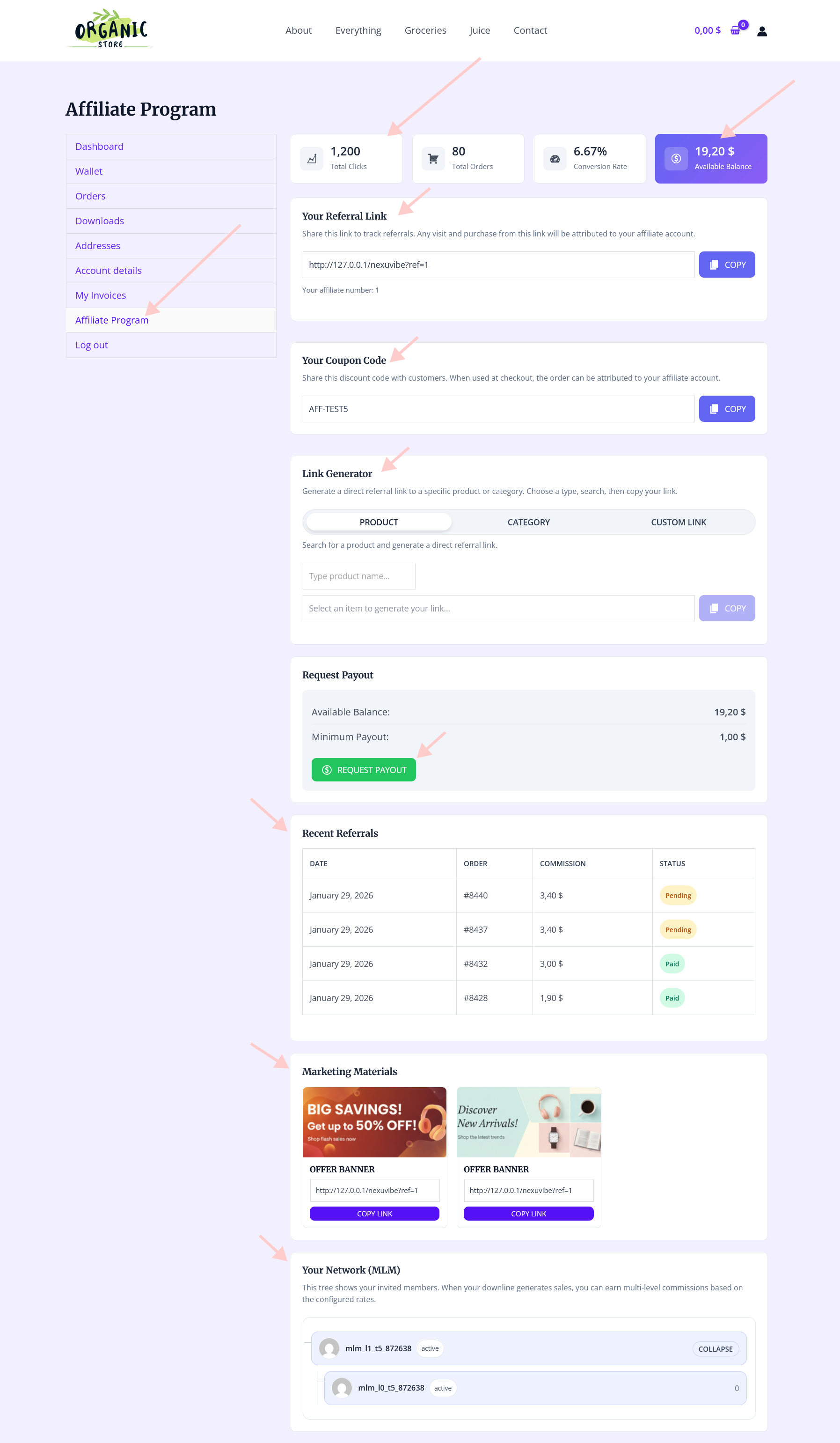
Affiliate Engine’s frontend dashboard lives inside the WooCommerce My Account area. Affiliates access their referral links, link generator, coupon code, commission history by status, tier level, payout request tools, and available creatives all from one familiar interface without a separate login. The experience is clean and well-structured without requiring customization. The choice to embed within My Account means affiliates associate the program with your brand rather than with a third-party portal.
Admin workflow: managing the program day-to-day
The admin side is what you work with every week. How well-organized the daily operational workflow is — reviewing referrals, approving affiliates, processing payouts, checking fraud signals — determines whether running the program feels manageable or like constant overhead.

AffiliateWP has a well-structured admin experience that most users find functional, though the add-on architecture means more navigation between areas. YITH’s admin is logically organized but lacks the guided onboarding that newer plugins offer. Coupon Affiliates received a major admin redesign in v7.0 in 2025 that significantly improved usability. Affiliate Engine uses a dedicated top-level admin menu structure with tabs for Dashboard, Affiliates, Referrals, Payouts, Visits, Tiers, Creatives, Fraud, and Settings — keeping the full operational workflow in one organized place.

Fraud protection: who includes it without an upgrade?
Fraud protection matters more as programs grow. Self-referral, household coupon sharing, fake click inflation, and multi-account manipulation are patterns that appear in any program worth gaming. How well each plugin handles these determines whether your commission data stays reliable over time.
Setup complexity and time-to-launch
For store owners who are not developers, time-to-launch matters. A plugin that requires hours of configuration before the first affiliate can be approved is a meaningfully different commitment from one that runs the same day you install it.
Solid documentation and an organized settings panel. Most users report getting a basic program running in a few hours. Complexity increases when configuring the full feature set — add-ons for product rates, tiered commissions, and fraud tools require additional plugins and configuration. Reviewers consistently note that unlocking the full capability takes significant setup time beyond the initial install.
No setup wizard — all configuration happens through manual navigation of settings tabs. For experienced WordPress users this is familiar. For newer users the lack of guided setup increases the chance of missing important settings. Getting full payout functionality running requires purchasing and configuring additional YITH plugins, which adds another setup layer on top of the core plugin configuration.
Consistently receives praise for setup speed and documentation quality. Pro modules enable with a single click. Reviews frequently mention quick setup and clear documentation including video tutorials. The coupon-first model is intuitive for store owners already familiar with WooCommerce coupons. The 7-day free trial also means you can validate the setup before committing to a subscription.
Includes a setup wizard that walks through the essential configuration decisions in a structured sequence. Most stores complete initial setup in under an hour. Commission settings, registration, fraud detection, payout rules, and notifications are each in their own organized panel. The dedicated admin menu structure — Dashboard, Requests, Settings — keeps ongoing management straightforward without requiring navigation through generic WordPress menus.
The honest verdict: which plugin for which store?
There is no universally correct answer in this comparison. Each plugin has a genuine fit scenario. The honest verdict depends on what your program actually needs and what you are realistically willing to pay year over year.
You run multiple WordPress sites with affiliate programs and need a single solution covering all of them. You also use Easy Digital Downloads alongside WooCommerce. You have a developer available to customize the affiliate dashboard, and you have budgeted ~$299/year or more as a long-term expense. AffiliateWP is the most mature tool in this comparison with the widest WordPress platform coverage — just go in with eyes open about the real renewal cost.
You are already invested in the YITH plugin ecosystem and benefit from cross-plugin compatibility. You run a small to medium WooCommerce store and want reliable integration with the YITH product family. Factor in the additional cost of YITH PayPal Payouts for full functionality — the effective all-in price is closer to $270/year than the headline $180. The free version is worth testing first given its availability.
Your affiliate program centers on coupon-code sharing — influencer marketing, social media promotion, podcast sponsorships, or anywhere that links are awkward but codes are natural. You want the most visually polished affiliate-facing experience available in the WordPress ecosystem right now. The Affiliate Portal is genuinely impressive. At ~$156/year with active development, a free tier, and a 7-day pro trial, it has one of the most accessible entry points in this comparison.
You want a WooCommerce-native affiliate program with both link and coupon tracking, built-in fraud detection from day one, a structured admin workflow, and a fixed license cost that never scales with program growth or affiliate count. The affiliate dashboard inside My Account eliminates the separate-login problem. The setup wizard gets you running quickly. Performance tiers, visits tracking, payout management, creatives, and Elementor support are all included without the add-on architecture that inflates ongoing costs elsewhere.
Full summary comparison at a glance
Every plugin in this comparison is capable of running a real WooCommerce affiliate program. The differences are in cost trajectory over time, the operational smoothness of the workflow, and whether specific features you need are included in the base price or locked behind additional spend. None of these are trivial considerations once a program is active and growing.
For WooCommerce stores that want a native integration, both link and coupon tracking, built-in fraud detection, a clean affiliate experience inside My Account, and a predictable cost that never increases with program success, Affiliate Engine’s WooCommerce referral and affiliate program plugin covers all of those requirements without the add-on architecture or subscription escalation that characterizes the higher-priced alternatives.
The WooCommerce affiliate plugin built for how real programs actually run
Affiliate Engine gives you referral link tracking, coupon attribution, a My Account affiliate dashboard, commission management, performance tiers, payout workflow, fraud detection, and creatives — in a single WooCommerce-native plugin with a fixed license cost.


The setup guide was clear, but I got stuck on the jobs took me extra time to figure
Hey! So I've been digging into WooCommerce affiliate plugins and hit a snag. a bunch of reviews on G2 and Capterra mention Affiliate Engine's renewal pricing being way steeper than the first year deal which seems like something you'd wanna know upfront, right? but weirdly, most comparison articles don't even bring it up. Anyone here using it in 2026 who can confirm if that's still a thing? Just trying to plan my budget before pulling the trigger!
Finally, no hidden add on costs!
Hey, just a heads up full payouts need
Just wanted to share my experience with Affiliate Engine after their recent redesign. The new admin and affiliate portal look really sleek way more modern than other platforms I've tried. but that polished interface comes with some hidden costs.