Next-Level Code. Nexuvibe Style ...
Hrs
Min
Sec

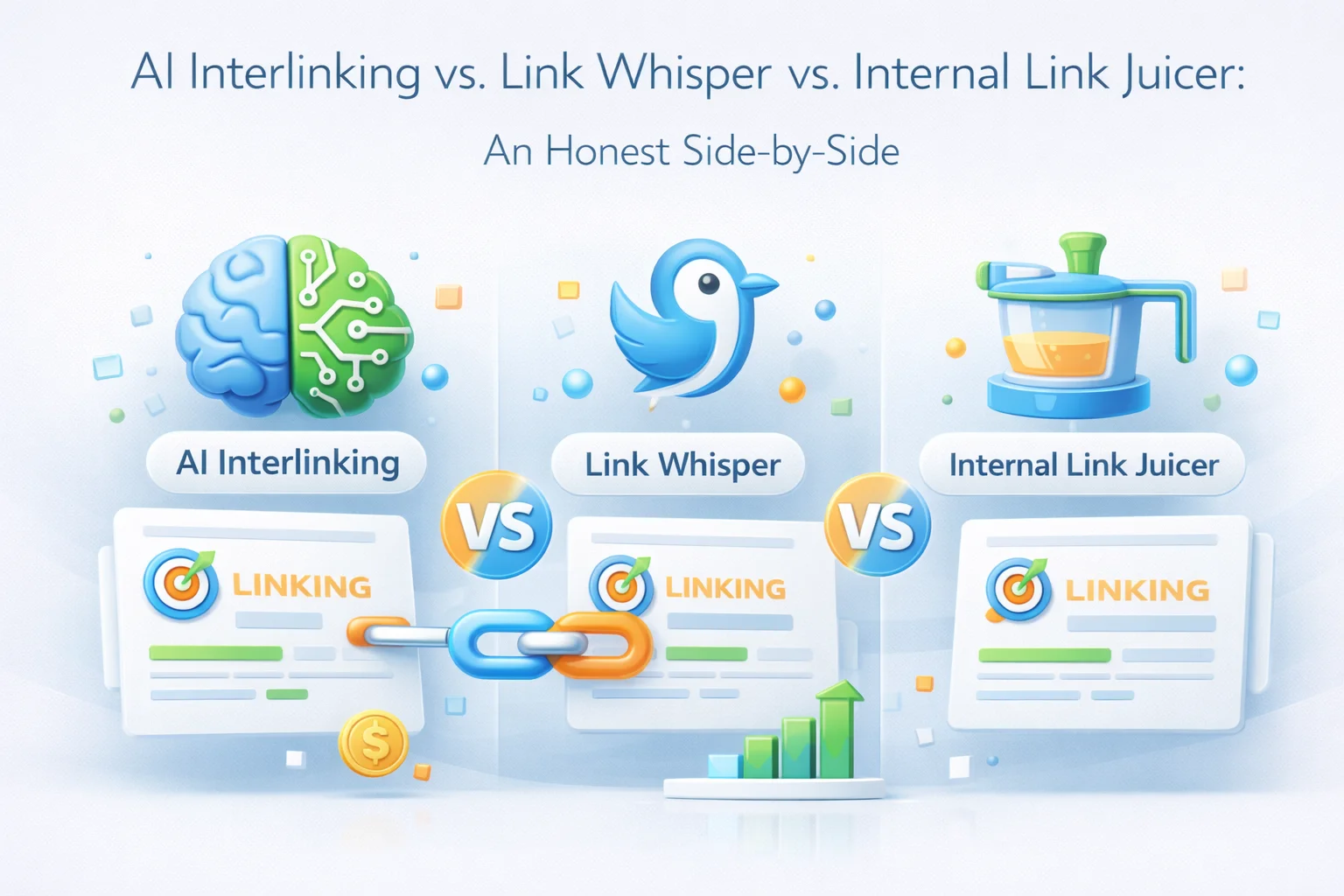
If you have spent any time researching internal linking plugins for WordPress, you have encountered the same three names repeatedly: Link Whisper, Internal Link Juicer, and the newer generation of AI-powered tools. Each has a vocal user base. Each has genuine strengths. And each has significant limitations that their marketing materials are understandably reluctant to highlight.
This comparison takes a different approach. Instead of listing features and scores to make one product look definitively better, it explains what each tool actually does well, what it does poorly, and which type of site and user it is genuinely the right choice for. The goal is to help you match the tool to your specific situation rather than to declare a winner.
That said, the three tools represent fundamentally different approaches to the same problem, and those differences have real consequences for SEO outcomes at scale. By the end of this comparison, the tradeoffs will be clear enough that your decision should be straightforward.
For the AI-powered category, we use Nexu Link Brain as the primary reference, since it is currently the most fully-featured implementation of semantic AI linking for WordPress. We look at it honestly too, including where its requirements make it a poor fit for some users.
The most important thing to understand about this comparison is that these three tools are not competing versions of the same thing. They represent genuinely different philosophies about how internal linking should work. Comparing them purely on feature counts misses this distinction entirely.
Nexu Link Brain starts by building a semantic understanding of every page on your site using AI vector embeddings. The fundamental question it asks is: what is this page really about, and which other pages on this site cover related topics? Link targets are determined by genuine topical similarity, not by keyword matches or manual rules. The plugin reads your content the way a knowledgeable editor would, understands the relationships between ideas, and creates links that reflect those relationships.
Link Whisper sits inside the WordPress editor and suggests internal link opportunities as you write or edit posts. It uses a combination of keyword analysis and a degree of NLP to identify potential link targets and shows them as quick-add suggestions in the editor interface. The workflow is editor-centric: the plugin assists a human making link decisions rather than making those decisions autonomously. You still review and approve each suggestion. Bulk processing exists but is more limited than in AI-first tools.
Internal Link Juicer is the most straightforward of the three. You define keyword rules: when phrase X appears in any post, automatically insert a link to URL Y. The plugin fires those rules across your content automatically without requiring manual review of individual links. It is the most automated of the three in terms of requiring minimal ongoing attention, but the automation is entirely keyword-driven with no semantic understanding of content relationships.
Link Whisper has been the dominant player in this space for several years, and its market position is well-earned. It introduced the concept of the in-editor suggestion panel that shows you internal link opportunities as you write or edit, which was a genuine improvement over purely manual linking. Its user base is large, its documentation is thorough, and it has a track record that newer tools cannot match.
The core limitation of Link Whisper is that its suggestion engine, despite using some NLP, still relies primarily on finding keyword matches between the text you are editing and titles or content of other posts. It is substantially better than pure keyword matching, but it does not build a semantic model of your site’s content the way vector embeddings do.
In practice, this means Link Whisper works best for sites with relatively focused, consistent vocabulary, where keyword-adjacent suggestions are reasonably accurate. For sites with broad topical coverage, technical niches with synonym-heavy vocabulary, or multilingual content that needs to stay within language boundaries, the keyword-dependent approach produces more misses.
The in-editor workflow is genuinely its strongest differentiator. If your content operation involves writers actively making linking decisions as they work, Link Whisper fits naturally into that process. If you want automation that runs independently of the editorial workflow, it is less suited to that use case.
Internal Link Juicer occupies a specific niche: set-it-and-forget-it keyword rule automation. You define your keywords and targets once, and the plugin fires those rules automatically across every post that contains matching phrases. It requires no ongoing attention once configured. For specific use cases, this simplicity is its primary virtue.
The over-optimization risk with Internal Link Juicer is worth understanding in detail, because it is the most consequential limitation for sites using it at scale. Every time a keyword rule fires, it uses that exact keyword as the anchor text. After the rule has fired across 50 posts, every single one of those 50 links points to the same page with the same anchor text. Google’s ability to detect this kind of programmatic, repetitive pattern has improved considerably. What was a neutral or positive signal several years ago has become a potential ranking suppressor on competitive keywords.
Internal Link Juicer is best suited to small sites with 30 to 60 posts where the number of keyword rules needed is manageable, the vocabulary is predictable, and the priority is low-cost, low-maintenance automation rather than SEO-optimized link quality. For these cases, it does its job reliably. For growing sites where topical authority and anchor text diversity matter, it is a tool that you eventually outgrow.
Nexu Link Brain represents a different generation of tool in this category. Rather than building on keyword matching with layers of additional features, it starts from semantic understanding and builds everything else on top of that foundation. The architectural difference matters because it changes what kind of linking is possible, not just how convenient the workflow is.
The API key requirement deserves a realistic assessment. The cost of using the embedding API for a typical site ranges from a few dollars for the initial indexing run to less than a dollar per month for ongoing auto-suggest operations on new posts. For most sites, the total additional monthly cost beyond the plugin license is $2 to $8. For agencies managing multiple sites, this is a real line item but not a prohibitive one.
The setup investment is genuine but front-loaded. Once the initial configuration and indexing are complete, the ongoing workflow is substantially less demanding than either competitor, because the automation handles more without requiring manual rules or keyword definitions.
Of all the feature differences between these three tools, the anchor text management gap deserves specific attention because it is the dimension most likely to create a ranking suppression risk rather than just a missed opportunity.
Internal Link Juicer creates the same anchor text every time a rule fires, by design. There is no mechanism for variation. On a site with 200 posts, a rule targeting “email marketing software” will create 40 identical anchor text links if that phrase appears in 40 posts. Link Whisper improves on this by generating suggestions rather than automatically applying rules, which introduces some human variation in anchor text selection. But it does not actively enforce site-level diversity or alert you when anchor repetition for a given target becomes excessive.
Nexu Link Brain’s anchor text system generates contextually varied anchor text for each link, tracks the anchor profile for each target URL across the entire site, enforces per-anchor repetition limits, blocks generic anchors automatically, and includes a Low Anchor Diversity report that flags over-optimized pages before they cause ranking suppression. This is a fundamentally different risk profile from the other two tools. For sites that are applying links at any meaningful scale, this difference matters.
Headline license prices do not tell the full cost story for any of these tools. Here is what the complete cost picture looks like.
Single site license starts at $89 per year. Add AI API costs: initial indexing typically $2 to $5 for a 200-post site, ongoing auto-suggest approximately $0.50 to $2 per month depending on publishing frequency and the AI provider chosen. Total first-year cost for one site: approximately $110 to $120. Total ongoing annual cost after initial indexing: $95 to $110. The multi-provider support means you can optimize costs by choosing the most cost-efficient embedding model for your specific needs.
Single site license starts at $97 per year. No external API costs. However, the multi-site pricing scales significantly: three sites at $147 per year, and unlimited sites at $197 per year. For agencies managing more than three client sites, Link Whisper’s all-in annual cost is comparable to or lower than Nexu Link Brain plus API costs, depending on content volume. For single sites, the prices are effectively equivalent.
The free version covers basic keyword rule functionality with limits. The premium version starts at approximately $69 per year for a single site. No external API costs. For users whose needs fit within the keyword rule model, it offers the lowest cost of the three. The pricing reflects the scope: this is a simpler tool serving a narrower use case, and the price is appropriate for what it delivers.
The decision matrix reflects a genuine spectrum. Internal Link Juicer serves simple use cases reliably at the lowest cost. Link Whisper serves editor-centric workflows well and adds meaningful reporting capabilities. Nexu Link Brain serves complex, large, or competitive sites where semantic relevance, anchor diversity, and systematic authority routing determine ranking outcomes.
The honest conclusion of this comparison is not that one tool is categorically superior. It is that the right tool depends entirely on where your site sits on the spectrum of content volume, topical complexity, and competitive ambition. For sites that have outgrown the limitations of keyword matching, the semantic AI approach in Nexu Link Brain represents the current ceiling of what internal linking automation can deliver. For sites that have not yet hit those limitations, simpler tools may serve perfectly well.
Nexu Link Brain builds a semantic understanding of your entire site, creates topically relevant internal links with natural anchor diversity, rescues orphaned pages, routes authority to your most important content, and gives you full visibility into your site’s link architecture.








Finally a comparison that doesn't just say "buy this one." The breakdown by site type and budget saved me hours way better than guessing from vague feature lists. Only wish it had 2026 pricing upfront instead of making me hunt
great breakdown really appreciate the honesty about the tradeoffs. i've been using Link Whisper for a while now, and while it's decent, I'm curious how Nexu Link Brain stacks up in terms of actual limitations. the marketing for AI tools always makes them sound flawless, but we know that's never the case. For example, does Link Brain struggle with niche or low traffic sites where context clues might be sparse? or does it over optimize to the point of creating unnatural link patterns?
Hey y'all, this breakdown actually helped me pick the right tool for my blog
Hey, finally a comparison that doesn't sugarcoat anything! saved me hours of guessing which tool fits my site
Hey, this actually saved me hours of trial and error.