Next-Level Code. Nexuvibe Style ...
Hrs
Min
Sec

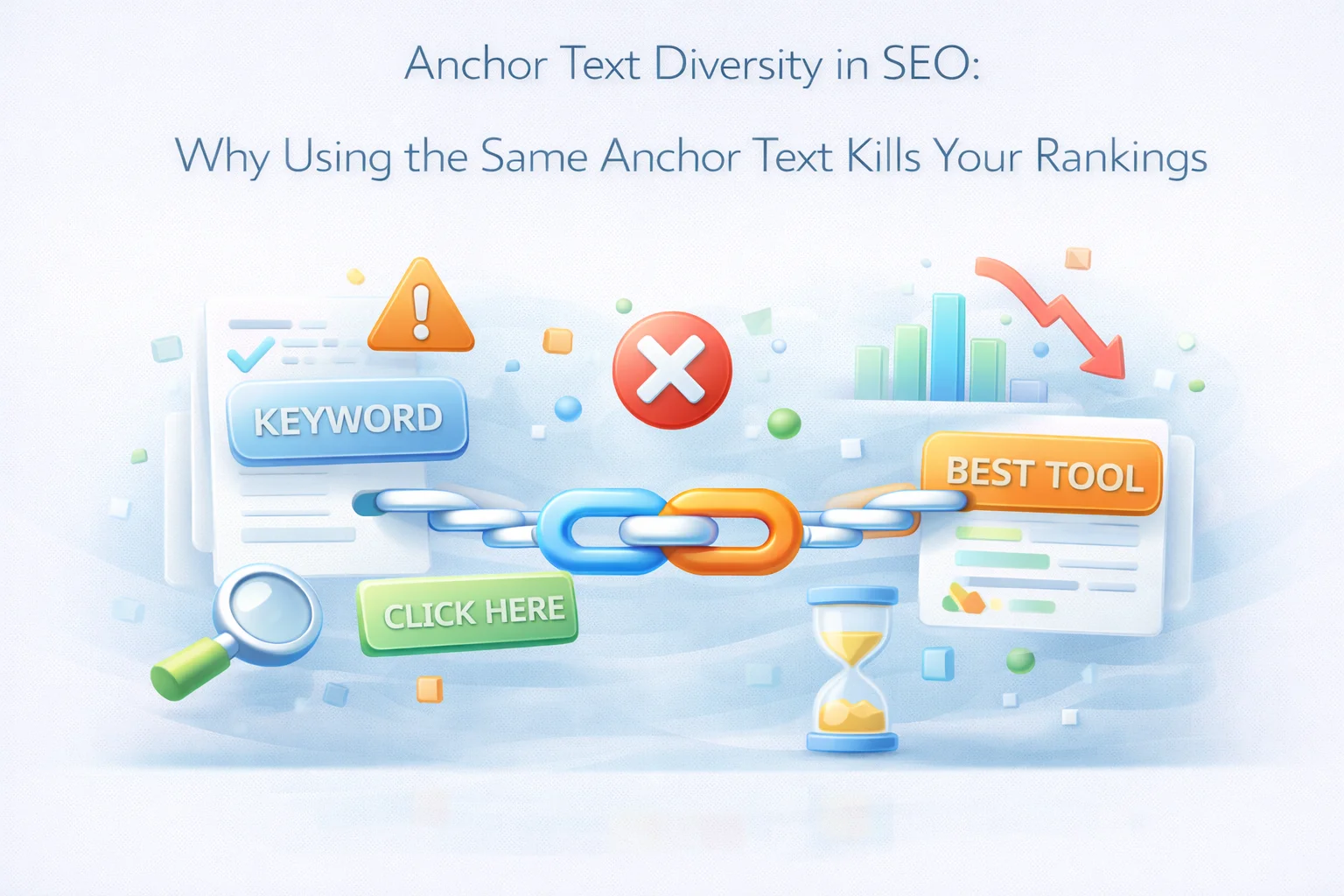
Anchor text sits at the intersection of two competing pressures in SEO. On one hand, descriptive and relevant anchor text helps Google understand what a linked page is about, which strengthens its ranking signal for related queries. On the other hand, anchor text that is too uniform across hundreds of links sends a signal that the linking pattern is artificial rather than editorial, which Google’s systems are specifically designed to discount or penalize.
Most discussions of anchor text focus on external backlinks, where over-optimization with exact-match anchor text has been a well-documented ranking suppressor since Google’s Penguin updates began in 2012. But the same dynamic applies to internal links, and with less attention paid to it. Sites that use keyword-based internal linking tools to automate link insertion routinely build exact-match anchor repetition patterns across their entire content archive without realizing it, and the ranking suppression that follows is difficult to diagnose because the connection is not obvious.
This guide explains the anchor text diversity problem in full: what healthy anchor text distribution actually looks like, how to identify over-optimization in your existing link profile, what the ranking consequences are, and how to build and maintain natural diversity at scale, including how tools like Nexu Link Brain prevent over-optimization automatically as part of their linking workflow.
A healthy anchor text profile for internal links contains a mix of five distinct types. Understanding what each type is and what proportion it should represent in a natural editorial environment is the starting point for diagnosing and fixing anchor text problems.
Example: a link to a page targeting “best espresso machines” using the anchor text “best espresso machines.” These are the highest-value anchors for ranking signal strength, but the most dangerous when overused. Google expects exact-match anchors to represent a small minority of your internal link profile, roughly 5 to 15 percent for most sites. When exact-match anchors dominate a page’s incoming link profile, particularly above 40 to 50 percent, the uniformity becomes a negative signal.
Examples using the same target page: “top espresso machine options,” “espresso makers for home baristas,” “our espresso machine guide.” These anchors include relevant keywords but vary the phrasing, which is how a human editor would naturally reference the same page in different articles. Partial match anchors are the workhorses of a healthy internal link profile. They provide strong topical signals without the uniformity risk of exact-match anchors.
Examples: “our review,” “this guide,” or the name of a specific product or brand your site promotes. These anchors appear naturally in editorial writing when referencing your own content. A small proportion of branded or navigational anchors in a page’s incoming link profile looks exactly like what genuine editorial linking produces. Their presence in a diverse profile is a positive naturalness signal.
Examples: “in this complete breakdown,” “as we covered in detail,” “our hands-on comparison.” These anchors describe the nature of the linked content without including target keywords. They appear naturally when a writer references related content by describing what it contains rather than what keyword it targets. Their presence in a link profile signals that the linking site writes naturally rather than building links with SEO intent in every anchor choice.
These carry no topical SEO value but appear naturally in editorial writing and should be a small but present part of any realistic internal link profile. The complete absence of generic anchors can actually look slightly unnatural on large sites, because human editors do occasionally use these phrases. The key is that they are a small minority rather than the dominant type, and they never appear in sites using keyword-based automation tools that generate only exact-match or partial-match anchor text.
Google has been explicit about its approach to unnatural anchor text patterns. The Penguin algorithm update, first launched in 2012 and now running as a continuous real-time system within Google’s core algorithm, specifically targets sites with anchor text profiles that appear manipulated rather than editorially generated. While Penguin was initially described in the context of external backlinks, the same pattern-detection logic applies to internal links.
The reason exact-match repetition is a red flag is that it does not occur naturally in genuine editorial writing. When a human editor writes 200 posts over two years and occasionally links to the same resource, they will naturally describe that resource in dozens of different ways depending on the context of the article they are writing. The anchor text will vary organically. A site where 60 posts all link to the same page using the exact same five-word phrase was not written that way: something automated it. Google’s pattern detection is designed specifically to identify that kind of programmatic consistency.
The specific threshold at which repetition becomes a ranking problem is not publicly defined by Google, and it likely varies based on the competitiveness of the anchor phrase, the overall link volume to the target page, and the quality signals of the pages doing the linking. A conservative and defensible guideline for internal links is that no single anchor phrase should represent more than 25 to 30 percent of the total incoming internal link anchors for a given page. Above that level, the concentration becomes visible as a pattern.
The anchor text problem is most acutely created by keyword-based internal linking tools, not because those tools are poorly designed, but because their design necessarily produces exact-match repetition. The core function of a keyword-based tool is to link every occurrence of a defined keyword phrase to a defined target page. The keyword phrase becomes the anchor text. Every time the rule fires, the same anchor is created. On a site with 300 posts, a rule for “email marketing strategy” linking to the main email marketing guide might fire 40 or 50 times, creating 50 identical anchors pointing to the same page.
The contrast between these two outputs illustrates the problem precisely. Keyword-based automation produces a monoculture of anchor text that grows more concentrated as the site grows. AI semantic linking generates contextually appropriate variation that mirrors what a team of skilled editors would produce if they had enough time and site knowledge to link every post thoughtfully.
The semantic approach also provides richer topical signals to Google. Each of the varied anchor texts in the AI output tells Google something slightly different about the target page: it is a complete guide, it is for beginners, it covers the planning process, it addresses newsletter strategy. This variety builds a richer, more robust topical profile for the target page than any number of identical exact-match anchors could achieve.
Before you can fix an anchor text problem, you need to understand where you stand. An anchor text audit for internal links is straightforward but requires combining data from a few sources.
Tools like Screaming Frog or Sitebulb can crawl your entire site and export a complete list of internal links with their anchor text. This gives you the raw data: every internal link across your site, the source page, the destination page, and the exact anchor text used. Export this to a spreadsheet. This is the foundation of your audit.
For each important target page, pivot the data to show all unique anchor texts and the count of each. Calculate what percentage each anchor text represents of the total incoming links to that page. Pages where a single anchor text represents more than 30 percent of incoming links are over-optimized candidates. Pages where a single anchor text represents more than 50 percent are at meaningful risk.
Nexu Link Brain’s Low Anchor Diversity report identifies this problem automatically without requiring you to build the pivot table manually. It flags every page where incoming internal link anchor text has become concentrated beyond a safe threshold, showing you exactly which pages are over-optimized and by how much. This is the most efficient way to run an ongoing anchor diversity audit as your content archive grows.
Anchor text over-optimization does not always produce dramatic ranking drops. More often it produces a quiet suppression: the page ranks, but it consistently places lower than its content quality and external link profile would suggest it should. The gap between expected and actual ranking is the signal.
You improve and expand a page’s content but its rankings do not improve meaningfully. You add external backlinks but it still plateaus at position 7 or 8 for important queries. If the page’s internal anchor text profile is heavily over-optimized, the quality of the content and the external links is being discounted by the over-optimization signal. Fix the anchor distribution and the content and link improvements begin to translate into ranking movement.
A page ranks well for long-tail variations of a keyword but struggles to crack the top 5 for the head term that all those identical internal anchors are trying to build authority for. This is a common pattern with over-optimized internal anchor text: the heavy exact-match emphasis on the head term creates a suppression specifically for that term while other rankings remain healthy.
If you set up a keyword-based internal linking tool and then noticed rankings for certain competitive pages declining over the following two to three months, the tool may have rapidly built an over-optimized anchor profile for those pages. The connection is easy to miss because the ranking change happens weeks after the linking change, and diagnosing the cause requires looking at anchor text distribution rather than standard ranking factors.
Rather than requiring you to audit and correct anchor text after the fact, the right approach is a system that prevents over-optimization from occurring in the first place. Nexu Link Brain’s anchor text management operates on three levels that together maintain natural diversity automatically.
The AI generates anchor text for each link from the actual language used in the source post, not from a predefined keyword. When the source post discusses email deliverability challenges, the anchor text for a link to your email marketing guide reflects that context: something like “improving your email delivery rates” rather than the generic target keyword. When the source post covers list segmentation, the anchor text reflects that angle instead. Each anchor is unique to its context.
A configurable maximum defines how many times any specific anchor phrase can appear across your site for the same target URL. Once that limit is reached, the AI automatically generates a different phrase for new links to that target. This limit operates at the site level, not the post level, which is the only place where anchor concentration can be meaningfully controlled. You set the threshold, and the system enforces it without manual monitoring.
A configurable blocked anchors list prevents phrases like “click here,” “read more,” and “learn more” from ever being suggested or applied. Minimum and maximum word count settings for anchor text ensure that extremely short anchors (which provide minimal topical signal) and extremely long ones (which look unnatural) are filtered out automatically. The combined effect of these three layers is an anchor text profile that remains naturally diverse regardless of how many posts are published or how many links are applied.
If your site already has an over-optimized internal anchor text profile, fixing it requires a measured approach. Rapidly removing many existing links can cause temporary ranking disruption as the authority flow changes. The goal is to dilute the concentration by adding new, varied-anchor links, while selectively updating the most egregious repetitions.
Anchor text diversity is one of the SEO factors that operates most invisibly. Unlike a missing meta description or a broken canonical tag, it does not show up as an error in any standard audit tool. It accumulates slowly through automated processes, suppresses rankings quietly, and requires a specific type of analysis to diagnose. The sites that stay ahead of this problem are those that built systems for preventing it rather than waiting to fix it after the damage is done.
The AI-powered WordPress internal linking system with anchor text diversity protection addresses this as a core design principle rather than an optional setting. Every link the system creates contributes to a natural, varied anchor text profile that builds ranking authority without creating the over-optimization patterns that suppress it.
Nexu Link Brain generates contextually varied anchor text for every link, enforces site-level repetition limits, blocks generic anchors, and proactively alerts you to diversity problems before they affect your rankings.







Hey, picked this up on a whim after noticing some weird ranking drops
Really solid breakdown on anchor text ratios. that 10 25% generic anchor rule totally makes sense so many sites skip this and end up looking way too robotic
I've been running our department's blog for years, and this guide finally explained why some of our older posts kept underperforming no matter how much we updated them. Turns out, our internal linking plugin was overusing exact match anchors without us realizing it. The section on auditing your anchor text profile was a lifesaver we ran the checks they described and found dozens of pages with the same repetitive links. Fixed it last week, and a few of those stubborn posts are already climbing back up
I bought this guide hoping for actionable fixes, but it's mostly theory. The "practical framework" they advertise is buried under pages of warnings about Google penalties. yes, we get it repetition looks like manipulation. But where's the step by step for actually fixing it?