
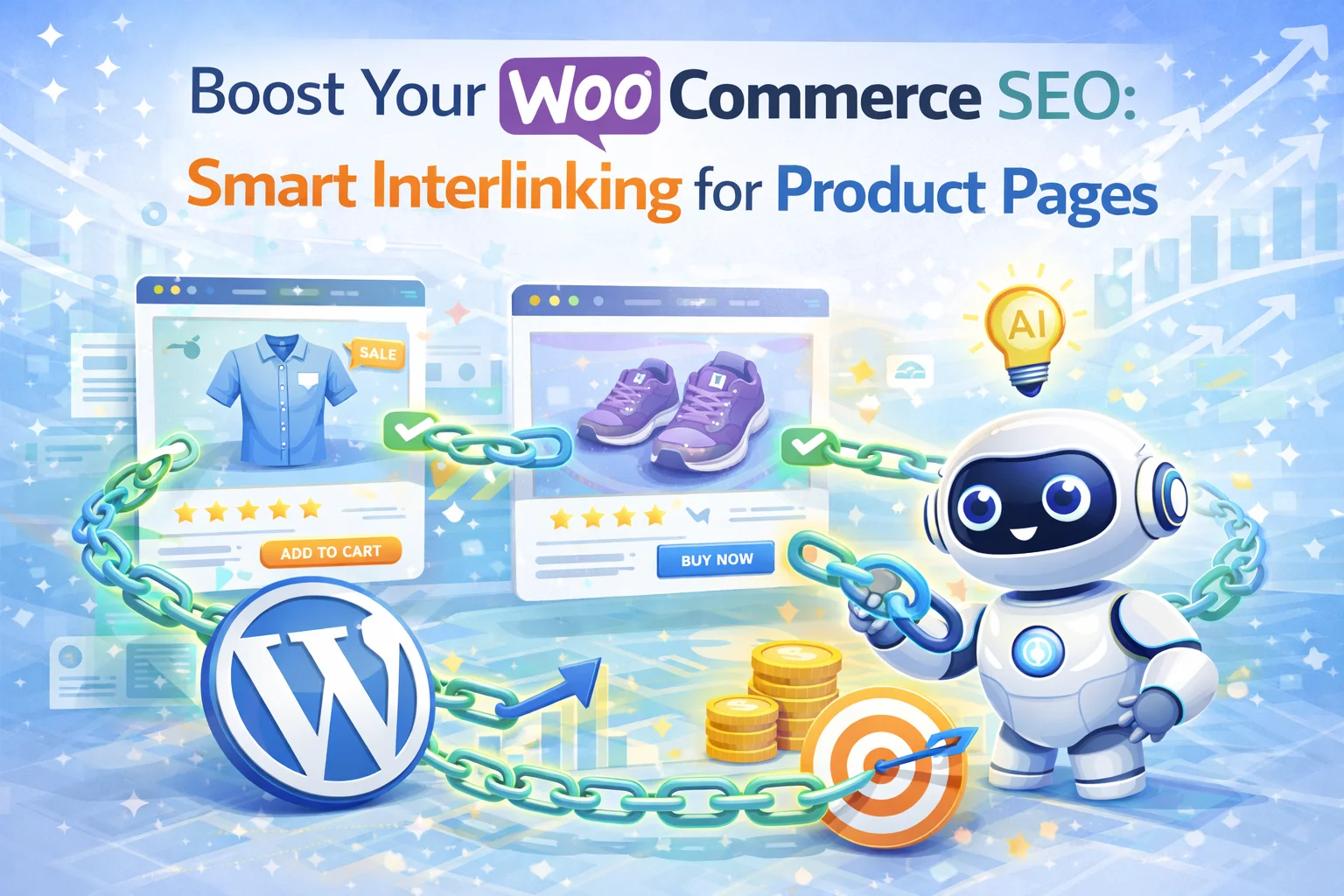
Here is something most WooCommerce store owners discover too late. They spend months getting their product photography right, weeks tweaking their pricing strategy, and real money running paid ads to drive traffic. Then they look at their organic search rankings and wonder why their product pages are not showing up for the terms they are targeting. The content is good. The products are competitive. The store is fast. And yet the pages sit on page two or three of Google results, collecting almost no organic traffic.
What is almost always missing in these situations is internal link structure. Product pages on WooCommerce stores are structurally isolated in ways that blog content rarely is. A blog post naturally gets linked from other posts, from category pages, from author pages. A product page often sits in a category listing and nowhere else. No blog post references it. No guide links to it from within editorial content. No related content elsewhere on the site points to it with meaningful anchor text. From a search engine’s perspective, that product page has almost no structural evidence that it matters, regardless of how good it actually is.
This article is about fixing that. We will look at why product pages are structurally disadvantaged by default in WooCommerce, what good internal linking looks like across the different content types that make up a real e-commerce site, and how Nexu Automated AI Internal Linker handles the cross-content-type linking that makes the difference between a WooCommerce store that ranks and one that does not.
If you run a WooCommerce store and you have not thought carefully about internal linking before, this is the article that will change how you see your site’s architecture.
Why product pages are structurally isolated by default in WooCommerce
WooCommerce generates several types of pages automatically: product pages, product category pages, tag pages, and shop pages. These are connected to each other through the default WordPress taxonomy structure. A product appears in its category. The category page lists all products in that category. This hierarchy exists and it creates some internal linking, but the links it creates are weak in two important ways.
First, category page links are navigational, not contextual. A category page linking to a product is functionally identical to a navigation menu linking to a page. Search engines understand the difference between navigational links that exist to help users browse a site and contextual links that appear within editorial content because the content is genuinely related. Contextual links carry significantly more weight as authority and relevance signals. A product that receives only navigational links from category pages is not receiving the kind of structural support that moves rankings.
Second, category page authority is diluted across every product in that category. If a category page links to forty products, the authority it passes is split forty ways. Each product receives a small fraction of what the category page could pass if it were linking selectively to fewer, more strategically important targets. The category linking structure is fine for user navigation but inadequate as the primary source of internal authority for your product pages.
The structural problem compounds when you consider that most WooCommerce stores also publish blog content, but they treat their blog and their product catalog as separate worlds. The blog posts get written, published, and linked among themselves. The product pages sit in their category hierarchy. The two content systems almost never connect, even when they are topically related in obvious ways. A store selling camping equipment publishes a detailed guide on how to choose a sleeping bag. That guide never links to the specific sleeping bags available in the store. The product pages that would most benefit from the authority and topical context that guide provides are completely disconnected from it.
The average WooCommerce store that publishes blog content has dozens of posts that are topically relevant to specific products in their catalog. None of those posts link to those products. Connecting them is not a technical challenge and it does not require creating new content. It requires systematically identifying which existing posts are relevant to which products and adding contextual links. This is where Nexu Automated AI Internal Linker does its most valuable work for e-commerce sites, finding those connections automatically across the entire content library.
The four content types in a WooCommerce store and how they should connect
Building a proper internal link structure for a WooCommerce store requires thinking about the different content types that exist on the site and the specific role each type plays in both the user journey and the authority flow. Most stores have four distinct content types that interact: product pages, product category pages, blog posts and guides, and static pages like the homepage, about page, and key landing pages. Each one has a different relationship to the others, and understanding those relationships is the foundation of a smart interlinking strategy.
Product pages are where conversions happen, which makes them the pages you most want to rank. They should be linking targets from every other content type on your site where a connection is contextually appropriate. A product page for a protein supplement should receive links from blog posts about workout nutrition, from buying guides for supplements, from comparison pages between similar products, and from any category page where it appears. Every contextual link it receives from editorial content strengthens its topical authority signal and increases the PageRank flowing to it from the rest of your site. Product pages should be treated as pillar pages for their specific topic, not just as endpoints in a navigation hierarchy.
Category pages rank for broader, higher-volume category-level queries. A well-optimized category page for “men’s trail running shoes” can capture significant organic traffic for that term and pass meaningful authority to the product pages within it. But category pages themselves need incoming links from editorial content to accumulate the authority they need to rank. Blog posts that discuss trail running, gear guides, and comparison articles should link to relevant category pages contextually. When your category pages rank well, every product inside them benefits from the category page’s own authority through the navigational links.
Blog content is the part of a WooCommerce site that accumulates external backlinks most naturally. Informational content attracts links from other websites in ways that product pages rarely do. This makes blog posts a disproportionately important source of incoming external authority, which then needs to flow through internal links to reach the product pages where it can actually drive rankings. A well-linked blog post that has attracted external backlinks and then links internally to related product pages is passing real, valuable authority to those products. Treating your blog as a separate content silo means all that external authority stays trapped in the blog and never reaches the pages you most need it on.
The homepage and key landing pages of a WooCommerce store typically accumulate the most external backlinks of any pages on the site. They are the first pages other sites link to when mentioning the store. This makes them the highest-authority pages in the link graph, and yet most stores link from their homepage only to top-level categories, never to specific products or blog posts that would benefit from that homepage authority. A homepage that selectively links to your most strategically important products, your most commercially valuable category pages, and your best-performing blog content creates authority pathways that lift the entire site.

Blog-to-product linking: the highest-leverage opportunity most stores are not using
If you had to choose one internal linking practice to implement immediately on a WooCommerce store that has been neglecting internal links, it would be blog-to-product linking. The reason it has such high leverage comes back to the authority flow logic described above. Blog posts are the content type on most e-commerce sites most likely to have external backlinks pointing to them. They are the content type that gets shared on social media, referenced in roundup articles, and cited in industry newsletters. The authority those external links bring sits in your blog content and needs a path to reach your product pages.
The way to create that path is simple in principle but requires discipline to execute consistently: every blog post that discusses a topic related to products you sell should include contextual links to those specific products, placed within the editorial content in a way that makes genuine sense for a reader. A buying guide should link to the products it recommends. A how-to post that uses specific equipment should link to that equipment in your store. A comparison article should link to both products being compared. A review post should link to the product being reviewed. These links should feel like natural extensions of the editorial content, not forced insertions.
The challenge is doing this at scale across an existing blog archive that may have 50, 100, or 200 posts, none of which currently link to products. Reviewing every post manually, identifying which products are relevant, finding the right placement in the text, and writing appropriate anchor text is a project that most store owners start and abandon. The scope is too large and the return on each individual link too hard to attribute to justify the hours.
This is precisely why cross-content-type AI linking matters for WooCommerce. Nexu Automated AI Internal Linker indexes your entire content library, including products, and understands the semantic relationship between a blog post about outdoor cooking techniques and a product page for a cast iron camping cookware set. It finds those connections without any human needing to read both pieces of content simultaneously, generates appropriate anchor text, and surfaces the suggestions for review or applies them automatically above your confidence threshold. The blog-to-product linking that would take a human editor weeks to complete across a 150-post archive gets handled in a single bulk analysis session.
How to configure cross-content-type linking for a WooCommerce store
Not every possible connection between content types makes sense for every store. The right configuration depends on your specific editorial standards, your product catalog structure, and your business goals. Getting the cross-content-type linking matrix right before running a bulk analysis saves you from applying links that do not fit your strategy and having to undo them afterward.

The Cross Post-Type Linking Matrix in Nexu lets you define exactly which source content types can link to which target content types. Here is what a sensible configuration looks like for most WooCommerce stores, with the reasoning behind each choice:
Configuring this matrix before running a bulk analysis means the AI works within the strategic framework you have set rather than suggesting connections that do not fit your editorial approach. Once the matrix is in place, every suggestion the system generates respects these boundaries automatically. You never see a suggestion to link from a product checkout page to an unrelated blog post because that combination is excluded from the analysis entirely.
Anchor text for product links: the e-commerce rules are slightly different
The anchor text rules for internal links to product pages require some adjustment from the general guidelines that apply to blog-to-blog linking. When you link from editorial content to a product page, the anchor text options include the product name, the product category, the specific benefit the product provides, and the problem it solves. Each of these creates a different topical context signal for the product page.
Linking with the exact product name as anchor text is often appropriate and not a problem when done naturally. If a blog post about marathon training mentions that the author uses a specific foam roller for recovery and links to that product’s page using the product name as anchor text, that is contextually natural and SEO-appropriate. The issue arises, as with all anchor text, when the same phrase appears repeatedly across multiple links pointing to the same product page. A product that receives twelve internal links all using the exact product name creates the same over-optimization signal as any other anchor text uniformity pattern.
The healthier practice is to mix anchor types across the different posts that link to a given product: some links using the product name, some using the primary benefit phrase, some using the problem-solving context, and some using broader category language. A foam roller product page might receive links anchored to “foam rolling for muscle recovery,” “deep tissue massage tool,” “post-workout recovery,” and the product name itself. Each variation reinforces a slightly different topical signal for the page without creating uniformity that triggers over-optimization concerns.
The anchor diversity system in Nexu Automated AI Internal Linker applies to product pages exactly as it does to blog posts. Per-target anchor frequency limits mean the same anchor phrase cannot appear more than your configured maximum number of times pointing to any single product page. The AI generates varied anchor text for each suggestion, drawing from the semantic understanding of both the source post and the product page content. The Low Anchor Diversity report flags product pages where repetition is building up so you can address it before it becomes a ranking risk.
Pillar page priority for your highest-value products
Every WooCommerce store has products that are more commercially important than others. A flagship product with high margins. A seasonal bestseller. A newly launched item you want to rank before competitors. A bundle that drives disproportionate revenue when it ranks. These products deserve more internal link support than the rest of your catalog, and getting that support without manually hunting for every possible linking opportunity is where the pillar page priority feature becomes essential.
When you mark a product page as a pillar page in Nexu Automated AI Internal Linker, the system gives those pages a scoring boost during relevance evaluation. This means that when the AI is analyzing a blog post and finds that both a standard product page and a pillar-designated product page have similar relevance to that post’s content, it will preferentially suggest the pillar page as the link target. Over the course of a bulk analysis that processes hundreds of blog posts, this scoring boost means your most commercially important products accumulate significantly more incoming internal links than they would through a neutral ranking of all candidate pages.
This is human strategic judgment encoded into the AI’s behavior. You are not waiting for the algorithm to discover which products matter most to your business. You are telling it directly, and the AI respects that designation in every linking decision it makes. The result is an internal link distribution that reflects your commercial priorities rather than just the neutral output of semantic similarity matching.
The WooCommerce orphan product problem: more common than you think
Product pages become orphaned in WooCommerce in ways that are completely invisible unless you are actively monitoring for them. A product gets discontinued and removed from its category but the page is left published. A new product is added to the catalog but not assigned to a category yet. A site reorganization moves products between categories and the old category links no longer exist. A product that was featured in a now-deleted blog post loses its only editorial incoming link. Any of these routine store management actions can leave a product page structurally isolated without anyone noticing.
Orphaned product pages are a significant SEO problem because product pages without incoming links receive almost no PageRank flow from the rest of the site, are less frequently crawled by Googlebot, and have no anchor text context signals helping Google understand what they should rank for. In a competitive product category where your competitors’ product pages are well-linked from editorial content and yours are structurally isolated, you are ranking with one hand tied behind your back regardless of how good your product page content is.
The orphan rescue system in Nexu handles WooCommerce product pages with the same approach it applies to blog posts: it identifies every product page with no incoming internal links, searches the full content library for the most semantically relevant and structurally authoritative source pages, and generates rescue link suggestions that come from editorial content rather than just navigational structures. A product page that has been sitting isolated since launch can go from zero incoming editorial links to three or four well-placed, contextually appropriate links from relevant blog posts within a single rescue session. The PageRank flow, crawl frequency, and topical context signals that those links create are often enough to produce measurable ranking improvement within a few weeks.
Most WooCommerce store owners are competing on product quality, pricing, and ad spend without ever addressing the structural SEO disadvantage that comes from treating their blog and their product catalog as separate worlds. The opportunity is significant precisely because so few stores are taking it seriously. The technical work required to create a unified, well-linked content architecture across all four content types of a WooCommerce site is not complicated. It requires a clear strategy for how the content types should connect, an anchor text policy that keeps your product links looking natural at scale, a system for identifying and rescuing orphaned product pages, and ongoing automation that keeps new products from entering the index in structural isolation.
Nexu Automated AI Internal Linker was built for WordPress and WooCommerce and handles each of these needs with a cross-content-type linking matrix you configure once, semantic AI that finds blog-to-product connections across your entire archive, pillar page priority for your commercially important products, automatic orphan detection for product pages, and anchor text diversity enforcement across every suggestion it makes. The stores that get this right are the ones that compound their SEO advantage month over month while their competitors keep spending on ads for traffic that their organic rankings should already be capturing.
Your products deserve to rank for what they actually are. The internal links are what tell Google that story.
Connect your blog to your products. Watch your rankings follow.
Nexu Automated AI Internal Linker finds every relevant connection between your blog content and your WooCommerce product pages, applies them with proper anchor text, rescues orphaned products, and keeps your entire store’s link structure healthy as your catalog grows.


I grabbed this on a whim after reading about SEO gaps. setup was easy enough, but I'm not really seeing that "structural support" it talked about yet. My product pages are still buried in the same old category listings
The internal linking logic works well, but setup was a little clunky
interesting read on interlinking. i didn't realize category page links were treated like nav menus by search engines explains why some of our products rank poorly despite good content. Worth testing, though setup seems manual