Next-Level Code. Nexuvibe Style ...
Hrs
Min
Sec

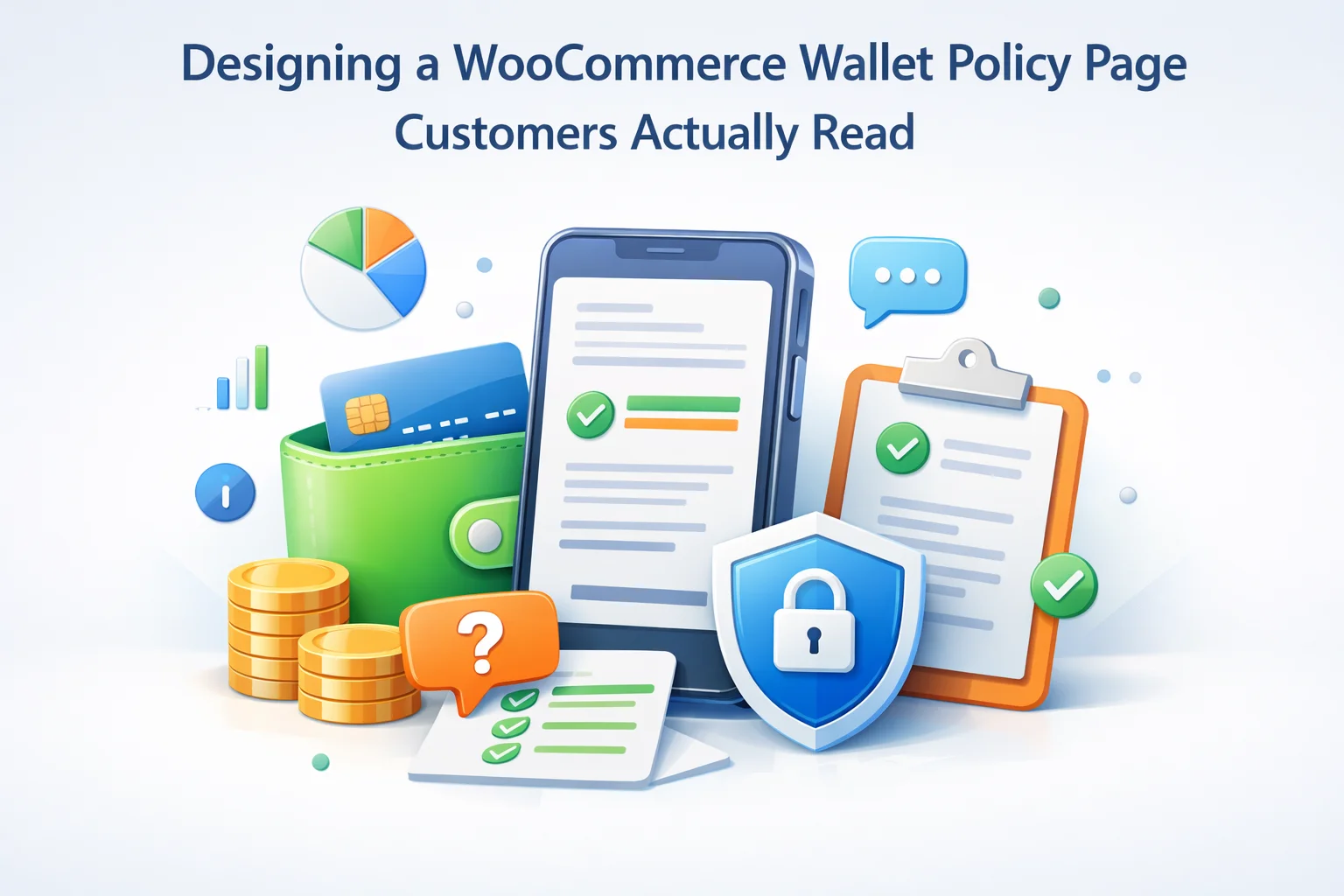
Stored-value programmes inherit a paradox: marketing celebrates instant rewards while finance tracks deferred liability. Customers live in the middle. They skim your homepage promise, glance at wallet balances in My Account, and resolve contradictions emotionally before they parse sentences. When the policy page feels like boilerplate imported from unrelated industries, shoppers assume you are hiding something even when your operations are reasonable. Readable policy is therefore not cosmetic; it reduces disputes, lowers chargeback narratives rooted in confusion, and gives support agents language they can quote without improvising.
Good policy writing for WooCommerce wallets mirrors good interface copy: same words for the same concepts everywhere. If My Account labels a balance “available wallet funds,” your policy should not call it “non-cash promotional credit” unless that distinction is real, explained once, and reflected in transaction history line items. Consistency is how you earn the right to longer paragraphs where nuance matters, such as partial refunds after split payments or cashback that accrues after shipment rather than authorization. The WooCommerce documentation on managing orders and refunds remains the canonical reminder that customer-facing records and admin flows should tell one story; wallet policies extend that obligation across marketing, checkout, and ledger views.
This guide walks through structure, language, operational alignment, and governance so your policy page earns attention instead of deferring it. Teams standardising wallet experiences on Nexu infrastructure often pair the page with a WooCommerce wallet policy framework tied to Nexu WP Smart Wallet My Account surfaces so published terms and actual wallet behaviour stay synchronized when toggles change.
Customers do not open your wallet terms for pleasure. They open them when something feels off: a balance lower than expected, cashback missing after a big order, or a refund that landed somewhere unfamiliar. In that emotional state, walls of uppercase notices and cross-references to unnamed schedules signal evasion even when your legal position is sound. The twelve-second skim test is brutal but realistic: if someone cannot identify where refunds are explained, they assume the worst and open a ticket or initiate a payment dispute.
Readable policy begins with empathy for that mindset. Lead with what happens to money in common situations: topping up, spending at checkout, cancelling before fulfilment, returning after delivery, receiving cashback, and withdrawing if you allow it. Defer jurisdictional boilerplate to collapsible sections or clearly labeled appendices rather than front-loading paragraphs that train readers to bounce. Your marketing team may worry plain language invites litigation; in practice, ambiguity invites confusion, and confusion generates evidence-rich complaints. Precision and accessibility coexist when definitions appear once, near the top, and reuse identical nouns across product and policy.
If shoppers only discover terms after support sends a PDF, your policy failed distribution, not drafting. Surface the same link anywhere wallet funds change state.
Different teams naming the same funds “credit,” “balance,” and “rewards” produces mistrust faster than any single ambiguous clause.
Marketing claims deserve special discipline. Superlatives about “instant” wallet credit should match gateway capture timing and any pending states your extension exposes. If your programme intentionally delays cashback until orders reach a status such as completed or delivered, say so beside every promotional banner referencing cashback, not only in subsection four of the policy. Cross-channel honesty reduces the volume of screenshots customers attach to complaints. Regulators increasingly treat stored-value promotions like other promotional claims; the Federal Trade Commission business guidance on advertising and marketing underscores that material limitations must be clear and conspicuous, which for wallets includes timing and eligibility constraints.
Finally, acknowledge mobile readers. Narrow columns, adequate contrast, and headings coded as real heading elements matter for comprehension and accessibility. Treat the policy page like a product surface: instrument scroll depth, search queries on site, and inbound ticket phrases that reference “terms,” then iterate wording where confusion clusters.
Policy is a promise log. Each sentence should map to something shoppers can observe: a balance figure, an email receipt, a ledger line, or a support macro quoting the same verbs. Start alignment exercises with three artefacts side by side: your wallet policy page, a logged-in My Account wallet view, and an anonymised admin export of transaction categories your team uses internally. Every delta is either a bug, outdated copy, or an intentional exception that belongs in customer-visible explanation.
Checkout deserves the same parity. If partial wallet payment is permitted, policy must describe how remaining card charges behave on refunds and whether wallet portions refund to wallet first. Silent mismatches surface during the first complicated return, often involving higher-order values where customers pay attention to cents. WooCommerce core behaviours around coupons, taxes, and shipping allocations already confuse occasional shoppers; wallet splits add another layer only documentation can stabilise when written patiently.
Email notifications should echo policy sentences about timing. When cashback moves from pending to spendable, the email subject and body should reuse the verbs your policy defines for those states. Internal teams sometimes resist repetition as redundant; customers experience repetition as confirmation. Treat alignment as operational hygiene similar to versioning release notes: when wallet rules change, update policy, transactional templates, and in-product microcopy in one release bundle.
Where extensions expose role-based behaviour, disclose it plainly. Wholesale buyers, VIP tiers, or test accounts may see different limits. Rather than hiding exceptions in footnotes only engineers understand, summarise each audience’s constraints under clearly labeled headings. Transparency reduces accusations of arbitrary treatment.
Structure carries meaning. A wall of paragraphs signals “we hope you give up.” Headings that reflect actual customer questions signal “we expected you.” Start with a one-paragraph overview no longer than six sentences answering: what wallet funds are, what they are not, and where they can be used. Follow with sections titled using shopper language: “Adding money,” “Spending at checkout,” “Refunds and returns,” “Cashback,” “If we reverse a payment,” and “Closing your account.” Legal teams can map statutes to those buckets instead of forcing shoppers to learn your internal taxonomy.
Within sections, favour short paragraphs and sentences that avoid nested clauses. When you must include numbers, repeat them in both numerals and words for critical thresholds only if your jurisdiction requires it; otherwise pick one format and stay consistent. Bulleted lists excel for sequences such as how refunds allocate across payment methods. Numbered lists communicate rank order, such as which funding source receives residual value after partial fulfilment.
Cross-links reduce duplication errors. Maintain a single canonical explanation for cashback pending logic and link to it from promotional FAQ entries rather than pasting variants that inevitably diverge. For multilingual stores, budget translation as part of policy updates, not as an afterthought; conflicting translations erode trust as quickly as conflicting English paragraphs.
Accessibility is part of architecture. Use hierarchical headings, meaningful link text instead of “click here,” and sufficient contrast. The WCAG 2.2 quick reference from the W3C Web Accessibility Initiative gives testable criteria; meeting them improves comprehension for everyone, not only assistive technology users.
Refund policy for wallet-funded orders should state precedence clearly. If your operations always credit the wallet before returning money to a card, write that rule plainly and describe exceptions such as regulatory requirements or gateway limitations. Customers forgive complexity when sequence is honest and stable; they do not forgive shifting sequences that depend on invisible support discretion. Pair rules with examples using round numbers to illustrate partial refunds after wallet plus card checkout.
Chargebacks deserve calm, non-accusatory language. Explain that payment disputes may trigger wallet restrictions until investigations close, and outline approximate timelines without overpromising banking networks you do not control. Support macros should restate the same sentences to avoid improvisations that contradict static policy during stressful chats.
If your store uses multiple gateways or currency presentations, mention how rounding works at refund time. Tiny rounding differences rarely matter until they matter intensely to someone reconciling personal budgets. A single clarifying sentence prevents conspiracy theories.
Cashback introduces time into wallet economics. Policy must define accrual triggers, approval windows, exclusions such as coupon-heavy orders or wholesale roles, and what happens when customers return products that originally generated rewards. Avoid hiding pending states behind internal-only terminology. If customers see “pending cashback” in My Account, your policy defines pending in one paragraph and links to the same definition from promotional landing pages.
Eligibility nuances belong in policy when they affect large cohorts. If first-order-only cashback campaigns apply, say so openly to prevent returning customers from feeling baited. If certain categories are excluded for margin reasons, name categories at the level shoppers recognise from navigation, not raw SKU prefixes only merchandisers understand. Link to category pages where helpful so visual expectations align with fine print.
Describe clawbacks without sounding punitive. Neutral language about adjusting rewards when orders refund mirrors accounting reality and preserves brand warmth better than accusatory tone. Pair words with timelines: customers deserve to know whether clawbacks happen instantly, nightly, or upon manual review.
Operators documenting programmes that blend wallet balances and promotional credits should adopt WooCommerce cashback and wallet liability controls merchants can reconcile to customer-facing terms so finance models and storefront copy reference the same mechanics.
Stored-value programmes often include maximum balances, minimum redemption increments, maintenance fees where legally permitted, and expiration dates for promotional segments. Material limitations belong near the overview, not solely at the end. Customers scanning for deal-breakers should find them early; customers studying edge cases should still find depth later. Repeat critical limitations in checkout summaries when wallet funds apply, because context switches reframe what “material” means.
If some provinces or countries restrict expiration or fees, publish region-specific addenda with clear applicability rules rather than blending incompatible regimes into one ambiguous paragraph.
Show next expiration date adjacent to balances in My Account when your programme uses time-bound credits. Policy text should explain extension criteria if grace exists.
Fees, even small ones, require justification customers accept as fair exchange for service, speed, or risk absorption. If you cannot articulate the fee’s purpose in one sentence a non-lawyer understands, reconsider charging it. Visibility beats surprise at withdrawal time.
Tax and accounting nuances sometimes influence whether wallet balances represent taxable prepayments or promotional liabilities. Legal counsel should translate conclusions into customer language without dumping statute citations into primary sections. When in doubt, split “plain overview” from “detailed regulatory appendix” to serve both audiences.
Distribution beats density. Place persistent footer links, wallet navigation sidebars, top-up confirmation screens, cashback announcement modals, and post-purchase emails near relevant actions. Each placement should deep-link to the subsection most pertinent rather than dumping readers at page top every time. Support signatures can include the wallet policy URL alongside hours and contact paths.
Top-up screens deserve inline summaries with “full terms” links because impulse funding decisions happen fast.
Macros should anchor to the refund allocation section so agents paste canonical explanations customers can reopen later.
Email announcements that alter earn rates must link forward to updated policy sections and archived prior versions if your programme promises transparency.
Search engine visibility matters for confused shoppers who Google your brand plus “wallet terms.” Maintain a readable slug, meta description summarising scope, and structured headings so results preview useful snippets. Avoid orphan PDFs as the only authoritative source; PDFs age silently and break mobile reading flows.
Affiliate and influencer partners occasionally paraphrase incentives incorrectly. Provide them a short quotable summary plus the canonical link to reduce drift. Partners appreciate clarity because it reduces their own audience backlash.
Treat policy updates like releases. Assign a business owner who signs off on customer-facing promises, a technical validator who confirms WooCommerce settings and extension toggles match those promises, and a communications owner who schedules email and social updates when changes affect outstanding balances or future accruals. Maintain an internal change log mirroring public “last updated” dates so teams know which version a customer quote references during disputes spanning weeks.
Staging rehearsals matter. Before publishing new wallet rules, walk through policy sections while clicking through My Account flows on staging with test personas representing edge roles. Update screenshots in help centres the same day text changes. Nothing undermines governance faster than knowledge base images showing obsolete toggles.
Security and fraud teams should review sections covering holds, verification, and account closure to ensure language matches operational capability. Promising manual reviews within hours when overnight staffing is thin converts policy into a service-level agreement you did not intend. Align words with staffing reality or adjust staffing.
Extension configuration should be reviewed whenever policy changes: minimum and maximum top-ups, withdrawal rails, cashback eligibility, coupon interactions, and order-status triggers. Teams rely on configurable WooCommerce wallet top-up withdrawal and cashback timing rules for policy accuracy to keep administrative truth aligned with public commitments.
Finally, train support leads to veto launches when documentation lags code. That veto is not obstruction; it protects revenue and reputation. A readable policy page customers actually use is an operational instrument, not a legal ornament.
Readable wallet policy turns ambiguity into procedure. When headings mirror My Account language, refunds follow predictable paths, cashback states map to ledger lines, and governance connects legal review to WooCommerce configuration, customers spend less time angry and more time buying again. Stores centralising wallet operations frequently adopt Smart Wallet and Cashback plugin dashboards that support finance review of stored-value programmes alongside customer journeys so internal and external narratives stay one story.
Ship policy updates with the same rigour as payment gateway changes: staged validation, measured language, and traceability from promise to ledger. Calm wording paired with accurate systems earns the trust that generic compliance templates only pretend to deliver.
NEXU Smart Wallet & Cashback helps WooCommerce teams align configurable wallet mechanics with storefront experiences customers can verify.

Get NEXU Smart Wallet & Cashback for WooCommerce policy-aligned wallet operations
Approximate reading time: 11 minutes at typical editorial pace.



Just finished setting up the wallet policy page for my plumbing supply site, and wow this guide nailed it. My customers were getting confused between "wallet balance" on their dashboard and "store credit" in emails. followed the advice to use the same terms everywhere, and support tickets about missing funds dropped overnight. only reason it's not 5 stars?
The scannable layout for refunds and chargebacks is a smart move customers don't read dense legal text, they search for their specific issue. Keeping it structured this way cuts down on support tickets. Well done
Hey! mobile users will love this.
Man, I gotta say this wallet policy guide saved my butt during our Black Friday rush. Had a customer freaking out because his "available funds" didn't match what he saw at checkout turns out our old policy page called it "store credit" in one place and "wallet balance" in another