Next-Level Code. Nexuvibe Style ...
Hrs
Min
Sec

Every franchise brand makes an implicit promise to its customers: the experience is consistent wherever you go. The logo is the same. The menu or product lineup is the same. The quality standards are the same. But when a customer tries to use their online account across locations — checking their loyalty balance, viewing their order history, scheduling an appointment at a different branch — the digital infrastructure often fails to keep that promise. They encounter a login screen they do not recognize, a loyalty program that has no record of them, or an account portal that shows no history at all because this location runs its own separate WordPress installation that has never seen their account before.
This is the franchise digital identity problem, and it is more common than franchise operators realize because the damage is often silent. Customers who encounter this friction do not always complain — they simply disengage from the digital channel, fall back on in-person interactions, stop using loyalty programs, and eventually attribute the friction to the brand rather than the technology. The customer who complains about it is the minority. The majority just quietly reduces their digital engagement without explanation.
This guide addresses the full architecture of consistent customer identity across franchise location websites built on WordPress. It covers how franchise WordPress networks are typically structured, why each structure creates specific identity consistency problems, and how WordPress franchise network customer account sync and SSO provides the consistent identity layer that franchise brands require across all their location sites.
We address both the franchisor’s perspective — the brand that wants to ensure a consistent customer experience across all franchise locations — and the franchisee’s perspective — the individual location operator who needs their local WordPress site to recognize customers who have engaged with other locations in the network. These two perspectives have different operational requirements that a well-designed franchise sync architecture must satisfy simultaneously.
Franchise networks build their WordPress presence in three distinct structural patterns, each reflecting different degrees of franchisor control and franchisee independence. The customer identity problem manifests differently in each structure, which means the sync architecture that solves it also differs.
Standard multi-site user sync — where one site is the master and others are sub-sites that receive data from it — works well when a single business controls all sites and there is a clear hierarchy. Franchise networks have a structural difference that complicates this model: franchisees have operational independence and data ownership rights that may conflict with a pure top-down sync architecture.
A franchisee who runs their location site has a legitimate interest in their customer data. They captured those customers through their own marketing efforts, their own service quality, and their own relationship-building. They may be contractually entitled to their customer data under their franchise agreement. A sync architecture that treats the franchisor’s master site as the unconstrained source of truth for all customer data — overwriting franchisee-specific data without consideration of the franchisee’s rights — may create contractual conflicts even while solving the technical problem.
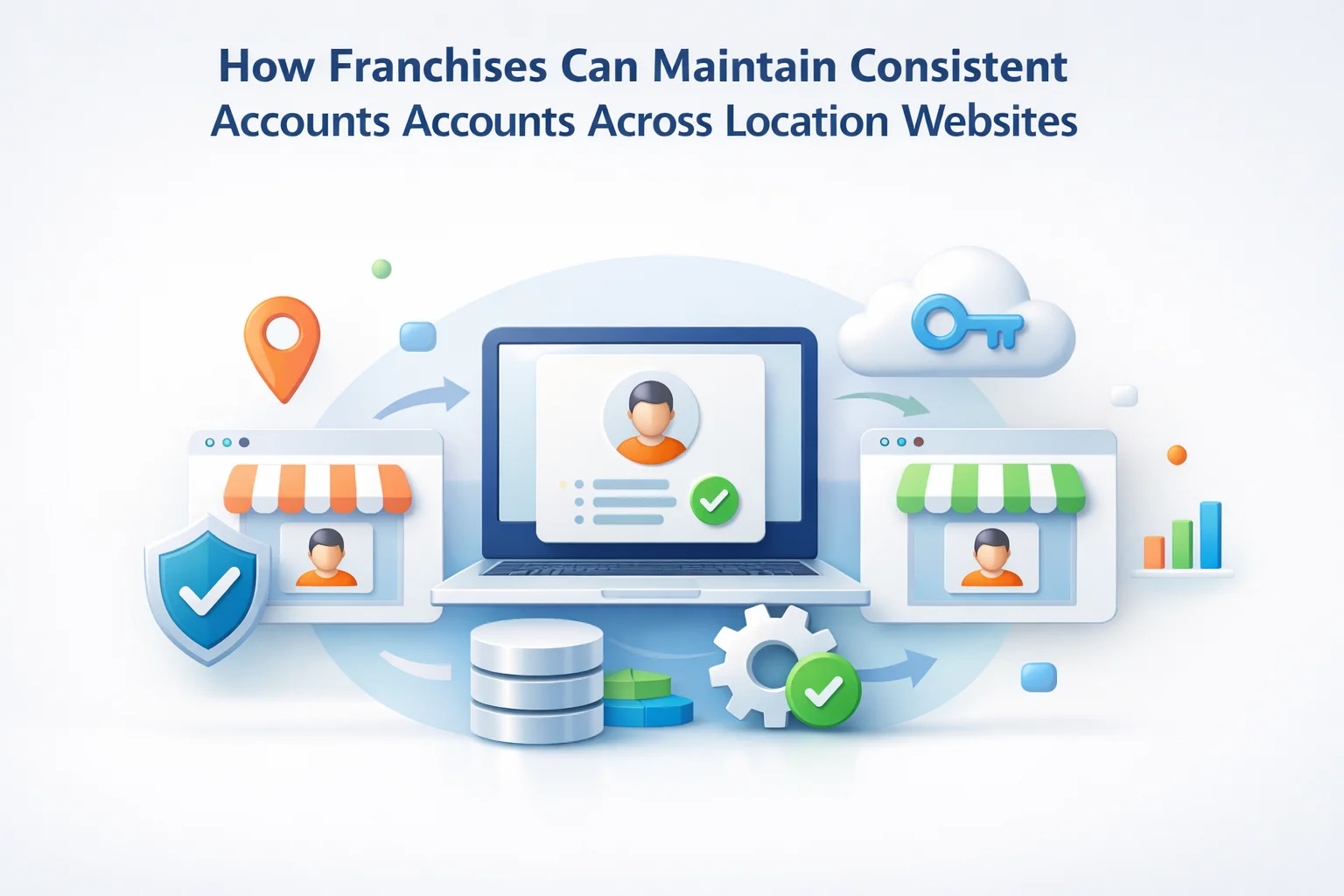
For most franchise networks, the hub-and-spoke model is the right architectural foundation. The franchisor’s central site (or a dedicated identity hub if no central site exists) serves as the master database for customer identity. Each location site connects to this hub as a sub-site. Customer registrations can occur on any site in the network — location or hub — but the hub is the canonical source of truth for the brand-level identity data that must be consistent everywhere.
In Structure 1, the central brand site is the hub. In Structure 2 (no central site), create a dedicated WordPress identity hub — it does not need to be a public-facing website. It can be a private WordPress installation that exists solely to maintain the canonical customer database and manage connections to all location sites. In Structure 3, the franchisor needs a global hub above the regional hubs, with regional hubs connecting both upward to the global hub and outward to their location sites.
Each location site establishes a secure connection to the hub through the sync plugin’s connection wizard. The connection uses unique encrypted keys per location. The hub holds the master-site keys. Each location site holds only the sub-site keys for its connection to the hub. No location site can communicate directly with any other location site — all identity data flows through the hub. This topology ensures that a franchisee cannot accidentally access another franchisee’s local customer data.
Sync direction is one-way from hub to each location for brand-level data. Location sites receive customer identity, but location-specific data stays local. If a customer registers at a location site, their registration event must propagate to the hub first (the hub creates or updates their canonical record) before being distributed to other location sites. This requires configuring location sites to push new registrations to the hub, which the hub then distributes network-wide.
Customers who log in through the hub or any connected location site are authenticated across the entire network via SSO. When a customer visits a new location site — either physically visiting a new franchise location or finding it online — they arrive already authenticated. The location site recognizes them, displays their name, shows their loyalty tier, and allows them to complete transactions without creating a new account. This is the customer experience that delivers on the brand’s consistency promise.
The most consequential configuration decision in a franchise sync setup is determining which customer data is brand-level (shared across all locations) and which is location-level (owned by the individual franchisee and not shared). Getting this taxonomy right is what allows the network to deliver brand consistency without violating franchisee data rights or creating misleading data on individual location sites.
Cross-location loyalty programs are one of the most visible and most valued aspects of a consistent franchise customer experience. A customer who earns points at every location in the network and can redeem them at any location is experiencing exactly what a successful franchise loyalty program should deliver. Achieving this requires a specific sync architecture that most franchise operators do not have in place.
The technical challenge is that WordPress loyalty plugins — like WooCommerce Points and Rewards, YITH WooCommerce Points and Rewards, or custom loyalty implementations — store point balances as user meta on the WordPress installation where they were earned. If each location site runs its own loyalty plugin instance, each location has its own user meta for point balances. These balances are siloed unless explicitly synced. A customer who earns 50 points at Location A has those points in Location A’s database. Location B has no record of them.
Run the loyalty plugin only on the hub site. Location sites do not have independent loyalty systems — when a customer earns points at a location, the location site fires an API call or webhook to the hub, which updates the customer’s point balance there. Redemptions are processed through the hub as well. This is the cleanest architecture for loyalty because there is only one source of truth for point balances.
Each location site maintains its own loyalty plugin instance and earns points locally. The location site’s loyalty point balance meta key is included in the bidirectional sync configuration, so the hub always holds the aggregate point balance visible to all other locations. This approach requires careful conflict resolution logic: if a customer earns points at Location A and Location B within the same sync window, both increments must be added to the canonical balance rather than one overwriting the other.
The difference between a franchise network with SSO and one without it is most visible at the moment a customer first visits a location they have not been to before — either a new branch in their area or a location in a city they are visiting. Without SSO, this first visit to a new location’s website mirrors the friction of encountering any new site: a login form, possibly a registration prompt, and no recognition of their existing relationship with the brand. With SSO, the experience is completely different.
One of the operational advantages of a hub-and-spoke sync architecture is that adding new franchise locations to the network is a repeatable, documented process rather than a bespoke integration project for each location. Once the hub is established and the first location is connected, adding each subsequent location follows the same workflow.
Standard WordPress plugin installation. Configure the plugin settings on the location site before establishing the connection — set it as a sub-site, confirm sync direction, and configure caching exclusions and any WAF exceptions needed for the connection to work on the location’s hosting environment.
From the hub site, use the Connections panel to generate a new location invite. Copy the invite link or key and enter it on the new location site’s connection settings. The handshake establishes the encrypted channel between hub and location. Verify the connection status shows green on the hub’s dashboard before proceeding.
Map the brand customer role from the hub to the appropriate role on the location site. If the location site uses WooCommerce, the mapping is typically hub customer → location customer. Map any loyalty tier roles explicitly. Exclude all administrative roles from sync.
From the hub, trigger a Bulk Push to the new location site. This creates accounts for all existing brand customers on the new location site, so that from the moment the location goes live, every existing customer in the network has an account there and can be recognized immediately. Monitor the push completion before opening the location site to public traffic.
Using a test customer account registered on the hub, navigate to the new location site via SSO. Confirm recognition, correct name display, correct loyalty tier, and correct access to any gated content. Test a registration on the new location site and confirm the account propagates to the hub and from there to all other connected location sites.
Franchise agreements typically define specific rights and obligations around customer data. A sync architecture that gives the franchisor unrestricted access to all franchisee customer data — including location-specific purchase history and local relationship data — may exceed what the franchise agreement authorizes. Conversely, a franchisee who feels that their customer data is being exported to a central hub without appropriate controls may raise concerns even if the contractual basis exists.
The hub-and-spoke sync model can be configured to respect franchisee data autonomy in specific ways. The sync scope is configurable at the individual location connection level — meaning the franchisor can define exactly which fields flow to the hub and which remain on the location site exclusively. This configurability allows the sync architecture to match the data governance terms in the franchise agreement precisely, rather than using a one-size-fits-all configuration that may not reflect the contractual relationship.
The event log in the sync system provides the audit trail for data governance discussions — a record of exactly what data was transmitted to the hub, when, and for which customers. This transparency is valuable when franchise agreements are renewed or renegotiated, and when franchisees have questions about what data the franchisor holds about their local customer base. Nexu User Sync’s franchise-configurable WordPress hub-and-spoke customer identity management provides the per-connection scope control, role mapping, SSO, and audit log that franchise networks need to deliver brand consistency while respecting the operational and contractual independence of individual franchise locations.
Nexu User Sync connects your franchise hub to all location sites with configurable brand-level identity sync, franchisee data isolation, cross-location SSO, and the audit trail your franchise agreements require.



Okay, so I run a few after school tutoring centers and grabbed this hoping it'd finally sync all our student accounts across locations. Seemed like a really helpful, but honestly? It's been more headache than help. yeah, it kind of works if you're some tech whiz who loves digging into settings and fixing glitches between sites. but for someone like me, just trying to track which kid earned what reward where? Forget it. The instructions call it "simple," but nothing's simple when each location's site does its own thing.
Got this for my cousin who runs a few auto shops, and honestly, it's been a really helpful. Before, customers would just give up if their login failed at a different location no complaints, they'd just stop using the online portal altogether. But after setting up that hub and spoke system from this guide? His regulars can finally log in anywhere without getting hit with that "who even are you?" error. no more losing customers to silent frustration
Hey everyone, just wanted to share my experience with this franchise sync guide. As a barista who's worked at a few different locations in the same chain, I've dealt with my fair share of frustrated customers who couldn't access their accounts or rewards when they switched stores. this guide actually explains why that happens and more importantly how to fix it. The part about regional hubs handling customer data for their specific locations really clicked for me. It's not just a tech issue; it's about making sure the brand delivers on what it promises.