
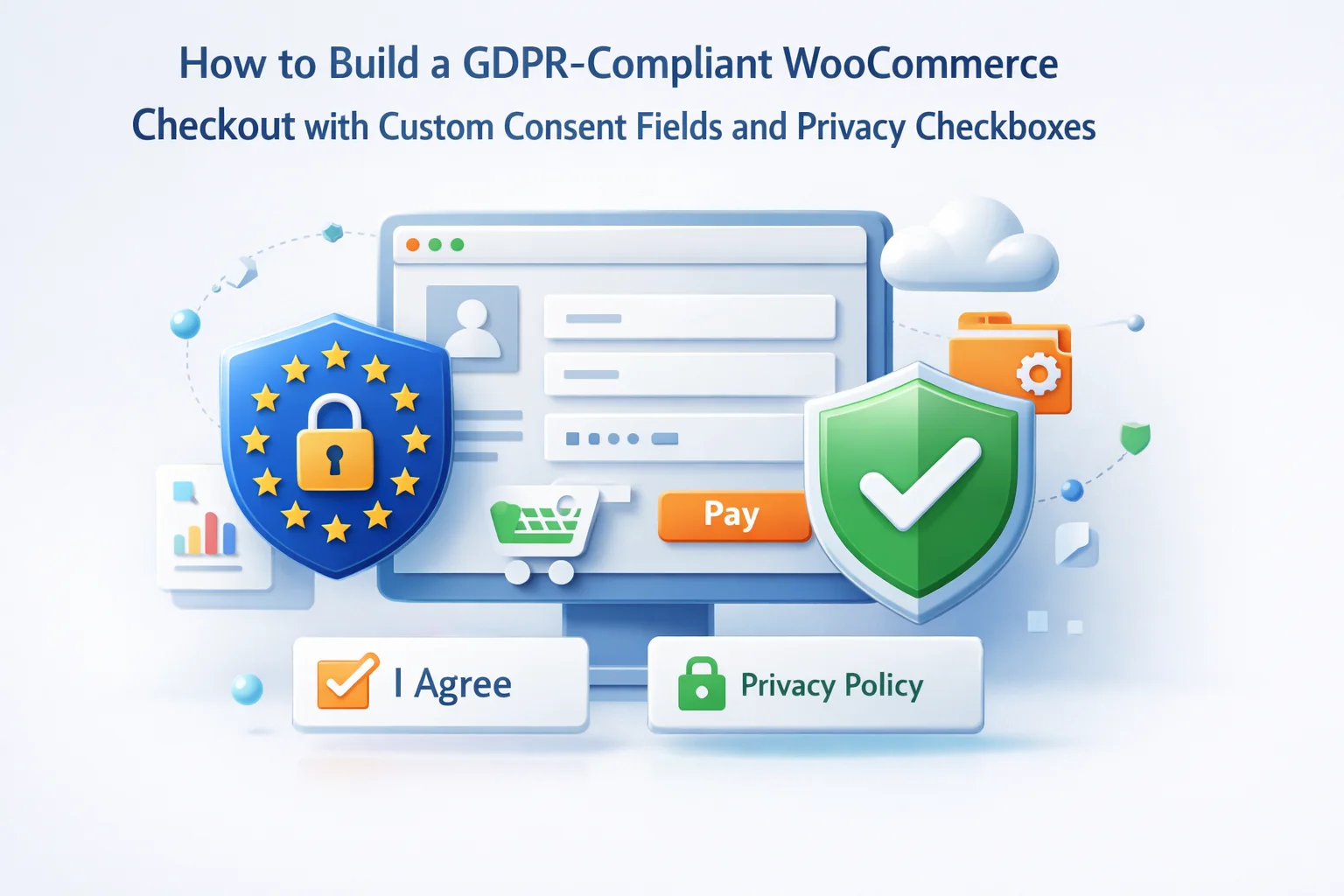
GDPR compliance at the WooCommerce checkout is one of those areas where well-intentioned store owners frequently implement something that looks compliant but is not, and where the gap between appearance and reality carries real legal and financial exposure. The most common version of this gap is a single “I agree to the Privacy Policy” checkbox that the customer must tick to complete their purchase — which satisfies neither the consent requirements of GDPR nor the legitimate interests framework that actually governs most e-commerce order processing.
Genuine GDPR-compliant checkout consent requires understanding what each processing activity actually needs in terms of legal basis, which activities require explicit consent and which do not, how to collect that consent in a way that is specific and granular rather than bundled, and how to create an auditable record that demonstrates compliance if challenged. Getting this wrong — either by over-collecting consent for things that do not require it, or by under-collecting it for things that do — creates both legal risk and a poor customer experience.
This guide covers the compliance architecture of a WooCommerce checkout: what GDPR actually requires at each processing touchpoint, which consent fields you genuinely need, which you do not, how to write checkbox labels that are legally defensible, and how to implement the required fields using the NEXU Advanced Checkout Field Editor for GDPR compliance. Throughout, the focus is on building a checkout that is genuinely compliant — not one that merely looks like it might be.
Important: this guide provides general information about implementing GDPR-related fields at WooCommerce checkout. It is not legal advice. GDPR obligations are specific to your organisation, the data you process, and the jurisdiction in which you operate. For advice on your specific compliance obligations, consult a qualified data protection lawyer or privacy professional.
What GDPR actually requires at checkout — and what it does not
The most important and frequently misunderstood aspect of GDPR at the checkout page is that processing personal data for the purpose of fulfilling a contract — which is exactly what processing a customer’s order is — does not require consent under GDPR. Article 6(1)(b) of the regulation establishes “performance of a contract” as an independent lawful basis for processing. A WooCommerce store processing a customer’s name, email address, billing information, and delivery address to fulfil their order does not need the customer’s explicit consent to do so. The contract itself is the lawful basis.
This is not a technicality or a loophole — it is the fundamental framework the regulation establishes for commercial transactions. A store that requires customers to tick a “I consent to you processing my personal data” checkbox as a condition of completing an order is actually creating a compliance problem rather than solving one. Under GDPR, consent must be freely given. Consent that is a condition of service — where the customer cannot complete a purchase without consenting — is not freely given and therefore does not constitute valid consent under the regulation. Adding a pre-ticked or required consent checkbox to order processing creates the appearance of consent while undermining the legitimacy of it.
Understanding this framework correctly determines which consent fields your checkout genuinely needs. The answer, for most WooCommerce stores, is fewer consent checkboxes than you might think — but the ones you do need are genuinely important and must be implemented correctly. The rest of this guide covers exactly which fields those are and how to implement them in a way that is legally defensible, clear to customers, and auditable.
The consent fields your WooCommerce checkout genuinely needs
Having established what GDPR does and does not require for order processing itself, here is a clear review of the consent and acknowledgment fields that a WooCommerce checkout should include — and why each one is genuinely necessary.
GDPR’s transparency requirements under Articles 13 and 14 require that you inform individuals about how their personal data will be processed before or at the point of collection. At the checkout, this is fulfilled by a checkbox that acknowledges the customer has been informed of and has access to your privacy policy. This is not consent to data processing — it is an acknowledgment that the required information has been provided. The distinction matters: this checkbox can be required (blocking order completion) because it is not consent to processing but rather confirmation that the legally required transparency notice has been presented.
Sending marketing emails, newsletters, and promotional communications requires either explicit consent under GDPR (for new contacts) or a soft opt-in under the UK/EU ePrivacy rules (for existing customers with whom you have a recent transaction relationship and who sell similar products or services). For most WooCommerce stores, the checkout is the appropriate place to offer an opt-in for marketing communications. This checkbox must be: optional (not required to complete purchase), not pre-ticked, specific about what kinds of communications will be sent, and easy to understand. The customer who checks it is actively choosing to receive marketing. The customer who does not check it has simply not opted in — which is a completely valid choice.
Terms and Conditions acknowledgment is a commercial law requirement rather than a GDPR requirement — it is about contract formation, not data protection. The customer needs to acknowledge the terms under which they are purchasing (returns policy, delivery terms, product descriptions, liability limitations) for those terms to be contractually binding. This should be a separate checkbox from the privacy policy acknowledgment — bundling T&C acceptance with privacy policy acknowledgment is a practice GDPR guidance discourages because it conflates consent for different purposes. Keep them as separate, distinct checkboxes with specific language for each.
If your store uses SMS marketing, this requires a separate consent to email marketing consent. SMS is an even more intrusive communications channel than email, and GDPR and ePrivacy rules treat it as such. Customers who have consented to email marketing have not consented to SMS marketing. If you use SMS for promotions or marketing, you need a distinct, clearly labelled checkbox for that specific purpose. Do not combine SMS and email consent in a single checkbox. If you only use SMS for transactional messages (order confirmation, delivery updates), no marketing consent is needed — transactional SMS falls under contract performance.
If your store shares customer data with third-party partners for their own marketing purposes — for example, passing buyer data to an affiliate partner or a brand whose products you sell — this requires explicit, specific consent. The consent must name the specific categories of third parties and be clearly distinct from any other consent you collect. Note that sharing data with processors who act on your behalf (your email marketing platform, your fulfilment house, your payment processor) does not require this consent because those parties process data on your instruction, not for their own purposes.
Checkboxes your checkout does not need — and why adding them creates problems
As important as knowing which consent fields to include is knowing which ones to avoid. Several common checkout consent practices are either legally unnecessary, counterproductive from a compliance perspective, or both.
This is the most common GDPR compliance mistake in WooCommerce checkouts. Processing personal data to fulfil an order is based on contract performance, not consent. Adding a required consent checkbox for this purpose creates invalid consent (because it is coerced — the customer cannot complete the order without consenting) while not actually making the processing more compliant (because contract performance is already sufficient as a legal basis). Worse, collecting invalid consent can be harder to defend in a regulatory review than simply relying on the appropriate lawful basis transparently.
GDPR’s Article 7(2) and Recital 43 specifically require that consent for different purposes be distinguishable and that consent should not be a precondition of a service if it is not necessary for that service. A single checkbox that bundles T&C acceptance, privacy policy acknowledgment, and marketing consent is explicitly problematic under the regulation. Each purpose must have its own checkbox with its own specific label. This is not over-engineering compliance — it is the minimum the regulation requires for consent to be valid.
Pre-ticked consent checkboxes are explicitly invalid under GDPR. Recital 32 states that consent requires a clear affirmative action and that silence, pre-ticked boxes, or inactivity should not constitute consent. A marketing opt-in checkbox that is pre-ticked and requires the customer to actively untick it to opt out does not constitute valid consent regardless of how it is labeled. Marketing consent checkboxes at checkout must always be unchecked by default — the customer must actively tick them to opt in.
Labels like “I agree to receive communications from [Store Name]” or “I consent to my data being used for marketing” are too vague to constitute valid GDPR consent. Consent must be specific about what the individual is consenting to. “Marketing communications” needs to describe what kinds of communications (email, SMS), about what (products, promotions, news), from whom (the store, partner brands), and with what opt-out mechanism. Specific language protects both the customer, who understands what they are agreeing to, and the store, which has a defensible consent record.
Positioning consent fields correctly in the checkout form
Where consent and acknowledgment fields appear in the checkout form affects both their legal standing and the customer experience. The ideal position for all consent-related checkboxes is immediately above the “Place Order” button — in the commitment zone, as discussed in the age verification guide. At this point in the checkout flow, the customer is reviewing their order and making their final decisions. Consent fields placed here are encountered in a moment of active decision-making, not skimmed past while filling in an address.

The recommended order for the consent section of a typical WooCommerce checkout, positioned immediately before the Place Order button, is: (1) Terms and Conditions acknowledgment — required; (2) Privacy Policy acknowledgment — required; (3) Marketing email opt-in — optional, unchecked; (4) SMS marketing opt-in if applicable — optional, unchecked; (5) Third-party sharing consent if applicable — optional, unchecked.
The required fields (T&C and Privacy Policy) should come before the optional marketing fields. This order communicates that the required acknowledgments are part of the contract and the marketing options are genuinely at the customer’s discretion. Customers who want to complete their purchase without any marketing opt-in can see the required checkboxes first, tick them, and proceed without engaging with the optional marketing fields at all.
Step-by-step configuration using the NEXU Checkout Field Editor
Here is the complete configuration sequence for building a GDPR-compliant consent section in your WooCommerce checkout using the NEXU Advanced Checkout Field Editor.
Add a new Checkbox field in the global checkout field builder. Label: “I have read and agree to the [Terms and Conditions], including the delivery and returns policy.” Mark the words “Terms and Conditions” as a hyperlink to your T&C page (this is done in the field label using a link within the label text). Set as required. Assign a field key like terms_acceptance for identification in order records.
Add a second separate Checkbox field. Label: “I have read and understand the [Privacy Policy], which describes how [Store Name] handles my personal data.” The words “Privacy Policy” should link to your privacy policy page. Set as required. Field key: privacy_acknowledgment. This is a separate field from T&C — do not combine them.
Add a third Checkbox field. Label: “Yes, I would like to receive emails about new products, promotions, and offers from [Store Name]. You can unsubscribe at any time.” Set as optional. Confirm the default is unchecked — this is critical. Field key: email_marketing_consent. The value of this field in the order record — checked or unchecked — determines whether this customer has opted in to marketing and should be added to your marketing lists.
Use the drag-and-drop interface to position all consent fields together in the checkout form, immediately before the Place Order button. Required fields first (T&C, then Privacy Policy), optional fields after (marketing consent). The visual grouping reinforces that these are the final decisions the customer makes before completing their purchase. Test the placement by going through the checkout flow as a customer to confirm the fields appear in the correct position relative to the order summary and payment section.
In incognito mode, attempt to place an order without checking the required T&C and Privacy Policy checkboxes — confirm the order is blocked. Confirm the marketing consent checkbox is unchecked by default. Complete a test order with marketing consent checked and one with it unchecked. Verify both orders appear in WooCommerce admin with the correct checkbox values recorded in order metadata. This recorded data is your consent audit trail.
How consent data creates an auditable GDPR compliance record
GDPR’s accountability principle (Article 5(2)) requires that controllers be able to demonstrate compliance — not just claim it. For consent, this means being able to show, for any individual who asks, that you have a record of when their consent was given, what they consented to, and through what mechanism. The checkout field system creates exactly this audit trail automatically.

Every consent checkbox value collected at checkout is stored as order metadata in WooCommerce — permanently linked to the specific order, visible in the order details panel, and timestamped by the order creation date. For each order, the record shows: whether T&C were accepted (yes/acknowledged), whether the Privacy Policy was acknowledged (yes), whether marketing email consent was given (yes or no), and the exact date and time the order was placed.
This gives you the core elements of a consent record that satisfies Article 7(1) of GDPR: you can demonstrate, for any order, that consent was given at a specific date and time. The field label in the order record shows what the customer consented to (because the label text is part of the stored field data). The order timestamp serves as the date of consent. Together, these create a defensible consent audit trail without requiring a separate consent management system.
Under Article 15 of GDPR, individuals can submit Subject Access Requests (SARs) asking what personal data you hold about them, including their consent records. With consent stored as WooCommerce order metadata, responding to a SAR involving a customer’s consent history means pulling the relevant order records and extracting the consent field values. The NEXU Advanced Checkout Field Editor’s per-user filtering capability — allowing you to pull all records for a specific customer — makes this technically straightforward. Document your SAR response procedure as part of your broader GDPR compliance documentation.
Connecting checkout consent to your marketing platform
Collecting marketing consent at checkout is only the first step — you also need a process for translating that consent record into the correct subscriber status in your email marketing platform. This is an operational workflow question as much as a compliance one.
Most WooCommerce email marketing integrations — Mailchimp for WooCommerce, Klaviyo, ActiveCampaign, and similar — can be configured to check the marketing consent checkbox value when syncing customers and only add customers to marketing lists when the checkbox value is “checked.” Review your specific integration’s configuration to ensure it is correctly reading the field value from the order record rather than adding all customers to the marketing list by default.
For customers who do not check the marketing consent box, your integration should not add them to your marketing list. These customers should still receive transactional emails (order confirmation, shipping notification, delivery confirmation) — those are based on contract performance and do not require marketing consent. The key distinction is: transactional = no consent needed; promotional = consent required.
According to the UK ICO’s guidance on consent under GDPR, for consent to be valid it must be specific, informed, unambiguous, and freely given. The checkout field configuration described in this guide satisfies all four requirements: it is specific (each checkbox has a precise description of what is being consented to), informed (it links to the relevant policy documents), unambiguous (checkbox requires an active tick), and freely given (the marketing checkbox is optional and does not affect the ability to complete the purchase).
WooCommerce Blocks compatibility for consent fields
Consent and acknowledgment checkboxes configured in the NEXU Advanced Checkout Field Editor work correctly in both the classic WooCommerce shortcode checkout and the WooCommerce Blocks checkout. Required field validation (preventing order completion when required consent fields are unchecked), default unchecked state, and order metadata saving all function correctly in both checkout environments.

This matters for GDPR compliance specifically because required field validation is a critical component of the consent mechanism. If a required consent checkbox does not actually block order completion in the Blocks checkout environment, the consent is not being genuinely collected — customers can complete purchases without acknowledging the privacy policy or terms. The NEXU Advanced Checkout Field Editor’s Blocks compatibility ensures the required validation functions as intended regardless of which checkout version is active on your store.
Summary: what a GDPR-compliant WooCommerce checkout consent section looks like
A genuinely GDPR-compliant WooCommerce checkout consent section is simpler than most guides suggest and more specific than most implementations achieve. It does not require a wall of text or a dozen checkboxes. It requires the right fields, with the right labels, in the right configuration — each serving a specific and clearly defined compliance purpose.
GDPR compliance at WooCommerce checkout is ultimately about being honest with your customers and with regulators about what you do with their data. A checkout that collects consent correctly — with specific, granular, unambiguous checkboxes for the things that genuinely require consent, and transparent information about the things that do not — achieves compliance through clarity rather than through bureaucratic box-ticking. The result is a checkout that is both legally defensible and communicates trustworthiness to customers who are increasingly attuned to how their data is handled.
The NEXU Advanced Checkout Field Editor for WooCommerce GDPR consent fields gives you the technical implementation layer: checkbox fields with required validation, default unchecked state, drag-and-drop positioning for the commitment zone, and order metadata storage for the consent audit trail. The compliance strategy — deciding which fields you need and how to phrase them for your specific business and legal context — is yours to determine, ideally with input from a qualified data protection professional.
Build a WooCommerce checkout that collects consent correctly — specific, documented, and legally defensible
NEXU Advanced Checkout Field Editor gives you checkbox fields with required validation, default unchecked state, drag-and-drop positioning, and WooCommerce order metadata storage — everything needed to build a GDPR-compliant consent section with a permanent audit trail for every order.



Hey! the checkbox labels guide was super helpful, but I'm still stuck on one thing how do you word a marketing opt in so it's legally solid and actually clear to customers? for example, if I go with "I consent to receiving promotional emails," is that enough, or should I spell out every type of marketing they might get? would love to see how other companies handle this in practice.
Almost missed the opt in checkbox could be a little clearer!
Finally, a guide that explains why that single "I agree" checkbox isn't enough. the breakdown of consent vs
This guide does a solid job breaking down the GDPR checkbox setup for WooCommerce, especially the part about keeping marketing consents separate from required terms. i run a small restaurant supply shop on the side, and the "freely given" consent piece was something I'd been doing wrong just one big checkbox for everything. the step by step for adding granular opt ins (like your example for promo emails) saved me a headache with my EU customers