
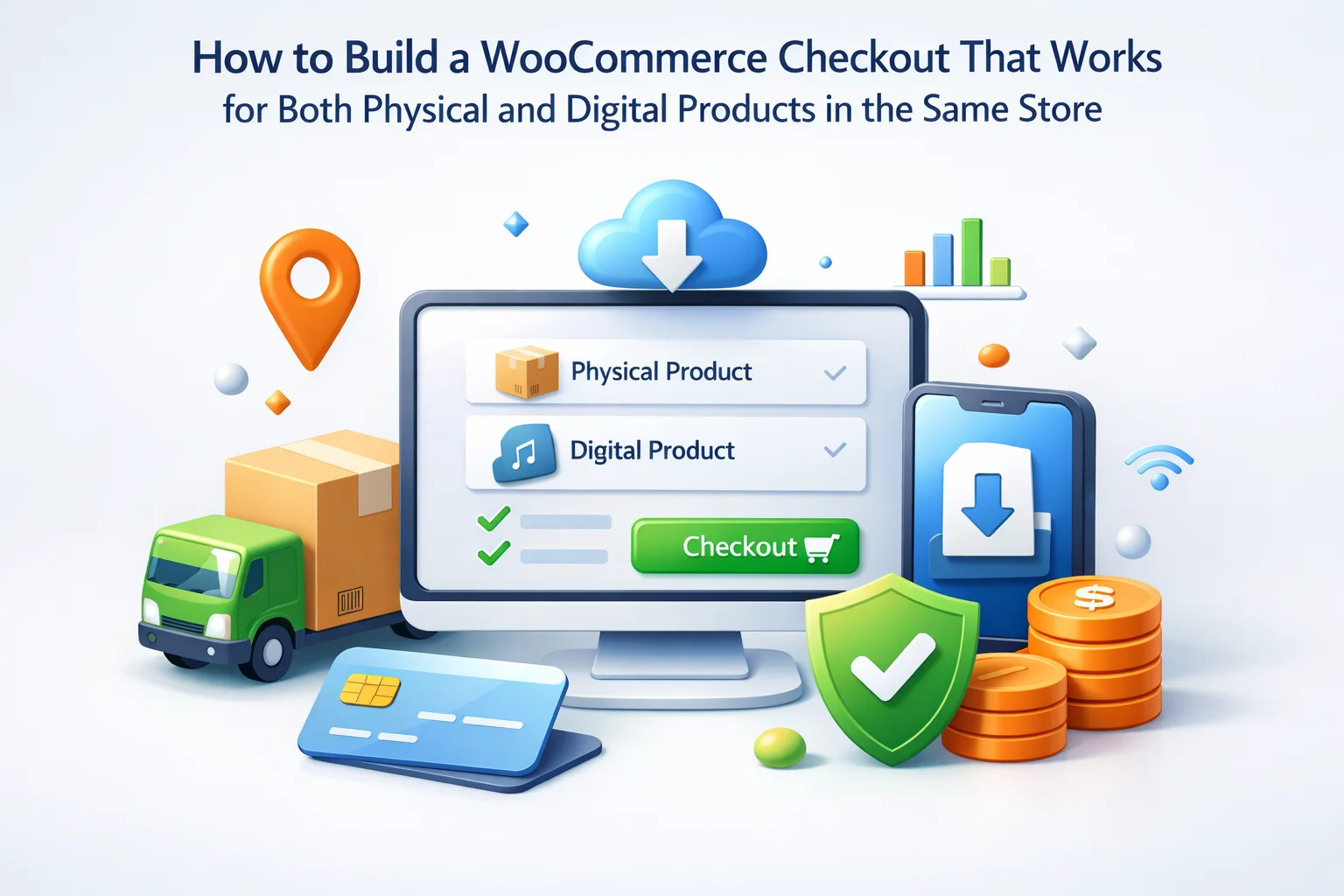
Running a WooCommerce store that sells both physical and digital products in the same catalog is more common than most e-commerce guides acknowledge. A photography business that sells printed wall art alongside downloadable Lightroom presets. A software company that sells plugin licenses alongside physical developer reference books. A musician selling vinyl records and digital album downloads. A skincare brand selling physical products alongside digital skincare consultation guides. In every case, the same checkout page must serve two fundamentally different transaction types — and the default WooCommerce checkout handles neither of them particularly well when they need to coexist.
The core problem is that a checkout optimized for physical products — with shipping address, delivery options, and logistical fields — is cluttered and confusing for a customer buying only a digital product. And a checkout stripped down for digital simplicity — email, name, payment — is completely insufficient for an order that includes something that needs to be physically shipped. A static checkout form cannot be simultaneously right for both.
The solution is a dynamically adaptive checkout — one that evaluates what is actually in the cart and presents exactly the fields that situation requires. Digital-only cart: minimal form, no shipping address, fast completion. Physical-only cart: full shipping fields, delivery options, address collection. Mixed cart: the right combination of both, handled gracefully without asking for anything redundant. This guide explains how to build that system using the NEXU Advanced Checkout Field Editor with conditional logic for mixed WooCommerce stores.
This is not a simple field toggle exercise. Building a checkout that genuinely works for both product types requires thinking through every cart scenario, understanding what each scenario actually needs, and configuring the conditional logic to handle the transitions between them smoothly. This guide walks through all of it.
The four cart scenarios your mixed checkout must handle
Before configuring a single field, it is worth mapping out the complete set of scenarios your checkout needs to handle. A mixed physical-digital WooCommerce store has four distinct cart states, each with different field requirements. Designing the checkout without this map leads to configurations that work for some scenarios and fail for others.
The customer is buying a PDF guide, a plugin license, a software download, an online course, or any other product where delivery is electronic. No physical shipment occurs. No shipping address is needed. No delivery fields are relevant. The checkout should be as minimal as possible: email address (the delivery mechanism), name for the billing record, billing country for tax, and payment. That is it. Showing a shipping address section to this customer creates confusion, friction, and lost trust.
The customer is buying something that ships in a box or envelope. They need to provide a complete billing and shipping address, and they expect to enter this information — it is part of their mental model of buying a physical product online. The checkout should present the full address fields cleanly and may include any additional fields relevant to physical orders: shipping method selection, special delivery instructions, gift wrapping options, or per-product fields like size, color, or personalization details specific to physical items.
This is the most complex scenario and the one that most mixed-store checkouts handle poorly. The customer is buying both a physical product (which needs a shipping address) and a digital product (which does not). The checkout must collect the shipping address for the physical item, while not presenting the address fields as confusingly duplicated or unnecessarily extensive. The digital download will be delivered to the email address provided. The physical item will ship to the address provided. Both can and should be handled in a single clean checkout without duplication or confusion.
WooCommerce redirects customers with an empty cart away from checkout by default. However, this edge case is worth noting because your conditional logic should default gracefully — if no trigger condition is met, the checkout should present the minimal form rather than an illogical combination of fields. Your conditional field configuration should always have sensible fallback behavior for states you did not explicitly design for.
Why WooCommerce’s built-in virtual product handling is not enough
WooCommerce does have some built-in behavior for virtual and downloadable products. When a cart contains only virtual or downloadable products, WooCommerce automatically removes the shipping address section from the checkout — it recognizes that nothing needs to ship and skips that part of the form. This behavior might lead you to think the mixed-store checkout problem is already solved. It is not, for several important reasons.
WooCommerce’s virtual product logic removes the shipping address section but leaves the billing address fields intact — street address, city, state, postcode. For a customer buying a digital product, these fields are just as irrelevant as the shipping address. They create friction, confusion, and a form that is still longer than it needs to be for a pure digital transaction. WooCommerce does not automatically strip billing address fields for virtual-only carts.
Even when the built-in virtual product logic does remove the shipping section, you have no control over the ordering, labeling, or appearance of the remaining fields. Moving the email address to the top (critical for digital product UX), renaming fields to match your brand voice, or adjusting the form layout to feel appropriate for digital purchases requires tools beyond what WooCommerce provides out of the box.
WooCommerce’s built-in virtual product logic handles one thing: showing or hiding the shipping address section. It has no concept of per-product custom fields — fields that appear only when a specific product is in the cart. A digital product that requires a license domain, a physical product that requires personalization text, a bundle that includes both — all of these need product-specific checkout fields that WooCommerce does not provide natively.
When a customer transitions from a digital-only cart to a mixed cart by adding a physical product, the built-in WooCommerce behavior does not communicate this change clearly to the customer. A well-designed mixed checkout should handle this transition gracefully — making it clear why the form just changed. This level of user experience control requires conditional field logic that goes beyond what WooCommerce provides natively.
The checkout field architecture for a mixed store
Building a mixed-store checkout correctly requires thinking in three layers: global fields (always visible), conditionally shown fields (visible based on cart content), and per-product fields (visible only when a specific product is present). Each layer has a distinct role.

The core mechanism: shipping-presence conditional logic
The key to the entire mixed-store checkout system is a single conditional logic trigger: whether the cart contains at least one item that requires shipping. This is the dividing line between a digital-only checkout experience and a physical checkout experience. When this condition is true, address fields appear. When it is false, they stay hidden. The challenge is configuring this trigger correctly so that it evaluates the cart in real time and responds immediately when products are added or removed.

In the NEXU Advanced Checkout Field Editor’s conditional logic system, you configure each address field with the rule: show this field when the cart contains a product that requires shipping (i.e., a non-virtual, non-downloadable product). Apply this rule to billing street address, billing city, billing state, billing postcode, phone number, and the entire shipping address section. Each of these fields becomes invisible for digital-only carts and visible the moment a physical item is added.
From the customer’s perspective, this transition is seamless. A customer browsing your store who adds a digital product sees a clean, minimal checkout. If they then add a physical product, the address fields smoothly appear — expanding the form precisely where needed without disrupting what they have already filled in. If they remove the physical product, the address fields disappear again. The form always reflects the exact fulfillment requirements of the current cart contents.
A critical technical point: when address fields are hidden by conditional logic, their required status must not trigger validation errors. A customer completing a digital-only order should not be blocked by validation on hidden street address fields they were never asked to fill in. The NEXU Advanced Checkout Field Editor handles this correctly — fields that are hidden by conditional logic do not generate required-field validation errors, even when they are configured as required. Always verify this behavior when testing your configuration with a digital-only cart.
Step-by-step configuration for the mixed-store checkout
Here is the complete implementation sequence for building a mixed physical-digital WooCommerce checkout using the NEXU Advanced Checkout Field Editor. This configuration handles all four cart scenarios described earlier.
For the shipping-presence conditional trigger to work correctly, your digital products must be marked as “Virtual” or “Downloadable” in their WooCommerce product settings. Go to each digital product, open Product Data, and check the “Virtual” checkbox (for service-type digital products) or “Downloadable” (for file-based products). This is what WooCommerce uses to determine whether a product requires shipping — and it is the signal that the conditional logic trigger evaluates. Any product not marked as virtual or downloadable will be treated as a physical product.
Open the NEXU Checkout Field Editor, navigate to Billing Fields, and use the drag-and-drop interface to move the email field to the first position — above first name and last name. In a mixed store, email is the delivery address for digital products, and its prominence at the top of the form reinforces this. Customers completing digital-only orders see the email field as the primary input, which matches their mental model of the transaction.
For each of the following fields — billing_address_1, billing_address_2, billing_city, billing_state, billing_postcode, billing_phone — open the field settings and configure the conditional logic rule: show this field when the cart contains at least one item that requires shipping. Apply this rule to each field individually. Also apply it to the entire shipping address section and the “Ship to a different address?” toggle. Save after each field configuration.
For digital products that require product-specific information at checkout — a license domain for a software product, a preferred username for an account-based service, a course intake question for an online learning product — open each product in the product edit screen and add a per-product field in the Checkout Fields tab. These fields appear only when the relevant product is in the cart and are completely invisible otherwise. This keeps your global checkout lean while still capturing what specific products need.
Similarly, for physical products that require personalization — engraving text, custom measurements, print artwork upload, or any information specific to that product — configure per-product fields in the product data panel. These fields appear alongside the address fields when the physical item is in the cart, providing a complete collection of everything needed to fulfill that specific order in one clean checkout flow.
In an incognito browser, test each scenario: (1) digital-only cart — confirm address fields are hidden, form is minimal, order completes; (2) physical-only cart — confirm address fields are visible, required validation works, order completes; (3) mixed cart — confirm address fields appear, both digital and physical items are in the order confirmation; (4) adding and removing physical items — confirm the form transitions correctly in both directions. Test payment completion for each scenario.
Handling the mixed cart customer experience thoughtfully
When a customer has a mixed cart — both physical and digital products — there are a few UX considerations beyond the basic field configuration that significantly improve the experience. The most important is clarity about what happens to the digital item in the order.
Customers who are buying a physical product alongside a digital one sometimes wonder where the digital product goes — they are providing a shipping address, so does the digital thing get shipped too? This confusion is easily resolved with a small addition to your checkout page: a note near the email field stating “Digital products in your order will be delivered to this email address.” This one sentence eliminates the question before it arises and reinforces the purpose of the email field in a mixed-cart context.

You can add this note as a helper text element on the email field itself — the NEXU Checkout Field Editor allows you to set helper text below any field, which is the perfect placement for this clarification. It appears immediately below the email input, in context, exactly where the customer’s attention is focused when they are entering their email address.
The order confirmation email that WooCommerce sends after a successful mixed-cart purchase should also be reviewed for clarity. The standard confirmation includes the billing address and order items — ensure that the email clearly distinguishes between physical items (being shipped to the address) and digital items (accessible via download link or email). WooCommerce handles this automatically for downloadable products by including the download links in the confirmation email, but reviewing the email template to ensure the distinction is clear to customers is worth doing once during your setup process.
Payment gateway considerations for mixed-cart transactions
Mixed-cart orders present a specific consideration for payment gateways: the order total includes both shippable and non-shippable items, and the billing address fields are conditionally shown or hidden based on cart content. Most modern payment gateways handle this without issue, but there are a few scenarios to be aware of.
For digital-only carts where billing address fields are hidden, some payment gateways that perform Address Verification System (AVS) checks may flag transactions as higher risk because no billing address was provided. Stripe and PayPal — the two most widely used gateways for mixed-product WooCommerce stores — both process transactions correctly without address fields, and their fraud detection relies on card tokenization and behavioral signals rather than AVS matching. If you use a gateway that enforces AVS, you may want to retain the billing postcode field (the minimum typically sufficient for AVS) even for digital-only carts, configuring it as always-visible rather than conditional.
According to the Stripe documentation on fraud prevention, the most effective fraud prevention mechanisms for digital product transactions are velocity checks, behavioral analysis, and 3D Secure authentication — not address verification. This means retaining address fields for fraud prevention purposes on digital-only orders is generally less effective than it might appear, and the conversion cost of showing irrelevant fields typically outweighs the marginal fraud prevention benefit.
Tax handling in mixed carts
Tax treatment for mixed physical-digital carts adds a layer of complexity that is worth understanding before you finalize your checkout field configuration. Physical products and digital products are often taxed differently — and in some jurisdictions they fall under completely different tax frameworks.
In the European Union, digital services and digital goods sold to EU consumers are subject to VAT at the buyer’s local country rate — this is the VAT MOSS / OSS framework. Physical goods shipped to EU customers are subject to different rules. When a single order contains both, the correct tax needs to be calculated on each item type separately. WooCommerce handles this tax differentiation automatically when your products are correctly categorized and your tax configuration is set up properly — but it requires that your digital products are configured as virtual or downloadable (which feeds the tax class calculation) and that your store’s tax settings reflect your specific obligations.
The billing country field — which you keep visible for all orders regardless of cart content — is the data point WooCommerce uses for EU digital VAT calculation. This is why it must remain in your global field set even when all other address fields are hidden for digital carts. Country alone is sufficient for digital goods VAT determination; the full address is not required by EU VAT rules for digital services. Consult with a tax professional to verify your specific obligations for the markets you serve.
Real-world mixed store examples and their checkout configurations
Seeing how different mixed-store types apply this framework makes the configuration decisions more concrete. Here are three common mixed-store scenarios and the specific checkout configurations that work best for each.
Global fields: email (first), name, country. Conditional on shippable item: street address, city, state, postcode, phone. Per-product on print products: “Preferred paper finish” dropdown (Glossy / Satin / Matte / Fine Art), “Any cropping preferences” text field (optional). Per-product on preset packs: “Which camera body do you primarily shoot with?” dropdown (optional, for support purposes). The preset buyer sees a 4-field checkout. The print buyer sees a full address checkout with paper finish selection. The customer buying both sees a full address form with the paper finish question appearing for the print item.
Global fields: email (first, with helper text noting it is also used for license delivery), name, country. Conditional on shippable item: full billing address, phone. Per-product on plugin licenses: “Domain name for license activation” text field (optional — many buyers purchase before choosing a domain) with placeholder “e.g. example.com or leave blank.” Per-product on physical books: no additional fields needed beyond address. The software-only buyer gets a clean 4-field checkout. The book buyer gets a full address checkout. The buyer getting both sees the full form with the domain field appearing alongside the book item.
Global fields: email (first, with note “Digital downloads will be sent to this email”), name, country. Conditional on shippable items: full address, phone. Per-product on vinyl records: “Record condition preference” if selling new and used variants, or no additional field if straightforward. Per-product on merchandise: size dropdown where applicable. No per-product fields needed on digital downloads. This configuration gives digital-only buyers a frictionless 4-step checkout while giving vinyl and merch buyers a complete shipping checkout. The mixed buyer — buying both a download and a record in one order — sees the full form with a clear note that their download goes to email while the vinyl ships to their address.
Saving and deploying your mixed-store checkout configuration
Once you have tested and verified your mixed-store checkout configuration across all four cart scenarios, export it using the NEXU Advanced Checkout Field Editor’s JSON export function. This export captures your complete setup — all field configurations, all conditional logic rules, all field ordering and labeling — in a single portable file.

Store this export file alongside your other site configuration backups. Mixed-store checkout configurations are moderately complex — rebuilding from scratch after a data loss or migration issue is time-consuming. Having the export file means your checkout configuration is restorable in seconds regardless of what happens to the live site.
For stores being migrated from staging to production, the export-import workflow is the cleanest deployment path. Build and test on staging, export the verified configuration, import it on production. The checkout field setup arrives on production exactly as it was on staging — no field-by-field re-entry, no risk of inconsistency between environments. This is one of the less-discussed advantages of the NEXU WooCommerce checkout field manager for mixed product stores that makes a meaningful difference in professional deployment workflows.
The mixed-store checkout — a summary of what good looks like
A well-configured mixed physical-digital WooCommerce checkout is invisible to the customer in the best possible sense. They never notice the conditional logic. They never see fields appear that do not apply to them. They never face a confusing form that seems designed for a different kind of purchase than the one they are making. The form is simply always right — minimal for digital purchases, complete for physical ones, and sensibly combined for mixed orders.
Building this system requires thinking through your product catalog clearly, configuring each field layer deliberately, and testing every scenario before going live. It is not the work of five minutes — but it is the work of an afternoon, and the result is a checkout experience that serves every customer in your store correctly for as long as your store operates.
The NEXU Advanced Checkout Field Editor for WooCommerce mixed product catalogs provides every mechanism this architecture requires: drag-and-drop global field management, cart-content conditional logic, per-product field configuration, WooCommerce Blocks compatibility, and JSON import/export for deployment and backup. The decisions about which fields belong in each layer, and what each product in your catalog needs, are yours to make — this guide gives you the complete framework to make them correctly.
One checkout that works perfectly for every product type you sell
NEXU Advanced Checkout Field Editor gives you the conditional logic, per-product fields, and global field control to build a WooCommerce checkout that adapts intelligently to digital-only, physical-only, and mixed-cart transactions — no coding required.



Just had to say this guide has been a total lifesaver for my skincare business. juggling both physical products and digital downloads used to be such a headache especially with customers getting tripped up by all those shipping fields they didn't need. Now everything's finally streamlined, no more confused messages about unnecessary forms, and honestly? Worth every single penny
Finally found a guide that actually nails mixed carts. my shop sells both dev books and plugin licenses, and WooCommerce's default "virtual product" toggle just hides stuff it doesn't actually adjust for different product types. That messes up the whole checkout flow when customers have both in their cart
Does this guide cover how to automatically hide shipping fields when only digital items are in the cart?