
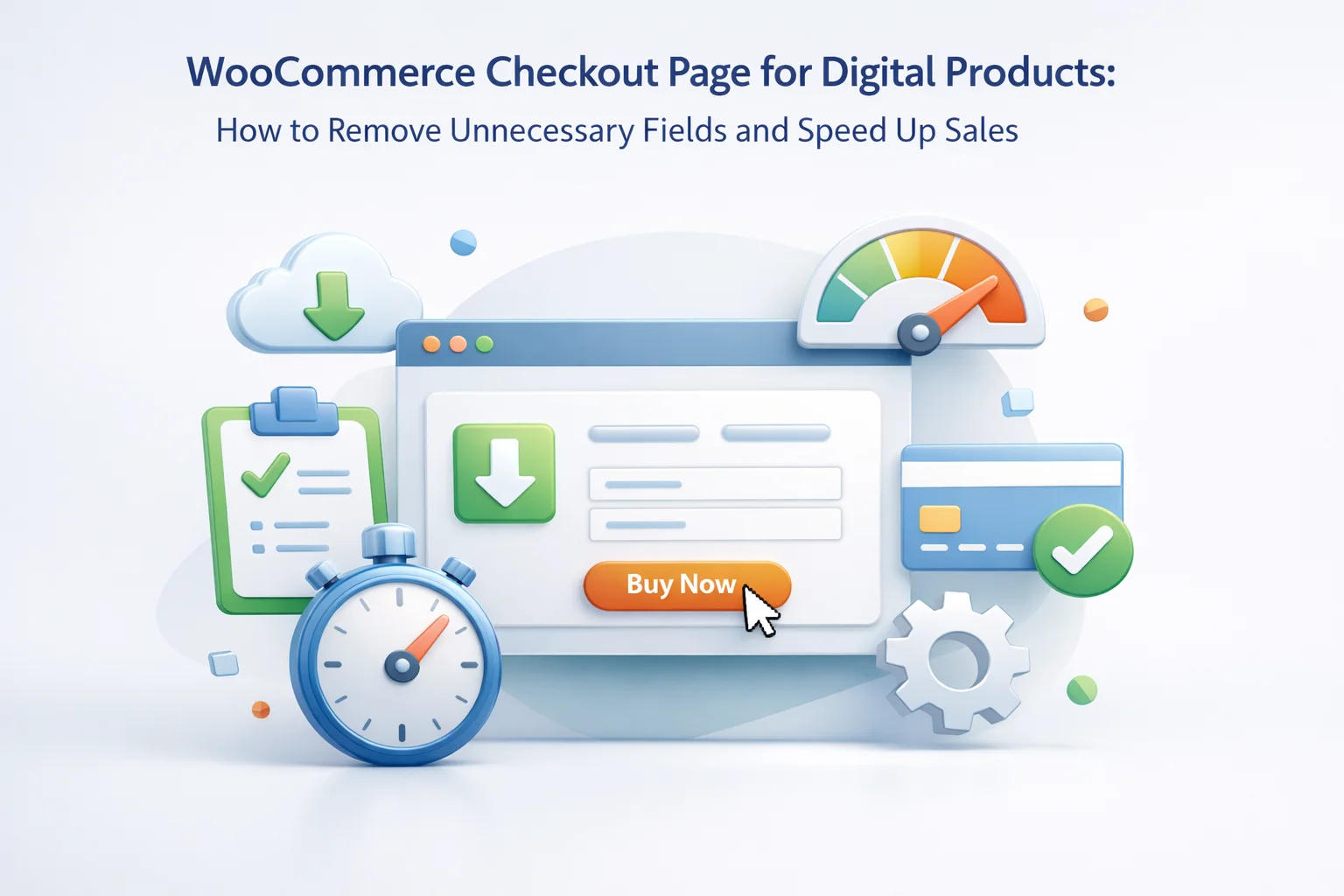
There is a specific kind of frustration that happens when you try to buy a digital product online and the checkout page asks for your shipping address. You pause. You wonder if you misunderstood what you were buying. You fill in the fields anyway because you want the product. Or — and this is what actually happens a significant portion of the time — you leave.
WooCommerce ships with a checkout form designed around the physical retail model. Billing address. Shipping address. Phone number. Company name. The form makes sense if you are shipping a package. It makes almost no sense if you are selling a PDF, a software license, an online course, a music download, or any other product that is delivered electronically the moment payment clears. Asking for a shipping address on a digital product checkout is not just unnecessary — it is actively damaging to your conversion rate, your store’s perceived professionalism, and the customer experience you are delivering.
This guide is specifically about fixing that. We will walk through which fields to remove from a digital product checkout, which fields you genuinely need, how to configure conditional field logic so that your checkout adapts correctly when customers have mixed carts (digital and physical items together), and how to use the NEXU Advanced Checkout Field Editor for WooCommerce digital stores to implement all of this without writing code.
The goal is a checkout page that feels instant, intentional, and trustworthy — because for a digital product, those three qualities directly determine whether the person completes the purchase or walks away.
The hidden cost of a physical-world checkout on a digital store
Checkout abandonment is one of the most studied problems in e-commerce. The Baymard Institute, which has tracked checkout usability data for over a decade, consistently finds that the average documented online cart abandonment rate sits around 70 percent — and among the top reasons users give for abandoning, “too long or complicated checkout process” and “required to create an account or provide unnecessary information” rank near the top every single year.
For digital product stores, this problem is amplified. Physical product buyers have a mental model that includes addresses and shipping — they expect to provide this information. Digital product buyers do not. When a customer decides to purchase a font pack, a Lightroom preset, an e-book, a plugin license, or a course enrollment, their mental model of that transaction is: I provide my email and payment, I get access. Every field beyond email and payment is a surprise, and surprises at checkout create hesitation.
Hesitation at checkout is not neutral. It does not simply slow the purchase down. It triggers a re-evaluation of the decision. The customer who pauses to fill in a shipping address they know is unnecessary starts to wonder: Is this a legitimate business? Is something being collected that should not be? Do I really need this right now? That re-evaluation is a conversion risk that simply does not exist when the checkout is clean and coherent with what the customer is buying.
According to the Baymard Institute’s checkout research, 22% of US adults have abandoned an order in the past quarter solely because the checkout process was “too long or complicated.” For pure digital product stores, that figure is likely higher because the expectation mismatch between what customers expect and what they encounter is greater. Every unnecessary field you remove from your digital product checkout is a direct, measurable improvement in conversion rate.
The same research estimates that the average large-scale e-commerce site can improve its checkout conversion rate by 35.26% through better checkout design alone. For a smaller digital product store where the checkout experience can be perfected and tailored exactly, the potential improvement is significant.
Every default WooCommerce checkout field, reviewed for digital stores
Before configuring anything, it helps to understand exactly what the default WooCommerce checkout form includes and make deliberate decisions about each field. Here is a field-by-field review from the perspective of a digital product store.
These are necessary for the billing record, invoice generation, and personalizing the order confirmation. They are also required by most payment gateways for fraud prevention. Keep both fields. Most customers expect to provide their name when making a purchase regardless of product type.
Unless your digital products are primarily purchased by businesses that need company names on their invoices (B2B software, agency tools, developer resources), the company name field adds friction without adding value for most digital product customers. If your store serves a mix of individual and business buyers, consider making it optional rather than required — or use conditional logic to show it only when a customer selects a “Business” purchase type.
Billing country is needed for tax calculation, VAT compliance in the EU, and payment processing. Keep this field — but consider whether you can set a default that applies to the majority of your customers, reducing the action required from most buyers. In many digital storefronts, pre-selecting the most common country and allowing customers to change it if needed speeds up the experience significantly.
This is the biggest conversion killer on a digital product checkout. A customer buying a plugin or an e-book has no logical reason to provide a street address. Removing these fields for digital-only carts can visually cut the checkout form in half. For stores that also sell physical products, this field needs to appear conditionally — which we will cover in detail later in this guide.
These fields exist to complete a physical mailing address. For digital products, they are unnecessary in their standard form. Note that for EU VAT compliance purposes, collecting the billing country is sufficient — the full postcode and city are not required by VATMOSS rules for digital services. Removing them from digital-only checkouts is safe from a tax compliance standpoint for most jurisdictions, though you should verify this with your accountant for your specific situation.
Phone numbers are used for delivery coordination on physical orders. For digital products, they serve no operational purpose in most cases. Unless you provide phone-based customer support and want the number for service continuity, make this field optional at minimum. Many successful digital product stores remove it entirely and see no meaningful negative impact on order processing or support quality.
Email is the delivery mechanism for most digital products. It is how the customer receives their download link, license key, course access, or account credentials. This field is not just necessary — it is the single most critical field on a digital product checkout. Consider moving it to the top of the form, above the billing name fields, to signal immediately that this is the primary contact point and the address where the product will be sent.
The entire shipping address section — “Ship to a different address?” checkbox and all its associated fields — should be removed from a digital-only store’s checkout. There is no shipping. The presence of this section creates confusion and doubt. For mixed stores, this section should only appear when physical items are in the cart, which requires conditional logic configuration rather than a simple field toggle.
For most digital products, order notes serve no operational purpose. A customer buying a font pack has nothing meaningful to put in an order notes field. However, for some digital product types — custom licenses, commissioned work, course enrollments where intake questions are relevant — a thoughtfully labeled notes field can actually add value. If keeping it, rename it to something specific like “Anything we should know about your order?” and make it clearly optional.
What an optimized digital product checkout should contain
After stripping the checkout down to its genuine requirements for digital products, the resulting form is remarkably lean. Here is what a well-optimized digital product checkout typically looks like — and why each remaining element earns its place.
What you end up with is a checkout form that a customer can complete in under 60 seconds. Email, name, country, payment. That is it. For a customer buying a digital product, this experience feels right — proportionate to what they are purchasing and respectful of their time. It also looks like what they see when buying from established digital platforms they trust, which reinforces confidence in your store.
How to configure a streamlined digital checkout using NEXU Checkout Field Editor
WooCommerce does not make it particularly easy to remove its built-in checkout fields out of the box. The standard settings panel lets you mark address fields as optional but does not give you a clean way to hide them entirely, rearrange the form, or apply cart-based conditional logic. The NEXU Advanced WooCommerce checkout field manager gives you a visual interface to do all of this cleanly, without touching any PHP or template files.

After installing the plugin, navigate to WooCommerce > Checkout Fields (or the equivalent menu location in your setup). You will see all current billing fields listed in a visual drag-and-drop panel. Each field has a toggle switch that controls visibility. Fields that are disabled are hidden from the checkout page — not deleted, just hidden. This means you can re-enable them at any time without losing any configuration.
Toggle off the billing_address_1, billing_address_2, billing_city, billing_state, billing_postcode, and billing_phone fields. Keep billing_first_name, billing_last_name, billing_email, and billing_country active. If you want to keep company name as optional for B2B buyers, leave it enabled but switch its required status from required to optional.
Drag the billing_email field to the first position in the form — before billing_first_name and billing_last_name. For a digital product purchase, the email address is the most important piece of information the customer provides. Leading with it signals the purpose of the form clearly and matches the mental model customers bring to digital transactions. It also means customers who want to quickly check they have typed their email correctly can do so before entering payment details.
In the Shipping Fields section of the editor, disable all shipping address fields. For a purely digital store, this section should be completely invisible. The “Ship to a different address?” checkbox should also be disabled — it triggers the shipping section and creates the exact type of confusion you are trying to eliminate from a digital-only checkout experience.
Save your configuration, open an incognito window, and add a digital product to the cart and go to checkout. Verify that the form shows only your intended fields. Check that the form still submits correctly, that the order confirmation email sends to the right address, and that the downloadable product link or license key is delivered properly. Also verify that the payment gateway accepts the transaction without the address fields — most modern gateways do, but confirming this for your specific gateway configuration is important.
The mixed store challenge: digital and physical products in the same cart
Pure digital stores are the simple case. The real configuration challenge comes when a store sells both digital and physical products — or when a store primarily sells digital items but occasionally bundles them with physical merchandise. In these scenarios, simply removing address fields from the global checkout creates a different problem: orders that include physical items will complete without a shipping address, making them impossible to fulfill.
The solution is cart-based conditional logic. Rather than a static decision — show address fields or hide them — you configure a rule that evaluates the cart content in real time and adjusts the form accordingly: if the cart contains a physical (shippable) product, show the shipping address fields; if the cart contains only digital (non-shippable) products, keep them hidden.

This approach delivers a dramatically better experience for all customer types simultaneously. A customer buying only digital items sees a clean, fast, minimal checkout. A customer who adds a physical product to the same cart sees the shipping address section appear automatically when needed. The transition is seamless — no page reload, no separate checkout experience, just a form that adapts to what is actually in the cart.
In the NEXU Advanced Checkout Field Editor’s conditional logic builder, you create a rule for each address field you want to show conditionally. The trigger condition is: “Cart contains a product that requires shipping” (or the equivalent cart-content trigger available in the interface). The action is: show this field. Set this rule for each of the address fields — street address line 1, line 2, city, state, postcode — and for the shipping address section toggle. Fields without this rule remain hidden for digital-only carts and visible when physical items are present.
It is worth testing this configuration thoroughly with several cart combinations: digital only, physical only, and mixed carts with one or more of each. Confirm that required field validation for address fields only triggers when those fields are visible — a customer completing a digital-only order should not be blocked by validation errors on hidden address fields. The NEXU plugin handles this correctly, but verifying it with your specific setup before going live is good practice.
Adding useful fields specific to your digital products
Stripping the checkout down to its minimum is not the whole story. For many digital product types, there is genuinely useful information worth collecting at checkout — information that improves the delivery experience, reduces support tickets, or helps you personalize access. The key is that these additions should serve the customer and the transaction, not create friction for the sake of data collection.
For courses or membership products where the customer’s experience level affects how you deliver or support the content, a simple optional dropdown field — “How would you describe your current experience level?” with options for Beginner, Intermediate, and Advanced — can be genuinely valuable. It takes five seconds to complete, creates zero friction when optional, and gives you data that helps you provide better onboarding. This is a per-product field configured on your course products specifically, not a global checkout field.
Plugin and software license buyers often want to note the domain or project they are activating the license for. An optional text field labeled “Domain name for license activation (optional)” is a common practice in plugin shops — it helps both the buyer (they have it in the order record) and the seller (you have a reference for license support queries). Keep it optional; many buyers purchase licenses speculatively before knowing the final domain.
If you sell custom digital design — logos, brand kits, templates made to order — a brief “Project Brief” textarea at checkout can replace an entire back-and-forth intake email sequence. Keep it clearly labeled and provide a specific prompt: “Please describe the style, colors, and key message for your design (you will be able to provide more detail via email after purchase).” This frames it as a starting point rather than a complete specification, which sets the right expectation and reduces customer anxiety about providing enough detail.
Business buyers purchasing digital products for company use often need a proper VAT invoice with their company’s billing address and VAT registration number. For these buyers, a conditional group of fields triggered by a “I am purchasing for a business” checkbox — revealing company name, billing address, and VAT number — gives them what they need without forcing individual buyers through the same form. This is the conditional logic approach applied to business invoicing rather than product types.
Payment gateway compatibility: what you need to know before removing address fields
Before removing address fields from your WooCommerce checkout, it is important to understand how your payment gateway uses that data. Different gateways have different requirements, and this is one area where the technical and business considerations intersect in a way that can cause problems if overlooked.
Some payment gateways use Address Verification System checks to validate that the billing address provided matches the address on file with the card issuer. Removing address fields means AVS data is not available, which can in some cases increase the rate of fraud flags or declined transactions, depending on your gateway’s risk model. Stripe and PayPal, which are among the most commonly used gateways for digital product stores, both process transactions successfully without address data — but if you use a gateway that enforces AVS, consult their documentation before removing address fields.
The practical advice here is straightforward: if your payment gateway works correctly after you remove address fields (confirmed through test transactions), you are fine. Most modern gateway integrations for digital products are designed to handle minimal address data. If you encounter higher decline rates after the change, you may need to reinstate the postcode field at minimum — postcode is the most commonly used AVS data point and is often sufficient even for gateways that perform AVS checks.
For most digital product stores, billing country is sufficient for tax calculation — it determines whether EU VAT applies, which VAT rate applies for the customer’s country, and whether US state sales tax rules are triggered. The full street address is not required for standard digital goods tax compliance in most jurisdictions. However, tax law is specific to your situation, and if you operate in a regulated sector or sell to customers in multiple countries with specific digital services tax rules, verify your minimum address data requirements with a qualified tax advisor before removing fields.
WooCommerce Blocks checkout and digital product optimization
WooCommerce has been actively developing its block-based checkout experience, and many stores — particularly newer ones — are using the block checkout rather than the classic shortcode-based version. If your store uses the WooCommerce Blocks checkout, the same principles apply but the implementation details differ slightly.

The NEXU Advanced Checkout Field Editor is built to support both the classic shortcode checkout and the WooCommerce Blocks checkout, so the configuration work you do in the plugin’s admin panel applies to your checkout regardless of which version you are running. This is an important point because one of the friction points in checkout optimization has historically been the compatibility gap between field editor plugins and the newer block-based checkout — a gap that made it impossible to use visual field management tools with the more modern checkout experience.
For stores that have already migrated to WooCommerce Blocks checkout or are planning to, this means you can implement a fully optimized digital product checkout experience — with minimal fields, cart-based conditional logic, and custom per-product fields where needed — without being forced to revert to the classic checkout or manage two separate configurations.
Real impact: what a streamlined digital checkout looks like to buyers
It helps to think through the before and after from the customer’s perspective to understand the full magnitude of the change. A customer arriving at an unoptimized WooCommerce digital product checkout encounters something like this: First name, Last name, Company name (optional), Country, Street address, Apartment/suite (optional), City, State, Postcode, Phone, Email — then a “Ship to a different address?” section with another complete set of address fields — then an order notes textarea.
That is up to 14 visible form elements before payment details. For a digital product worth perhaps $15 to $49, the cognitive overhead of that form is wildly disproportionate to the transaction. It signals that this store was not built with digital products in mind, which erodes confidence in the seller’s professionalism and creates hesitation about whether the product is worth the effort.
After optimization: Email, First name, Last name, Country, Payment details. Five elements. A customer who made the decision to purchase and arrived at checkout with intent can complete this form in under 45 seconds. The form matches the mental model they arrived with. There are no unexpected questions. The path from “I want this” to “I have this” is as short as it can possibly be while still being complete and professional.
A checkout form optimized for digital products does not just convert better — it communicates something important about the seller. It says: we know what we sell, we know what we need from you, and we respect your time. That signal is particularly powerful for digital products sold to professional buyers — designers, developers, business owners — who use dozens of digital tools and have a well-developed sense of what a well-built product looks like. A clean, intentional checkout is part of the product experience, not separate from it.
Deployment and backup: using export to protect your configuration
Once you have configured your optimized digital checkout, export the configuration as a safety measure. The NEXU Advanced Checkout Field Editor’s import/export functionality saves your complete field setup — which fields are active, their order, their settings, and any conditional logic rules — as a JSON file that can be imported onto any site running the same plugin.

For digital product stores making meaningful changes to their checkout, this exported configuration file serves as a rollback option if a plugin update or site change disrupts the checkout setup. Store it alongside your other critical site files — it is a small file but represents the outcome of deliberate optimization work that would take time to recreate from scratch.
For agencies managing multiple digital product client stores, this export becomes a reusable starting template. Build the optimized digital checkout configuration once, save the export, and deploy it to each new client site as the baseline. This is significantly faster than reconfiguring each site from scratch and ensures consistency across projects. The multi-site license option for WooCommerce checkout customization makes this particularly practical for agencies managing several stores under one license.
Summary: the optimized digital product checkout in practice
A well-configured WooCommerce digital product checkout is one of the highest-return improvements a digital store owner can make. The investment is a one-time configuration effort. The return is a permanently better conversion rate on every transaction, a more professional experience for every buyer, and fewer abandoned carts from customers who got partway through an unnecessarily complicated form and gave up.
The checkout experience is the last thing a customer does before becoming a customer. For digital products, it should feel as frictionless as clicking a button — because functionally, that is what the delivery is. The configuration work described in this guide closes the gap between what the default WooCommerce checkout assumes and what a digital product store actually needs.
The NEXU Advanced Checkout Field Editor plugin for digital WooCommerce stores gives you the complete toolkit to make these changes: visual field management, cart-based conditional logic, per-product field configuration, WooCommerce Blocks support, and import/export for easy deployment and backup. The decisions about what to ask and what to remove are yours — this guide gives you the framework to make them well.
Build a checkout that matches what digital buyers actually expect
NEXU Advanced Checkout Field Editor gives you complete control over every WooCommerce checkout field — remove what you do not need, add what you do, and apply cart-based conditional logic that adapts automatically to what your customers are buying.



Finally got around to cleaning up my WooCommerce checkout for digital downloads, and this guide was an absolute lifesaver. that phone number field was the worst customers kept messaging me like, "Uh, why do you need this for an ebook?" Ditched it along with the shipping address section, and honestly, my cart abandonment dropped so much I kinda want to kick past me for not doing this sooner. No more confused emails clogging up my inbox either. just smooth, simple checkouts
Hey, perfect! Exactly what I wanted.
Okay so I bought this guide because I was losing my mind with cart abandonments on my digital downloads. like, why does WooCommerce need my customer's shipping address for an ebook? the guide does a solid job breaking down which fields are actually useless for digital stuff and how to hide them