Next-Level Code. Nexuvibe Style ...
Hrs
Min
Sec

When people hear about connecting multiple WordPress sites, their first thought is often WordPress Multisite. It is the built-in solution, after all. One WordPress installation managing multiple sites from a shared codebase and database. But Multisite comes with constraints that do not fit every situation, and many site owners discover those constraints only after they have committed to the architecture.
The good news is that Multisite is not the only path to a unified WordPress network. You can connect completely independent WordPress installations into a cohesive network with shared user accounts and Single Sign-On. Each site keeps its own database, its own plugins, its own hosting environment. But users move between them seamlessly as if they were one system.
This approach offers flexibility that Multisite cannot match. Different sites can run different WordPress versions, different plugin sets, even different hosting providers. You get the unified user experience without the architectural constraints. This guide explains when this approach makes sense, how it works technically, and exactly how to set it up.
WordPress Multisite is a powerful feature that lets one WordPress installation host multiple sites. The sites share the same WordPress core, the same plugin files, and operate from the same database. This tight integration has benefits, but also creates constraints that become painful at scale or in certain use cases.
In Multisite, all sites share the same plugin installation. If Site A needs a plugin that conflicts with Site B’s plugin, you have a problem. You cannot run different versions of the same plugin. Network-activated plugins apply to all sites whether individual sites want them or not. This shared environment limits flexibility significantly.
Multisite means one database, one server, one WordPress core. If something breaks at the core level, every site goes down simultaneously. A corrupted database affects all sites. A server outage takes the entire network offline. You cannot isolate failure to a single property.
Every site in a Multisite network runs the same WordPress version. You cannot update one site independently to test compatibility before rolling out network-wide. If Site A’s critical plugin is not compatible with the latest WordPress, Site B cannot update either. Version management becomes an all-or-nothing proposition.
Multisite requires all sites to exist on the same server or hosting environment. You cannot have Site A on premium managed hosting while Site B runs on a budget VPS. Geographic distribution for performance is complicated. You lose the flexibility to optimize hosting for each site’s specific needs.
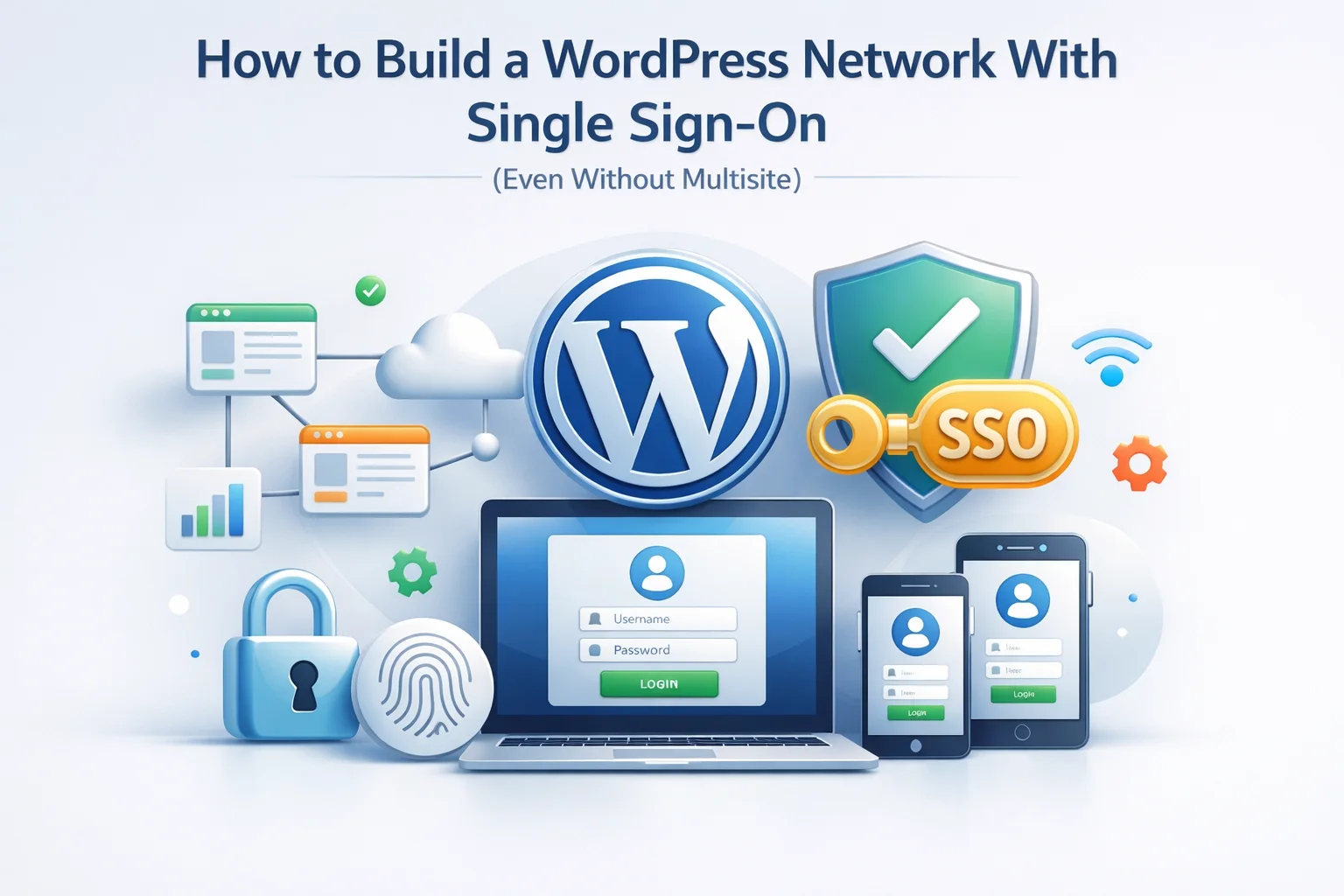
A network of independent WordPress installations connected through SSO and user synchronization offers a fundamentally different architecture. Each site is a complete, standalone WordPress installation. They are connected through a secure API layer that handles authentication and user data, but remain operationally independent.
Each site runs its own plugins. Site A can use WooCommerce while Site B runs LearnDash. Different versions of the same plugin can coexist across sites. There are no conflicts because each installation is isolated. You install exactly what each site needs.
If Site A experiences a database problem or gets hacked, Site B continues operating normally. Each site is independently resilient. You can take one site offline for maintenance without affecting others. Problems stay contained to the site where they occur.
Update WordPress on Site A first to test everything works. Roll out to Site B a week later. Different sites can run different WordPress versions based on their specific compatibility requirements. You control the update schedule for each site independently.
Host each site wherever it makes sense. Put your main store on premium WooCommerce hosting. Run your documentation site on a lightweight static-friendly host. Place regional sites on servers geographically close to their audience. Optimize each site’s infrastructure independently.
An independent site network still needs a coordination model. The master-sub architecture provides this structure. One site serves as the master, acting as the central authority for user identity. Other sites connect as sub sites, trusting the master for authentication and receiving user data from it.
The master site typically is your primary web property, the site with the largest user base or the site that serves as your main brand presence. When a user registers on any site in the network, the registration ultimately syncs to the master, which then propagates the new user to all other sub sites.
This model creates a single source of truth for user identity while still allowing each site to operate independently. The sites are connected through a secure API layer that handles user synchronization and SSO, but each site maintains its own database, runs its own plugins, and operates on its own hosting infrastructure.
Building a WordPress network from independent sites requires establishing secure connections between them and configuring how user data and authentication flow through the network. Here is the step-by-step process.
Every site that will participate in the network needs the synchronization plugin installed and activated. This establishes the API endpoints and sync infrastructure on each site. Start with your intended master site, then proceed to each sub site.
On your primary site, set the site role to Master. This tells the plugin that this site will be the central hub for the network. The master site will generate connection invites for sub sites and serve as the authentication authority for SSO.
From your master site, generate an invite for each sub site you want to connect. Each invite contains secure credentials that authorize the connection. Copy each invite carefully as you will need to paste it on the corresponding sub site.
On each sub site, set the role to Sub and paste the invite from your master. The plugin will validate the connection and establish the encrypted communication channel. Repeat for each site you want in the network.
With connections established, enable Single Sign-On on both the master and all sub sites. This activates the token-based authentication that allows users to move between sites without logging in repeatedly.
Once sites are connected, configuring SSO determines how authentication flows between them. A properly configured WordPress SSO network offers multiple options for how users experience cross-site authentication.
Central login mode redirects all authentication to your master site. When a user clicks login on any sub site, they are sent to the master site’s login page. After successful authentication, they return to the sub site already logged in. This centralizes your authentication experience and ensures consistent branding on the login page.
Silent SSO checks authentication in the background without visible redirects. When an unauthenticated user arrives at a sub site, the system quietly checks if they have an active session on the master. If they do, a local session is created automatically. The user sees no login process because they are already authenticated from their previous activity on the master.
For SSO to work, users must exist on all sites they might visit. User synchronization handles this automatically. When a user registers on any site in the network, their account is created on all connected sites. Profile updates, password changes, and other modifications sync in real time.
You control exactly what data synchronizes. Core identity fields like email and password always sync to enable authentication. Additional profile fields, custom meta, and WooCommerce customer data can be configured based on your needs. Role mapping ensures users have appropriate permissions on each site even when role structures differ.
With multiple independent sites connected, monitoring becomes important. You need visibility into whether connections are healthy, sync is working correctly, and authentication is flowing properly across the network.
Detailed logs track individual sync events and authentication flows. If a user reports an issue, you can trace exactly what happened, when it happened, and identify where the problem occurred. This troubleshooting capability is essential for maintaining a reliable multi-site network.
Both approaches have valid use cases. The right choice depends on your specific situation and priorities.
Choose Multisite when your sites are closely related, share most plugins and themes, can live on the same server, and you want the simplest possible setup with built-in WordPress functionality.
Choose independent sites with SSO when you need plugin flexibility, want failure isolation, require different hosting for different sites, or are connecting sites that already exist independently. The right WordPress network SSO solution makes independent sites behave like a unified network while preserving all the operational benefits of separation.
Nexu User Sync connects independent WordPress installations with full SSO and user synchronization. Keep your operational flexibility while delivering unified user experience.



Just wrapped up setting up SSO across three different WordPress sites using this guide, and man what a really helpful to skip Multisite's rigid setup. My main site's running WooCommerce with a bunch of custom plugins, while the other two are just straightforward blogs. if I'd gone with Multisite, I'd have been stuck standardizing everything or dealing with constant conflicts
Got this for the price, but the setup is way more rigid than expected
Oh man, this is exactly what I needed no more fighting with Multisite's clunky setup! Huge time saver