Next-Level Code. Nexuvibe Style ...
Hrs
Min
Sec

The internet trained users to expect seamless authentication. When someone logs into Gmail, they are instantly logged into YouTube, Google Drive, and Google Maps. When they authenticate with their Apple ID, every Apple service recognizes them immediately. This is the experience people now consider normal, and anything less feels broken and outdated.
Yet most WordPress site owners running multiple properties still force users through separate login processes for each domain. A customer buys a product on your main store, then visits your knowledge base and encounters a login wall. They click to your community forum and face another registration form. Each friction point loses you engagement, creates support tickets, and damages the perception that your brand operates as a unified professional entity.
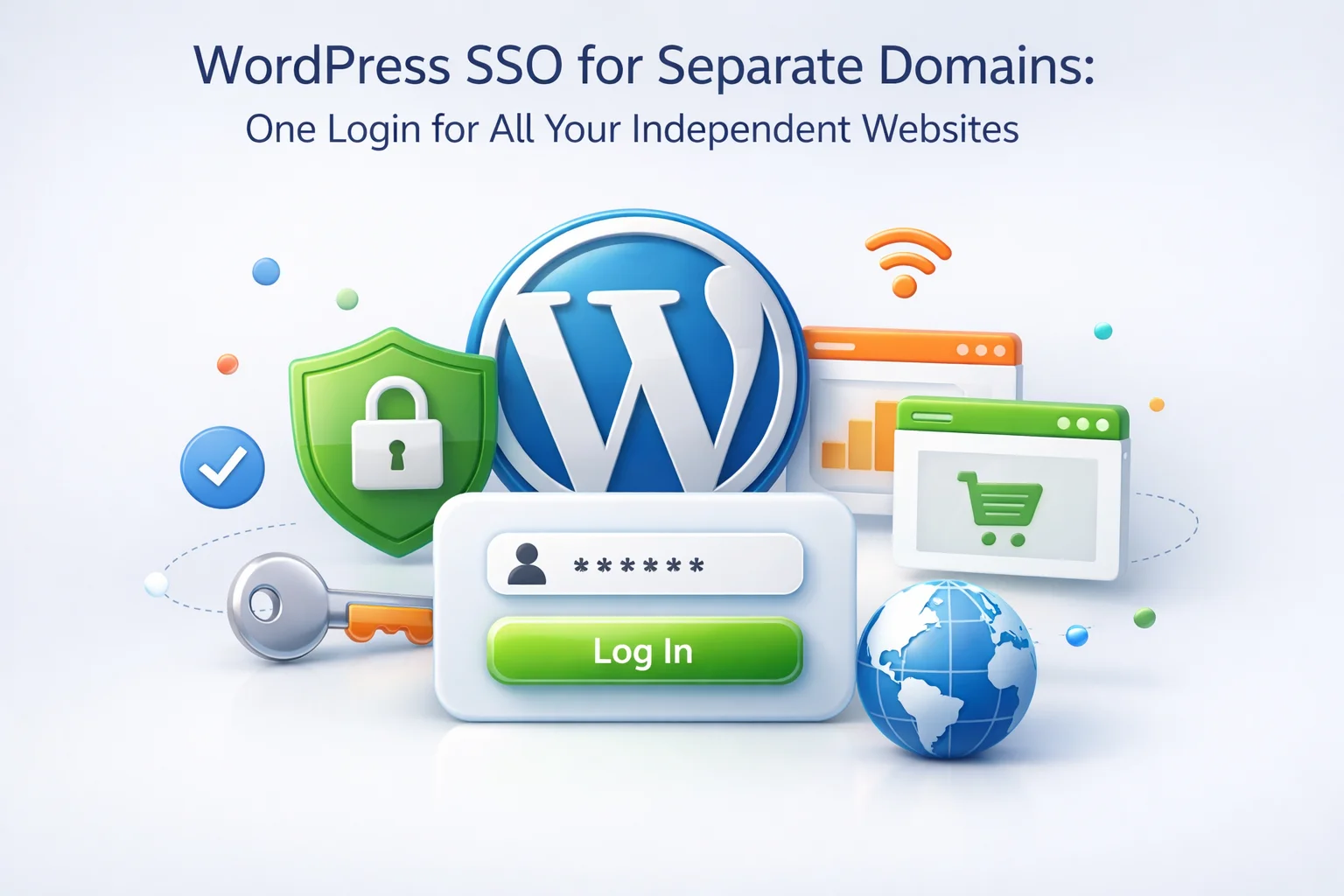
Single Sign-On for WordPress solves this problem completely. A user authenticates once on any site in your network and gains instant access to all connected properties. No additional logins. No password confusion. No duplicate account management. Just the smooth, unified experience that modern users expect from any serious online platform.
This guide explains how cross-domain SSO works at a technical level, why traditional WordPress setups cannot achieve it without specific tooling, and exactly how to implement unified authentication across your independent WordPress installations.
Understanding why SSO across separate domains is difficult requires a quick look at how web authentication normally works. When you log into a WordPress site, the server sets a cookie in your browser containing your session identifier. On subsequent requests, your browser sends this cookie back, and WordPress recognizes you as logged in.
The problem is that cookies are domain-scoped. A cookie set by shop.example.com cannot be read by support.example.com. They are different domains, and browsers enforce strict isolation between them for security reasons. This is a fundamental web security feature called the Same-Origin Policy, and it prevents one website from accessing another website’s authentication data.
Browsers intentionally prevent cookies from being shared across different domains. This stops malicious websites from stealing your login sessions on other sites. The protection is essential, but it means that traditional WordPress authentication cannot work across domains without additional infrastructure.
Subdomains of the same root domain can share cookies if configured correctly. A cookie set with domain=.example.com can be read by shop.example.com and support.example.com. But completely separate domains like brandone.com and brandtwo.com cannot share cookies at all. True cross-domain SSO requires a different approach.
SSO systems work around cookie limitations by using short-lived authentication tokens passed through URL parameters or secure API calls. When you visit Site B after logging into Site A, Site B asks Site A to verify your identity through a backchannel, then creates its own local session for you. The token proves you already authenticated elsewhere.
A properly implemented WordPress Single Sign-On solution handles the complex token exchange process invisibly. From the user’s perspective, they simply log in once and access everything. Behind the scenes, a sophisticated authentication flow makes this possible.
The process begins when a user visits a site where they are not currently logged in. The SSO system detects this and checks whether the user might be authenticated on the master site. If the user has an active session on the master, a secure token is generated and passed to the requesting site. The requesting site validates this token, confirms the user’s identity, and creates a local session.
There are two primary approaches to implementing this flow. Silent SSO attempts to authenticate the user in the background without any visible redirect. The user lands on Site B, a hidden check runs against Site A, and if authenticated, the session is established seamlessly. Central login redirect takes a more explicit approach: when an unauthenticated user visits Site B, they are redirected to Site A’s login page. After successful authentication on Site A, they are returned to Site B already logged in.
Implementing SSO across your WordPress sites requires establishing a master-sub relationship and configuring the authentication flow between them. The master site serves as the central authority for user identity. Sub sites trust the master to verify user authentication and create local sessions based on that verification.
Choose which WordPress installation will serve as the authentication authority. This is typically your primary website with the largest user base or your main brand domain. All other sites will defer to this master for SSO authentication decisions.
Each sub site needs a secure connection to the master. This is established using encrypted API keys that allow the sites to communicate. The connection enables both user data synchronization and SSO token validation.
After connections are established, enable SSO functionality on both the master and all sub sites. The master needs to know it should generate tokens for authenticated users. Sub sites need to know they should check for tokens and validate them against the master.
Decide whether sub sites should redirect unauthenticated users to the master for login, or whether they should maintain their own login forms that communicate with the master in the background. Both approaches have valid use cases depending on your user experience goals.
SSO alone is not enough. For a user to log in on Site B using credentials from Site A, that user must exist on both sites. This is where user synchronization becomes essential. A complete WordPress SSO and user sync system handles both aspects together.
When a user registers on the master site, their account is automatically created on all connected sub sites. When they update their profile or change their password on any site, that change propagates across the entire network. This ensures that when the SSO system validates a user, that user’s account exists and is current on the site they are trying to access.
The synchronization also handles role mapping, translating user permissions appropriately between sites with different role structures. An administrator on your main site might become an editor on your support site. A customer on your store becomes a subscriber on your blog. Smart role mapping ensures users have appropriate access everywhere without requiring manual permission assignment.
The impact of proper SSO implementation extends far beyond technical convenience. It fundamentally changes how users perceive and interact with your brand ecosystem. Consider the difference in these two scenarios.
A customer purchases a product on your store. They have questions and visit your support portal. Login required. They create another account with the same email but a different password. Later they visit your community forum. Another login wall. Another account. Three passwords to remember. Three profiles to maintain. Every touchpoint feels disconnected. The friction accumulates into frustration and eventually disengagement.
The same customer logs in once on your store. They click to your support portal and are instantly recognized. They browse to your community forum, already logged in. One account. One password. One profile that stays consistent everywhere. Your ecosystem feels like a single professional platform. The customer engages more because every interaction is frictionless.
This difference in experience translates directly into business metrics. Lower bounce rates when users move between properties. Fewer support tickets about login problems. Higher engagement across your network because users can access everything without barriers. The technical investment in SSO pays dividends in user satisfaction and retention.
Once SSO is running, you need visibility into how it is performing. Authentication failures, token validation issues, and connection problems between sites should be immediately visible so you can address them before users are impacted.
Detailed logs capture every SSO event: successful authentications, failed token validations, session creations, and any errors that occur during the process. This audit trail is valuable for troubleshooting when a user reports they cannot access a particular site, and it provides security visibility into authentication patterns across your network.
Single Sign-On transforms a collection of separate WordPress sites into a unified platform that users can navigate seamlessly. The technical implementation involves token-based authentication, secure cross-domain communication, and synchronized user databases. But the result is simple: one login, everywhere.
The right WordPress SSO plugin makes this implementation straightforward. You configure your master site, connect your sub sites, enable SSO, and your users immediately benefit from unified authentication. The complex token exchange, session management, and security considerations are handled by the plugin infrastructure.
Your users already expect this experience from major platforms. Now you can deliver the same seamless authentication across your WordPress properties, regardless of whether they are on subdomains or completely separate domains.
Nexu User Sync delivers complete SSO functionality with secure token authentication, real-time user synchronization, role mapping, and comprehensive network monitoring.



Hey, this actually works like Google's login color me surprised!
As a content creator managing multiple WordPress sites, I've always hated how users had to log in separately for each domain it just feels outdated compared to how Google or Apple handles authentication. This plugin finally bridges that gap
The setup works, but I'm still running into issues with cookies not carrying over between my main site and subdomains. Even after following the guide, users have to log in twice once for the shop and again for support. The instructions mention cookie scope, but it's not as straightforward as it sounds
The security docs mention token validation, but the actual implementation leaves gaps. default JWT tokens here use weak signing keys out of the box, and there's no clear guidance on rotating them without breaking existing sessions. for a plugin handling auth across domains, I'd expect stronger defaults like enforced key rotation policies or warnings about HS256 vulnerabilities