
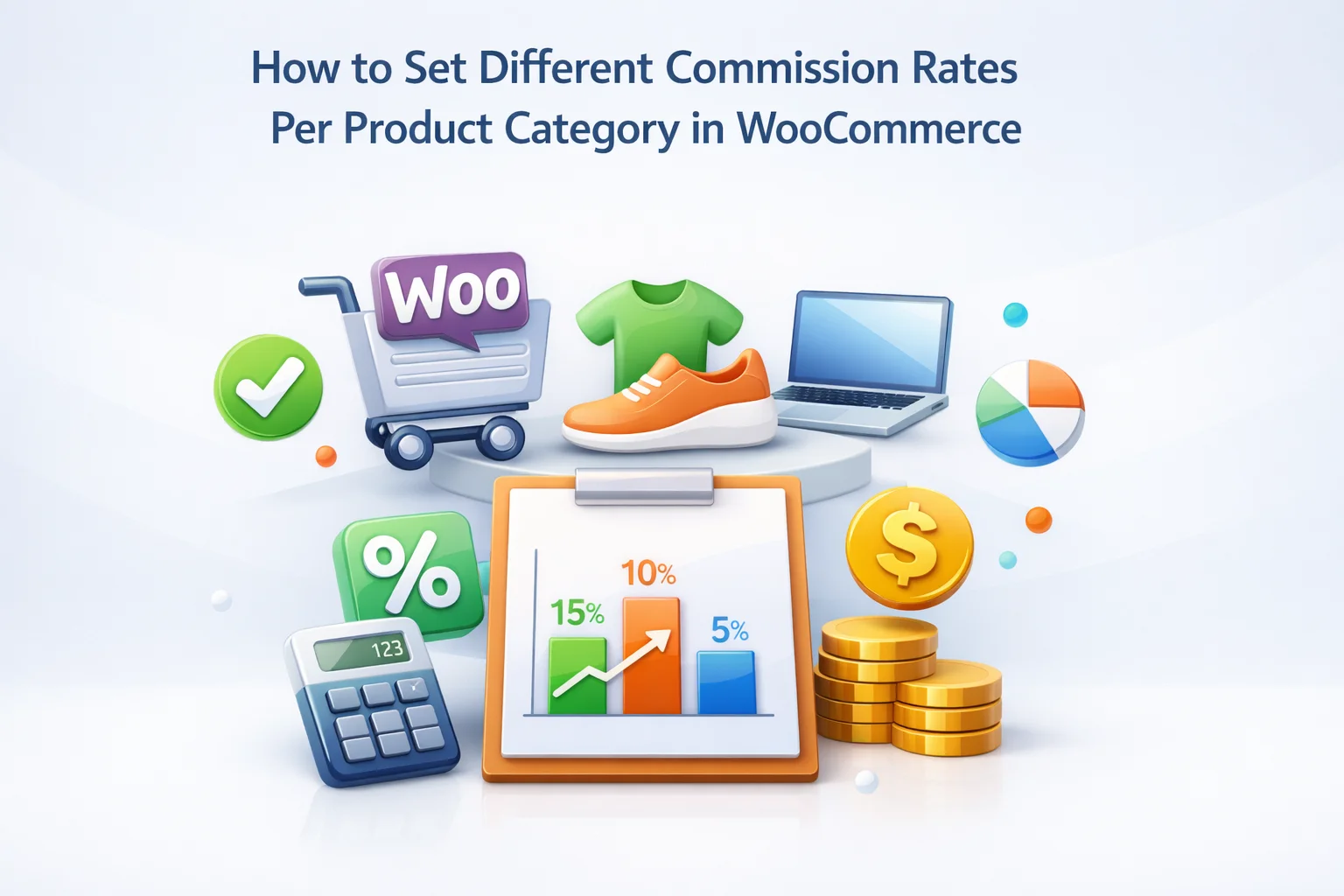
WooCommerce gives you product categories as the primary way buyers browse your catalogue. For operators, those same categories are often the cleanest slice of the business to reason about: accessories behave differently than consumables, digital goods carry different cost structures than freight-heavy furniture, and clearance inventory should not automatically pay the same referral economics as full-margin hero products. When your affiliate program ignores that structure, you either over-incentivise low-margin lines or under-incentivise the categories where partners could actually help you grow.
The practical fix is not to negotiate custom deals in email for every affiliate on every product. The fix is to encode category economics once in the system, then let product-level exceptions handle the rare outliers. Native WooCommerce does not ship a full affiliate commission engine, so store owners typically pair WooCommerce with a referral plugin that understands overrides, priority order, and line-item calculations. Affiliate Engine, the WooCommerce referral and affiliate marketing plugin with flexible commission rules, adds category-level controls directly on the product category screens, alongside product-level overrides and configurable commission priority.
This guide walks through why category rates matter, where to configure them in WordPress, how priority interacts with product rules and global defaults, and how to test mixed carts so you never discover a surprise payout on launch day. For foundational context on how WooCommerce organises categories in the catalogue, see the official WooCommerce documentation on product categories and tags.
Why flat commissions break when categories carry different economics
Imagine two affiliates sending the same traffic quality to your store. One promotes a line where your net margin after fulfilment is thin. The other promotes a category where your contribution margin is healthy and repeat purchase rates are strong. If both earn an identical percentage of order value, the first relationship quietly drains profit while the second barely feels rewarded for bringing customers into your best segment. That imbalance shows up in finance reviews, not in your affiliate leaderboard, because dashboards rank gross sales rather than contribution.
Category-based commission rates are the standard retail answer to that problem. Buyers already think in categories. Your buying team already plans in categories. Affiliates who specialise in beauty, home improvement, or electronics already speak in categories. Aligning payouts with category economics makes your program easier to explain internally and easier to defend when someone asks why two products pay different referral fees. The explanation becomes a business rule everyone recognises: “We pay more where we earn more, and we protect margin on constrained lines.”
Higher commissions on high-margin categories attract partners who can narrate value. Lower commissions on constrained categories keep referrals from turning into a silent discount channel that erodes net income.
When categories pay differently, affiliates self-select into the parts of your catalogue they can promote authentically. That reduces refund rates from mismatched expectations and improves content quality.
Without category rules, operators negotiate one-off percentages in email and hope admins remember to adjust them. System rules scale; private deals do not.
Start from category defaults that reflect margin bands, then reserve product-level overrides for hero SKUs, bundles with unusual cost allocation, or contractual obligations. Your future self will thank you when the catalogue grows and you are not maintaining hundreds of product-specific rates.
What WooCommerce categories control in an affiliate context
WooCommerce categories are taxonomy terms attached to products. They power navigation menus, layered navigation widgets, and many SEO architectures. They do not, by themselves, calculate affiliate payouts. What they provide is a stable grouping layer that mirrors how you merchandise the store. A referral plugin that respects category overrides reads those same assignments when an order line item is priced and converts your policy into a per-line commission calculation.
The operational detail that trips people up is multi-category products. Real catalogues rarely assign exactly one category per SKU. A running shoe might live in “Footwear”, “Running”, and a seasonal “New Arrivals” collection. When multiple categories carry different commission modes, your plugin needs a deterministic rule for how those signals combine. In Affiliate Engine’s commission service, category evaluation inspects all assigned category terms. If any applicable category disables commission for that product’s categories, the category path resolves to disabled. Among override categories, the engine selects the strongest favourable override using type and value comparisons so you get consistent behaviour rather than silent ambiguity.
| Category assignment | What to verify | Why it matters for payouts |
|---|---|---|
| Primary merchandising category | Matches how buyers think about the item | Affiliates link to URLs that often emphasise this path |
| Secondary or seasonal categories | Not accidentally set to “disable” commission | A clearance bucket with commission disabled can zero out mixed assignments |
| New categories after migrations | Rules copied or intentionally left on global defaults | Imports often break category IDs while leaving products assigned |
Where to configure category commissions in WordPress
Affiliate Engine surfaces category commission fields on the standard WooCommerce product category add and edit screens. The interface uses three commission modes: follow global rules (tiers, roles, and store default), override with a category-specific percent or fixed amount per item quantity, or disable commission for products in that category unless a higher-priority product-level rule applies. The commission type selector offers percent or fixed, and the value field accepts decimals for precise percentages or currency amounts.
The plugin’s commission settings screen also explains that product and category settings are edited in context: Products → Edit product → Affiliate tab for SKU-level exceptions, and Products → Categories → Edit category for aisle-level policy. That separation keeps routine merchandising work inside familiar WordPress flows rather than forcing operators into a single monolithic form. If you are comparing solutions, look for that pattern: Affiliate Engine for WooCommerce with per-category and per-product commission overrides documents the behaviour in-product and keeps priority order visible in settings rather than hidden in code.

Choose the category that represents the economics you want to adjust. If you are restructuring the tree, fix merchandising first so affiliates see stable URLs.
Pick global default, override, or disabled. Overrides expose type and value fields; disabled stops category-driven payouts for assigned products subject to priority.
Place a controlled order that includes SKUs from the category. Confirm line-level commissions in the referral record match your intent.
Priority order: product, category, role, tier, and default
Commission engines only feel fair when everyone understands which rule wins. Affiliate Engine stores a configurable priority order, defaulting to product first, then category, then role, then tier, then the store default. Product-level overrides win when product sits ahead of category in that ordered list, which matches how most operators think: SKU exceptions beat aisle policy. If you invert priority without realising it, you can accidentally let a broad category rule steamroll a careful product exception you created for a loss-leader bundle.
Role-based commissions, when enabled, reward affiliates with specific WordPress roles, but documentation in the plugin notes that product and category overrides still take precedence when those scopes rank higher in your priority list. That layering is what lets you run a simple default program while still carving out sophisticated economics where needed. Before you announce new category rates externally, screenshot your priority order and file it next to your affiliate terms so finance and support answer questions the same way. For a deeper technical overview of how WooCommerce structures product data, the WooCommerce developer documentation hub remains the authoritative reference alongside your referral plugin’s behaviour.
When you need a mental model for affiliates, describe priority as a funnel: the tightest rule attached to the item fires first; if nothing applies, the affiliate’s tier or role fills in; if those are absent, the store default applies. That explanation prevents the misconception that “category rate” always wins, which is only true when product scope does not contradict it and ordering supports that outcome. Affiliate Engine WooCommerce plugin with configurable commission priority order keeps that funnel explicit in the admin UI rather than leaving operators to infer behaviour from a single global percentage field.
Percent versus fixed commissions by category
Percent commissions track order value, which makes them easy to communicate: “You earn ten percent on eligible sales.” They also scale automatically when average order value rises. The downside is that ultra-low-priced SKUs can pay trivial amounts while still consuming support time, and ultra-high-priced SKUs can pay outsized rewards unless you cap or split rules. Fixed commissions per item quantity shine when you want predictable acquisition economics, when you promote entry products with narrow dollar margins, or when you need a simple story for micro-influencers who think in “dollars per sale” rather than basis points.
Category boundaries help you mix those modes without creating a patchwork on every product. Consumables with stable basket sizes might stay on percent to align partner incentives with customer lifetime value. Heavy goods with thin percentage margin but meaningful absolute dollars might use fixed per unit to keep payouts proportionate to fulfilment reality. Digital categories with near-zero marginal cost can sometimes carry slightly higher percentages because incremental sales are genuinely incremental profit, provided refunds and chargebacks stay controlled.
Model three orders: small basket, typical basket, large basket. Compare percent versus fixed outcomes and ask whether affiliates would still promote the category if your discount stack changes. If the answer wavers, refine the rule before you broadcast it.
Disabling commissions for specific categories
Some categories should not pay referrals. Gift cards, warranty add-ons, replacement parts sold at cost, or third-party marketplace items with contractual restrictions are common examples. A disable flag at category scope keeps those products from silently accruing affiliate liabilities while still letting you merchandise them visibly. Because disabling is blunt, document the business reason in your internal wiki and mention excluded categories in affiliate terms so partners do not feel surprised during payout review.
Remember that product-level overrides may still revive commissions if your priority list ranks product above category and you set a product override. That flexibility matters when ninety percent of a category is excluded but a flagship SKU is intentionally promoted through partners. The alternative—duplicating products outside the excluded category—creates SEO and reporting debt. It is usually cleaner to keep merchandising honest and rely on scoped rules instead.

Testing mixed carts, migrations, and edge cases
Category commissions only earn trust after you stress-test them. Build a cart that contains one SKU from a high-rate category, one from a low-rate category, and one product with a SKU-level override. Complete checkout using a referral cookie or approved coupon, then open the referral detail and confirm each line’s commission components. If anything aggregates incorrectly, fix priority before you invite partners to optimise for specific aisles.
Volume-tier affiliates add another wrinkle: category overrides determine the item rate, while tiers may adjust the affiliate’s baseline before overrides apply, depending on how your stack is configured. The safe approach is to test with both a standard affiliate account and a top-tier test account so you see the full matrix of outcomes. Subscription or bundled products deserve the same rigour: if part of a bundle maps to a excluded category while another part pays normally, you want the referral record to show each component clearly rather than blending into a single opaque total that finance cannot audit.
Migrations from other platforms deserve a dedicated pass. Category IDs change, term slugs get renamed, and imported products sometimes land in “Uncategorized” temporarily. Run a script or admin audit to list products lacking intentional categories, then either assign them or accept that they will follow only global defaults. After bulk edits, repeat the mixed-cart test. The hour you spend here prevents days of reconciliation later.
Single-category product, multi-category product, category disabled plus product override, tiered affiliate plus category rate, coupon-discounted order, partially refunded order. Each scenario teaches you something different about how totals flow into payouts.
Export or screenshot a sample referral for finance. When category rates change, store a dated changelog entry with the business rationale. Your affiliates may not read internal docs, but support will.
Operating the program after you change category economics
Affiliate relationships are expectation games. If you raise or lower a category rate, communicate the effective date, whether pending orders grandfather under old rules, and how long partners have to update creative assets. Sudden silent changes erode trust faster than a temporary commission reduction announced transparently. If you run seasonal swings, schedule them in your content calendar the same way you schedule merchandising promos so affiliates can align launches.
Internally, align merchandising and affiliate teams before you move categories. A renamed category might not change IDs, but a split category tree might strand half your catalogue on outdated rates until someone updates child terms. Treat affiliate commission configuration as part of the same change-management checklist you use for pricing, not as an afterthought bolted on after products go live.
Category-based commissions turn your WooCommerce taxonomy into a lever you can pull deliberately rather than a passive label. Pair clear economics with a plugin that respects line items, priority, and affiliate-facing transparency, and you get a program that scales with the catalogue instead of fighting it. Affiliate Engine – Ultimate WooCommerce Referral & Affiliate Marketing Plugin implements category overrides where merchants already manage merchandising, documents commission priority in admin settings, and calculates item-aware commissions so mixed carts reflect each product’s true rule set.
Match affiliate payouts to how your catalogue actually makes money
Affiliate Engine adds category-level commission modes on WooCommerce product categories, respects configurable priority against product overrides, and keeps affiliates informed through structured account dashboards.



Quick question for anyone using this with affiliates if I set a 10% commission on my "Clearance" category but leave the default at 15%, does the system automatically apply the lower rate to those items?
Finally set commissions by category without spreadsheets! saved me hours
Will it auto apply the 10% for electronics and 5% for furniture when affiliates link to those products
This was a great find for handling commissions by category. The logic actually makes sense no more flat payouts when margins are all over the place.