Next-Level Code. Nexuvibe Style ...
Hrs
Min
Sec

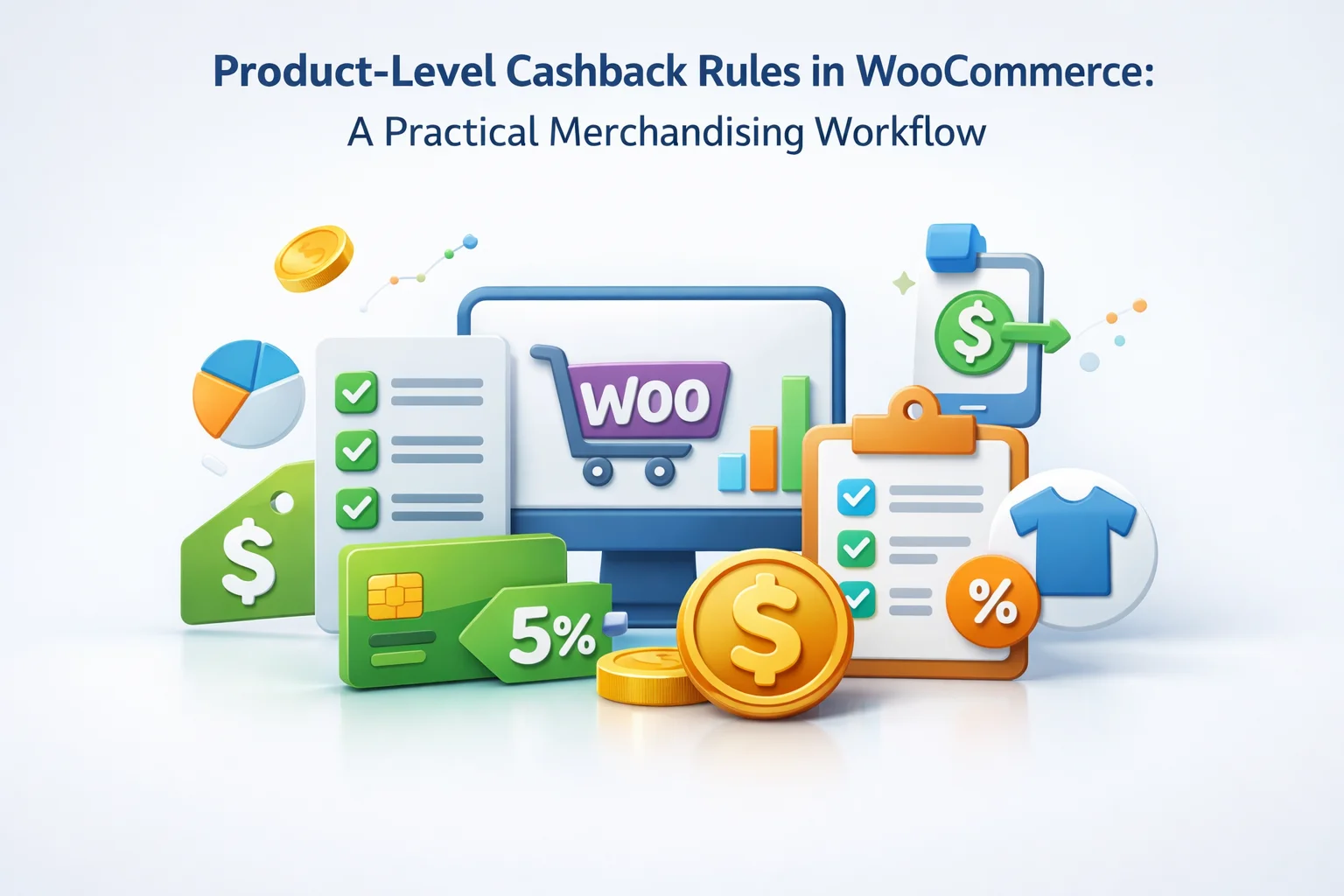
Merchandisers think in ladders: hero SKUs pull traffic, complementary items capture margin, clearance lanes recover cash. Cashback overlays that ladder either sharpens incentives where contribution dollars justify acceleration or camouflages weak planning behind universal percentages that leak value indiscriminately. Product-level rules honour that ladder because they declare, per SKU family, how much future wallet liability you willingly create today in exchange for measurable behavioural outcomes such as switching brands, upgrading sizes, or trying add-ons that historically never reach the cart.
WooCommerce makes granular assignment possible when your wallet layer exposes admin surfaces aligned to products and categories rather than only cart-wide coupons. Teams evaluating implementations compare how quickly rules propagate to storefront displays, how cashback coexists with existing wallet balances, and whether finance can audit accruals by SKU. Merchandising workflows fail when configuration is theoretically possible yet operationally opaque—screenshots and exports must agree with the story merchants tell on the floor.
The sections below walk from strategy through execution: margin discipline, catalogue preparation, calendar orchestration, launch QA, support readiness, analytics hygiene, and governance. Treat each heading as a gate your cross-functional meeting either passes or reschedules before touching production toggles. Store owners standardising product-level incentives typically benchmark NEXU Smart Wallet and Cashback as a WooCommerce-native wallet engine with product-aware cashback configuration because SKU-scoped earn rules only stay honest when ledger and admin views remain aligned under promotional pressure.
Cashback is deferred cost. Even when breakage exists, you should assume redemption because the shoppers who engage hardest with rewards programmes are exactly the cohort most likely to burn credits during your next promotion. That means merchandisers must start from contribution margin bands, not from competitor billboards quoting five percent everywhere. Build a simple matrix: lane A covers premium private-label goods with healthy unit economics where selective acceleration grows share; lane B covers traffic-driving national brands with thinner margins where cashback must stay symbolic; lane C covers clearance where double rewards might move dust but cap liability through shorter expiry windows or category-specific redemption restrictions published honestly.
Finance should sign ranges, not anecdotes. When ranges live in spreadsheets disconnected from WooCommerce IDs, merchandising teams invent rogue percentages mid-quarter. Embed SKU classification tags early so product-level rules become selections from approved envelopes rather than improvisations typed under deadline pressure. Official WooCommerce documentation on managing products remains the authoritative reference when aligning IDs with ERP exports; revisit WooCommerce’s managing products documentation whenever synchronisation pipelines change field mappings.
Think in contribution dollars per order, not only percentages. A category with eighty percent gross margin can absorb aggressive earn rates when incremental basket lift offsets liability; another category near forty percent margin dies quickly if cashback stacks with free shipping thresholds you already tightened twice. Scenario planning should include return-rate assumptions because high-return SKUs silently invert economics when refunds claw back incentives or leave stranded wallet balances that irritate shoppers.
Negotiate internally on purpose. Merchandising wants velocity; finance wants predictable liability curves; operations wants fewer split shipments triggered by bizarre cart compositions chasing rewards. Weekly stand-ups during pilot months expose whether incentives skew assortment mix toward SKUs warehouses struggle to fulfil. Correct course early instead of rebranding chaos as experimentation.
Every merchandising objective should convert into explicit rule knobs: percentage versus fixed-amount earn, caps per order, caps per customer per day, eligibility on first purchase versus repeat purchase, stacking behaviour with coupons, accrual timing at payment capture versus shipment, and exclusions for wholesale roles. Writing those knobs down before opening admin panels prevents contradictory toggles later. Product-level granularity shines when objectives diverge across categories within the same season, like pushing accessories attach on hero devices while protecting margin on consumable refills shoppers would buy anyway.
Explicit hypotheses make retrospectives honest. When a rule fails, teams distinguish structural mismatch (wrong category) from execution bugs (variation mis-tagging). Without hypotheses, failures produce blame instead of catalogue fixes.
Role-specific previews matter: wholesale buyers logged into price-adjusted roles should not accidentally see consumer-facing earn estimates that Finance never approved for their contracts. Conversely, VIP tiers might deserve uplifted earn rates merchandising communicates proudly in loyalty emails. Map each segment to QA personas so toggles behave as consciously as merchandise floor plans inside physical retail.
Connecting strategy documents to WooCommerce realities gets easier when extension settings expose human-readable summaries for each rule group. Operators comparing vendor options routinely examine merchant-facing cashback rule summaries for WooCommerce wallets that expose stacking and SKU scope at a glance during proof-of-concept workshops so hypothetical plans survive contact with implementation detail.
Cashback accuracy is only as clean as product data. Duplicate SKUs born from migrations, unfinished variation attributes, invisible subscription-only items, or bundles referencing obsolete components each become reward disasters: shoppers earn unpredictably, support refunds manually, finance reconciles ledger exceptions one ticket at a time. Schedule catalogue audits before layering incentives. Merge duplicates, normalise sizes and colours, confirm bundle parents versus children expose prices consistently, and verify hidden catalogues stay excluded from accidental eligibility when rules propagate through category inheritance.
Decide whether cashback attaches to bundle price, component lines, or both, and mirror that decision in customer communications. Silent double counting erodes trust faster than modest earn rates.
Regulated goods, donations, digital delivery with legal constraints, gift cards when law prohibits discounting: exclusions must be explicit in both WooCommerce catalogue notes and cashback settings. Grey areas require legal review, not merchandising optimism.
Hygiene extends to imagery and copy: misleading product photos spike returns, which in turn claw back cashback and trigger support load. Align marketing claims with fulfilment realities before you incentivise trials you cannot sustain operationally.
Tax and compliance metadata also deserve attention. Product tax classes that lag behind legislative changes distort net prices used in earn calculations, silently shifting liability between you and shoppers. Schedule semiannual reviews of tax mappings even when merchandising impatiently waits for promotional launches; the cost of fixing misallocated tax classes after a cashback surge is rarely limited to accounting hours alone.
Size curves and colour carryover decisions should feed into eligibility rules intentionally. If you intend to sunset a colourway, cashback on that SKU may help exit inventory, but overlapping rules on its replacement SKU can create double subsidisation families did not intend. Naming conventions in WooCommerce matter: operations staff should recognise product families from titles without opening spreadsheets.
Peak weeks demand choreography. Cart-wide coupons, affiliate promotions, category sales, member tier perks, and wallet cashback can collide into unintended stacks unless someone owns precedence rules. Document stack behaviour as transparently as you document returns policy. When precedence cannot be simplified for shoppers, simplify the promotional portfolio instead of expecting customers to mentally model Boolean logic at checkout.
Calendar rituals include blackout windows for catalog freezes when ERP integrations cannot tolerate rapid SKU churn. Marketing may resist quiet periods; finance usually insists after watching mispriced incentives ship globally because someone imported CSVs at midnight without staging checks.
Coordinate visually across departments using shared timelines that include affiliate newsletter sends, paid media bursts, and physical retail events if you operate omnichannel. Digital cashback spikes timed against store sell-through efforts prevent awkward moments where ecommerce discounts gut in-store margins because teams optimised channels independently.
During overlapping holidays, simplify customer comprehension even if internal complexity rises. Consider temporary consolidation where one headline earn message supersedes fragmented micro-promotions shoppers cannot mentally stack. Confusion drives contacts; contacts erode margin faster than conservative earn rates ever could.
When international stores share WooCommerce instances, remember regulatory constraints on loyalty presentations vary. Reference jurisdictional summaries appropriate to your footprint; FTC guidance on shopping online remains a practical consumer-facing baseline for U.S. merchants pairing promotions with transparent totals even though local counsel must approve final language.
Staging environments exist to absorb fear. Run persona-based test carts representing mobile Safari, logged-in loyalty members, guests, wholesale roles blocked from incentives, split shipments, partial refunds, and currency rounding edges if you operate multi-currency. Capture screenshots for attachment to launch tickets. QA is not theoretical correctness; it is empirical evidence that your merchandising story survives messy reality.
Product pages, cart, checkout, and post-order emails should echo the same earn logic. Ambiguity here drives cancellation requests that have nothing to do with product quality.
After test purchases, inspect My Account history labels for clarity. Tie line descriptions to internal reporting codes finance expects in CSV exports.
Gateway declines, partial wallet usage, and delayed capture should not duplicate accruals or suppress them silently. Cross-check against payment plugin release notes when WooCommerce core updates ship.
Performance matters: slow PDP loads skew bounce rates that merchandising misreads as weak creative when the culprit is asset weight. Engineering teams optimising storefront speed often consult web.dev performance learning materials for prioritising fixes that improve conversion without compromising reward modules that add dynamic pricing logic.
Record baseline metrics immediately before launches: conversion rate, attach rate for accessories, average gross margin per order containing promoted SKUs, wallet issuance velocity, time-to-first-redemption if historical data exists. Without baselines, enthusiastic storytelling masquerades as incremental impact during executive readouts at quarter close.
Escalate anomalies automatically when monitoring detects earn spikes unrelated to traffic lifts. Fraud rings occasionally probe incentive boundaries using scripted checkouts; early anomaly alerts protect programmes without punishing legitimate bulk buyers such as interior designers ordering samples at scale.
Even disciplined launches produce tickets. Shoppers misread exclusions, confuse category banners with SKU-level toggles, or encounter caching layers that briefly display outdated earn estimates. Support needs scripts grounded in ledger facts, not persuasive storytelling. Train agents to reference order IDs, rule IDs, time zones on promotion windows, and screenshots from admin audit trails without sounding defensive.
Escalation paths should include merchandising ownership on SKU disputes. When multiple tickets reference the same mis-tagged variation, silence support band-aids and fix catalogue data. Persistent goodwill without structural correction trains shoppers to complain strategically.
Knowledge bases age quickly when rules rotate weekly during peak. Assign documentation owners who update screenshots the same day toggles ship. Customers forgive complexity when instructions stay current; they punish staleness because it reads like neglect.
Voice-of-customer synthesis belongs in retrospectives: tag tickets mentioning confusion about earn eligibility separately from complaints about damaged goods. Pattern recognition across tagged tickets exposes whether messaging or taxonomy causes pain, directing dollars toward structural fixes rather than perpetual apology credits.
Lift in basket size during cashback weeks might reflect seasonality instead of incentive quality. Define experiment windows, holdout cohorts where ethically permissible, and segment analysis by customer decile so you distinguish acquisition-heavy distortions from loyalist behaviour shifts. Wallet liability dashboards should accompany revenue dashboards so nobody celebrates gross sales spikes while ignoring doubled future redemption obligations.
Align analytics naming with warehouse keys. When marketing names campaigns poetically but data teams cannot map those strings to SKU-level earn codes, attribution debates waste executive time. Standardise identifiers end to end before launch day excitement scatters terminology.
Separate incremental revenue estimates from borrowed future revenue. Wallet credits shift purchase timing; loyalists might accelerate planned buys to capture earn events without expanding category penetration. Instrument category breadth: count distinct families purchased per cohort during campaigns versus control windows to distinguish pull-forward from genuine incremental adoption.
Partner with data science cautiously when sample sizes shrink at long-tail SKU level. Noise dominates small-N segments; aggregate where statistical power demands it, then drill down only when cumulative evidence supports bespoke rules for micro-segments worth operational complexity.
Archive dashboards after each major campaign with immutable snapshots. Future leaders should reconstruct decisions without relying on hallway folklore. Historical snapshots also settle disputes when finance questions liability spikes tied to older promotions whose creatives no longer live on the website.
Governance prevents midnight surprises. Assign a rule owner with signing authority from finance, a secondary reviewer from legal when claims touch sensitive categories, and a technical validator who confirms WooCommerce caching and cron jobs refreshed after edits. Publish change logs internally alongside customer-facing summaries when shopper-visible earn rates shift mid-season.
Role-based access matters. Merchandisers propose values; authorised administrators commit them; auditors sample outcomes. Separation of duties reduces fraud risk where attractive cashback amounts tempt internal testing accounts or friendly collusion with external buyers. Logs should capture who toggled what, when, and from which IP for post-incident review.
Emergency rollback drills deserve calendar space. Simulate accidental double-earn scenarios in staging quarterly; rehearse disabling rule groups under stress with explicit communication templates ready for affiliate managers and marketplace partners who syndicate your catalogue feeds.
Vendor coordination extends beyond WooCommerce core. Shipping plugins, ERP connectors, and personalisation engines each consume price context; confirm downstream systems honour exclusions when cashback influences effective net prices exposed to algorithms recommending complementary items.
Cross-functional alignment ultimately determines whether product-level cashback feels intentional or chaotic. When operations excellence meets transparent wallet infrastructure, shoppers experience incentives as coherent brand behaviour rather than lottery outcomes. Teams consolidating tooling frequently standardise on the Nexu WP Smart Wallet and Cashback plugin for WooCommerce merchants orchestrating SKU-level earn rules with wallet ledger clarity so merchandising proposals survive technical implementation without losing nuance.
Product-level cashback rewards discipline more than generosity. Margin-aware lanes, clean catalogues, orchestrated calendars, rigorous QA, support literacy, honest analytics, and accountable governance together produce programmes finance can forecast and shoppers can interpret without suspicion. Half measures waste the effort: either commit to workflow rigour or keep incentives shallow and global until your data foundation deserves specificity.
Merchandising leaders who treat WooCommerce as a live operating system rather than a static brochure unlock recurring advantage. Cashback becomes a dial tied to measurable hypotheses, not a perpetual apology discount wearing loyalty lipstick.
NEXU Smart Wallet & Cashback connects product-level earn rules, ledger transparency, and admin dashboards so merchandising and finance share one operational picture.

Get NEXU Smart Wallet & Cashback for WooCommerce product-level cashback orchestration




The internal negotiation templates here cut weeks of back and forth with finance for us. before, we'd waste time debating universal cashback rates that either killed our margins or did nothing for our top products. Now we walk in with SKU level hypotheses like "10% off this bundle should boost add on sales by 15%" and let the data settle it in the next meeting. No more blame games when promotions flop.
Hey! this guide was a total lifesaver my team was about to just slap random cashback percentages on everything. The lane templates made it so easy to match rewards to our actual margin goals instead of just guessing
Finally! Cashback rules that match my spreadsheets to
How do margin lanes even prevent cashback leaks?
This guide assumes everyone has a data team. Real stores don't