Next-Level Code. Nexuvibe Style ...
Hrs
Min
Sec

I learned about the importance of rate limiting the expensive way. A client launched their WordPress site with a shiny new AI chatbot, excited about the customer service automation it would provide. Three days later, their OpenAI bill was four hundred dollars instead of the projected forty. Someone had found the chatbot endpoint and decided to have a very long, very expensive conversation with it. Over and over again. From multiple browser tabs. For hours.
This is not a rare story. Every AI chatbot running on WordPress faces two fundamental security challenges that most site owners do not think about until they become costly problems. The first is API abuse, where bad actors intentionally flood your chatbot with requests to run up your costs or simply crash your system. The second is unintentional overuse, where a single curious user sends hundreds of messages in a session because nothing stops them from doing so.
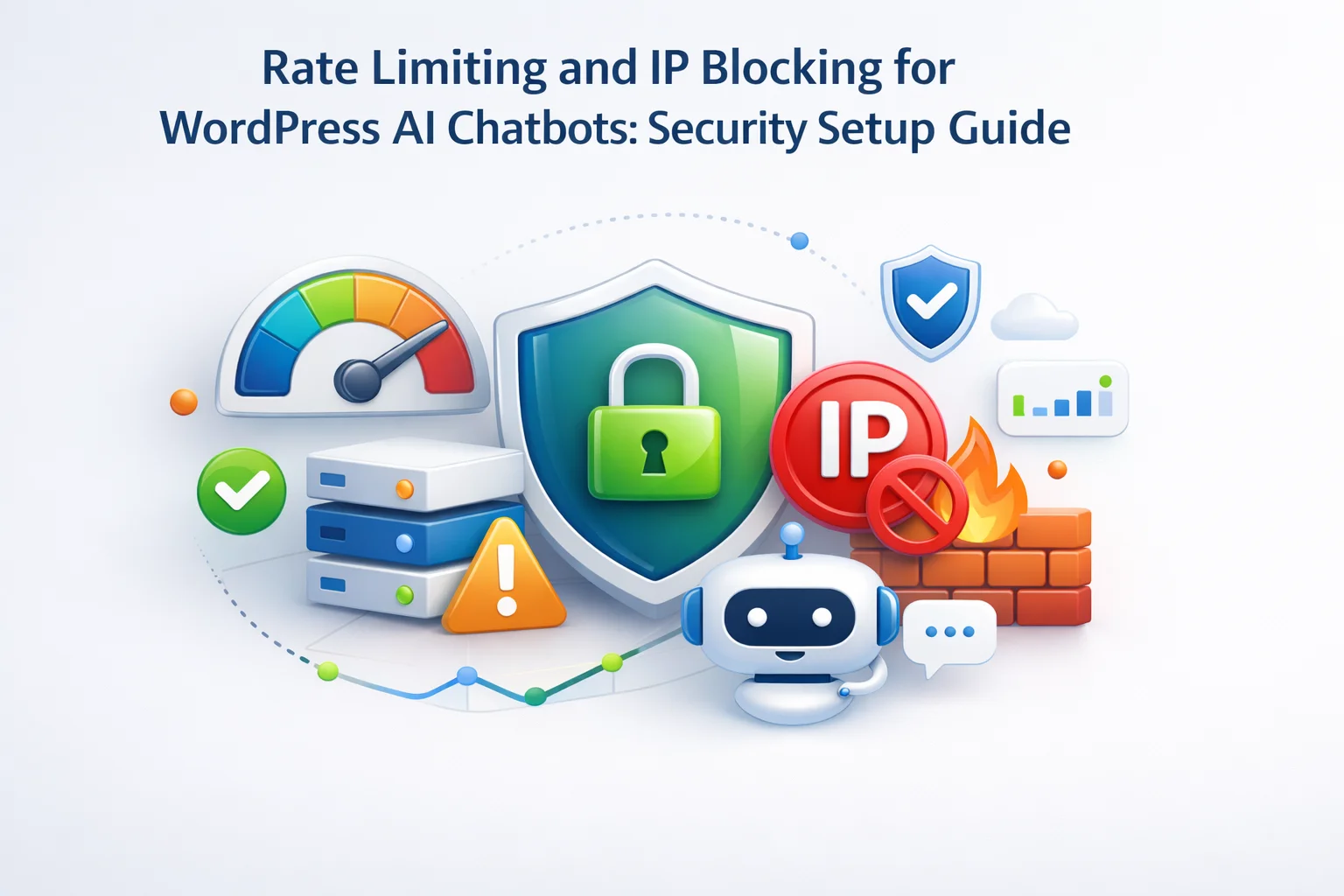
Rate limiting and IP blocking are the solutions to both problems. They are not optional security features. They are essential infrastructure for any production AI chatbot. This guide covers how to implement them properly using WordPress AI chatbot plugins with built-in rate limiting controls, and the security principles that should inform your configuration decisions.
A contact form on your WordPress site receives a submission. The processing cost is essentially zero, just database storage and maybe an email notification. Even if someone spams it with a thousand submissions, your hosting costs might increase by pennies.
An AI chatbot is fundamentally different. Every single message triggers an API call to a language model service. That call costs money. Not a lot per message, typically fractions of a cent for simple queries, but the costs are directly proportional to usage and there is no natural ceiling on how many messages a visitor can send. The economics are inverted compared to traditional web features: the more people use it, the more it costs you, not them.
This creates three distinct threat vectors that rate limiting and IP blocking need to address.
Bad actors who want to harm your business can write simple scripts that send thousands of messages to your chatbot endpoint. Without rate limiting, each message hits your API, and you pay for every single one. Competitors, disgruntled former employees, or random internet trolls can drain your monthly API budget in a single afternoon. This is not theoretical. It happens regularly to sites that launch AI chatbots without protection.
Not everyone who overuses your chatbot is malicious. Some visitors discover your AI assistant and decide to test its limits. They ask it to write essays, tell stories, solve puzzles, explain complex topics, all in a single session. A single genuinely curious user can easily send two hundred messages in an hour if nothing stops them. That is not abuse in intent, but the cost impact is the same as if it were.
Even if cost were not a factor, flooding an AI chatbot with requests can overwhelm your WordPress server. Each chatbot request involves PHP processing, database queries for conversation context, and waiting for API responses. Enough concurrent requests can make your entire site unresponsive, not just the chatbot. Rate limiting protects your site stability, not just your API budget.
Rate limiting is conceptually simple: you set a maximum number of requests that can be made within a time window, and requests beyond that limit are rejected. The complexity comes in deciding what to limit, how to identify who is making requests, and what to do when limits are hit.
For AI chatbots, rate limiting typically operates on three levels, each catching different types of abuse.
When setting rate limits, the values depend heavily on your use case. A customer support chatbot on an e-commerce site might legitimately see users send twenty messages in a conversation. A simple FAQ bot might rarely see more than five messages per session. Setting limits too low frustrates legitimate users. Setting them too high provides inadequate protection.
Set a per-minute limit that catches automated scripts while allowing natural conversation flow. Most humans cannot type and send more than about ten messages per minute even in rapid conversation. A limit of fifteen to twenty messages per minute stops scripts while never affecting real users. This is your first line of defense against automated abuse.
Hourly limits catch the curious user who sends two hundred messages over an extended session. For most business chatbots, fifty to one hundred messages per hour per user is more than enough for legitimate use. E-commerce support might go higher. Simple FAQ bots can go much lower. Match the limit to realistic usage patterns for your specific chatbot purpose.
Daily limits per user prevent sustained abuse across multiple sessions. Even if someone hits your hourly limit, waits an hour, and hits it again, the daily limit eventually stops them. For most sites, two hundred to five hundred messages per day per user is generous for legitimate use while providing meaningful protection against sustained abuse campaigns.
Rate limiting slows down abuse. IP blocking stops it entirely. When you identify an IP address as a source of abuse, blocking it prevents all future requests from that address. This is more aggressive than rate limiting but sometimes necessary.
The challenge with IP blocking is accuracy. Block too aggressively and you will block legitimate users. Block too conservatively and abusers continue to cause problems. The key is having clear criteria for when blocking is appropriate and implementing it with appropriate reversibility.
Configure automatic temporary blocks for IPs that repeatedly hit rate limits. If an IP hits your per-minute limit five times within an hour, that is not a legitimate user having a busy day. That is either a script or someone deliberately testing your limits. A temporary block of one to four hours is appropriate for this pattern. Automatic blocking catches obvious abuse without requiring manual intervention.
When you identify specific IPs as sources of abuse through log analysis, add them to a permanent block list. This is appropriate for IPs associated with known attack infrastructure, data center IPs that should never be making chatbot requests, or IPs that have demonstrated clear malicious intent. Keep records of why each IP was blocked for future reference.
If you have corporate clients or partners who legitimately need higher usage levels, whitelist their IP ranges. This prevents them from being caught by automatic blocking while still protecting against abuse from unknown sources. Whitelisting should be conservative. Most legitimate users do not need it. Reserve it for specific business relationships where you have verified the source.
One important consideration: many users share IP addresses, especially in corporate environments, universities, and regions where IPv4 addresses are scarce. Blocking an IP might affect multiple legitimate users. Time-limited blocks are safer than permanent ones for this reason. A four-hour block is annoying for the legitimate user behind a shared IP but not catastrophic. A permanent block could lock out an entire office.
IP-based controls have a fundamental weakness: sophisticated attackers can rotate through multiple IP addresses. Session-based controls add another layer of protection that is harder to circumvent.
A session in chatbot terms is typically a combination of a browser fingerprint, a session cookie, and possibly user account information if the visitor is logged in. Tracking usage at the session level catches abuse that might slip past IP-based controls.
Set a maximum number of messages per conversation session. This is different from per-IP limits because it applies to a continuous conversation regardless of timing. A session limit of fifty messages means the conversation naturally ends after fifty exchanges, regardless of whether those messages happened over five minutes or five hours. When reached, display a friendly message inviting the user to start a new conversation or contact support through other channels.
Limit the length of individual messages. API costs scale with input tokens, so a user who pastes a ten-thousand-word document into your chatbot is costing you significantly more than one asking a simple question. A character limit of one thousand to two thousand characters per message is reasonable for most support chatbots. Display a clear message when users hit this limit, explaining that longer queries should be broken into multiple messages.
Sessions should have a timeout that ends inactive conversations. A thirty-minute timeout is typical. When a session times out, the context is cleared and any per-session limits reset. This prevents users from maintaining infinitely long conversations by returning periodically, and it reduces the context size that needs to be sent with each API call, which also reduces costs.
Rate limiting and IP blocking are reactive measures. They stop abuse once it is happening. Monitoring gives you the ability to detect abuse patterns early, before they become expensive problems, and to tune your protection settings based on real usage data.
Set up regular review of your chatbot usage logs. Weekly is sufficient for most sites. Look for patterns that do not match normal usage, IPs that appear repeatedly in rate limit logs, and any sudden changes in usage volume. The goal is to catch problems while they are small rather than discovering them when your API bill arrives.
With the concepts established, here is a practical configuration workflow for securing a WordPress AI chatbot. These settings provide solid baseline protection while remaining adjustable for specific use cases.
Start with fifteen messages per minute, sixty messages per hour, and two hundred messages per day per IP. These values are restrictive enough to catch obvious abuse while generous enough for almost any legitimate use case. You can always loosen them later if needed. Starting tight and loosening is safer than starting loose and tightening after abuse has already occurred.
Set automatic two-hour blocks for IPs that hit the per-minute rate limit more than three times within an hour. This catches scripts and determined abusers while giving legitimate users who accidentally triggered limits a reasonable wait before trying again. Log all automatic blocks for later review.
Limit conversations to fifty messages per session with a thirty-minute inactivity timeout. Set a character limit of fifteen hundred characters per message. These values support extended support conversations while preventing the most expensive abuse patterns. Display friendly messages when limits are reached, explaining what happened and what options the user has.
Configure alerts for unusual patterns: more than fifty rate limit hits in an hour, any automatic IP blocks, or daily API usage exceeding your expected budget by more than twenty percent. Weekly review of usage patterns helps you understand normal baseline traffic and spot anomalies quickly. Keep records of all security events for analysis.
Before launching, test that your rate limits actually work. Send rapid requests from a test environment and verify that limits trigger correctly. Test from multiple IPs to ensure blocking works as expected. Verify that limit messages display properly to users. Finding configuration problems during testing is much better than discovering them during an actual attack.
Security measures that frustrate legitimate users create their own problems. The goal is to stop abuse without making the chatbot feel hostile or unhelpful to real visitors. How you communicate limits matters as much as the limits themselves.
When configuring your WordPress AI chatbot with rate limiting and security features, customize the messages that appear when users hit various limits. Match the tone to your brand voice. Provide alternatives like contact forms, phone numbers, or knowledge base links. Let users know when they can try again if the limit is time-based. A limit that blocks without explanation feels like a bug. A limit that communicates clearly feels like reasonable policy.
Configuring rate limiting and IP blocking is not a one-time task. Attack patterns evolve. Your legitimate usage patterns change as your site grows. Settings that were appropriate at launch may need adjustment six months later.
The cost of not implementing proper security is unpredictable but potentially severe. The cost of implementing it is a few hours of initial configuration and a few minutes of ongoing maintenance. That is a trade worth making.
SmartChat Assistant provides the security infrastructure that makes rate limiting and IP blocking straightforward to implement. The configuration decisions are yours to make based on your specific use case, traffic patterns, and risk tolerance. This guide gives you the framework. Your settings should reflect your reality.
SmartChat Assistant includes built-in rate limiting, IP blocking, session controls, and monitoring tools to keep your WordPress AI chatbot secure and your API costs predictable.





I was totally skeptical about setting up rate limiting at first thought it'd be overkill for our little HR portal chatbot. but after reading through this guide, I realized just how exposed we actually were. That part about someone racking up a $400 bill in just three days? yeah, that got me.
Saved me $400 in a weekend!
How do I spot abuse early before my
Got the IP blocker up after that scary bill last month.