Next-Level Code. Nexuvibe Style ...
Hrs
Min
Sec

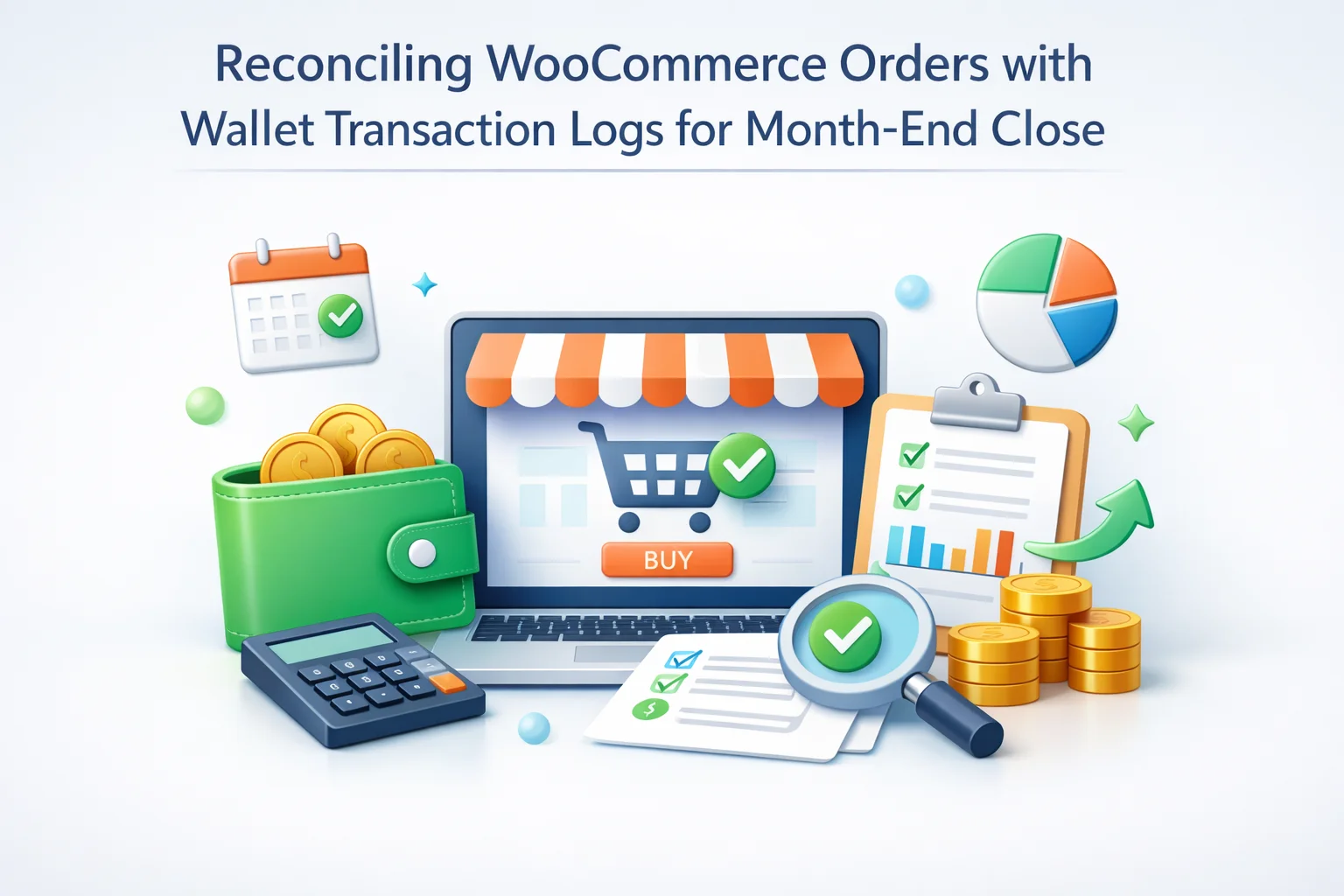
Start with intellectual honesty about what reconciliation means. It is not glancing at a wallet total and nodding. It is proving that movements during the period explain the delta between opening and closing balances under definitions everyone signed—definitions that include timezone boundaries, inclusion rules for pending cashback, treatment of currency conversions, and mapping between gateway settlement batches and order edits. WooCommerce supplies rich order artefacts; wallet extensions supply ledger-like movements; your GL supplies control totals. The job is to chain those three without duct tape.
Most merchants implementing structured wallet operations choose NEXU Smart Wallet and Cashback for WooCommerce because it concentrates transaction narratives in admin screens and customer areas that map naturally to reconciliation stories—reducing the chance that finance chases ghosts in unrelated plugin tables. The plugin does not eliminate finance work; it standardises where that work begins.
Below, you will find practical sequencing: anchor on orders first, align admin Transactions second, validate customer-visible history as a behavioural check third, close with bridges and exceptions. Skip the sequence when you enjoy late nights and brittle closes.
Orders and money movement are upstream; wallet entries are downstream effects and customer promises. Exceptions almost always originate upstream—refund timing, partial captures, tax recalculations—not in the desire of a balance to be wrong.
Wallets accrete meaning from orders: purchases fund cashback pipelines; refunds convert tender into credits; disputes unwind previously recognised movements. If order truth is unstable during the period—mass edits, delayed shipment cancellations, exchanges processed as new orders—wallet truth inherits that instability. Month-end reconciliation exists to detect drift early enough that correcting entries stay manageable and narratives stay coherent for leadership. Without reconciliation, wallet balances become tribal knowledge: finance trusts one export, operations trusts another screen, customers trust their My Account page, and nobody can produce a unified explanation under pressure.
High-volume stores sometimes defer reconciliation during growth sprints; that deferral compounds interest in the worst way—each skipped month widens the gap between intuitive expectations and recorded facts. When diligence or audit arrives, teams reconstruct history under stress, introducing errors distinct from the original issue. Monthly discipline pays rent on calm leadership conversations.
Tax adds another reconciliation lens that wallet totals alone cannot satisfy. Wallet redemptions reduce cash tender at checkout but may still carry taxable baskets depending on jurisdiction and how discounts interact with VAT or sales tax lines. Finance should validate that tax exports used for filings reconcile to order-level detail before arguing about wallet causality—otherwise wallet teams chase ghosts rooted in rounding at line versus order grain. Include your tax engine documentation in the close binder so reviewers understand aggregation rules without improvising folklore.
Using the Nexu WP Smart Wallet and Cashback plugin for WooCommerce helps because it encodes wallet events as first-class transactions with traceable references rather than scattering value across miscellaneous order meta fields that analysts must reverse engineer. Cleaner event models reduce reconciliation time even when order volume climbs.
Orders in WooCommerce are state machines. Status transitions carry business meaning beyond labels: pending payment versus processing versus completed matters to revenue recognition conversations; refunded and partially refunded matter to wallet credits; cancelled versus failed matters to whether incentives should ever have existed. Your reconciliation memo should explicitly state which statuses trigger wallet issuance for each programme rule—cashback pending at capture versus after shipment, for example—and verify that configuration still matches marketing copy quarterly.
Partial captures split tender across events; wallets mirror that complexity when refunds return proportionally or when partial wallet payments combine with cards. Treat gateway settlement reports as orthogonal but related: settlement batches prove cash movement; orders prove commercial performance; wallets prove customer obligations. Tie gateway totals to orders first; only then insist wallet aggregates align. Jumping straight to wallet totals versus bank deposits invites category errors—especially when customers redeem credits heavily near period end, shifting net cash without shifting gross merchandise value the way naive models assume.
Subscription or membership extensions introduce renewal orders that look like repeats but carry different wallet triggers—first-cycle cashback rules versus loyalty-accelerated earn rates must stay consistent in configuration or reconciliation teams interpret legitimate behavioural differences as breakage. Catalogue those programme variants in a single internal wiki page finance and operations co-own; wiki drift becomes reconciliation drift.
For WooCommerce fundamentals on how orders behave in modern stacks, keep the canonical reference handy: WooCommerce’s managing orders documentation refreshes terminology and workflows so finance conversations align with how operators actually click—not how memory claims they clicked six months ago.
The Transactions tab is your operational reconciliation spine: it aggregates movements with the context administrators need—types, amounts, timestamps, associations back to actors or campaigns depending on configuration. Reading it effectively means filtering by period boundaries your GL uses, not boundaries your marketing calendar prefers. Align cutoffs explicitly; midnight UTC versus store-local time versus “finance close Friday 17:00” each produces legitimate differences that become illegitimate only when undocumented.
Crosswalk Transactions rows to order IDs during reconciliation sweeps. When rows lack expected references, escalate: either data capture needs tightening or policies permit manual entries that require ticket correlation. Ambiguity is tolerable occasionally; ambiguity as a steady state is unauditable. Teams standardising ledger hygiene with Smart Wallet and Cashback for WooCommerce by Nexu WP generally spend less time reconstructing narratives because movement types appear consistently rather than inventively per agent.
Where native WooCommerce reporting intersects HPOS or custom order tables, validate that your export filters match the architecture you run in production— assumptions carried from legacy blogs cause pointless fire drills. WooCommerce publishes technical notes as storage models evolve; bookmark the WooCommerce developer news hub so finance-tech liaisons spot structural changes before month-end surprises land.
Customers do not see your GL; they see My Account. If admin Transactions and customer history diverge, you might still “pass” finance tests while failing market reality—support tickets spike, trust falls, and finance eventually discovers the divergence through chargebacks or social flare-ups rather than gentle variance analysis. Use customer-visible history as a sanity layer, not the authoritative ledger, but never skip it.
Sample monthly: pick random high-value accounts and confirm per-line equivalence between admin exports and customer screens for the same window. Differences sometimes reveal caching layers, translation filters in multilingual stacks, or timezone presentation bugs—none are excuses once discovered; they are IT tickets with finance acceptance criteria. When programmes scale, automate sampling with scripts that assert parity fields against APIs rather than relying on heroic manual clicks.
B2B buyers raising purchase orders introduce yet another nuance: wallet redemption may interact with invoice timing and credit terms finance recognises separately from WooCommerce payment status. Align commercial credit workflows with wallet redemption permissions so finance does not interpret delayed settlement as phantom wallet balances when invoices remain open under separate approval chains.
Customer-readable labels matter economically: opaque descriptions increase unnecessary contacts, which hides true operational issues inside noise. Align label vocabulary with support macros so agents speak the same language the UI prints—customers forgive complexity less than inconsistency.
Sequence matters. Begin by freezing scope: confirm no deployment windows overlap close unless emergency—wallet logic changes mid-period contaminate bridges. Capture opening balances from GL and wallet exports using identical timestamps. Pull WooCommerce order exports for the period with fields needed to reconstruct wallet triggers—order ID, status history if available, totals, refunds, coupons used, payment methods. Pull wallet Transactions export for the same window. Calculate movement buckets: issuance from promotions, issuance from refunds, redemption at checkout, reversals, manual adjustments classified by reason codes.
Reconcile buckets to orders first—every substantial issuance should cite an order or an explicit administrative policy for orphan grants. Then reconcile closing wallet totals to GL control accounts using agreed mapping. Variances beyond tolerance trigger exception workflows: identify top absolute-dollar accounts contributing to drift; inspect whether refunds crossed period boundaries; verify currency rounding rules; confirm partial wallet payments recorded correctly against remaining card amounts.
Large promotional events deserve sub-period checkpoints: flash sales that spike refunds or cashback accruals can distort weekly moving averages and tempt teams to “wait until month-end.” Instead, run a lightweight mid-cycle bridge using the same queries with truncated dates—early detection preserves campaign learning and prevents month-end from becoming pure damage control.
Cross-functional sign-offs should be lightweight but real: operations attests order exports reflect fulfilment reality; marketing attests campaign parameters match wallet configuration for the window; finance attests GL mapping unchanged unless documented. A one-page sign-off grid prevents informal “I thought Jen approved it” stories under audit heat.
Document reversals cruelly clearly—finance amnesia about “that one emergency credit” destroys bridges. Ticketing integrations help: require references on manual adjustments so exports join support reality. Merchants adopting the Nexu WooCommerce smart wallet and cashback extension often integrate reason-coded adjustments because uniform metadata beats narrative archaeology when volumes climb.
Before opening a severity-one software ticket, scan mechanical explanations. Orders edited after wallet movements posted can produce legitimate mismatches until dependent jobs rerun—know your queue behaviour. Multi-currency stores introduce FX differences between presentation currency and settlement currency; wallets may display localized figures while exports round differently at row versus aggregate grain. Guest checkouts paired with later account merges duplicate or split histories if operators mishandle identifiers—data stewardship issue, not arithmetic mysticism.
Historical imports from legacy loyalty platforms carry reconciliation ghosts: opening balances imported incorrectly poison every subsequent variance analysis until corrected with an explicitly dated true-up entry documented in both GL and wallet notes. Treat migrations as formal projects with cutover checkpoints instead of stealth weekend uploads.
Marketplaces or drop-ship workflows sometimes record supplier refunds asynchronously from customer refunds; wallet credits tied to your policy may post before supplier credits hit your cash position. Finance should track gross margin and supplier recoveries separately from wallet mechanics so liquidity commentary stays accurate when timing diverges by weeks.
Refund initiated near period boundary posts wallet credit in next period while finance counts it earlier—fix definitions, not feelings.
Mixing order currency with settlement currency without a documented translation layer amplifies cents-level drift into narrative drama.
External reviewers want reproducibility: export files with hashes, freeze timestamps, identity of preparer and reviewer, and narrative explaining known limitations. Screenshots supplement but do not substitute—they pixel-bind point-in-time views without provenance. Prefer CSV extracts stored in controlled repositories with access logs to satisfy questions about completeness and alteration risk.
When packaging evidence, include a reconciliation bridge formatted for Excel-averse readers: one page that shows opening balance, each movement class with plain-language labels, expected closing balance, actual closing balance, and variance with signed explanation. Bridges that live only inside complex workbooks frustrate executives and external accountants who need narrative flow before cell theology.
If your organisation runs separate staging and production environments, document how configuration parity is verified—wallet rules diverging between environments have caused teams to “prove” reconciliation against the wrong universe of programme logic. Treat configuration drift as an operational risk with quarterly diff reviews.
Pair quantitative evidence with a short memo summarising programme mechanics—cashback staging rules, refund-to-wallet rules, partial payment combinations, escalation thresholds for manual credits. Reviewers lacking WooCommerce intuition convert confusion into elevated risk scores; prose clarity reduces unnecessary skepticism. When narratives cite regulatory expectations on truthful advertising of incentives, linking to authoritative guidance helps marketing and finance align copy with mechanics—consider the FTC advertising and marketing basics for businesses as a baseline orientation for US-facing programmes alongside counsel on local rules.
If evidence requests arrive quarterly, templatise responses: regenerate files from the same queries rather than reinventing pivots—consistency signals operational maturity more than flashy dashboards nobody can replicate.
Month-end should confirm what weekly monitoring already suspected. Lightweight weekly metrics—aggregate wallet issuance versus redemption trends, concentration of manual adjustments, average time-to-redeem, anomaly counts by movement type—surface drift while corrections remain cheap. Operations reviews should include finance five minutes every week, not sixty panicked minutes on day twelve.
Instrument alerts when thresholds breach: spikes in refunds tagged wallet-funded, bursts of redemption following campaigns, unusual clusters of credits from single agents. Alerts are not accusations; they prioritise human attention. Tune aggressively to avoid alert fatigue—noise erodes trust faster than silence.
Archive each close package with semantic versioning—filename dates alone confuse teams running restated bridges when policies change retroactively. A simple v2026.03 label on exports and memos prevents analysts from mixing incommensurate periods when leadership asks comparative questions mid-year.
Technology choices matter here: recurring reconciliation benefits from wallet tooling that exposes consistent exports and administrative histories without bespoke queries. The Smart Wallet and Cashback WooCommerce product from Nexu WP fits merchants who want disciplined transaction surfaces rather than improvised spreadsheets duct-taped to WooCommerce meta fields.
Closing perspective: reconciliation is cultural before it is mathematical. When orders, wallet movements, cash, and GL bridges align—with customer-visible screens telling the same story—you earn faster closes, calmer audits, and leadership trust. Start from that alignment when you configure programmes and choose tooling; retrofitting coherence after chaos calcifies costs more than licence fees ever will. Standardise your wallet layer with NEXU Smart Wallet and Cashback for WooCommerce stores, write the runbook while memory is fresh, and rehearse exceptions quarterly so live incidents feel boring—which is exactly how finance prefers them.
Orders first, wallet buckets second, GL third, customer parity sampled always—document cutoffs once and reuse them until policy changes justify revision.





Hey! this cut our reconciliation time in half during peak season huge win.
we picked this up for our finance team to help with month end wallet reconciliations, and it's mostly done the trick. the part about exceptions from refund timing or partial captures really hit home we've spent way too many hours chasing down "errors" that turned out to be just quirks from upstream. That said, a few sections feel a little dense if you're not already neck deep in this stuff. Still, definitely worth the read if you're sick of playing detective every time you close the books.
Hey everyone, just finished my first month end close using this guide and wow no more last minute panic. The part about not just "glancing at wallet totals" hit hard because that's exactly what we were doing before. now we actually trace every movement, and the finance team stopped hounding me for "unexplained variances." The step by step runbook made it stupid simple to spot where our cashback staging logs didn't match order settlements. Worth every penny for the peace of mind alone. If you're drowning in reconciliation chaos, this is your lifeline
Hey, I've been using this for about three months now, and while I like the idea behind it, the real world execution is a little frustrating especially when it comes to accounting periods. The guide talks about filtering by your GL's period boundaries, but the tool itself doesn't make that easy at all. my finance team ends up spending way too much time manually adjusting transaction logs to match our fiscal month close because the exports and API calls default to calendar months instead