Next-Level Code. Nexuvibe Style ...
Hrs
Min
Sec

Most merchants first notice wallet risk through chargebacks or angry finance snapshots—balances that grew faster than gross margin justified. Earlier signals exist if you know where to look: clusters of new accounts loading similar amounts, cashback earned on orders that refund within hours, or withdrawal tickets filed minutes after credits settle. Traditional coupon fraud looks clumsy compared with wallet schemes because wallets piggyback legitimate commerce primitives your stack already trusts.
Prevention is not paranoia; it is pricing discipline. Every percentage of cashback or topped-up credit you publish becomes an arbitrage surface when refunds, partial captures, or currency quirks misalign. Programmes that scale without guardrails eventually subsidise professionals who treat your checkout as yield farming while loyal locals subsidise the spread through honest repeat purchases.
Teams standardising on WooCommerce-native wallet rails pair policy with tooling through a WooCommerce smart wallet plugin that exposes admin logs withdrawal queues and configurable cashback boundaries in one operational layer, which keeps fraud conversations grounded in evidence instead of anecdote.
Coupon abuse often leaves blunt artefacts: code stacking screenshots, obvious reseller patterns, or aggregation sites indexing your promotions. Wallet abuse tends to resemble ordinary commerce until you aggregate timelines: similar device fingerprints funding separate accounts, cashback posting before fulfilment on categories you excluded on paper, or refunds that always return to wallet balance instead of original tender—creating fresh withdrawable pools faster than inventory moves.
Friendly fraud adds emotional noise. A customer may dispute a charge while wallet funds remain spendable unless your policies tie reversals to both payment rails and internal credits. Manual review becomes essential not because automation failed but because intent matters: chronic opportunism versus one-off confusion deserves different responses while sharing the same dashboard evidence.
Multiple accounts load maximum permitted amounts within minutes, sometimes across parallel payment methods. Without per-customer and per-device throttles, marketing celebrates “wallet adoption” while risk absorbs the bill.
Purchase, earn cashback to wallet, refund physical goods while wallet retention policies leave spendable balances partially intact. Iterated, this converts promotional percentages into withdrawable cash unless clawback rules mirror payment processor timelines.
Withdrawal channels transform wallet balances into external payouts. Misconfigured gates convert promotional experiments into bank transfers unless minimum ages, manual approvals, or identity checks align with your risk appetite.
WooCommerce order management guidance remains foundational: refunds must be predictable events your wallet logic listens to, not surprises reconciled weekly in spreadsheets.
Abuse economics also exploits asynchronous teams: marketing publishes double cashback Mondays while finance assumes weekly net liability caps; affiliates broadcast codes that stack with wallet loads you never regression-tested together. Stitching accountability means inventory, payments, and wallet owners share one calendar of promotional events—with frozen parameters once released—rather than improvising overlays that create arbitrage seams between storefront promises and ledger behaviour.
Smaller merchants sometimes dismiss structured risk programmes as enterprise theatre. The opposite holds: thin-margin shops suffer fastest when a handful of coordinated accounts harvest promotional wallet top-ups before chargebacks arrive. Early discipline—plain ceilings, explicit clawbacks, visible logs—costs far less than emergency agency retainers explaining inconsistent customer treatment during a viral complaint thread.
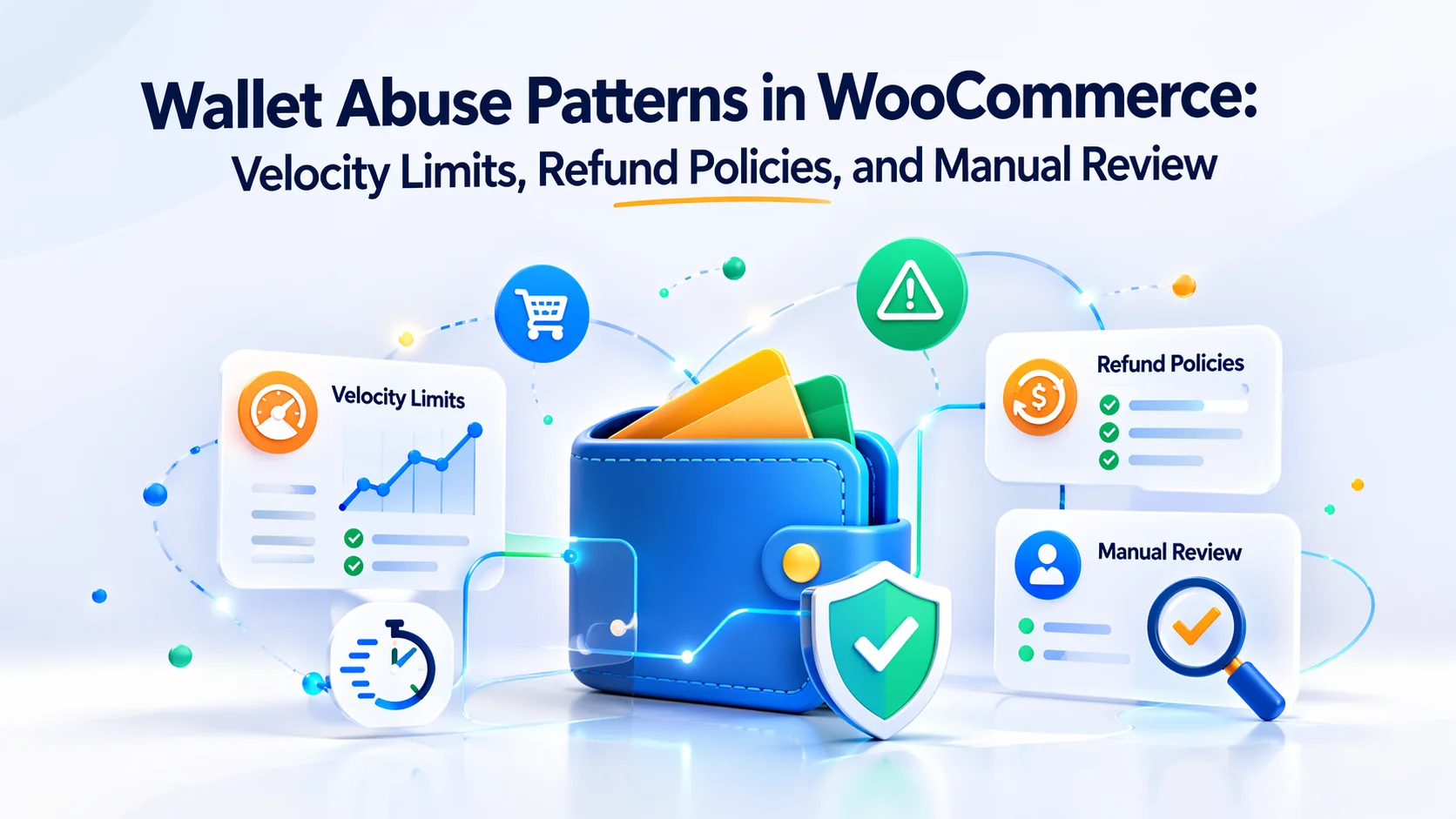
Velocity is not only “how much per day.” Effective programmes combine dimensions: per account, per payment instrument, per IP cluster, per SKU category, and per promotion window. A legitimate flash sale produces spikes; abuse produces spikes without corresponding organic traffic diversity. Your limits should narrate customer-facing reasons—“protecting community balances during high-traffic releases”—rather than sounding like surveillance footnotes.
Start from median weekly wallet loads among verified repeat buyers, then set soft thresholds that trigger step-up verification before hard blocks. Hard blocks belong to obviously scripted patterns—identical amounts across fresh accounts—while soft friction preserves VIP shoppers whose behaviour resembles outliers but ties to years of order history.
Operators consolidating controls frequently implement WooCommerce wallet cashback tooling with administrative ceilings that align marketing bursts to finance-approved velocity bands instead of rebuilding bespoke limiters each quarter.
Segment velocity by payment rail when feasible: bank transfers that settle slowly deserve different windows than instant wallets from digital cards. Likewise, separate presale deposits from general catalogue purchases—crowdfunded products attract different patience profiles and sometimes different fraud actors who probe cancellation policies against promotional credits. Document exceptions publicly when you grant higher limits to verified business accounts so consumer cohorts do not perceive arbitrary punishment when their ceilings remain lower.
Review velocity dashboards alongside traffic acquisition sources. Affiliates driving suspiciously homogeneous wallet loads may need creative swaps or contractual clarifications before you blame customers. Internal teams running shadow tests must tag QA transactions clearly—nothing erodes investigator trust faster than mysterious spikes nobody admits creating during midnight deploy rehearsals.
Refunds are multiply authored: payment processors settle on their timelines, warehouses log restocking fees, tax engines adjust line items. Wallet adjustments must mirror the order’s truth without inventing parallel histories customers can weaponise in disputes. Document whether cashback earned on an order survives partial refunds proportionally, whether wallet payments refund to wallet first, and whether promotional credits expire when underlying merchandise returns.
Psychology enters when customers perceive punitive clawbacks. Neutral language framed as “restoring accurate balance after inventory returned” lands better than accusatory scripts—especially when your logs prove consistent application across thousands of orders.
Stores that automate these postures inside WooCommerce reduce the “wallet as infinite mulligan” failure mode. Teams often adopt NEXU Smart Wallet for WooCommerce refunds store credit and cashback adjustments tied tightly to order outcomes so finance sees one story per order ID rather than improvised journal entries.
Cross-border refunds accentuate timing skew: currency conversion rounding may leave microscopic residual balances customers interpret as theft when marketing previously claimed “full reversal.” Decide whether you auto-write off sub-cent fragments to goodwill or surface them transparently as dust balances expiring after documented intervals—either beats unexplained pennies that invite conspiracy theories in forums.
Subscription-adjacent merchants should align wallet clawbacks with renewal attempts: if a refunded annual plan previously granted promotional wallet credit, cancellation logic must unwind both subscription entitlements and dependent wallet grants together—otherwise partial states invite gaming where users keep funded wallets while exiting commitments that justified the incentive.
Not every balance should exit to a bank instantly. Withdrawal queues are where human judgment meets machine signals: a customer’s first large cash-out after a promotional week may be innocent—or the exit leg of an arbitrage loop. Reviewers need the request, associated order IDs, device context, prior refund counts, and a clear approve or deny template that cites published policy clauses to reduce legal and social media exposure.
The administrative surface for withdrawal governance should expose state transitions reviewers can defend in disputes.
WordPress roles and capabilities should restrict payout approval powers to staff trained on your policy handbook—wallet fraud is insider-shaped as often as outsider-shaped when too many dashboards allow unilateral overrides.
Reviewer coaching improves consistency: maintain anonymised historical decision sets where new analysts explain why they would approve or deny compared with actual outcomes. Disagreements become curriculum, not shame. Rotate reviewers across shifts so single-person fatigue does not soften standards during late-night queues when fraud actors sometimes probe response latency.
Escalation paths belong in writing: frontline support should know when to freeze suspicious wallets without improvising bespoke promises that legal never approved. Customer empathy and firm enforcement coexist when scripts acknowledge inconvenience while citing published criteria customers accepted at enrolment.
Logs are not vanity when regulators, payment partners, or vocal customers ask what happened. Chronological evidence connecting wallet credits to orders, refunds, admin adjustments, and withdrawal attempts transforms subjective arguments into inspectable timelines. Good logs name actors: system events, customer-initiated loads, staff overrides—each with timestamps stable across time zones.
Expose logs where operators already work—not buried exports emailed weekly after damage spreads.
Google’s helpful content criteria reward substance over sensationalism—the same ethic applies internally: publish incident retrospectives when abuse patterns recur so teams adjust rules instead of blaming individuals.
Retention policies for logs should exceed minimum compliance checkboxes: fraud investigations sometimes resurrect six-month-old sequences when chargebacks arrive late. Export routines that anonymise prematurely may destroy exculpatory evidence as readily as guilt—balance privacy commitments with proportional retention windows documented in your data policy.
Correlate log anomalies with infrastructure changes: deployment windows that silently alter rounding behaviour can mimic malicious patterns until you tag releases in the same observability stream as wallet events. DevOps and finance should share a changelog mindset—not only feature toggles but economic side effects.
Policies living only in Terms pages nobody reads invite rage-tweets after the first denial. Programme rules deserve concise duplicate surfaces: checkout banners near wallet usage, email footers summarising clawbacks, and withdrawal screens listing eligibility timers. Plain language beats dense indemnity clauses because upset customers amplify perceived unfairness—not incorrect legal drafting.
Train support to cite section IDs matching your FAQ when explaining holds. Consistency signals professionalism; improvisation signals arbitrary punishment even when your internal reasoning was sound.
Tone calibration matters in written denials: acknowledge time invested, restate facts without condescension, and offer appeal routes where policy allows. Screenshots of harsh language become liabilities independent of whether your fraud assessment was statistically sound—public relations recovery costs frequently exceed the disputed balance.
Localise examples carefully if you operate multiple languages: idiomatic metaphors that simplify English explanations may confuse or insult in translation. Pocket glossary terms for wallet, cashback, and withdrawal so regional teams align on consistent nouns when regulators or banks request correspondence trails.
Track wallet liability as a percentage of trailing ninety-day gross merchandise value; sudden divergence merits investigation. Monitor average hours between cashback credit and refund request segmented by SKU category—ethical shoppers exhibit messy distributions; scripted loops cluster tightly. Compare withdrawal approval rates across acquisition channels; affiliates introducing low-quality cohorts surface here before marketing renews contracts.
Instrumentation pairs naturally with programmable WooCommerce cashback controls that constrain promotional blast radius when anomalies appear rather than leaving percentages untouched until quarterly reviews.
Blend quantitative thresholds with qualitative tags: reviewers marking “likely household sharing” versus “likely scripted automation” train future classifiers even before you invest in bespoke machine learning—structured tags beat heroic analyst memory when staff rotate off programmes during reorganisations.
Benchmark cautiously: another merchant’s acceptable wallet liability ratio may assume categories, return rates, and payment mixes unlike yours. Peer forums provide directional hints, not targets—especially when participants omit losses they consider embarrassing.
Abuse programmes die when enforcement feels random. Anchor decisions to orders, timestamps, and published formulas customers could replicate on a spreadsheet if they tried. Escalate humans only where intent matters after mechanical rules scored risk. Teach marketing that each uncapped incentive is debt until proven otherwise—and celebrate campaigns where honest retention crowds out exploit economics because guardrails stayed tight.
WooCommerce-native wallet stacks reduce glue code that drifts during plugin updates; fewer seams mean fewer unexplained balances. Serious operators consolidate around the Nexu WP Smart Wallet and Cashback WooCommerce bundle for ledger clarity withdrawals and cashback governance together because fragmented tooling hid the correlations that investigators need first.
Velocity caps, disciplined refunds, transparent logs, and compassionate denials are not antagonistic to growth—they define sustainable liquidity. Implement them deliberately, rehearse incidents quarterly, and let legitimate shoppers feel speed precisely because boundaries exist.
Future-proofing includes extension compatibility: major WooCommerce upgrades should trigger wallet regression suites that simulate partial refunds, mixed tender checkouts, and delayed cashback settlement—because abuse hunters probe version transitions assuming temporary regressions in validation logic.
Celebrate teams when prevention works quietly: highlight reduced manual review hours, falling duplicate account ratios, or shrinking variance between wallet liabilities and cash outcomes. Positive reinforcement keeps risk hygiene funded when executives prefer funding only flashy growth narratives.
Finally, integrate wallet risk review into quarterly business retrospectives alongside merchandising and logistics—not as a standalone scolding appendix. When executives see fraud prevention as a growth enabler that preserves promotional budgets for honest cohorts, funding for tooling and staffing stabilises instead of oscillating with whichever headline incident last scared the board.
Close each quarter by asking whether wallet programme ROI still clears hurdle rates after subtracting estimated abuse leakage—if marketing refuses that subtraction, finance should insist on publishing two figures: headline acquisition metrics and risk-adjusted contribution. Honest dual reporting prevents denial cycles that postpone structural fixes until margins collapse.
Treat programme sustainability as living documentation: revise risk assumptions whenever payment partners alter settlement windows or when your category’s return profile shifts materially after assortment changes.
NEXU Smart Wallet & Cashback puts operational guardrails, withdrawal workflows, and activity logs where WooCommerce teams already work.







Not great for small businesses
Hey! This guide saved my store during Black Friday. The part about cashback percentages creating arbitrage risks? Spot on. Caught two accounts gaming refunds before they even hit payout. Worth every penny!
Just read this and wow I never realized how refund loops could be gamed like that. The part about wallet freezes tied to chargebacks? Pure genius. definitely saved me a future headache!