Next-Level Code. Nexuvibe Style ...
Hrs
Min
Sec

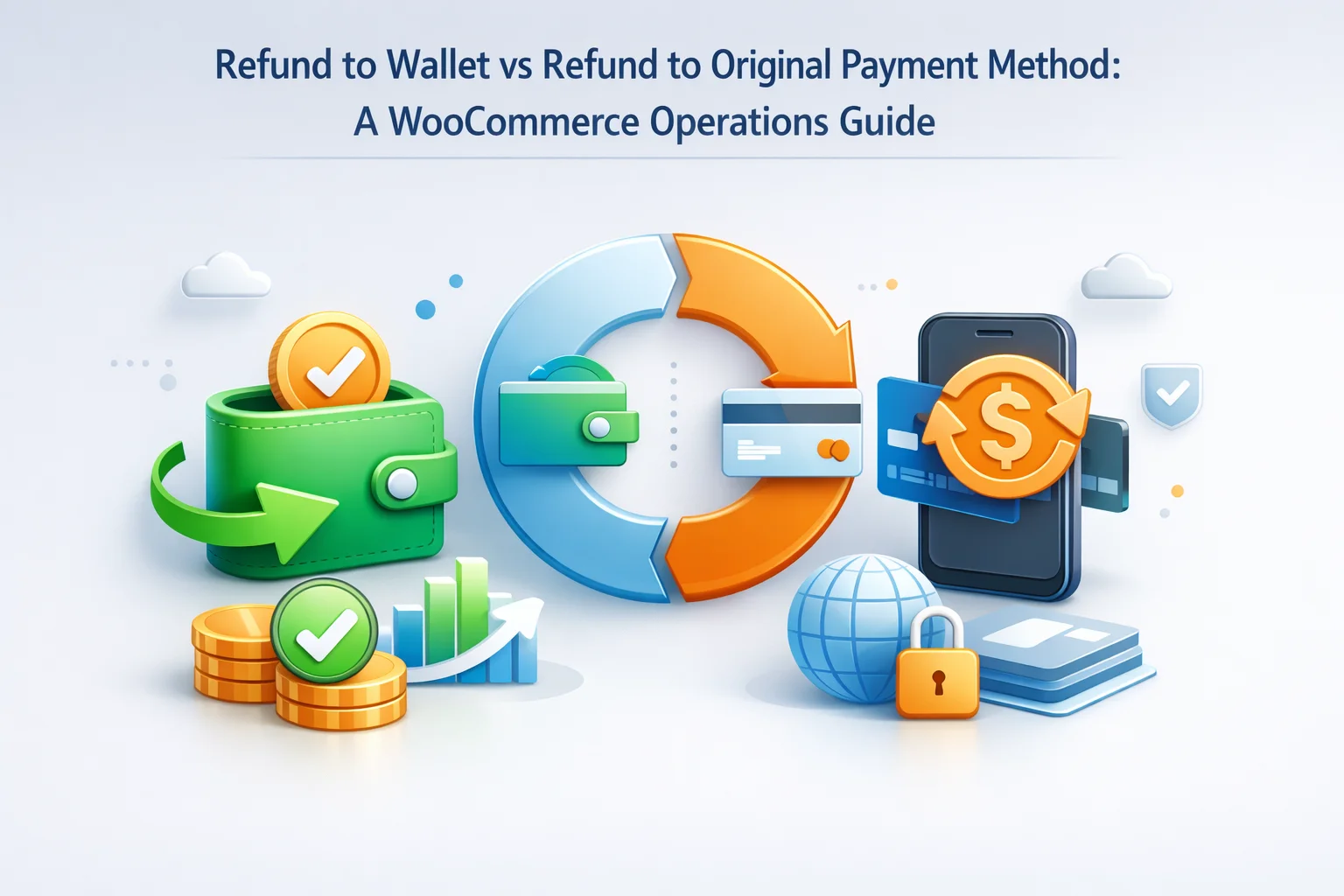
Most refund confusion is not mathematical; it is definitional. “We refunded you” sounds singular to a customer, yet your organisation may execute two materially different movements: reversing an external capture through your payment gateway, or crediting an internal wallet balance that can only be spent back with you. Both can be fair. Both can be abused if policy is vague. The operational goal is to pick the rail that matches the promise you made at purchase, the regulatory posture of your markets, and the incentives you want repeat buyers to feel—without letting support improvise economics at ticket volume.
Stores that centralise programmes on a dedicated wallet stack get one quiet advantage: a consistent transaction history language between what shoppers see in My Account and what admins audit in the back office. If you standardise on NEXU Smart Wallet & Cashback as a WooCommerce-native wallet and cashback plugin with ledger-grade transaction lists, your teams can rehearse refund scripts against the same screens customers read—reducing “two truths” incidents where the card statement disagrees with the wallet narrative.
Below, each section mirrors how serious operators sequence the decision: recognise liability first, decide business outcomes second, honour external constraints third, then train customers and auditors on how to read the trail.
Wallet balance is deferred consumption, not vanished obligation. When a shopper pays by card and you later refund to wallet, you typically reduce your immediate cash outflow while increasing your future fulfilment liability: the customer can spend that balance on another order, possibly with different margin, shipping, or tax characteristics. Finance should treat wallet credit as a classified liability on your internal model even if WooCommerce alone does not replace your ERP. Conversely, refunding to the original card usually reduces both customer receivable and your cash on hand in a way payment processors report in settlement files—timing depends on acquirer cut-off rules and partial capture states.
The operational lens is pairing. A wallet credit should appear as an explicit ledger line tied to an order ID and reason code, not as a mysterious “bonus” that could be mistaken for marketing currency. That is why teams adopt a WooCommerce smart wallet plugin that records refund-to-balance movements with traceable references to the originating order. When auditors ask “show me the refund,” you point to both the WooCommerce order note trail and the wallet ledger entry with the same monetary amount (or the split, for partial refunds).
Wallet refund: an increase in spendable store credit recorded in your wallet ledger, executed in response to a refund event, without an identical outgoing ACH/card reversal for the same monetary component. Original-method refund: funds returned through the payment pathway used at checkout, governed by processor rules and settlement timelines, reducing captured revenue in processor reporting.
Risk sits at boundaries. If agents promise “money back to your card” while the workflow credits wallet, you will generate escalations and reputational damage disproportionate to the ticket size. If finance assumes wallet refunds reduce chargeback exposure identically to card reversals, you may mis-model dispute windows. The WooCommerce order screen remains your canonical commercial record; authoritative discussions of refunds and order states belong in the ecosystem documentation merchants already cite when training staff. Review WooCommerce’s official managing orders documentation alongside your wallet ledger exports so training materials stay aligned with core platform language.
Finally, treat incentives honestly. Wallet refunds can be framed as speed (“instant spendable credit”), continuity (“keep your member perks”), or fairness (“avoid FX losses”), but the finance team must still model breakage, redemption latency, and category shift when customers spend credit differently than they would have with cash returned. Those second-order effects belong in your forecast—not in optimistic tweets from Marketing.
There are repeatable commercial scenarios where routing refunds to wallet is not a dark pattern but a deliberate operations choice. The first is goodwill at scale during service failures—out-of-stock after payment, carrier delays on high-expectation gifts, or digital fulfilment hiccups. A timely wallet credit with transparent messaging preserves the relationship while reducing immediate processor reversal volume and the accompanying reconciliation noise on busy weeks. The second is loyalty mechanics: if shoppers enrolled specifically for cashback or tier perks, re-channeling a remedy into the same economic universe reinforces programme coherence.
The third scenario is margin-aware retention. Cash refunds are leakier: customers may pocket funds and never return. Wallet credits anchor the next purchase. That is not automatically manipulative; it is priced retention—provided the shopper consented to programme rules and can still obtain an original-method refund when regulation or your written policy requires it. Ethical implementation pairs visibility with choice at the moment of refund issuance, not buried clauses from three seasons ago.
During promotional spikes, gateway reversals can queue or collide with capture batches. Wallet credits are internal postings when orchestrated through your wallet layer, letting agents stabilise customers faster while card reconciliation proceeds on its own cadence—without pretending card timelines vanished.
Credit framed as “money on your account for your next order” can match membership narratives better than a reversal that disappears into the bank feed. The tone matters: proactive, specific amounts, and explicit expiry rules if you use them.
If your marketing already positions the wallet as the home for rewards, refunds that land there feel continuous. A cashback-aware WooCommerce wallet extension that unifies incentives and corrective credits in one ledger prevents customers from juggling “promotional dollars” versus “support dollars” in their heads.
If you publish public policy, state the default rail and the upgrade path for exceptions. Silence is where margin-protective mechanics get misread as obstruction. Customers forgive structure; they rarely forgive surprises on money.
Even the most wallet-forward merchant hits walls. Regulated categories, marketplace-style buyer guarantees, enterprise purchase orders, and certain card network conditions can require funds to retrace the original settlement path. Buy now, pay later workflows and wallet-style pay-in-four products add another layer: the shopper’s obligation to the instalment provider may not be satisfied by merchant-issued store credit unless the BNPL agreement explicitly allows that remedy. Your support script should name the constraint without improvising exceptions that legal has not approved.
Chargebacks and payment investigations are another forcing function. When a dispute is open or a retrieval request is pending, altering the economics with a parallel wallet credit can confuse both the customer narrative and your evidence packet. Processor guidance on reversal lifecycle should inform how you sequence wallet goodwill versus gateway refund. Stripe’s reference material on how refunds propagate and settle—see Stripe’s refunds documentation —is a practical external anchor when training finance on timing offsets between “clicked refund” and “money moved.”
Document escalation paths before anger spikes. Agents should know who can approve an original-method exception, what evidence must attach to the ticket, and how WooCommerce order notes must read so finance recognises the adjustment during month-end review.
Customers do not navigate refunds as ledger theorists; they scan for verbs and amounts. Your wallet UI should translate backend events into plain sequences: starting balance, debit for purchase, credit for refund or cashback, ending balance. When refund-to-wallet occurs, the shopper should see an unmistakable credit line labelled as refund-related—not as generic “bonus,” which fuels suspicion. Pair textual clarity with timestamps and order references wherever possible so self-service reduces ticket load.
Coach frontline teams to narrate dual-path refunds without sounding defensive. If wallet credit appears immediately while a card reversal could take multiple banking days, say so plainly and point to where the shopper can verify the wallet line on the history screen you standardised. If your programme uses the Smart Wallet plugin for WooCommerce customer-facing wallet pages and transaction chronology, rehearse screenshots during onboarding so newer agents stop improvising geography on the site map.
Admin tooling exists to compress forensic time. When finance asks whether a refund truly landed as wallet credit, your answer should be a short navigation path with reproducible filters: user, date window, associated order, amount symmetry. The Transactions tab is where teams validate that operational intent matched system behaviour—especially after bulk adjustments, imports, or integration glitches from ERP bridges you trial in Q4.
Treat dashboard review as a ritual, not heroics. Daily spot checks during campaigns catch anomalies early; monthly reconciliations compare sampled wallet deltas against gateway settlement summaries and refund batches. Where teams adopt NEXU’s admin Transactions tooling as part of a WooCommerce wallet ops stack with export-friendly ledger views, auditors spend less time reconstructing narratives from screenshots and more time validating controls.
Ambiguous refund language creates adversarial creativity: customers interpret “money back” as literal cash; finance interprets “credit” as liability-neutral until redeemed; legal worries about unfair terms. The fix is not bigger paragraphs in your footer; it is a concise matrix published internally and mirrored in customer-facing FAQs with identical definitions. Start with triggers: when wallet refund is default, when original method is mandatory, when the shopper may elect either path, and how quickly each executes.
Support macros should quote the policy sentence verbatim for each scenario—no paraphrase on tickets worth more than a trivial threshold. Finance should sign off on numeric examples used in training decks so examples match rounding rules your WooCommerce tax configuration actually applies. Consumer-facing principles from regulators can inform tone and prominence; for United States merchants, the FTC’s guidance on refund requirements for advertisers is a sobering reminder that burying conditions contradicts the clarity regulators expect—even when your implementation is technically sophisticated.
“Unless otherwise required by law or stated at checkout, qualifying refunds may be issued as store credit to your programme wallet. Store credit is spendable only on purchases from [Brand] and does not accrue interest.”
“Where refunds must return through your original payment method, processing times follow your card issuer or payment provider and may take several business days after we submit the reversal.”
Align marketing incentives with legal defaults. If a campaign promises “cash back” colloquially but funds the wallet, ensure headlines match ledger reality. Precision is cheaper than retractions.
Partial refunds are the stress test. Split shipments, restocking fees, and line-item cancellations each demand itemised amounts rather than blunt order totals. Wallet postings should mirror the same decomposition finance expects on the tax invoice: which lines were reversed, which fees retained, and whether shipping was recalculated. When tax jurisdictions mix rates inside one order, partial refunds can shift effective tax more than newcomers expect—especially where VAT-inclusive display meets enterprise exemptions.
Multi-currency merchandising compounds confusion if wallet balances are denominated differently from the order currency history customers remember. Decide whether wallet credits anchor to shop base currency with transparent conversion notes, or whether you maintain currency-specific sub-ledger balances for international programmes. Either approach can work; inconsistency cannot. Payment platforms publish FX behaviour on refunds; consult your processor’s international guidance in parallel with WooCommerce currency plugin choices so agents do not promise FX outcomes your stack cannot guarantee.
Gift cards layered with wallet promotions remain a recurring edge case: redemption sequencing affects perceived fairness when partial refunds occur. Governance here is less about WooCommerce mechanics than about programme design—yet your ledger must still say who received what, when. Document edge-case playbooks quarterly; edge cases age into incidents faster than core flows.
Mixed-tax carts deserve explicit QA scripts. When one line attracts reduced VAT and another standard rate, a naive partial refund screen can propose totals that finance cannot defend on audit. Walk through scenarios where coupons stack with wallet balance: ensure your refund calculator applies discounts in the same sequence your checkout used, because reversing that sequence changes remainder allocation between gateway and wallet when you split refunds across rails. If your catalogue spans digital and physical goods with different evidence requirements for tax exemption certificates, attach exemption metadata to orders so agents do not strip tax incorrectly during remediation.
Subscription-adjacent stores introduce proration refunds that interact awkwardly with wallet incentives. When a subscriber cancels mid-cycle, decide whether wallet credits represent unused time, waived fees, or goodwill—and reflect that vocabulary consistently on ledger entries. Mislabelled lines invite disputes when customers compare wallet history with emailed invoices from your billing extension. Keep cross-team glossary documents versioned alongside WooCommerce plugin updates so terminology does not drift across departments after a major release weekend.
Finally, rehearse refund storms: Black Friday batch cancellations, carrier strikes, or supplier recalls can force hundreds of partial wallet credits in hours. Load-test not only web servers but human workflows: who approves thresholds, how duplicate prevention works if two agents open the same order, and how you detect accidental double-credit before customers spend it downstream. Stress exercises reveal whether your operational guide is decorative or operational.
Auditors care about completeness and linkage, not branding. Your objective is trivial reproducibility: given order O, produce wallet lines W1…Wn whose signed sum matches the wallet portion of the refund decision, plus gateway artefacts G for card reversals where applicable. Treat mismatches as incident-class events until proven benign—rounding aside, rounding itself should be explicit in policy so finance does not defend ambiguous pennies across ERP boundaries.
Start from WooCommerce order notes and refund records as the narrative spine. Export wallet transactions for the same customer and window; align by timestamp clusters and amounts. Investigate outliers: credits without matching orders often trace to manual goodwill adjustments; debits without purchases may indicate wallet-funded checkouts mis-tagged in reports. Establish sampling cadence—weekly during programmes, monthly at steady state—with larger samples whenever you deploy payment gateway certificate rotations or wallet plugin upgrades.
Pairing improves when identifiers propagate cleanly. Train agents to paste order IDs into adjustment reasons when permitted, and forbid free-text improvisation on high-value credits. Engineering should ensure hooks fire exactly once per refund attempt; duplicate firing shows up as twin ledger lines that terrorise reconciliation until someone spots the duplication pattern. Document rollback steps when an automation misfires so you reverse wallet credits with the same rigour as card refunds—half measures create zombie balances nobody wants to explain at year-end.
External reviewers may ask how you segregate duties: who can issue credits, who approves thresholds, who exports data. Map those roles before audit season; retrofitting authority matrices during live review looks improvisational even when controls exist informally. Archive CSV snapshots of ledger exports alongside gateway settlement files for the same periods so later disputes reference immutable artefacts rather than mutable dashboards alone.
Stores standardising audit posture across wallet and gateway rails frequently consolidate on one wallet implementation with transparent exports and disciplined admin screens. Teams evaluating an enterprise-style WooCommerce wallet plugin that pairs WooCommerce orders with wallet ledger entries for reconciliation-ready workflows typically aim to shorten month-end bridges between ecommerce data and finance systems without hiring another analyst purely for spreadsheet archaeology.
Publish a one-page refund routing matrix, rehearse wallet versus card scripts with support, then reconcile a pilot week where every refund maps cleanly from WooCommerce orders to ledger lines and gateway reports. When the trail holds under scrutiny, scale confidently—wallet economics should never rely on heroic interpretation.
Explore NEXU Smart Wallet & Cashback for WooCommerce
Centralise wallet credit, cashback, customer history, and admin Transactions in one WooCommerce-native layer built for operators—not demo gloss.





This guide saved my team hours of back and forth with finance. Just the admin verification patterns in the Transactions dashboard made refund routing way clearer no more guessing which rail to use.
This guide reads like it was written by accountants for accountants. bought it hoping for clear WooCommerce refund workflows, but it's just 17 pages of corporate jargon about "liability classification" and "ERP alignment." If I wanted a finance lecture, I'd hire a CPA. Where's the actual step by step for store owners? waste of time
Hey, the admin verification patterns in the Transactions dashboard actually make sense now.
This guide really cleared up a lot for me. The part about wallet credits being a liability was something I'd never even thought about it actually helped me get my books in order