Next-Level Code. Nexuvibe Style ...
Hrs
Min
Sec

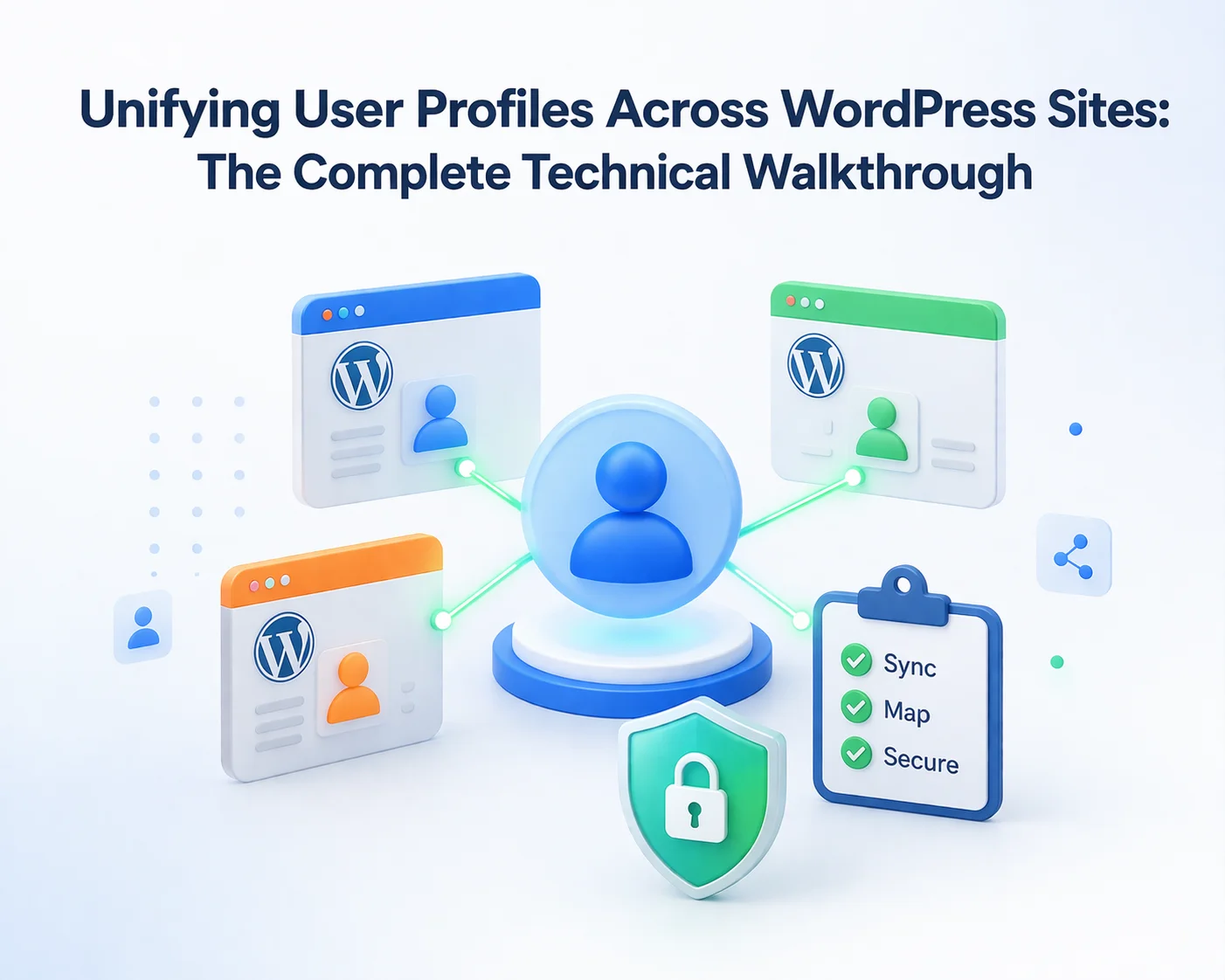
Most articles about WordPress user synchronization focus on the what and the why. This one focuses on the how. If you are a developer, site administrator, or technical decision-maker who needs to understand exactly what happens when user profiles synchronize between WordPress sites, this is the comprehensive reference you have been looking for.
We will examine the WordPress user data architecture, the REST API mechanisms that enable cross-site communication, the event hooks that trigger synchronization, and the data transformation logic that handles fields differently structured across sites. We will also cover the edge cases: what happens during conflicts, how the queue system manages load, and how security is maintained throughout the process.
Whether you are evaluating sync solutions, planning an implementation, or troubleshooting an existing setup, this guide provides the technical foundation you need.
Before diving into synchronization mechanics, you need to understand how WordPress stores user data. This architecture directly influences what can be synchronized, how efficiently it can be done, and what edge cases you might encounter.
WordPress splits user data across two primary tables. The wp_users table contains core identity fields: ID, user_login, user_pass (hashed password), user_nicename, user_email, user_url, user_registered timestamp, user_activation_key, user_status, and display_name. These are the fundamental attributes that define a user account.
The wp_usermeta table stores everything else using an Entity-Attribute-Value (EAV) pattern. Each row contains a user_id, meta_key, and meta_value. This flexible structure allows WordPress and plugins to store arbitrary user data without schema changes. Your first_name, last_name, nickname, description, and wp_capabilities all live here. So do WooCommerce billing addresses, membership plugin data, and any custom fields you have added.
The EAV structure of usermeta creates both flexibility and complexity for synchronization. You cannot simply copy the table, because meta_keys might mean different things on different sites. A meta_key like membership_level might be used by different plugins on different sites with incompatible value formats. This is why field-level configuration, specifying exactly which meta_keys to sync, is essential.
A robust WordPress user synchronization system operates on an event-driven model. Rather than polling for changes or running periodic batch jobs, it hooks into WordPress actions that fire when user data changes. This enables real-time synchronization with minimal overhead.
The key WordPress hooks for user synchronization include user_register which fires after a new user is created, profile_update which fires when user profile data is updated, delete_user and deleted_user which fire during the user deletion process, after_password_reset which fires when a password reset completes, and wp_login which can be used to trigger sync verification on authentication.
Fires immediately after WordPress inserts a new user into the database. The hook receives the new user’s ID as a parameter. At this point, the user exists in wp_users but usermeta may still be incomplete. A sync system typically waits briefly or hooks into additional actions to ensure all initial meta is captured before transmitting the new user to connected sites.
Fires when a user profile is updated through the WordPress admin or via wp_update_user. Receives user_id and old_user_data parameters, allowing the sync system to determine exactly what changed. Efficient implementations compare old and new values to transmit only the modified fields rather than the entire profile.
Password changes can occur through multiple paths: profile updates, password reset flows, programmatic changes. The after_password_reset hook catches reset-based changes, while profile_update catches admin changes. A comprehensive sync system monitors all paths to ensure password hash consistency across sites, which is essential for SSO functionality.
The updated_user_meta, added_user_meta, and deleted_user_meta hooks fire when individual meta values change. These are essential for catching changes made by plugins that update usermeta directly without going through the profile update flow. WooCommerce billing address updates, for example, often happen through direct meta updates.
Cross-site synchronization requires a reliable communication channel. The WordPress REST API provides this foundation. A properly architected user sync plugin registers custom REST endpoints for receiving sync payloads and authenticates requests using secure API keys.
When a sync event fires on Site A, the system constructs a JSON payload containing the relevant user data. This payload is transmitted via HTTPS POST request to Site B’s sync endpoint. Site B validates the request authentication, processes the payload, and returns a response indicating success or failure.
The payload structure typically includes an action type (create, update, delete), a user identifier (usually email since user IDs differ between sites), the changed fields with their new values, a timestamp for conflict resolution, and a cryptographic signature for integrity verification. The receiving site uses the email to locate the corresponding local user, then applies the changes according to its sync configuration.
Not all fields should sync identically between sites. Field mapping configuration lets you control exactly what data flows where and how it transforms during transmission.
Core user fields like email, password hash, and display name typically sync bidirectionally. These are fundamental identity elements that must match everywhere for SSO to work correctly.
User roles require mapping rather than direct copying. The wp_capabilities meta stores serialized PHP arrays representing user roles. Role names might differ between sites (customer vs subscriber, for example), and blindly copying capabilities could create security issues. Role mapping configuration specifies which source role translates to which target role on each connected site.
WooCommerce customer data involves multiple meta fields that should be treated as a logical group. Billing address fields (billing_first_name through billing_phone) and shipping fields should typically sync together to maintain consistency. The configuration interface lets you enable or disable entire field groups rather than managing dozens of individual meta keys.
In a distributed system, conflicts are inevitable. Two sites might receive updates to the same user at nearly the same time. A robust sync architecture needs deterministic rules for resolving these conflicts.
The simplest conflict resolution strategy. Each sync payload includes a timestamp. When a receiving site already has data newer than the incoming payload, it ignores the update. When the incoming data is newer, it overwrites the local data. This requires reasonably synchronized clocks across servers, which modern infrastructure typically provides via NTP.
In a master-sub architecture, the master site’s data always takes precedence. Sub sites can push changes to the master, but if both have changes, the master’s version wins. This provides a clear single source of truth and eliminates ambiguity, at the cost of occasionally overwriting legitimate sub-site changes.
More sophisticated systems can merge at the field level. If Site A updates first_name while Site B simultaneously updates billing_city, both changes can be preserved since they affect different fields. This requires tracking per-field timestamps and increases implementation complexity, but provides the most accurate representation of user intent.
Processing sync operations inline with web requests would create performance problems and reliability issues. A queue-based architecture decouples the event capture from the actual sync processing.
When a sync event fires, the system adds a job to a queue stored in the WordPress database. A background process, typically triggered via WP-Cron or a system cron, picks up queued jobs and processes them. This approach provides several benefits.
Web requests complete immediately without waiting for external API calls. The queue can implement rate limiting to avoid overwhelming receiving sites. Failed sync attempts can be automatically retried with exponential backoff. High-traffic periods that generate many sync events do not impact site performance because processing happens in the background.
The queue interface provides visibility into what is pending, what is processing, and what has failed. Administrators can manually retry failed jobs, clear the queue if needed, or investigate why particular sync operations are not completing.
Transmitting user data between sites requires careful security implementation. A secure WordPress user sync implementation addresses authentication, encryption, and integrity verification.
Each site connection uses a unique API key generated during the connection setup process. Incoming sync requests must include this key in their headers. The receiving site validates the key before processing any data. Keys are stored hashed in the database, and the connection setup process ensures both sites have matching credentials.
All sync communication must occur over HTTPS. This provides transport-layer encryption that prevents eavesdropping on user data in transit. Most sync systems refuse to connect to sites that do not have valid SSL certificates, enforcing this requirement at the connection setup stage.
Each sync payload includes a cryptographic signature computed from the payload contents and a shared secret. The receiving site recomputes the signature and verifies it matches. This prevents tampering with sync data in transit and ensures the payload was generated by a legitimate source that knows the shared secret.
Comprehensive logging is essential for troubleshooting sync issues, verifying data integrity, and maintaining confidence in the system. Every sync event should be recorded with sufficient detail to understand exactly what happened.
Log entries typically include the timestamp, the action type (create, update, delete), the user identifier, the source and destination sites, the specific fields affected, the outcome (success or failure), and any error messages. Logs should be searchable by user, by date range, by outcome, and by site to enable efficient troubleshooting.
Dashboard-level monitoring complements detailed logs by showing aggregate metrics: total users synced, recent sync activity, connection health status, and any pending queue items. This high-level view lets administrators quickly assess whether the system is functioning normally without diving into individual log entries.
User profile synchronization across WordPress sites involves coordinating multiple complex subsystems. Understanding these technical foundations helps you make informed decisions about implementation, troubleshoot issues effectively, and customize behavior for your specific requirements.
The Nexu User Sync plugin implements all these technical components in a production-ready package. The configuration interfaces expose the necessary controls without requiring you to write code, while the underlying architecture handles the complex synchronization logic reliably and efficiently.
Whether you are a developer evaluating solutions, an administrator planning deployment, or a technical consultant advising clients, this technical foundation enables informed decision-making about cross-site user profile unification.
Nexu User Sync delivers robust architecture with REST API communication, background queuing, field mapping, conflict resolution, and comprehensive logging. Enterprise-grade sync for any WordPress network.



Hey everyone! Just finished reading the technical walkthrough on user profile sync, and wow this is the kind of deep dive I wish I had before tackling my last multisite project. The section on wp_usermeta and how first_name, last_name, and wp_capabilities are handled was a game saver.
Oh man, this guide saved me during a last minute migration. the part about table prefixes was a lifesaver our multisite setup had three different ones, and I was freaking out about how to map users correctly. explained it in a way that actually made sense, not just tech jargon. wish I found this sooner instead of wasting hours guessing.
This guide actually breaks down why syncing user meta across sites is such a pain turns out it's not just copy paste like I thought. The EAV setup in usermeta is wild because you can shove anything in there (membership tiers, random WooCommerce fields, whatever), but that flexibility becomes a nightmare when one site stores "membership_level" as a number and another uses text labels. The part about conflict resolution was a lifesaver I had no idea how often "last write wins" would mess things up without clear rules.
The guide says first_name, last_name, nickname, description, and wp_capabilities are all stored together could someone confirm which table they're actually in? like, is it wp_users or wp_usermeta? Just want to double check before digging in.