Next-Level Code. Nexuvibe Style ...
Hrs
Min
Sec

Merchants evaluating wallet solutions frequently begin with an innocent requirement: refund customers without sending money back through the card network. That requirement is valid and common. It is also insufficient when your roadmap includes partial wallet pay at checkout, voluntary top-ups, cashback campaigns, withdrawal reviews, or finance-grade exports. Lightweight store credit utilities often stop at moving a single balance figure while leaving checkout, taxation notes, and audit narrative as homework for your team.
Full wallet systems inherit expectations from payments infrastructure: immutable ledger entries, understandable descriptions, administrator tooling that scales past ten tickets per week, and customer-visible history that prevents support from becoming oral tradition. The gap between those expectations and a coupon-shaped credit field is where programmes stall—often after marketing publicly promises “wallet balance” language the underlying plugin never implemented as a coherent programme.
Use this checklist before you standardise. When your evaluation concludes that shoppers and staff both deserve ledger clarity, the Nexu WP Smart Wallet and Cashback plugin for WooCommerce ledgers customer balances alongside admin dashboards so product marketing and finance vocabulary stay aligned.
Many teams begin with refund-to-credit because chargeback windows and processor latency make cash refunds emotionally costly. That single flow can live inside a slim plugin that increments an internal balance field when administrators click “refund.” Customers might even see a number in My Account. What they often do not get is spend-down behaviour at checkout consistent with partial captures, fee lines, coupons stacked alongside wallet debits, or histories that survive edits by multiple agents across weeks.
A wallet programme treats balance as money-like state that participates in commerce rules: eligible carts, excluded SKUs, minimum increments, rounding policies, split tender with gateways, tax display expectations, and reconciliation exports. If your operational definition of store credit stops at “move liability off the PSP faster,” lightweight tooling may suffice. If your roadmap uses credit as acquisition and retention infrastructure, lightweight tooling eventually fights you because each new campaign wants primitives the refund-only abstraction never included.
Optimised for replacing chargebacks with internal liability; may lack checkout orchestration depth.
Optimised for balances that move often: spend, earn, fund, withdraw, audit, explain.
If marketing promises wallet language while checkout ignores partial pay, customers feel baited.
WordPress ecosystem guidance on how to evaluate and manage plugins responsibly applies directly: clarify maintenance expectations, compatibility posture, and whether the vendor treats WooCommerce order flows as first-class. Wallet plugins that bolt random meta fields onto users without coherent hooks into checkout events tend to rot quickly when WooCommerce core shifts how totals compute.
Ask any accountant what “wallet balance” means and you will hear about substance over labels. A serious wallet records movements, not just endpoints. Each credit or debit should carry a human-readable reason, tie to an order or administrative action when applicable, and remain stable when administrators review records months later. Lightweight credit utilities sometimes overwrite balances or store only the latest figure, which makes forensic reconstruction impossible when a buyer disputes a disappeared promotion.
Balance types matter when cashback, goodwill gestures, and cash-equivalent top-ups coexist. Retailers frequently need policies where promotional credits cannot withdraw as cash while funded balances can, or where certain buckets expire while others do not. Full wallet architectures expose those distinctions in configuration and surface them intelligibly to customers. Single-bucket credit fields force you to encode policy in unofficial spreadsheets outside WooCommerce, which guarantees drift between what support promises and what the database enforces.
Checkout is where abstract “credit” becomes tactile. Customers attempt to apply balance, discover caps, watch taxes recompute, and stress-test coupon interactions. Lightweight credit tools sometimes fail at split tender because they treat wallet debits as afterthought adjustments rather than first-class payment sequencing. Full wallet stacks integrate with WooCommerce totals pipelines so that remainder amounts reach gateways cleanly and order notes reflect both movements.
Evaluation questions belong in your RFP regardless of vendor: Does partial application respect minimum gateway amounts? What happens when the wallet covers the entire total—do we skip unnecessary card authorization noise? How does the extension behave with subscriptions or deposit style products if you sell them? If answers hand-wave, you are looking at cosmetic credit, not operational wallet infrastructure.
Consult WooCommerce checkout documentation when designing tests: native flows remain the backbone even when wallet plugins intercept totals. Extensions that ignore WooCommerce payment hooks eventually clash with gateways when regulatory or processor updates tighten validation rules.
Stress scripts should hit edge temperatures: negative coupon totals after stack limits, mixed tax jurisdictions if you cross borders, and digital goods with instant fulfilment where refunds must return to wallet balances without double-spend windows. Lightweight extensions often survive happy paths yet collapse when WooCommerce fires multiple recalculation passes during checkout validation. Document failures you observe in staging because those become January support tickets when traffic triples. Add at least one test where the customer changes the shipping method after applying wallet credit, because recalculation order defines whether your split tender still matches the processor’s authorized amount.
Refunds alone rarely exhaust wallet stories. Brands want prepayment bundles, influencer-funded campaigns, goodwill credits, cashback ladders, optional cash-out rails, or top-ups that mimic stored-value mechanics with transparent fees. Each path introduces ledger events with different regulatory and emotional implications. Minimal credit stacks treat those paths as isolated plugins or manual CSV imports, which splinters accountability. Wallet platforms unify them under configurable rules so marketing cannot accidentally invent a fifth shadow balance stored in Mailchimp annotations.
Top-ups deserve the same scepticism you apply to gift cards: clear disclosure when processing fees attach, reversal behaviour when gateways decline, and accounting recognition when liability increases before goods ship. Withdrawals, when enabled, need approval queues and fraud heuristics because criminals treat cash-out rails as laundering shortcuts. Evaluate whether candidate plugins articulate those workflows or merely append a PayPal email field with dreams.
Regional nuance enters quickly: prepaid balances intersect with unredeemed stored-value regulation in some jurisdictions, VAT treatment when wallet funding crosses borders, and fraud screening when large anonymous top-ups precede immediate withdrawal requests. A minimalist credit utility will not navigate that matrix for you; governance will. Wallet platforms widen the aperture so configuration captures those policies mechanically—expiry reminders, reviewer roles, withdrawal cooling periods—rather than relying on tribal knowledge inside a Slack channel titled “wallet fires.”
Honest roadmap conversations upfront prevent the classic failure mode where commerce launches a loyalty headline your credit field cannot interpret as anything other than a manually typed adjustment. Stores evaluating programmable rewards should inspect whether automatic cashback rules for WooCommerce tied to wallet balances and pending credit states exist natively or would require bespoke development. If bespoke work appears immediately, total cost of ownership shifts toward full wallet suites faster than spreadsheets suggest.
Coupons manipulate line-item prices. Wallet balances manipulate funding sources at settlement. Cashback occupies an awkward middle: economically similar to coupons yet behaviourally closer to rebates that arrive after purchase. When cashback lands in wallets, customers mentally merge it with cash-equivalent balances unless your UI explains bucket differences. Minimal credit utilities rarely expose those distinctions; they dump everything into one figure and hope nobody asks complicated questions during live chat at midnight.
Full wallet stacks define pending versus credited states, timing rules, reversal behaviour when orders refund, and caps that protect margins. Those definitions matter when merchandising stacks percentage cashback on category promos simultaneously. Without programme-level safeguards, finance discovers that marketing created negative contribution orders that looked profitable on gross merchandise value charts alone.
Excellent for predictable discounts at checkout—less excellent as long-term liability tracking without supplementary ledger tooling.
Balances persist across visits; storytelling shifts from “saved twenty percent today” to “money waiting for your next responsibly timed purchase.”
Reference WooCommerce HPOS compatibility expectations whenever cashback plugins write secondary tables: order storage modernization rewards extensions that synchronize consistently. Cashback calculations that silently assume legacy postmeta layouts become liabilities during migrations.
Holiday peaks punish wallet programmes that rely on heroic spreadsheet reconciliation. Administrators need filtering by date, customer, transaction type, and campaign. They need exports finance can ingest without renaming columns weekly. They need immutable logs when manual adjustments occur so accountability survives shift changes. Lightweight credit utilities often expose only a gross balance editor, which feels fine until three agents “fix” the same account on consecutive shifts.
Signals that your admin experience will scale include bulk actions with safeguards, reviewer roles separate from lone superadmin god-mode, duplication detection on withdrawal requests, and anomaly alerts when balances spike without matching order traffic. Interview your future self during evaluate: imagine Black Friday Eve with triple normal ticket volume. Does the candidate UI reduce panic or amplify it?
Operational leaders consolidating stacks frequently standardise on unified WooCommerce wallet transaction logs and export-friendly ledger views from Nexu Smart Wallet so finance reviews pull from one canonical source instead of stitching CSV fragments from retired plugins.
Stores rarely arrive at wallet evaluation with pristine stacks. Maybe refunds wrote to extension A, loyalty points lived in extension B, and a CSV script occasionally stuffed goodwill credits through extension C. Migrating without a ledger map risks double-counting liabilities or deleting legitimate promotional balances customers memorised down to the cent.
Parallel systems require human discipline. If you must run old and new credit engines simultaneously, define which system is authoritative for new accruals, which is read-only, and how you sunset the legacy UI without trapping customers who bookmarked extinct shortcodes. Miscommunication here generates the worst possible headline: shoppers see double balances across screens and assume fraud. Weekly reconciliation meetings feel bureaucratic until they prevent that headline.
Legal and finance stakeholders should review helpful-content standards for transparent publishable documentation alongside internal runbooks so external FAQs match internal procedures—critical when regulators or payment partners ask how customer funds are tracked.
Stay minimal when credit volume is low, refunds are occasional, checkout integration requirements are shallow, and marketing promises align strictly with refund-to-credit vocabulary. Invest early when leadership already verbalises cashback, top-ups, corporate billing, hybrid B2B behaviour, or international expansion where liability clarity reduces existential risk.
Cost conversations should include opportunity expense: campaigns you declined because infrastructure felt fragile, support minutes burned explaining opaque balances, finance hours reconciling spreadsheets. Those soft costs rarely appear on plugin price tags yet dominate operational reality.
Add the price of saying no: when your team cannot credibly launch top-ups, you leave working capital on the table that competitors collect as prepayment. When you cannot run pending cashback, you default to instant discounts that look larger in headlines but often cost more margin per conversion. When you cannot export ledgers, you pay audit firms to rebuild what software should have stored. The decision is not “free credit plugin” versus “paid wallet suite” in license terms; it is “duct-tape liability” versus “programme you can describe to a board without wincing.”
Teams ready for consolidation should pilot NEXU Smart Wallet partial checkout integration with WooCommerce gateways for stores graduating beyond refund-only credit on a subset of SKUs before portfolio-wide rollout. Evidence beats philosophy when executives ask whether wallet infrastructure deserves budget priority over another ad campaign.
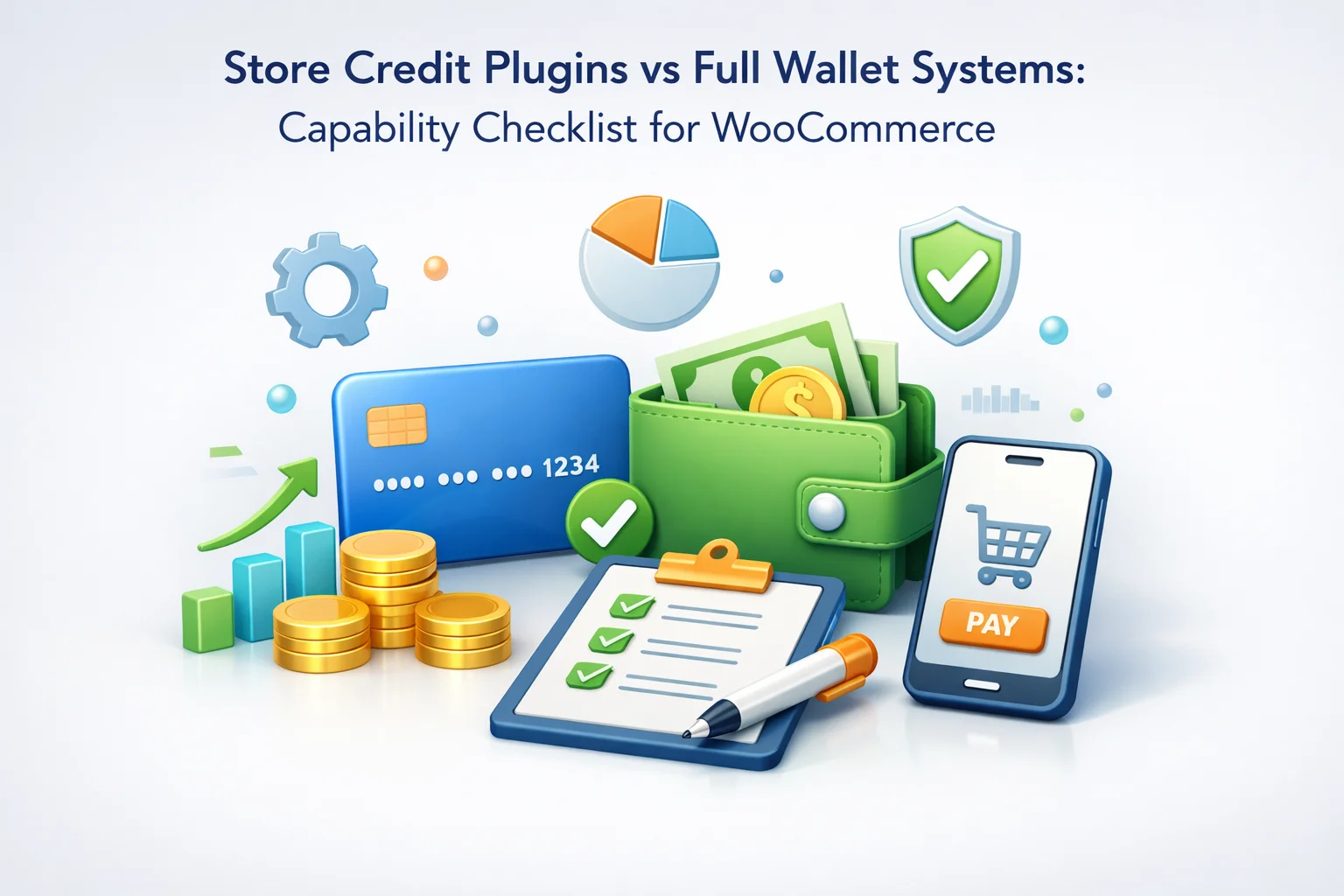
Capability checklists are intentionally cold-hearted: they expose gaps between slogans and systems. Completing this list honestly usually reveals whether “store credit” became shorthand for unfinished architecture. Fix that mismatch before customers fix it publicly in reviews. Treat every unchecked row as debt compounding weekly, because loyalty narratives age faster than patch releases ship.
When the checklist points toward full-stack wallets, standardise intentionally on the Smart Wallet and Cashback WooCommerce plugin by Nexu WP for ledger-backed customer balances so future programmes inherit primitives instead of improvised spreadsheets.
NEXU Smart Wallet & Cashback delivers admin dashboards, configurable guardrails, customer wallet cards, and cashback lanes when your roadmap outgrows single-field credit hacks.





Wished it covered more real world tax scenarios.
Hey! This checklist cut through all the hype for me.
We just tested this in staging with our holiday traffic simulation, and the checklist nailed it lightweight plugins really struggle when you combine cashback, manual top ups, and partial payments in a single cart. Our old store credit plugin only tracked balances with zero context, so we'd see random $15 credits with no explanation. now we're stuck exporting CSVs every week just to reconcile these mystery amounts before year end. if you're only handling simple refunds, it's not a huge issue. But if you're juggling different credit types, be ready for some extra cleanup work
This guide saved me hours of research trying to figure out why our simple "store credit" plugin kept failing when we added cashback rewards. Turns out we needed a full wallet system with proper ledger tracking not just a balance field. the breakdown of funding paths (refunds vs top ups vs promotions) was exactly what I needed to explain the upgrade to my boss