Next-Level Code. Nexuvibe Style ...
Hrs
Min
Sec

You spend time and effort building a recovery email sequence. You write a good subject line. You get the timing right. The email lands in the inbox, the shopper opens it, they click. And then they arrive at your homepage, or your cart page showing zero items, or a product listing page with no indication of what they were originally buying. That click — the hardest thing to earn in the entire recovery process — is wasted.
This is not a hypothetical failure mode. It is the default outcome for a significant percentage of WooCommerce stores running cart recovery without magic links. The email works. The click happens. The return path breaks. And the shopper, who was close enough to buying to open a recovery email and click a link, abandons again — this time for good — because reconstructing a cart from memory is just slightly more effort than they are willing to make.
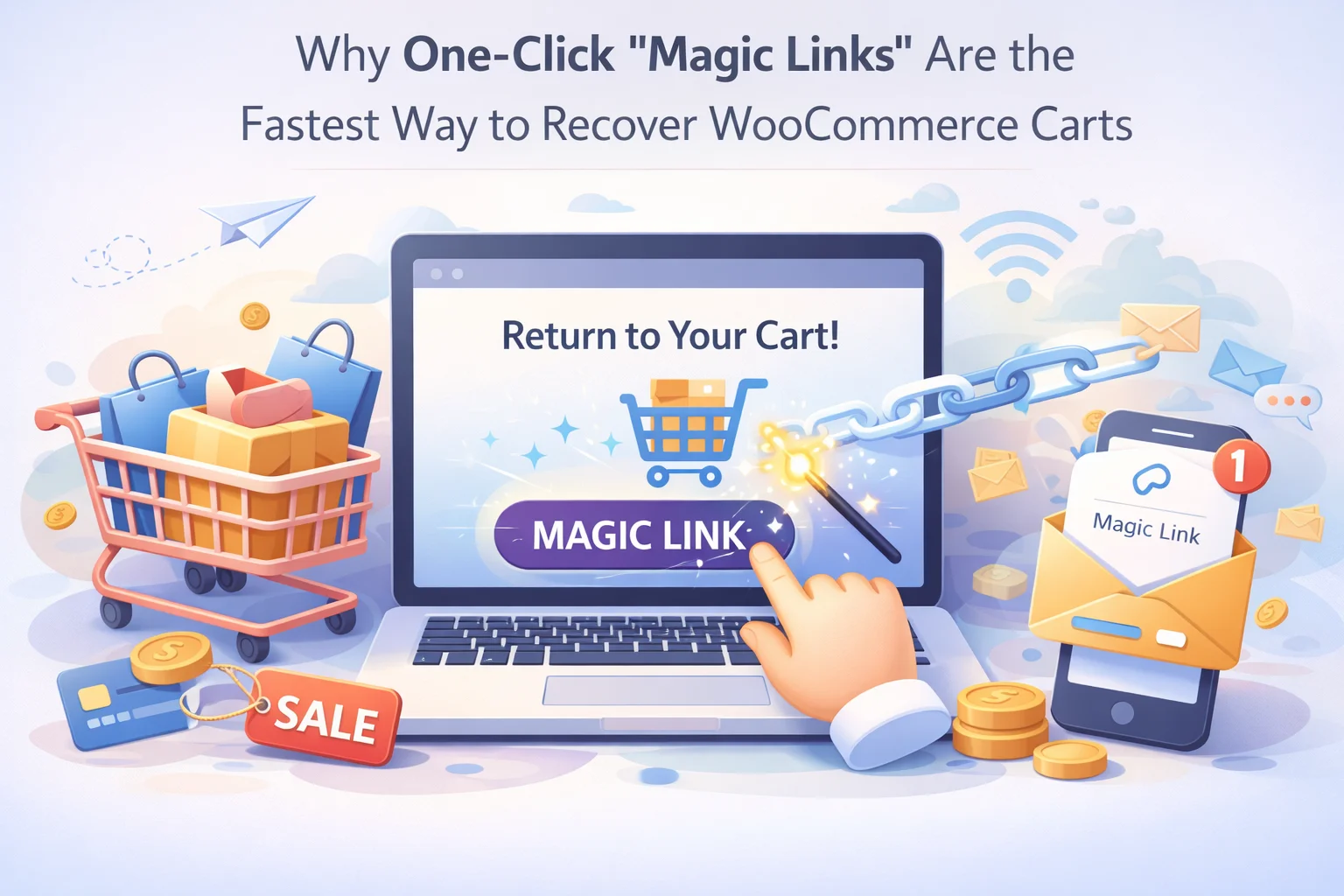
Magic links — also called cart restore URLs or one-click recovery links — solve this problem at its root. They carry the entire cart state inside a single URL so that clicking the link in a recovery email takes the shopper directly to their populated checkout page, every item restored, ready to complete. No login. No searching. No rebuilding anything. One click, one step, done. We cover this through the lens of WooCommerce one-click cart restore link generation for recovery emails, but the core mechanic and the reasoning behind it applies universally.
This guide covers why magic links work, how they work technically, what a good implementation looks like, the common ways they fail, and how to test whether yours are performing correctly. By the end you will understand why the link in your recovery email is as important as every word written around it.
There is a measurement gap in abandoned cart recovery that almost every store owner eventually notices but rarely diagnoses correctly. Email open rates look reasonable. Click rates are decent. But the conversion rate on clicks — the percentage of people who click the recovery email and actually complete a purchase — is far lower than expected. The instinctive response is to blame the email content. The real culprit is usually the destination.
When a shopper opens a recovery email and clicks a generic link to your store, they face a reconstruction problem. They need to remember which specific product they were looking at, find it again in your catalog, add it back to their cart in the right variant and quantity, navigate back to checkout, and re-enter their payment details. Every one of those steps is an abandonment risk. The shopper who opened your email was motivated enough to click — but each additional step between clicking and completing drains that motivation.
A magic link is a URL that contains encoded information about the abandoned cart session — the specific items, quantities, variants, applied coupons, and in some implementations the customer’s prefilled checkout details. When the shopper clicks the link, WooCommerce decodes that information, reconstructs the cart exactly as it was at the moment of abandonment, and delivers the shopper to the checkout page with everything already populated.
The link itself does not look like a meaningful URL to the shopper. It is typically a short, tokenized URL that resolves server-side to the correct cart state. The token in the URL is unique to the specific cart session and is generated at the moment the abandoned cart is recorded, not at the moment the email is sent. This means the link can also carry authentication — for logged-in users, clicking it can restore both their cart and their logged-in session simultaneously, so they do not have to stop to sign in before completing the order.
The magic link encodes the product ID, quantity, and variant selection — size, color, material, configuration — for every item in the abandoned cart. When the link resolves, WooCommerce adds each item back to the cart in exactly the form the shopper had selected it. A shopper who chose “Blue, Large, 2 units” of a product arrives at the checkout with exactly that in their cart. They do not have to reselect anything.
If the recovery email includes a dynamic coupon, the best implementations encode that coupon directly into the magic link so it is automatically applied when the cart is restored. The shopper does not have to copy a code, find a coupon field, and manually enter it — the discount is already there when they arrive. This is a meaningful conversion improvement because it eliminates the friction of coupon application, which is itself an abandonment risk.
For registered customers, the magic link can include a secure authentication token that logs them into their account when they click. This means a returning customer does not interrupt their purchase path to enter a password. They click the recovery email, land at the checkout fully authenticated with their address and payment preferences pre-populated, and face nothing but the confirmation step. The experience is genuinely seamless in a way that no generic link can produce.
For guest shoppers who entered their email and began filling in their checkout details before abandoning, a well-implemented magic link can also pre-populate whatever checkout fields were already typed. The guest does not have to re-enter their name, email address, and shipping details — those fields come back pre-filled. Combined with the restored cart, the guest experience on return is as close to seamless as it can be without an account.
The magic link improvement in recovery conversion is meaningful for every shopper segment — but it is most significant for guests. A registered user who receives a recovery email can, in a pinch, log into their account, find their saved cart (if WooCommerce has persisted it), and proceed from there. The experience without a magic link is friction-heavy but workable. A guest who receives a recovery email without a magic link faces a genuinely difficult path back.
The guest has no account to log into. Their cart is not saved to a profile. The link in their email sends them to your store, which greets them with an empty cart and no indication of where their selected items have gone. They have to navigate your catalog from scratch, find the exact product in the exact configuration they had selected, add it back, and re-enter every piece of checkout information from the beginning. This is the moment at which a significant majority of guest shoppers give up — not because they do not want the product, but because the effort has exceeded their remaining purchase motivation.
Magic links are not immune to failure. There are specific, predictable ways in which they break — and because the failure often happens silently, many stores run recovery campaigns for months without realizing their magic links are not working correctly. Understanding the failure modes is the first step to preventing them.
If your magic links expire before a meaningful portion of your audience opens the email, the link arrives broken for late openers. Recovery email open rates peak within the first few hours but have a long tail that can extend to 48–72 hours. Links that expire in under 24 hours lose that tail. A minimum expiration of 72 hours, with 7 days being a more generous and reasonable setting for most stores, ensures the link is still functional when the shopper finally opens the email.
A magic link that restores a cart containing a product that is now out of stock will either fail silently — the cart restores but the product is grayed out or removed — or produce an error. Both outcomes are deeply confusing for the shopper. A good implementation handles this gracefully: checking stock availability on link resolution and either showing an informative message or suggesting alternatives, rather than presenting a broken or empty cart with no explanation.
Some email security systems — particularly corporate email gateways and Microsoft Safe Links — modify URLs in emails before delivering them to the inbox, wrapping them in a redirect layer for security scanning. If the plugin generating your magic links does not account for this, the token embedded in the URL can be corrupted or stripped by the redirect layer. Using a short, clean URL structure (ideally a dedicated domain subdirectory rather than a long query string) reduces the risk of link corruption significantly.
If a product’s price changes between the time of cart abandonment and the time the magic link is clicked — due to a sale starting, a price increase, or a promotional period ending — the restored cart will reflect the current price rather than the price the shopper saw when they added the item. For a price increase, this can cause confusion and a second abandonment. A transparent notification at the time of restore (“Prices may have changed since you last visited”) is better than silent discrepancy.
A shopper who abandons on their laptop, opens the recovery email on their phone, and clicks the magic link on the phone has no existing session on that device. For guest shoppers especially, this means no cookies and no session data to restore against. The token-based approach — where all cart state is encoded in the URL itself rather than stored in a cookie — handles this scenario correctly. Session-dependent implementations break it.
If a shopper abandoned their original cart but completed a different purchase before clicking the magic link — perhaps they decided to try a different product or bought from a competitor and came back — the cart restoration should either merge the recovered items into the current cart or present the recovered items as an addition option. Overwriting an existing cart without warning is a guaranteed way to frustrate a customer who was already happy enough to have just completed a purchase.
Testing magic links is one of the most consistently neglected parts of recovery campaign setup. The email gets tested. The subject line gets tested. The send time gets tested. The link — the most functionally critical element of the entire email — often gets assumed to be working. That assumption is how stores run silent failures for months.
The cleanest way to measure the specific impact of magic links on your recovery performance is to look at the click-to-order conversion rate — the percentage of email clicks that result in a completed purchase. This is distinct from the email open rate and distinct from the overall recovery rate. It isolates the moment that magic links most directly affect: the transition from “clicked the email” to “completed the order.”
A click-to-order conversion rate below 15% on recovery emails almost always indicates a return path problem rather than an email quality problem. When shoppers are clicking — showing clear intent to return — but not completing, the barrier is between the click and the checkout. Magic links that correctly restore the cart and eliminate login friction typically push this number to 25–40% or higher. If yours is well below that range and you have confirmed your emails are reaching the right people at the right time, the return path is where the problem lives.
The return path is the last mile of cart recovery. Every other element — the capture, the timing, the email content, the coupon strategy — builds toward the moment a shopper clicks the link in your email. What happens in that final step determines whether all that work converts into revenue or evaporates. WooCommerce abandoned cart email recovery with token-based cart restore links gives you the technical foundation to make that last mile as frictionless as possible — and that is where most of the recoverable revenue actually lives.
Nexu Abandoned Cart Recovery generates unique magic links for every recovery email — restoring the full cart, applying coupons automatically, logging in registered users, and prefilling guest checkout fields in a single click.







The magic link tech is clever URL encodes cart contents so clicks restore everything. no guesswork for shoppers. wish I'd known this existed sooner for our store's abandoned carts
Oh my gosh, I can't tell you how many times I've lost sales because guests couldn't restore their carts. This magic link thing actually works no more frustrated emails from customers! Worth every penny.
I picked up this guide to tackle our cart abandonment problem, and the section on magic links was a really helpful. The breakdown of why they work is so clear no more losing customers to dead end links! my only nitpick is that the testing part felt a little rushed compared to the rest.
I was really excited about the concept of magic links for cart recovery, but the execution left me disappointed. the idea of a single URL restoring the entire cart is brilliant, but in practice, it didn't work as smoothly as I hoped