Next-Level Code. Nexuvibe Style ...
Hrs
Min
Sec

There is a conversation that plays out repeatedly in WooCommerce communities and business forums. Someone announces they are starting an affiliate program and asks which tool to use. Half the responses recommend a SaaS platform — something like Tapfiliate, PartnerStack, or Rewardful. The other half say just install a plugin. Both camps are usually speaking from experience, but almost nobody in these conversations does the actual math.
This guide does the math. It compares what WooCommerce affiliate plugins and SaaS affiliate platforms actually cost across different store sizes and program scales, looks at what each approach gives you in return, and identifies the point at which one option clearly makes more sense than the other. The goal is not to tell you one is always better. It is to give you enough clarity to make the right call for your specific situation.
Throughout this comparison, we reference Affiliate Engine, a WooCommerce-native affiliate and referral program plugin, as the representative of the plugin category. For SaaS platforms, we reference publicly available pricing from Tapfiliate, Rewardful, and PartnerStack. All pricing figures cited reflect published rates as of early 2026.
SaaS affiliate platforms operate on subscription models, and those subscriptions are more nuanced than their pricing pages suggest. Understanding the full structure of what you are paying — and what changes as your program grows — is essential before you can compare them fairly to a plugin.
Most SaaS affiliate platforms charge on one or more of these dimensions: a monthly base subscription fee, a per-affiliate fee above a certain threshold, a transaction fee or revenue share on commissions processed, and sometimes a per-click or per-conversion fee. Not every platform uses all of these, but most use at least two of them simultaneously.
The transaction fee model deserves special attention because it is the most opaque cost in affiliate platform pricing. When a platform charges a percentage of commissions processed, it means your cost to the platform scales directly with your program’s success. A store paying $3,000 a month in affiliate commissions through a platform that takes 9% of that is handing $270 every month to the platform on top of their subscription fee — whether or not the platform provided anything of additional value that month.
Plugin-based affiliate programs for WooCommerce are typically sold as one-time purchases or annual license renewals. The one-time cost covers installation and use on a single site. Some plugins, including Affiliate Engine for WooCommerce, charge for license renewal to maintain access to updates and support. But even with renewal costs factored in, the structure is fundamentally different from a SaaS subscription.
With a plugin, you pay once (or annually) for the software. You do not pay more because you approved more affiliates. You do not pay more because your program generated more commission. You do not pay more because your store grew. The cost of the plugin is entirely decoupled from the performance of the program it runs.
There are real costs associated with running a plugin that do not show up in the purchase price: your existing WordPress hosting (which you are already paying for), the time to configure and maintain the plugin, and any developer time if customization is required. But these are costs you are likely already absorbing for the rest of your WooCommerce store. Adding an affiliate plugin to an existing WordPress setup does not meaningfully increase your infrastructure cost.
Abstract comparisons only get you so far. Let us run through three realistic WooCommerce store scenarios and compare what each approach actually costs over a 12-month period. These numbers are illustrative rather than exact, but they reflect the real cost structures of each option.
This comparison would be dishonest if it only focused on cost without acknowledging what SaaS platforms genuinely offer. They do have advantages in specific areas. The question is whether those advantages are relevant to your store and worth the price difference.
Some SaaS platforms, particularly PartnerStack, operate networks where affiliates actively look for programs to join. If your program is listed there, you can attract affiliates you would never have reached through your own promotion. This is a real advantage — but it is only relevant if you need to discover new affiliates at scale. If you already have a community, existing customers, or industry contacts who can form the core of your affiliate program, this advantage does not apply to you.
If your business operates across multiple platforms — a WooCommerce store plus a SaaS product plus a mobile app — a SaaS affiliate platform can track conversions across all of them from a single system. A WooCommerce plugin, by definition, only tracks what happens inside WooCommerce. For single-platform businesses, this is irrelevant. For multi-platform businesses, it can be a genuine operational need.
SaaS platforms often have native integrations with CRM tools, email marketing platforms, and analytics systems that sit outside WordPress. If your affiliate program management depends on syncing data with Salesforce, HubSpot, or similar enterprise tools, a SaaS platform will handle that more cleanly than a plugin. For stores whose entire operation runs inside WordPress and WooCommerce, this advantage disappears entirely.
The advantages of a plugin-based approach go beyond cost. Several of them are structural and affect how your affiliate program operates day-to-day in ways that are easy to underestimate until you have experienced the alternative.
Every affiliate record, every referral, every commission calculation, and every payout record lives in your WordPress database. You own it completely. With a SaaS platform, your affiliate program data lives in their system. If you cancel your subscription, leave the platform, or the company shuts down, your historical data becomes inaccessible or requires a painful export. For stores that plan to operate affiliate programs for years, this ownership distinction matters significantly.
A plugin built specifically for WooCommerce integrates at the order level, product level, and checkout level in ways that a generic SaaS platform cannot replicate cleanly. Commission calculations that account for WooCommerce-specific order statuses, coupon attribution that works with native WooCommerce coupons, and payout logic tied directly to order completion are all things a WooCommerce plugin handles natively. SaaS platforms handle them through API calls and workarounds that introduce latency, edge cases, and occasional failures.
When the affiliate dashboard lives inside the WooCommerce My Account area, affiliates do not need to manage a separate login to a third-party platform. They access their referral links, commission history, and payout tools from the same account they use to manage their purchases. This reduces friction and keeps the affiliate relationship seamlessly connected to your brand, not mediated through a generic third-party interface.
SaaS platforms have been acquired, shut down, changed their pricing structures dramatically, and had service outages that took affiliate tracking offline for hours or days. Your affiliate program’s operational reliability is not in your control when it depends on a third-party platform. With a plugin, if something breaks, it is in your WordPress installation and you can fix it, update it, or get direct support for it. The operational dependency stays inside your own infrastructure.
Beyond the subscription and transaction fees, both options carry costs that do not appear in any pricing comparison but show up in real operational experience. Understanding these gives a more complete picture of what each approach actually demands from a WooCommerce store owner.
A WooCommerce affiliate plugin is the right choice in the following situations, and the advantage in each case is significant enough that the decision should not be a close call.
You are running a single WooCommerce store and all of your sales happen there. Your affiliate program is for customers, bloggers, or community members who want to promote your products. You want the affiliate experience to feel like part of your store, not a separate product. You care about keeping overhead costs low and predictable. You want to own your program data indefinitely. Or your affiliate commission volume is growing and you do not want a platform taking a percentage of it forever.
Any one of these conditions makes a strong case for the plugin approach. Most WooCommerce stores meet several of them simultaneously. Affiliate Engine handles all of the core program functionality — referral tracking, commission rules, coupon attribution, fraud detection, payout management, performance tiers, and creatives — without any of the recurring cost structure that makes SaaS platforms increasingly expensive as programs grow.
Being balanced means acknowledging the scenarios where paying for a SaaS platform is actually justified. There are a few, and they are specific enough that most WooCommerce store owners will recognize whether they apply.
If your business generates revenue through a WooCommerce store, a SaaS subscription product, a mobile app, and possibly a marketplace listing — all tracked separately — then a SaaS affiliate platform that unifies attribution across all of those channels is solving a real problem. A WooCommerce plugin only tracks WooCommerce orders. If your affiliate program needs to span multiple platforms, a plugin is not the right tool for that specific job.
If you are launching a brand new store with zero audience, no email list, and no existing community to draw affiliates from, a platform with a built-in affiliate marketplace gives you a starting point. That said, cold-recruiting affiliates from a marketplace is harder than it sounds, and the quality of traffic from marketplace affiliates varies enormously. This advantage is real but often oversold in SaaS platform marketing.
Large enterprise operations that need affiliate data synced in real-time with Salesforce, HubSpot, Marketo, or similar platforms will generally find that a SaaS affiliate platform handles those integrations more cleanly than a WordPress plugin. If your affiliate operations team works primarily in CRM tools rather than WordPress, the SaaS approach fits their workflow better.
Beyond cost, here is how the feature sets actually compare for the things that matter most to WooCommerce store owners running affiliate programs. This is not a marketing comparison — it reflects what each approach genuinely handles well and where each has limitations.
One concern store owners sometimes raise about plugin-based affiliate programs is whether the affiliate experience feels professional enough. SaaS platforms are often perceived as having more polished affiliate portals. In practice, the gap is much smaller than the perception, and for WooCommerce-native programs, the plugin experience is often better because it feels like part of the store rather than a separate product.
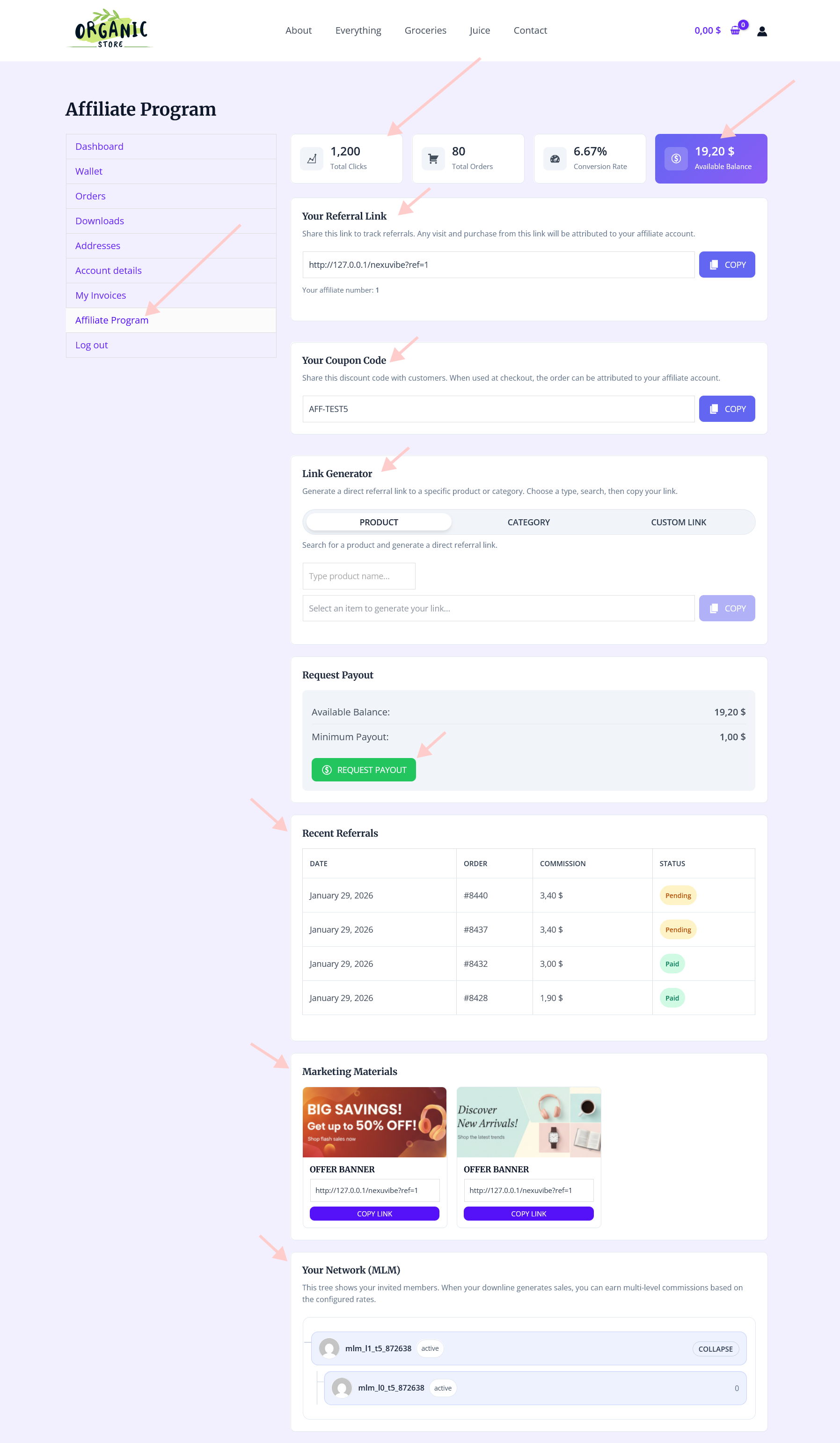
The frontend affiliate dashboard inside WooCommerce My Account gives affiliates access to their referral links, a link generator for creating custom tracking URLs, their commission summary, their payout request tools, and any promotional creatives you have published. Everything an affiliate needs to operate effectively is available from a single familiar interface — the same place they manage their orders and account details.
For the vast majority of WooCommerce stores — single-platform businesses, stores with existing audiences or communities to recruit affiliates from, and stores where the affiliate program is a WooCommerce-native growth channel — a plugin-based approach saves a significant amount of money over any meaningful time horizon. Not marginally more. Substantially more.
Over three years, a store paying $89 per month for a SaaS affiliate platform spends $3,204 on the subscription alone, before any transaction fees. A store paying a one-time or annual license for a plugin like Affiliate Engine spends a fraction of that — and the cost does not increase as the program grows or as commission volume increases. The math at three years is not close.
The only scenarios where SaaS makes financial sense despite the higher cost are the ones outlined earlier: genuine multi-platform tracking needs, dependency on a specific affiliate discovery marketplace, or deep enterprise CRM integrations. If none of those apply to your store, you are paying more for less.
Yes, but migration has real costs. Affiliate records and commission histories will need to be exported from the SaaS platform and re-imported into the plugin. Affiliates will need to re-register or be manually added. Historical referral data may not map cleanly between systems. Migrating is doable, but it requires planning and a transition period during which your program may have reduced visibility. Starting with a plugin avoids this migration cost entirely.
Yes. A well-built WooCommerce affiliate plugin running on a properly hosted WordPress installation handles hundreds of affiliates and significant referral volumes without performance issues. The limiting factor is your WordPress hosting quality, not the plugin itself. Stores with large programs should ensure they are on managed WordPress hosting rather than shared hosting — but this is true regardless of which affiliate tool they use.
Affiliate Engine handles this through the optional Lifetime Commissions add-on, which links customers to affiliates at the database level for persistent attribution beyond cookie windows. This is a feature that some SaaS platforms market as a differentiator, but it is available in the plugin ecosystem too — without the SaaS pricing structure.
The support experience varies more by provider than by category. Some SaaS platforms have slow, ticket-based support that feels impersonal. Some plugins have responsive, detailed support that resolves issues quickly. The key is choosing a plugin from a provider with a clear support track record, not assuming SaaS automatically means better support. Check reviews specifically for support responsiveness before buying either type of product.
The decision between a WooCommerce affiliate plugin and a SaaS platform is not a close call for most store owners once the actual numbers are laid out. If you run a WooCommerce store, want to own your affiliate program data, and do not need cross-platform tracking or an affiliate discovery marketplace, the plugin approach saves you real money — month after month, year after year — while delivering equivalent core functionality with tighter WooCommerce integration.
Affiliate Engine for WooCommerce gives you the full affiliate program infrastructure — referral tracking, commission management, coupon attribution, fraud detection, payout workflow, performance tiers, and a clean affiliate dashboard — without the monthly subscriptions, transaction fees, or third-party data dependencies that come with SaaS platforms. For a WooCommerce store, that is a straightforward value proposition.
Affiliate Engine gives you referral tracking, commission rules, coupon attribution, fraud detection, payout management, and a WooCommerce-native affiliate dashboard — for a one-time license cost that never scales with your success.








Just wanted to share my thoughts after checking out that cost comparison. i've used both plugins and SaaS tools for affiliate programs before, and the numbers here totally match what I've seen. If you're running a smaller shop or just dipping your toes in, a WooCommerce plugin like Affiliate Engine is way easier on the wallet no monthly fees cutting into your profits. But once you start growing, those SaaS platforms get tempting with their automation and support. the part about hidden costs really opened my eyes, too.
Look, I got this plugin hoping to cut costs compared to those SaaS platforms everyone talks about. but here's the thing it's not actually cheaper if your program takes off.
Finally someone did the math instead of just yelling about SaaS or how plugins stinks.