
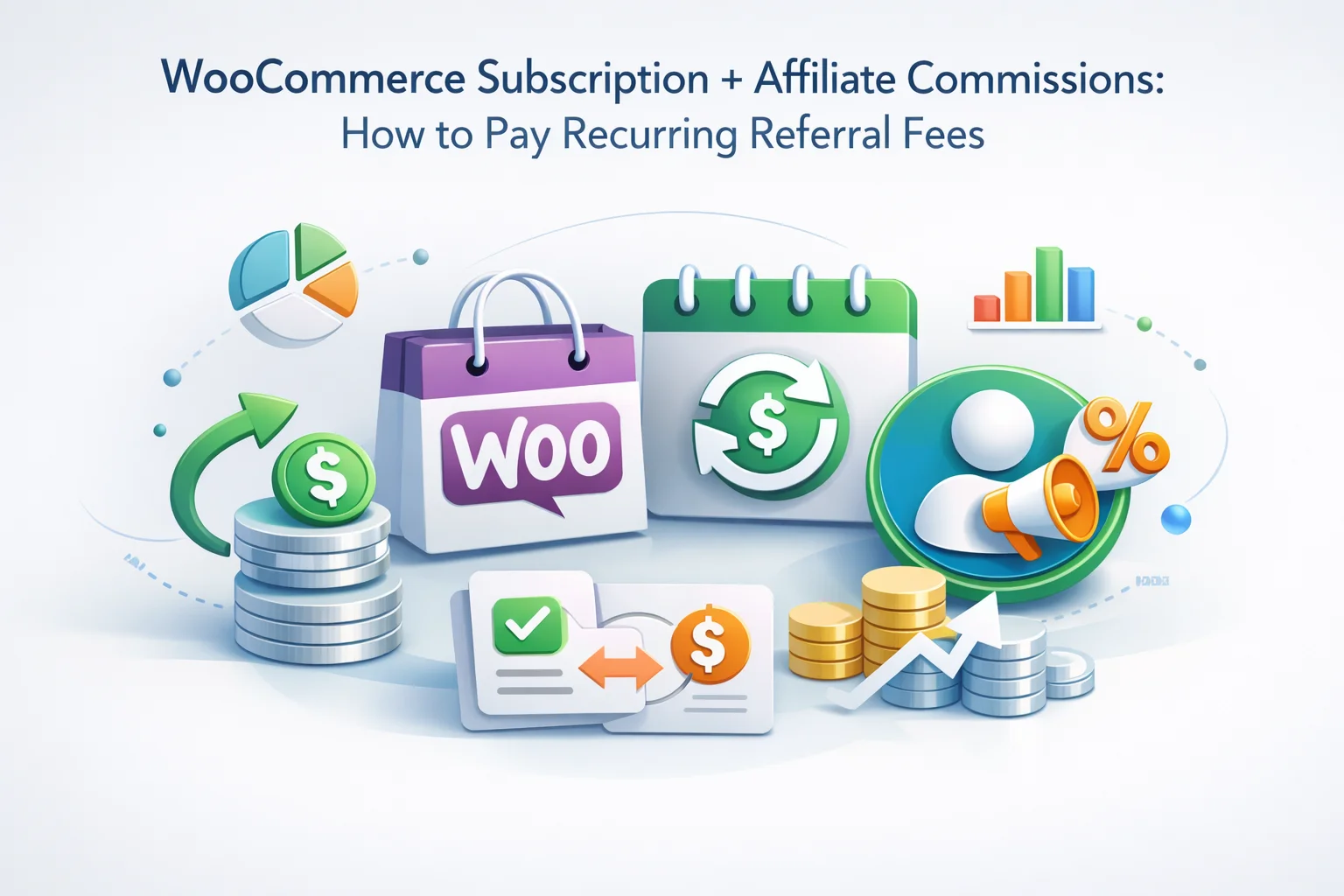
Recurring referral fees sound simple: the affiliate who brought the subscriber should share in the continuity the business worked hard to build. Reality is messier. Renewals may process as separate WooCommerce orders with different metadata than the original signup. Customers may change cards, pause subscriptions, or reactivate months later. Affiliates may expect a slice of every renewal; finance may only want to pay on margin-positive months. Your job is to translate philosophy into policies that your storefront can represent consistently.
WooCommerce Subscriptions (the extension from WooCommerce) models subscription lifecycles with renewal orders, scheduled actions, and statuses that differ from one-time products. The official WooCommerce Subscriptions documentation is the right place to understand how renewals appear in admin, how failed payments retry, and how refunds interact with subscription state. None of that replaces your affiliate terms, but it prevents you from promising partners a renewal flow your commerce stack does not actually emit.
On the affiliate tooling side, Affiliate Engine, the WooCommerce referral plugin that records commissions per order with coupon and cookie attribution, implements commission creation when WooCommerce runs the checkout order processed action. The core plugin source tree does not contain WooCommerce Subscriptions-specific hooks or settings by name; treat renewal behaviour as something you validate in staging against your actual gateway and subscription configuration rather than assuming a bespoke “recurring commission mode” ships inside the core codebase.
The finance reality: renewals are cash flow, not vanity metrics
Every renewal pays the gateway, the subscription engine, sometimes the tax authority, and often a customer success cost hidden in support tickets. Paying affiliates a flat percent of gross renewal revenue can be generous or reckless depending on net margin. Before you advertise recurring commissions, model three scenarios: healthy retention, mediocre retention with discounts, and a churn spike after a bad release. If your programme cannot survive those scenarios, your public promise is fragile.
Affiliates are not accountants, but they understand incentives when you explain them plainly. If renewals pay a lower percent than first orders because CAC is already recovered, say so in the terms. If you cap renewal months, say that too. Ambiguity creates optimism bias, then anger. The WooCommerce order management guide helps your internal team trace how refunds and partial credits appear on orders that might correspond to subscription changes.
If you cannot explain your renewal commission in one sentence without caveats, it is not ready for a public landing page.
How Affiliate Engine’s core path thinks about orders (not “subscription” labels)
Affiliate Engine resolves the affiliate at checkout using cookies, coupon session data, and coupons present on the order, then attempts to create a commission record tied to that WooCommerce order. The commission service refuses to create a second record for the same order ID if one already exists. That pattern is order-centric: whatever WooCommerce considers a distinct order ID is the unit of deduplication.
Whether a subscription renewal produces a new order ID in your store, and whether that renewal passes through the same checkout processed hook your affiliates expect, is a function of WooCommerce Subscriptions configuration and gateway behaviour, not a claim anyone should invent from marketing copy. That is why staging tests matter: place a test subscription, force or wait for a renewal, and inspect the resulting orders like an auditor. If renewals never create referral rows and you told partners they would, you have a communications problem even if engineering is “working as coded.”
Because the core Affiliate Engine codebase does not expose WooCommerce Subscriptions-specific settings by name, your internal runbook should record the observable behaviour you validated: hook fired or not fired, affiliate resolved or unresolved, coupon present or absent, and whether the customer session resembled a logged-in renewal or a guest transaction. That runbook becomes the single source of truth when leadership asks whether recurring commissions are “automatic.” Precision prevents accidental promises.
Also distinguish between “automatic renewal billing” and “automatic affiliate recognition.” Billing can succeed while attribution signals are empty if the shopper neither uses a tracked link nor applies an affiliate-linked coupon on the renewal path your store actually uses. Programmes that rely on first-touch cookies should measure how often those cookies survive across the renewal interval in real browsers. If the interval exceeds your cookie lifetime, your commercial model may need coupon or customer-link logic, not hope.

Renewals, upgrades, and downgrades: the product moments partners care about
Subscription businesses rarely stay static. A customer upgrades from a monthly box to an annual plan, adds seats, removes seats, or swaps variants mid-cycle. Each event might create proration lines that look unfamiliar on a WooCommerce order. Your affiliate terms should state whether upgrades commission as new acquisition value, as delta only, or not at all until the next clean renewal. Silence invites each partner to assume the most generous interpretation.
Downgrades and cancellations are emotionally charged. Affiliates who helped you acquire a customer may feel entitled to ongoing credit even when the customer churns. Decide whether you pay through the final paid period, stop at cancellation request, or use a short grace window for involuntary churn caused by card failures. Write those rules for humans, then verify that your order records in WooCommerce reflect the timing you described.
Treat as incremental revenue or as a new contract phase; either can work if documented.
Clarify whether commissions shrink with MRR or freeze at acquisition tier.
Separate voluntary churn from payment failure; partners notice if you conflate them.
Commercial models that work when “pay forever” does not
Front-loaded bounty. Pay a higher commission on the initial subscription order that covers expected LTV share you are willing to allocate. Renewals pay zero or a token amount. This model is easy to explain and avoids debating gateway fees on tiny monthly charges. It aligns affiliates with signup quality, not with your retention team’s quarterly interventions.
Time-capped renewals. Pay reduced commission for six or twelve renewal cycles, then stop. This mirrors how many SaaS partner programmes acknowledge diminishing marginal contribution from the original referral click. Publish the cap clearly; do not let partners infer infinity from silence.
Coupon-led continuity. If subscribers keep a partner coupon active on the subscription, you may decide coupon attribution remains the honest signal of influence. That is a business rule, not a physics law. It can be powerful for creators whose audiences stay loyal to a code, but fragile if coupons rotate or if WooCommerce limitations affect how codes attach to renewals in your stack. Validate with real renewal invoices.
Approval, holds, and refunds: subscriptions amplify timing risk
Subscription businesses see more partial refunds, prorations, and failed renewals than average one-time stores. Your commission approval settings should assume messy months. Longer hold periods often make sense when chargebacks cluster around free-trial abuse or when payment retries create duplicate-looking events. Communicate those holds as a programme feature (“we protect partners from clawbacks”) rather than as punishment.
When an order status changes, Affiliate Engine can advance pending referrals according to the status you designate for approval, subject to hold timers you configure. That mechanism is powerful for subscriptions because it ties partner cash timing to operational reality, not to the moment a shopper clicked an ad. Document which statuses mean “fulfilled enough to count” in your store so support does not improvise.

Payouts: when recurring revenue meets recurring withdrawals
If commissions accrue monthly from renewals, affiliates may expect monthly withdrawals. Your finance team may prefer biweekly batches. Close that gap in writing. Also decide whether minimum payout thresholds apply per currency and whether inactive affiliates forfeit small balances after dormancy (where legally permissible). Subscription economics are sensitive; tiny unresolved payout frictions compound into programme distrust.
Self-serve payout requests help, but only when states are crystal clear. Pair payouts with notification emails that confirm amounts and reference periods. Ambiguity in subscription months (“which renewals landed in April?”) is where otherwise happy partners become sceptics.

Legal and disclosure: recurring fees attract regulatory attention
Subscriptions already face heightened scrutiny in many jurisdictions. Affiliate commissions that scale with renewals can intersect with disclosure rules about endorsements and material connections. Your partner agreement should require compliant disclosure language and give you enforcement tools for non-compliance. Software cannot replace counsel, but it can provide consistent tracking that makes audits possible.
Tax documentation for international affiliates also scales in complexity as renewal commissions dribble in monthly. Decide whether you aggregate annual statements or provide monthly summaries. Consistency beats perfection; partners should know what to expect.
| Topic | Why subscriptions amplify it | Operational response |
|---|---|---|
| Refunds | More partial credits across billing cycles | Document reversal policy per order type |
| Trials | Low initial revenue, high intent noise | Delay approval until paid conversion |
| Pauses | Gaps break mental models of “monthly fees” | Explain whether paused months pay partners |
Staging checklist before you promise recurring affiliate payouts
Create a private subscription product with a short renewal interval for testing. Run a controlled signup with a referral link or affiliate coupon, then observe whether renewal orders appear as expected in WooCommerce and whether referral rows appear according to your business rules. Repeat with coupon-only signup if creators drive most volume without link clicks. Repeat with a customer who cancels mid-cycle if your policy addresses mid-term refunds.
Capture screenshots of order timelines and referral entries for internal training. When support receives the inevitable “why didn’t my renewal count?” ticket, your team should open the same views and answer from evidence. The WordPress data validation and security practices handbook is a useful reminder that subscription stores process more user state than average blogs; treat affiliate data with the same seriousness.
Write what “counts” before you look at numbers.
Match gateway simulation to production behaviour.
Marketing promises should lag staging evidence, not lead it.
Talking to affiliates about recurring fees without overpromising
Creators hear “recurring” and think “passive income.” Finance hears “recurring” and thinks “liability schedule.” Your partner briefing should bridge that gap with numbers, not vibes. Show an example month: list price, typical discount, tax, gateway fee, average refund rate, and the resulting commission dollars on renewal. You do not owe partners your entire P&L, but you owe them enough realism that sophisticated partners do not feel misled after month three.
When you change renewal policy, grandfather existing cohorts if you can afford to. Retroactive reductions destroy trust faster than almost any product bug. If you cannot grandfather, offer a sunset window and personal outreach to top partners. The incremental cost of that communication is cheaper than public complaints in communities you do not control.
Instrument partner sentiment the same way you instrument churn: watch ticket themes, social mentions, and withdrawal request timing. Spikes after renewals often indicate confusion about what counted, not malice. Fix the explanation before you fix the algorithm.
State what counts, what does not, when money moves, and how disputes are resolved. Link to your canonical terms on every payout email.
Where tooling fits (and where leadership still decides)
Affiliate Engine gives WooCommerce operators a disciplined place to record visits, attribute orders, calculate commissions with layered rules, and move money through payout workflows. It does not remove your obligation to decide whether renewals should commission at full rate, partial rate, or not at all. Treat the plugin as enforcement infrastructure for policies your leadership team signs.
If your programme outgrows flat percentages, use category and product overrides thoughtfully: subscription SKUs may deserve different economics than consumable add-ons. Keep notes in your admin procedures so future you understands why digital memberships pay differently than boxed kits. Coupon attribution priority remains relevant for subscription stores that acquire through creators: if renewals rarely repeat the original click path, coupon policies can be the difference between fair credit and systematic underpayment. Revisit those settings whenever you change checkout flows or migrate to new cart experiences.
Finally, connect your subscription analytics to affiliate analytics intentionally. If product teams watch cohort retention in one system while partner teams only see gross referral dollars, you will misallocate budget. A monthly joint review prevents marketing from overpaying for low-quality signups that churn before renewal economics materialise.
Operational tools should reduce manual reconciliation, not increase it. When Affiliate Engine’s WooCommerce affiliate fraud monitoring and visit diagnostics flag anomalies, treat them as subscription programmes treat dunning: investigate systematically, document outcomes, and adjust rules when patterns repeat.
For stores that want WooCommerce-native referral infrastructure with coupon and cookie attribution, configurable commission behaviour, and operational dashboards, Affiliate Engine Ultimate WooCommerce affiliate commission and payout management plugin remains the practical backbone even as your subscription strategy evolves. Pair it with honest terms, conservative staging, and finance-aligned hold windows, and recurring referral fees become a programme you can run for years instead of a promotion you regret. Subscription commerce rewards operators who treat partner economics as seriously as customer economics, because both sides notice when numbers stop making sense long before your dashboards turn red or finance schedules an emergency review of every payout batch you approved too quickly without reading the notes your own team left on the very tight weekly affiliate payout exceptions queue.
Build subscription affiliate economics on verifiable WooCommerce orders
Affiliate Engine helps you attribute purchases, calculate commissions with configurable rules, and run payout workflows while you set the renewal policy that matches your margins.


Wait, so if a customer's renewal order doesn't carry the original affiliate tag, does that mean the affiliate
Honestly, I expected this to handle recurring affiliate payouts a little better. The main problem is that renewals create separate orders with different metadata, so if a customer's original cookie expires before their renewal, the system just loses the affiliate link completely. now I'm stuck manually matching old signups to new orders, which pretty much defeats the whole point.
Tried it twice and still a mess
Well this was a headache. renewal orders don't match the original metadata so affiliates get shorted