Next-Level Code. Nexuvibe Style ...
Hrs
Min
Sec

There is a moment that every user of Google’s products has experienced without thinking about it. You check your Gmail in the morning, open a new tab, and your Google Docs are there. You search something and your search history is already contextual. You open YouTube and your subscriptions are waiting. You move between a dozen different Google products throughout your day and at no point are you asked who you are. The authentication happened once, somewhere, and the entire ecosystem remembered.
Apple does the same thing across iPhone, iPad, Mac, Apple Watch, and Apple TV. Amazon does it between the main store, Amazon Prime Video, Kindle, Audible, and AWS. Microsoft does it across Office, Teams, Azure, Xbox, and dozens of enterprise tools. The pattern is consistent and deliberate: when a company owns multiple digital products, it engineers its authentication so that the user’s identity follows them transparently across all of them. The user never feels the seams between products. They feel a single, coherent brand.
This is not accidental. These companies invested in unified authentication specifically because the research and the revenue data both pointed to the same conclusion: when users have to re-authenticate as they move between your products, you lose them. Not always immediately and not always permanently, but consistently and measurably. The WordPress equivalent of this problem, and the solution to it, is what this article is about.
Authentication is not just a security mechanism. It is a statement about the relationship between a user and an organization. When you require a user to authenticate, you are saying: prove to us who you are before we let you in. The more times you ask that question, the more transactional and the less relational the interaction feels.
When a company’s systems remember you across all their properties, those systems are communicating something different. They are saying: we know who you are, and wherever you go within our world, that knowledge travels with you. This is not just a convenience. It is a signal about how well-organized and how invested the company is in maintaining a consistent relationship with you. At a subconscious level, it communicates competence, scale, and care.
The psychological literature on customer experience is consistent on this point. Effort is the enemy of loyalty. Every additional action a customer has to take to access your products increases the perceived effort of their relationship with you. Customers who find it easy to do business with you stay longer, spend more, and refer more. Customers who encounter unnecessary friction quietly reduce their engagement, and the most frustrated ones leave without ever telling you why.
The companies that built the world’s most valuable consumer digital ecosystems did not arrive at unified authentication by accident. Each of them made deliberate, significant investments in cross-product authentication infrastructure at a specific point in their growth, and in each case the investment was justified by measurable improvements in user retention, cross-product adoption, and lifetime revenue per customer.
The damage from login friction does not always announce itself as an abandoned purchase or a cancelled subscription. It often accumulates quietly across a series of small negative moments that individually seem minor but collectively erode the customer relationship. Understanding where these moments occur helps you measure what you are actually losing.
A customer reads your email newsletter, sees a link to a complementary product on your secondary store, and clicks with genuine purchase intent. They arrive at the product page and immediately see a login form. The intent was real and the timing was right, but the authentication barrier interrupts the purchase state. Studies on impulse and intent-driven purchases consistently show that delays or interruptions between intent and action significantly reduce conversion probability. The login screen is not a brief inconvenience. It is a reset of the mental state that was making a purchase likely.
A returning customer visits your secondary site for the first time in several months. They cannot remember which email they registered with or what password they used for that specific site. They try to log in, fail, request a password reset, wait for the email, click the link, set a new password, and finally arrive at the product page several minutes after their original intent. The research on abandoned password resets is stark: a substantial percentage of users who request a password reset never complete the process and never return to the site in that session. Your most forgetful customers, which includes most customers, are your most at-risk customers in a fragmented authentication environment.
A customer who has purchased from your main store multiple times visits your second site and finds a completely empty checkout form. Their name is not pre-filled. Their address is blank. Their account does not exist here even though they have spent hundreds of dollars with your brand. The cognitive dissonance of being a loyal customer who is treated as a stranger on a site you own is a meaningful CX failure. It communicates that the relationship the customer thought they had with your brand is narrower than they believed. The emotion this creates is not anger. It is subtle disappointment, which over time becomes reduced engagement.
A customer purchases a course or a training program from your WooCommerce store and is directed to your LMS to access their purchase. They arrive at the LMS and are asked to create an account or log in. They just paid. The first experience of the product they paid for is an authentication barrier. This is a post-purchase CX failure that creates immediate buyer’s remorse regardless of how good the actual content is. The experience sets a negative emotional tone for everything that follows and increases churn risk from the very first moment of the customer’s relationship with the product.
For most of the history of WordPress as a platform, the kind of unified authentication that Google, Apple, and Amazon implemented was effectively out of reach for independent multi-site operators. Enterprise SSO implementations required dedicated identity servers, OAuth infrastructure, development teams to maintain the integration, and the kind of operational overhead that made sense for organizations with thousands of employees but not for a business running two or three WordPress sites.
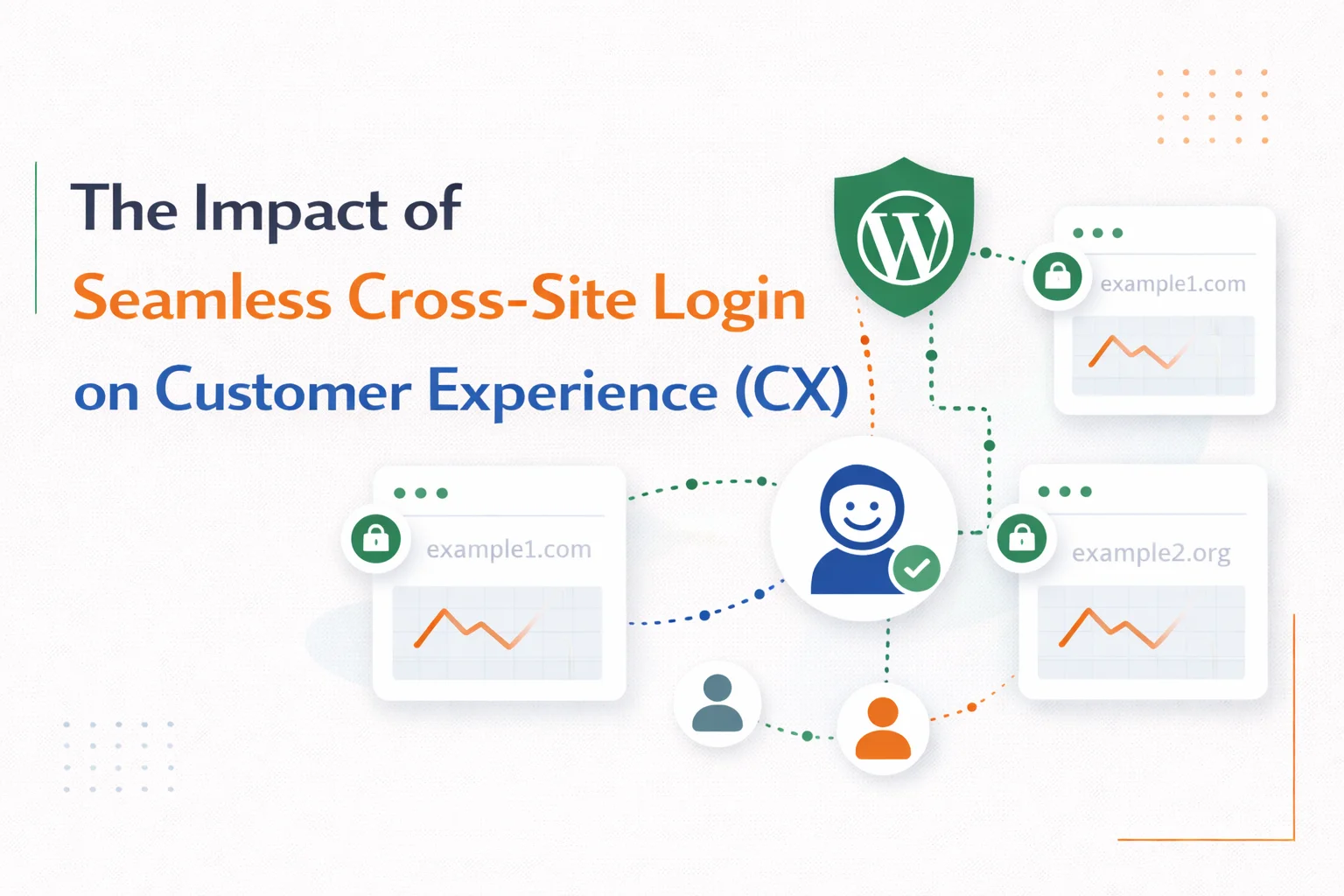
That gap has closed. The Nexu User Sync plugin for cross-site WordPress login and seamless customer experience brings the same architectural principle that powers Google’s ecosystem to independent WordPress networks. The implementation does not require server configuration, developer time, or external identity infrastructure. It requires installing a plugin on each of your connected sites and spending twenty minutes on configuration. After that, the experience your users have is indistinguishable, from their perspective, from what Google’s users experience.
The comparison with Google and Apple is not aspirational. It is structural. The technical mechanism is the same: a user authenticates once, a secure token is created, and that token is recognized by all connected properties so the user never has to prove their identity again. The scale is different. The underlying principle is identical. What Nexu User Sync does is make that principle accessible to anyone running a WordPress network, regardless of size or technical resources.
The best way to understand what seamless cross-site login delivers as a customer experience is to trace the complete journey of a customer through your network before and after implementation.
Customer experience research distinguishes between what customers say they value and what actually drives their behavior. Customers say they care about product quality, pricing, and service responsiveness. What actually drives long-term loyalty is something more fundamental: the effort required to maintain the relationship. The less effort the relationship requires, the stronger it becomes. The more effort it demands, the more it erodes.
Seamless cross-site login is one of the most concrete reductions in relationship effort you can implement. It removes a recurring friction point that your customers encounter every time they move between your properties. Over the lifetime of a customer relationship, that friction occurs dozens or hundreds of times. Each successful removal of that friction is a small positive signal. Each failure to remove it is a small negative signal. The accumulation of these signals is what determines whether customers experience your brand as easy and natural to engage with or as effortful and inconsistent.
Google, Apple, and Amazon figured this out at scale and invested accordingly. The Nexu User Sync plugin for seamless WordPress cross-site login that improves customer retention and brand loyalty makes the same investment available at WordPress scale, without the infrastructure overhead that made enterprise SSO inaccessible to independent operators. The principle is the same. The implementation is simple. The CX outcome is the same thing that built the world’s most valuable digital brands: a customer who feels continuously recognized, continuously valued, and never asked to prove themselves twice.
Nexu User Sync brings Google-style unified authentication to your WordPress network. One login, every site, all data pre-filled, every time. The same customer experience principle that built the world’s most loyal digital audiences is now a 20-minute WordPress plugin setup.







Hey everyone, just read this and wow finally someone explaining why my WordPress sites feel like separate islands! This is exactly what's been missing for my school project sites. so glad I came across it!
The idea of one login for all my WordPress sites sounded amazing at first like how Google and Apple make everything feel smooth. but actually setting it up on my own network wasn't nearly as easy as the article made it look. The guide was decent, but I still had to fiddle with a bunch of settings to get it working properly. Honestly, unless you've got a ton of sites to manage, I'm not sure it's worth the hassle
Oh man, I was really hoping this would help me fix the login mess on my WordPress sites, but it just left me more frustrated