Next-Level Code. Nexuvibe Style ...
Hrs
Min
Sec

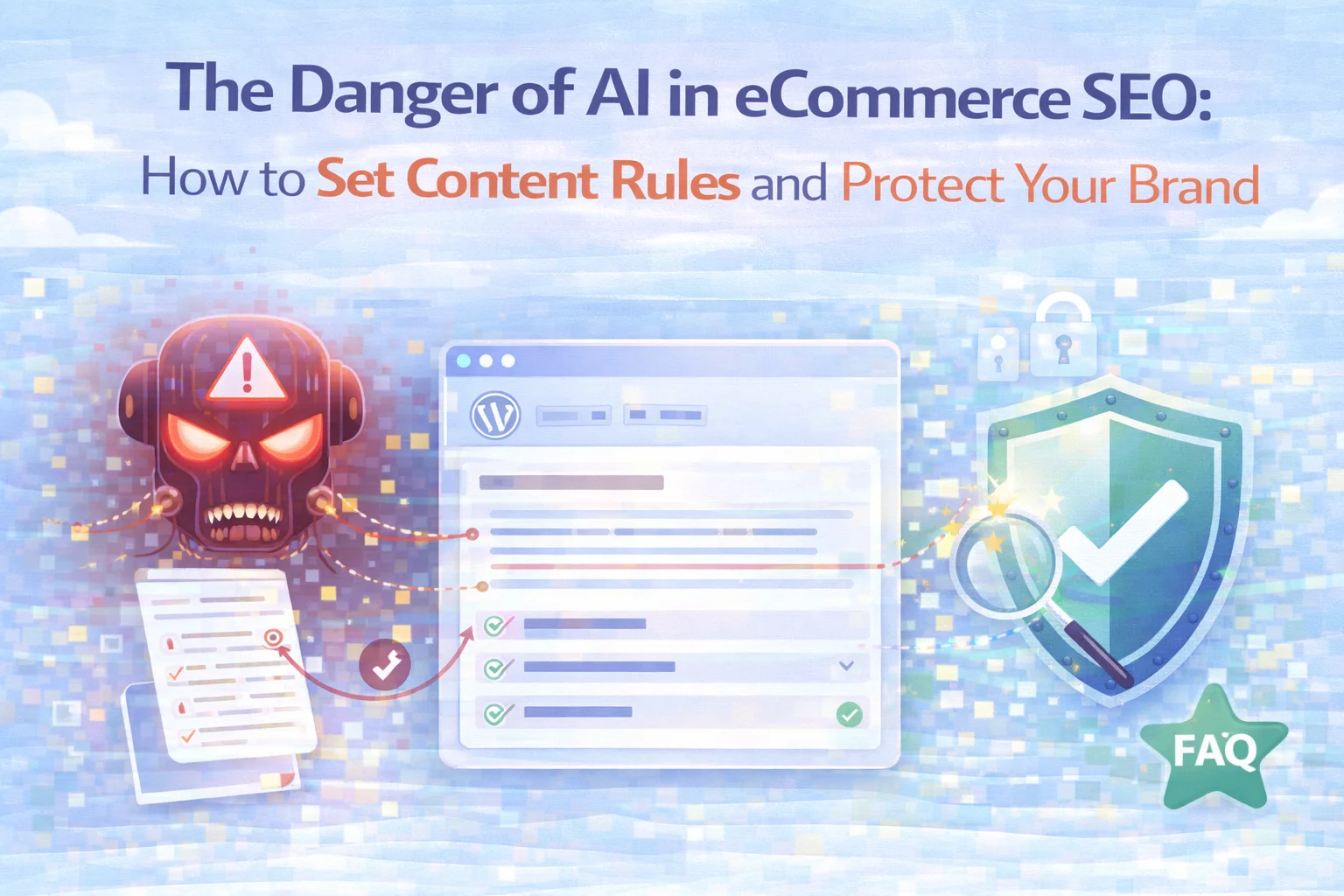
AI content generation for WooCommerce category pages has a straightforward value proposition: instead of writing category descriptions manually for every archive in your catalog, you generate them quickly and move on. But there is a specific failure mode that this framing obscures, and it is one that most guides on AI eCommerce content quietly skip over. The failure mode is not that AI produces bad writing. It is that AI produces confidently wrong writing — and publishes it permanently to pages that your customers, Google, and your competitors all see.
A category description that says “all items in this section are currently 20% off” does not age well when the promotion ends. A category intro that says “most products here are in stock and ready to ship within 24 hours” becomes actively harmful during a supply disruption. A FAQ answer that mentions a specific price point becomes misleading the moment you reprice the category. These are not hypothetical edge cases — they are the predictable output of AI generation that runs without constraints, and they create exactly the kind of trust-damaging, legally ambiguous content that store owners assume they are avoiding by using automated tools.
This guide is about the content rules that prevent this. It covers what kinds of AI output put a WooCommerce brand at risk, what specific settings in a properly configured generation system address each risk, and how to use the WooCommerce AI category content plugin with brand safety rules by Nexu to generate content that stays accurate and on-brand long after the initial generation run.
One clarification upfront: the content rules discussed in this guide are configuration settings — things you set up once in the plugin before generating content, not automated post-processing that detects and removes problems after the fact. The protection is in the instruction: you tell the AI what not to write before it writes anything. That is how the risk is managed, and understanding that distinction matters for setting realistic expectations.
Before discussing solutions, it helps to be specific about the problem. There are four distinct categories of AI-generated content that create brand risk on WooCommerce category pages. Each one comes from a different failure mode, and each requires a different type of rule to prevent it.
It is worth being clear about why AI models produce this kind of content, because understanding the cause makes the solution make more sense. The problem is not that the AI models are low quality or that they are malfunctioning. It is that they are doing exactly what they are designed to do: producing content that resembles the category page content they were trained on.
Real eCommerce category pages — the ones in the training data — frequently contain prices, promotional language, stock assurances, and seasonal references. These are the patterns the models have learned to associate with good category copy. Without instructions to the contrary, the model produces what category pages typically contain. The output is only wrong in the context of your specific store, at this specific moment, for these specific categories. The model has no way of knowing that a fact it includes will be untrue tomorrow.
The content rules tab in the plugin is where you configure the generation parameters that apply to every category content run. These are not post-processing filters — they are instructions that shape what the AI produces at the generation stage. Here is what each available rule does in practice.
This rule instructs the AI to write about the category without including specific price figures. The generated content can still reference price positioning in general terms — “accessible entry-level options,” “premium range for serious athletes,” “wide price range to suit different budgets” — without naming numbers that will become wrong when you next update your pricing. This is the single most valuable guardrail for long-term content accuracy on category pages.
This rule suppresses the promotional framing that AI models default to: “currently on sale,” “special offers available,” “discounted prices,” “limited time deals,” and similar phrases. The generated content focuses on the category’s product scope, use cases, and buying considerations rather than transient commercial events. Categories that run permanent promotions can still reference those in context notes — this rule prevents the AI from inventing promotional claims that do not exist.
This rule prevents the AI from asserting anything about current stock levels, dispatch times, or availability. The content instead focuses on what the category contains and who it serves, rather than operational claims that WooCommerce’s own product listings communicate more reliably and in real time. For any store that experiences seasonal stock variation, supply chain uncertainty, or frequent out-of-stock situations, this is an essential rule.
Evergreen mode is the broadest of the content rules. It instructs the AI to write content that is not anchored to any specific time period, season, or year. No seasonal references, no “new for this year,” no “just arrived” framing. The generated content describes the category in terms that are as accurate in eighteen months as they are today. For the vast majority of WooCommerce category pages — which are permanent archives, not event-based landing pages — this is the right default.
Brand safety is not only about preventing inaccurate content. It is also about ensuring that generated content sounds like it came from your store rather than a generic AI template. The content rules tab addresses this through three additional controls: tone, length, and product mentions. These are not guardrails against risk — they are positive shaping tools that make the output more specifically yours.
Choose between formal, friendly, or sales-oriented writing tone. This setting influences how the AI frames information — the difference between “This category contains professional-grade tools suitable for commercial applications” and “Whether you’re a weekend warrior or a working pro, you’ll find the right tool in here.” Neither is right for every store — the tone setting makes the output fit your brand character rather than defaulting to a neutral middle ground.
Control how long the generated intro text and main article section should be. Shorter output is appropriate for smaller sub-categories where a brief orientation is sufficient. Longer output is appropriate for broad, high-traffic categories where the additional topical depth supports SEO goals. Setting this at the global level means all categories receive appropriately scaled content without individual configuration for each one.
When product mentions are enabled, the generator can draw on the actual products in the category when producing content — referencing product types, attributes, or characteristics that make the category description specific to this store’s actual inventory. When disabled, content focuses on the category in general terms. Enabling this produces more relevant content; it also requires careful review because product-specific references can become inaccurate when the catalog changes.
The FAQ section of a category page has its own content rules considerations. As covered in the FAQ schema guide in this series, Google’s guidelines for FAQ rich results specifically discourage promotional content in FAQ answers. But even independent of rich results eligibility, promotional FAQ answers create the same risk as promotional category descriptions: the claim will become inaccurate, the trust damage will compound, and the cleanup will require revisiting every affected category.
The FAQ behavior setting in the content rules panel controls how the FAQ generation is approached for category pages. The key principle to configure for is that FAQ answers should be informational and useful to the buyer’s decision-making process — not promotional, not stock-dependent, and not price-specific. An FAQ answer that says “products in this category are competitively priced starting from $X” creates the same problem as the same claim in the main description. An FAQ answer that says “prices vary by material, feature set, and brand — budget-friendly options exist alongside premium choices” stays accurate indefinitely.
The content rules you set in the panel apply to FAQ generation as well as the main category content, which means you do not need to configure guardrails separately for each content type. Setting “avoid exact prices” once means neither the intro, the article section, nor the FAQ entries will contain specific price figures. This is how the protection scales across an entire catalog without requiring per-category or per-content-type configuration.
Different stores have different risk profiles depending on how frequently their catalog changes, how dynamic their pricing is, and how much editorial review happens after generation. That said, there is a sensible default configuration that protects most WooCommerce brands without restricting the AI’s ability to produce genuinely useful, specific content.
The honest summary of the content rules system in Nexu AI Category SEO is this: it is a set of configurable instructions that shape what the AI produces before it produces anything. It is not a detection system, a post-processing filter, or an AI that monitors your catalog for inconsistencies after generation. What it does — preventing the specific, predictable failures that unguided AI generation creates for eCommerce category content — it does well. And for most WooCommerce stores, configuring these rules once before the first bulk generation run is the difference between content that stays accurate for two years and content that requires emergency cleanup within two months.
The WooCommerce AI category SEO plugin with content rules and brand safety guardrails is built around this principle. The content rules panel is not an afterthought — it is the part of the workflow that makes everything else sustainable. Speed of generation without accuracy of output is not a benefit. These rules are what turn the speed into something a real store can actually rely on.
Nexu AI Category SEO includes configurable content rules that prevent exact prices, discount language, stock claims, and time-sensitive phrasing from appearing in generated category content — before generation runs, not after.





Bought this hoping for clear steps to lock down stock claims in WooCommerce. Instead, got 11 pages of warnings about AI risks I already know. Only two paragraphs actually explain how to set rules for inventory updates, and even those assume you've got a dev team to implement them. Not helpful for solopreneurs. Should've just been a checklist.
Not worth it
Man, I wish I'd found this guide a year ago before we let our marketing team go wild with AI on our WooCommerce store. That part about "confidently wrong writing" hits way too close to home we had a category page claiming everything was 20% off for months after the sale ended because nobody caught it. the worst part? It wasn't even the AI's fault, just us not setting up basic guardrails. This actually explains why that kind of mess happens and how to prevent it with simple constraints no fluff, just the technical breakdown.