Next-Level Code. Nexuvibe Style ...
Hrs
Min
Sec

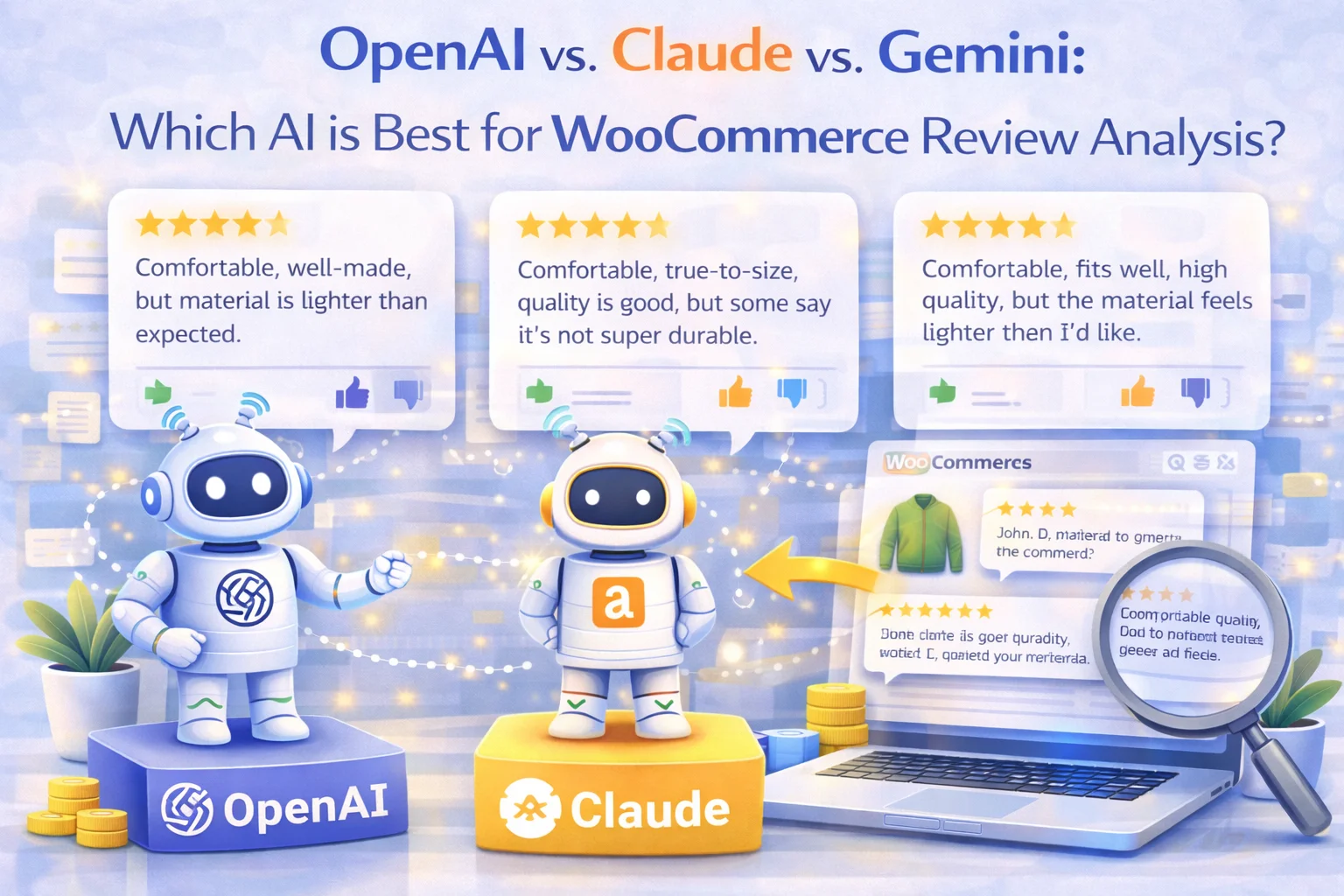
One of the more interesting decisions you face when setting up AI review analysis for a WooCommerce store is which AI model to use. The three serious options in 2026, OpenAI’s GPT-4o, Anthropic’s Claude, and Google’s Gemini, are each genuinely capable and each genuinely different. Marketing from all three providers suggests their model is the best. The truth is more nuanced and more useful than that: each model has specific strengths and specific weaknesses when applied to the particular challenge of processing product review text at scale.
Review analysis is a distinct task from general content generation. It requires reading a large, unstructured, often contradictory corpus of opinions written by people with varying levels of writing ability in multiple tones and languages, and extracting from that corpus a structured, accurate, and useful summary of the genuine buyer consensus. Not every model excels at this task in the same way or for the same product categories.
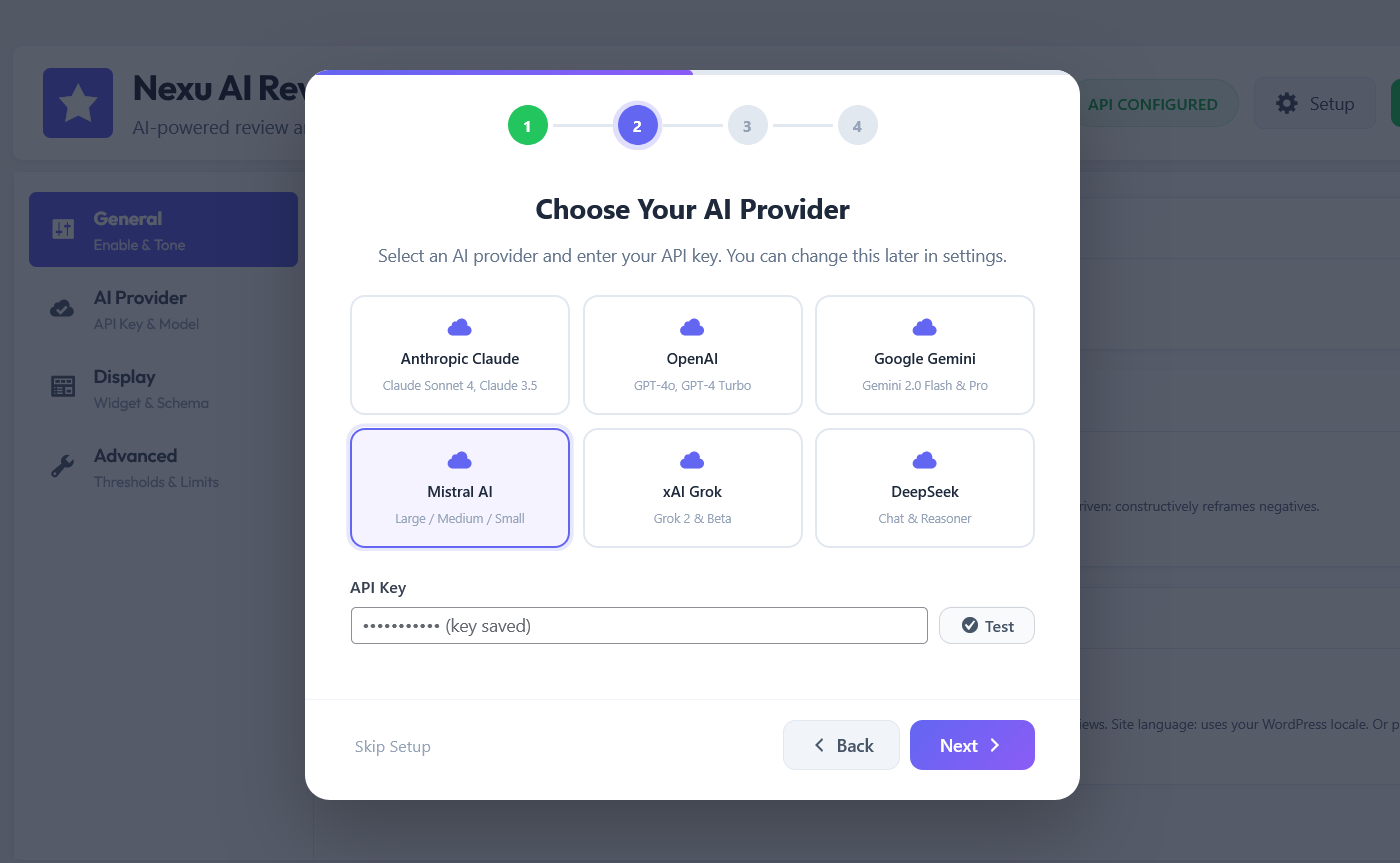
The practical advantage of using a plugin like Nexu AI Review Analyzer, a WooCommerce ChatGPT and Claude review analysis plugin, is that it supports all three providers and lets you switch between them with a settings change. This means you are not locked into a permanent choice before you have tested the output quality on your specific review corpus. You can compare models and make an informed decision.
This guide gives you the information you need to make that comparison intelligently: what each model does well, where each falls short for review analysis specifically, and a framework for deciding which one is right for your store.
Before comparing the models, it helps to understand what makes review analysis specifically demanding for AI systems. The challenge is not simply reading text and summarizing it. It involves several capabilities that not all AI models handle with equal competence.
When 70 buyers say quality is excellent and 30 say it feels cheap, the model needs to reflect this distribution accurately rather than averaging them into a vague middle ground or defaulting to the most recent opinions. Good review analysis requires understanding the weight of evidence, not just the presence of different views.
Product reviews are not well-written. They contain typos, non-standard grammar, inconsistent punctuation, and a wide range of writing quality. A model that is thrown off by informal or poorly written text will produce worse summaries than one that can extract sentiment reliably from low-quality input. This is a practical concern that varies between models.
For stores with international buyers, the model needs to correctly identify sentiment in reviews written in French, German, Spanish, Japanese, and other languages, and integrate that sentiment correctly into a unified analysis. The quality of multilingual comprehension varies significantly between the three major providers.
The plugin needs the model to return output in a specific structured format: an overview paragraph, a defined number of pros and cons, FAQ pairs, and attribute scores. Models vary in how consistently they follow structured output instructions, particularly when processing a large number of reviews at once. Consistency failures require manual correction and reduce the scalability of bulk analysis.
GPT-4o is the model most WooCommerce store owners will encounter first, and for good reason. It is the most mature API in the consumer and developer markets, the most extensively documented, and the most predictable in its behavior across a wide range of review analysis scenarios.
GPT-4o is the right choice for most WooCommerce stores as a starting point. It handles the core review analysis tasks reliably, produces consistently structured output that works well with the plugin’s formatting requirements, and covers European language reviews with high quality. If your store primarily serves English-speaking or European markets and your review corpus is mostly in those languages, GPT-4o will produce excellent results with the least configuration effort.
Claude’s approach to language processing is different from GPT-4o in ways that matter specifically for review analysis. Anthropic trained Claude with a strong emphasis on careful reasoning, balanced judgment, and avoidance of overconfident claims. For review summarization, this translates into a few distinct behaviors that can produce better output in specific scenarios.
Where Claude consistently outperforms GPT-4o is on products where the genuine buyer experience is complex and where a generic summary would miss important nuance. For premium goods, technical products, products with strong use-case-dependent satisfaction patterns, and any product where buyers write long, detailed reviews, Claude’s more careful analytical approach produces summaries that feel more accurate and more trustworthy.
Claude is also notably better at detecting the kind of faint negative signal that appears in otherwise positive reviews: the buyer who gives five stars but mentions in passing that the product arrived with minor packaging damage, or who praises the product but notes it required more setup time than expected. GPT-4o sometimes smooths over these observations in the interest of a clean summary. Claude is more likely to surface them as meaningful data points.
Gemini is Google’s entry in this space and it brings a specific competitive advantage that reflects Google’s history and infrastructure: unmatched multilingual capability. Google has been processing text in dozens of languages at massive scale for two decades. That foundational investment is visible in how Gemini handles non-English review content compared to its competitors.
For stores selling into Asian, Middle Eastern, or other non-Western markets where a significant portion of reviews are written in non-Latin script languages, Gemini is the model to test first. The quality gap between Gemini and its competitors on Japanese, Korean, Arabic, and Chinese review analysis is meaningful and can make a real difference to the accuracy of summaries for products popular in those markets.
Rather than giving a single definitive answer about which model is best, because the right answer genuinely depends on your store’s specific characteristics, here is a decision framework that maps store profiles to model recommendations.
Start with GPT-4o. It handles this profile reliably and with the least friction. The structured output is consistent, the analysis quality is high, and the setup is simple. There is no compelling reason to use a different model unless you find specific quality gaps after testing.
Test Claude. If your buyers write long, thoughtful reviews and you want a summary that reflects the full depth of their experience rather than a simplified consensus, Claude’s more careful analytical approach is worth testing. Run the same product through both GPT-4o and Claude and compare the output quality before committing.
Start with Gemini. The multilingual advantage is real and meaningful for stores where a significant portion of reviews are in languages that GPT-4o handles less well. Test on a product with a large non-English review volume and check whether the concerns raised by non-English buyers appear in the output.
Compare Gemini and GPT-4o on cost. For high-volume bulk analysis, the cost difference between providers can become meaningful. Run a cost comparison based on your estimated review token volume before committing to a model for catalog-wide deployment.
The honest answer to the question of which AI is best for WooCommerce review analysis is that it depends on your store, your products, and your review corpus. GPT-4o is the reliable default. Claude is the nuance specialist. Gemini is the multilingual leader. None of them is universally superior. All of them are capable enough to produce genuinely useful review summaries when deployed correctly.
What matters most is using a WooCommerce AI review analysis plugin that supports all three so you can test and decide for yourself rather than being locked into someone else’s choice. Connect your API key, run the analysis on a representative sample of your products, compare the outputs, and deploy the model that works best for your specific catalog. That is the practical path to getting the most out of AI review intelligence.
Nexu AI Review Analyzer connects to OpenAI, Claude, and Gemini with your own API key. Switch models at any time. Pay your provider directly. Stay flexible as the AI landscape evolves.






Hey! this thing nails non English reviews spot
This article was a lifesaver when I was trying to figure out which AI to use for my daughter's WooCommerce store she sells handmade candles and gets reviews in both Spanish and English, so the part about how well it handles multilingual text really caught my attention
The ability to switch between GPT 4o, Claude, and Gemini in the same plugin is a smart feature. I ran tests on a batch of 500 reviews for a tech accessory store, and the differences were noticeable.