Next-Level Code. Nexuvibe Style ...
Hrs
Min
Sec

A customer enters their postcode incorrectly. Not because they do not know it — they type it every day — but because the checkout form on a mobile device is slightly cramped, the keyboard covers the field, and the confirmation button is right there. The order goes through. The label is printed. The driver spends forty minutes trying to find an address that does not exist at that postcode. The parcel comes back. The customer contacts support. The re-delivery costs more than the original shipping. And the customer, who only wanted what they ordered, has now had a bad experience with a store that has no mechanism to tell them why.
This is the operational cost of missing checkout field validation. It is not an edge case. Industry data from logistics providers consistently shows that address errors are among the top causes of failed first-attempt deliveries. The UK’s Royal Mail estimates that address inaccuracies cost UK businesses over £1 billion annually in failed deliveries, returns, and customer service costs. The numbers are proportionally similar in other markets. Every one of those failed deliveries began with a form that accepted data it should have questioned.
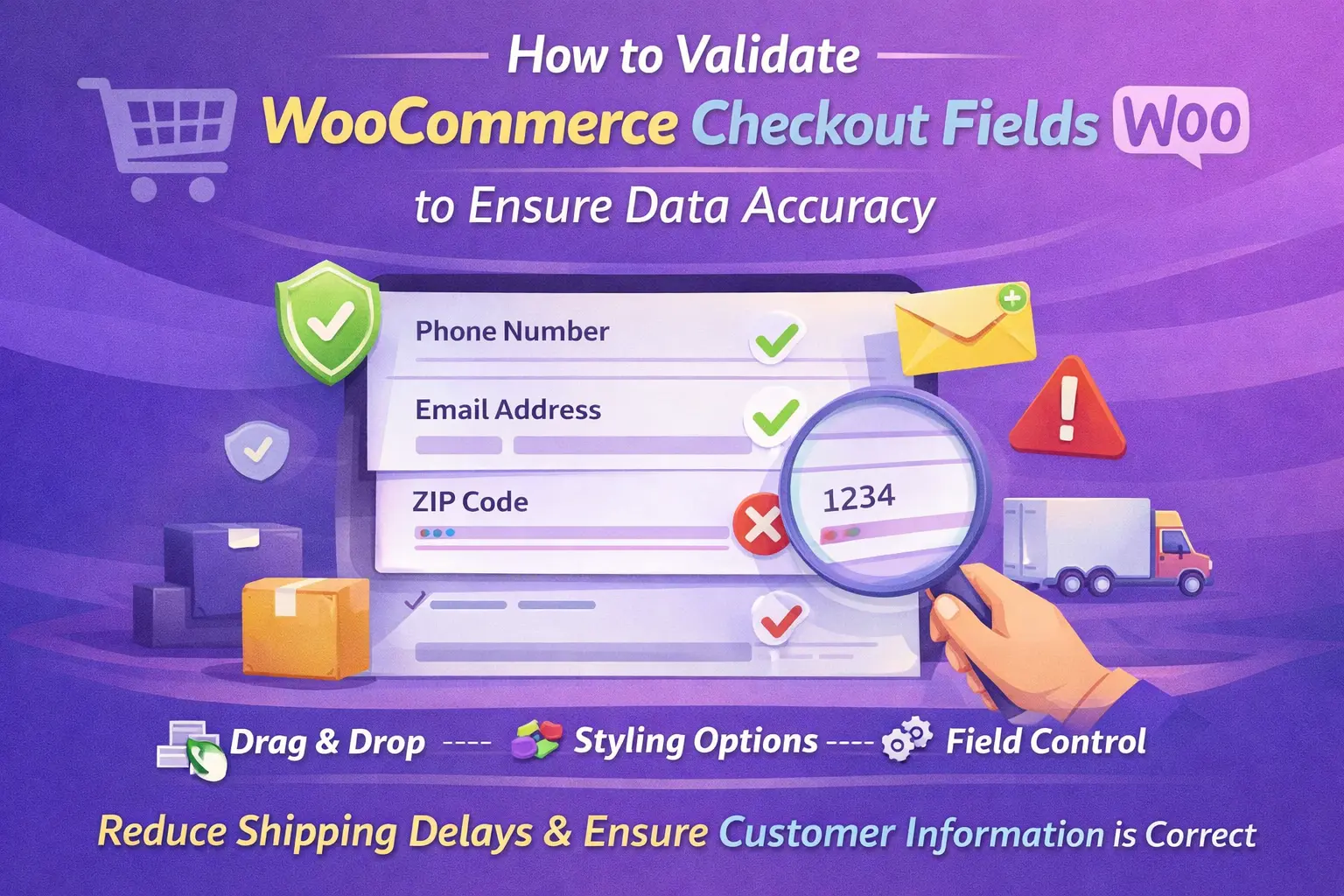
Field validation — the process of checking that data entered into a form meets defined criteria before the form is submitted — is the most direct technical intervention against this problem. When validation is configured correctly, a customer who enters an incorrectly formatted postcode, an invalid phone number, or a VAT number that does not match the expected pattern is prompted to correct the error before the order is placed. The bad data never enters your system. The operational cascade that follows bad data never begins.
This guide covers what validation means in the context of WooCommerce checkout fields, the different types of validation available, which fields benefit most from validation rules, and how to configure both standard required-field validation and custom format validation for specific field types — using a WooCommerce checkout field editor with built-in validation and required field configuration rather than custom code.
Every piece of data that enters your order management system through the checkout form travels further than most store owners track. It flows into your fulfillment workflow, onto shipping labels, into your accounting system, into your CRM, and potentially into third-party integrations with your carrier, your tax platform, or your warehouse management system. Bad data entered at checkout does not stay in the checkout. It propagates.
An incorrect postcode or address generates a failed delivery. Failed deliveries cost an average of two to three times the original shipping cost when you account for carrier redelivery attempts, return shipping, and re-despatch. The UK’s Royal Mail estimates that address-related delivery failures cost UK businesses over £1 billion per year. Even at a small scale, the cumulative cost of address errors is material for stores processing more than a few hundred orders per month — and in almost every case, it could have been caught at the point of data entry with a simple format validation rule.
For B2B stores, an incorrect VAT number on an invoice causes the invoice to be rejected by the customer’s accounts payable department. The invoice must be corrected and reissued — a process that delays payment, requires staff time, and creates a paper trail of corrections that introduces uncertainty into your accounts receivable. In EU jurisdictions, a VAT number that does not pass basic format validation (the correct prefix for the country, the right number of digits) should never be accepted at checkout in the first place.
Customer data collected at checkout flows into CRM systems, email marketing platforms, and audience segmentation tools. Phone numbers entered in inconsistent formats (with or without country code, with or without spaces, with or without a leading zero) create duplicate customer records that are difficult to merge and undermine the reliability of any analysis built on that data. Email addresses entered without proper format validation generate bounces and suppress deliverability scores. The data quality problem starts at checkout and compounds with every system that consumes the data downstream.
Every failed delivery, rejected invoice, and undeliverable email that results from bad checkout data generates a customer support interaction. The customer contacts you because something went wrong with their order. They are not at fault — they entered what they believed was correct information. But your store has to spend support resources resolving a problem that could have been prevented at the point of data collection. Support costs are real and they scale with order volume in ways that bad data makes non-linear.
Not all validation works the same way, and using the right type for each field and situation matters. There are three distinct validation types that a well-configured WooCommerce checkout should implement, and each one operates at a different level of the data quality problem.
Required field validation is the most basic form of validation: it prevents the checkout form from being submitted when a field that has been marked as required is left empty. WooCommerce implements this natively for its core required fields, but it applies to any field you mark as required in your checkout configuration. The validation fires on form submission, highlights the empty required field, and displays an error message prompting the customer to complete it before proceeding.
Format validation checks not just that a field has been filled in, but that what has been filled in matches a defined pattern. An email address field that accepts any non-empty string will happily accept “john@” or “notanemail” — a format validator will reject these and prompt the customer to enter a valid email format. A phone number field with format validation rejects entries that are too short, contain letters, or use an invalid country code. A postcode field validates against the expected format for the selected country. Format validation catches the errors that required-field validation cannot see.
Length validation ensures that a text field’s content is neither too short nor too long to be useful. An engraving text field with a maximum character limit prevents customers from entering more text than will physically fit on the product. A minimum length constraint on a reference number field prevents single-character entries that are clearly incomplete. Range validation on number fields prevents a customer from selecting zero items for a quantity field or entering a negative number where a positive integer is required. These constraints are both a data quality measure and a communication tool — they tell the customer what is expected before they submit.
Different field types carry different validation requirements. Below is a practical guide to validation for each major checkout field category, covering what to validate, why it matters operationally, and the specific rules that make the most difference.
The email address is both required and format-validated natively by WooCommerce, which handles the most basic validation correctly. What WooCommerce does not do is catch common typos like “gmail.con” instead of “gmail.com” or double dots in the domain portion. For stores where email is the primary post-order communication channel — which is effectively all stores — a mistyped email address means the order confirmation, shipping notification, and any follow-up communication go to a dead address. The customer never gets confirmation and contacts support, believing their order was not placed.
Phone number validation is one of the most practically impactful validations you can add, partly because phone numbers are one of the most commonly entered incorrectly of all checkout fields. The reasons are multiple: customers switch between formats (with or without country code, with or without spaces, with or without the leading zero), they accidentally enter their postcode in the phone field, they enter a landline when a mobile number is required. A format validator that checks minimum digit count and numeric-only content catches the most common errors. For stores requiring international phone numbers, format validation against the E.164 standard ensures the number is usable by carrier communication systems.
WooCommerce validates postcodes natively by country, which means entering a UK postcode for a delivery in Germany or an Irish Eircode for a UK address will trigger a validation error. This built-in validation is genuinely useful and catches a large proportion of address input errors. What it cannot catch is a valid-format postcode that belongs to a different location than the street address entered — that level of verification requires a real-time address lookup API integration that is beyond standard field validation. For most stores, WooCommerce’s native postcode format validation, combined with clear placeholder text showing the expected format, is sufficient.
VAT number validation is among the most operationally important validations for B2B stores serving EU customers. EU VAT numbers follow a strict format: a two-letter country code prefix followed by a defined number of alphanumeric characters that varies by member state. A UK VAT number is GB followed by 9 digits. A German Umsatzsteuer-Identifikationsnummer is DE followed by 9 digits. A French TVA number is FR followed by 2 letters and 9 digits. A basic format validation rule can check that the entered number matches the expected pattern for the country selected — catching obvious errors like missing country prefix, wrong length, or invalid characters before the order is placed. Full real-time VAT validity checking against the EU’s VIES system is a more advanced step and is beyond basic field validation, but format validation alone eliminates the majority of bad VAT number entries.
Custom text fields for product personalization — engraving text, monograms, dedication messages, gift card inscriptions — carry a specific validation requirement that is easy to overlook: character limits. If the physical product has a maximum engraving character count of 20, the text field needs a maximum length validator set to 20. A customer who enters 35 characters will receive a product that cannot fulfill their expectation, and you have accepted an order you cannot complete as described. Similarly, reference number fields often have defined length structures that a minimum and maximum length validator can enforce.
Numeric fields should be typed as number inputs rather than text fields wherever the input is definitively numeric. Number input types activate the numeric keyboard automatically on mobile, which is a significant UX improvement. They also enable native browser range validation (minimum and maximum values) that prevents implausible entries — a floor number field with a minimum of 0 and maximum of 100, a guest count field with a minimum of 1 and maximum that reflects your catering capacity, a personalization quantity field that matches the batch size your production process handles.
A validation rule that fires correctly but displays an unhelpful error message has done only half the job. The customer knows something is wrong. They do not know how to fix it. Research into form usability by Luke Wroblewski — author of Web Form Design and one of the most cited voices in form UX — consistently finds that error message quality is as important as error detection accuracy for form completion rates. An error message that tells the customer exactly what is wrong and exactly how to correct it results in a much higher recovery rate than a generic “this field is invalid.”
The pattern in the helpful examples is consistent: they tell the customer what is expected (the correct format), why it is needed where relevant (to send the order confirmation), and in some cases what they specifically got wrong (you entered 27 characters, the limit is 20). Error messages that include the specific constraint are significantly more likely to be acted on correctly than messages that only signal that an error exists.
There is a real tension between validation strictness and checkout completion rate that requires honest acknowledgement. Every validation rule that fires on a legitimately entered value — a phone number in an accepted regional format that your validator rejects, a postcode that is correctly formatted but triggers an overly strict regex — creates a barrier for a customer who has done nothing wrong. Validation rules that are calibrated too aggressively generate abandonment for the wrong reasons: not because the customer’s data was bad, but because your validation was too narrow.
The practical calibration approach is to identify the minimum format constraint that catches the majority of genuine errors without rejecting valid inputs: minimum digit count for phone numbers (rather than a strict format regex), standard email format (rather than a whitelist of accepted domains), expected length range for postcodes (rather than exhaustive pattern matching). These looser constraints catch the errors that cause operational problems — missing area codes, missing @ symbols, obviously wrong-length postcodes — without generating false positives against legitimate regional variations.
Custom PHP validation hooks in WooCommerce give you complete flexibility but require ongoing maintenance, compatibility testing on WooCommerce updates, and developer involvement for any change to the validation rules. For most stores, a checkout field editor that exposes validation as a configuration option within the field settings panel is the more practical approach — faster to implement, easier to maintain, and accessible to store owners without development skills.
When choosing a checkout field editor for validation capability, look for the ability to set required status per field, to specify custom error messages (not just use the plugin’s generic defaults), and to apply format or length constraints through the field settings interface. These three capabilities handle the vast majority of practical validation requirements without any code, and they update instantly when you change the configuration without requiring a site rebuild or deployment.
Use this checklist when auditing your existing checkout for validation gaps or configuring validation on a new or revised checkout form. The goal is to systematically confirm that every field that can cause an operational problem if entered incorrectly has an appropriate validation rule preventing the most common errors.
Checkout field validation is an investment in the quality of every order your store processes. The customer experience benefit — being guided to enter correct data rather than discovering a problem after the order is placed — is genuine and immediate. The operational benefit — fewer failed deliveries, fewer invoice corrections, cleaner CRM data, lower support volume — compounds with order volume in ways that make the return on investment increase as your store grows.
The WooCommerce checkout field editor with required field and custom validation configuration handles all three validation types described in this guide through a visual interface, with support for custom error messages on every field. The validation checklist above is the guide to what to configure; the plugin is the tool that makes configuration possible without custom development.
Advanced WooCommerce Checkout Field Editor lets you set required status, format validation rules, length constraints, and custom error messages for every field in your checkout — all from a visual interface, with no custom code required and no compatibility risks on WooCommerce updates.







Does this catch typos in email fields too?
Hey I finally got around to adding field validation and wow what a difference. No more bad addresses or typos causing delivery headaches. Took me 10 mins to set up and no code needed
Hey everyone, just wanted to share how much this validation guide saved my online store. Last year, we had way too many failed deliveries because customers would mess up their addresses especially on mobile. One wrong postcode and boom, the package is lost, support is flooded, and we're eating the re shipping cost
Saved my store from so many shipping headaches!