Next-Level Code. Nexuvibe Style ...
Hrs
Min
Sec

There is no shortage of opinions online about which AI model produces the best translations. Most of those opinions are based on casual observation: someone translates a paragraph, reads the output, and declares a winner. That is not how translation quality actually works. What reads well to a non-native speaker might contain subtle errors that a native speaker catches immediately. A model that excels at French might struggle with Arabic. A model that handles marketing copy beautifully might produce awkward technical documentation.
We wanted real data. So we designed a structured test: the same five pieces of WordPress content (a blog post, a product description, a landing page, a technical guide, and a short marketing blurb) translated into eight languages by four AI models. Native speakers of each language scored the translations on a simple five-point scale across three dimensions: accuracy, naturalness, and tone preservation.
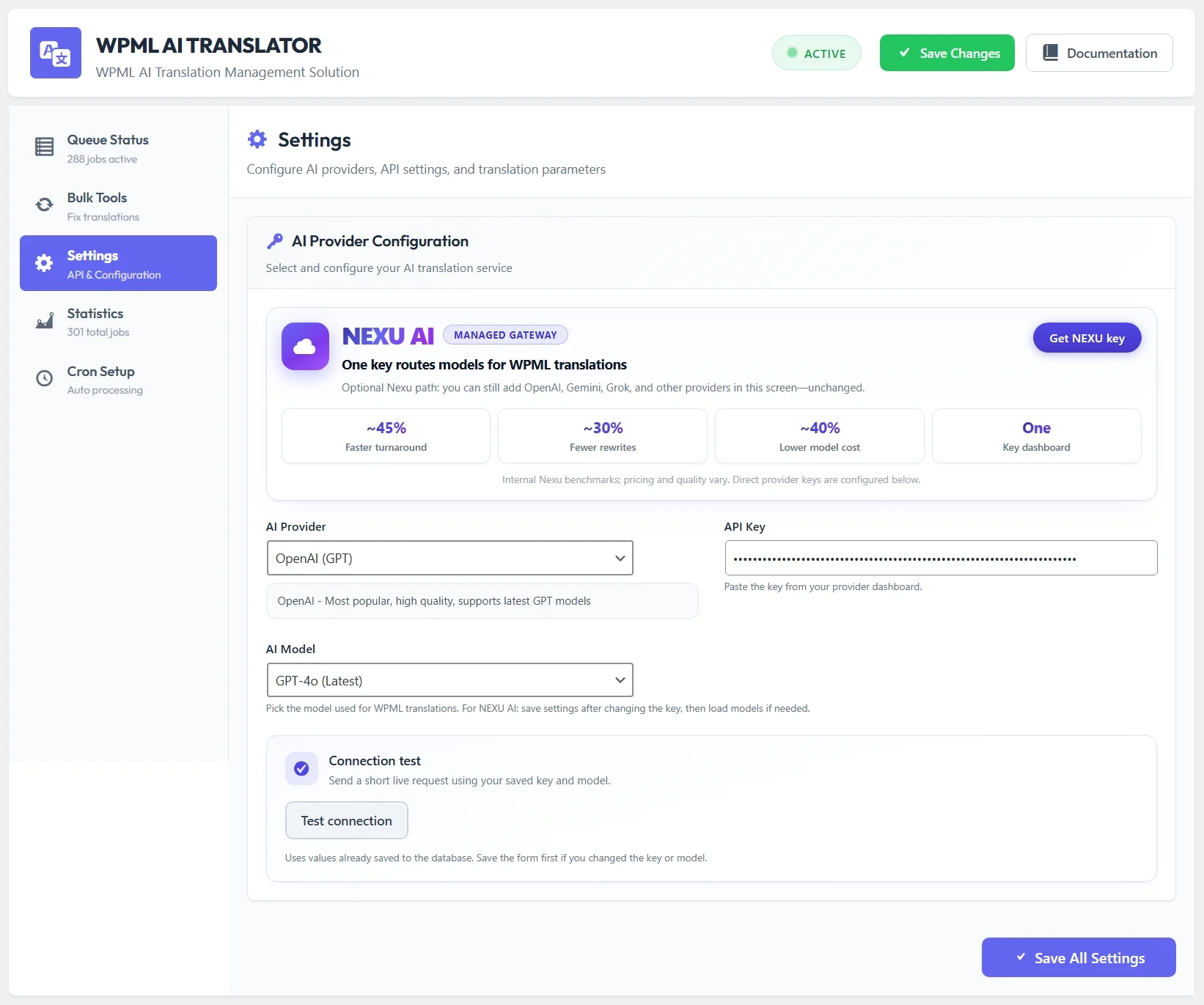
We ran all translations through NEXU AI Auto Translator for WPML with OpenAI, Claude, Mistral and Grok because it is the only WPML addon that supports all four providers from a single installation. We switched between models in the settings panel and ran the same content through each one, keeping everything else identical. This eliminated any variables related to different plugin architectures or prompt engineering approaches.
Before we break down the results by language, here are the overall averages across all eight languages and all five content types. These give you the big picture of how each model performed as a general-purpose WordPress translation engine.
Claude Sonnet 4.6 scored highest across every dimension when averaged across all languages. But these averages hide important details. The per-language results tell a more nuanced story that matters for your specific translation needs.
The aggregate scores are useful, but the real actionable insight is in the per-language breakdown. Each model has languages where it outperforms the others and languages where it is weaker. This is the data that should drive your choice of model for specific language pairs.
French was the most competitive language in our test. Claude and Mistral were nearly tied, with both producing translations that our French reviewer described as reading like native-written content. Mistral, being a French company, has obvious strengths here. Claude’s slight edge came from better handling of marketing tone and idiomatic expressions. GPT-4o scored 13.1 and Grok 12.5. All four were strong for French, but if French is your primary target language, Claude or Mistral should be your first choice.
German translation is tricky because of compound nouns, case inflection, and formal vs. informal register (Sie vs. du). Claude handled all three aspects consistently well. Our reviewer noted that Claude’s German output maintained the correct register throughout long documents, while GPT-4o occasionally mixed formal and informal address within the same piece. Mistral scored 12.8 and Grok 12.2. For German, Claude is the clear recommendation.
Spanish was the closest race between Claude and GPT-4o. Both produced excellent translations. The difference came down to Claude’s slightly better handling of regional variations: our reviewer (Latin American Spanish speaker) noted that Claude’s output used more universally understood Spanish phrasing, while GPT-4o occasionally used Iberian Spanish constructions that sound unnatural in Latin America. Mistral scored 12.6 and Grok 12.0. For Spanish, either Claude or GPT-4o is a strong choice.
Arabic was the biggest surprise in our test. Mistral, which many people associate primarily with European languages because of its French origins, produced the best Arabic translations. Our reviewer highlighted that Mistral’s Arabic maintained natural Modern Standard Arabic sentence structure without the awkward literal constructions that the other models sometimes produced. Claude came second with strong accuracy but occasionally stiff phrasing. GPT-4o scored 12.4 and Grok 11.8. For Arabic content, try Mistral first.
OpenAI ‘s GPT-4o took the top spot for Japanese, which aligns with what we have heard from other multilingual content managers. Our reviewer noted that GPT-4o correctly chose between kanji compounds and hiragana based on context, and its use of keigo (polite language) in formal content was particularly well-calibrated. Claude was close behind, with Mistral at 11.6 and Grok at 11.2. For Japanese content, GPT-4o is the strongest choice.
A dead heat between Claude and GPT-4o for Brazilian Portuguese. Both models correctly used Brazilian rather than European Portuguese conventions, which is critical since the two variants differ significantly in vocabulary and sentence structure. Mistral scored 12.2 and Grok 11.8. Either Claude or GPT-4o works well for Portuguese.
Turkish, an agglutinative language with very different syntax from English, was one of the harder tests for all four models. GPT-4o handled Turkish suffixation and word order most consistently. Our reviewer noted occasional awkward phrasing from all models but fewer from GPT-4o. Mistral scored 11.6 and Grok 11.0. Turkish translation quality across all models is good but not as polished as for European languages. Human review of important Turkish content is recommended regardless of model choice.
Claude dominated Dutch translation, with our reviewer noting particularly natural word order and correct use of diminutives and compound words. Dutch has subtle grammatical features (de/het articles, word order in subclauses) that trip up many translation tools. Claude handled these consistently. GPT-4o scored 12.8 and Grok 12.0.
The language-by-language results are the most actionable data, but the content-type results reveal something interesting about each model’s character.
The standout finding here is Claude’s strength in marketing and persuasive content. Landing pages and marketing blurbs require translation that does not just convey meaning but also maintains emotional impact and call-to-action effectiveness. Claude’s translations consistently preserved the persuasive tone of the original, while GPT-4o tended to produce slightly more neutral, informational output for the same marketing copy.
GPT-4o’s advantage in technical content is also noteworthy. For documentation, how-to guides, and content with specific technical terminology, GPT-4o produced the most precise translations. The difference was small compared to Claude, but consistent across languages.
Grok’s scores were consistently the lowest, but it had the fastest response times by a significant margin. If you are translating high volumes of straightforward content and speed matters more than the last percentage of quality, Grok is a viable option. Its translations are professional and usable. They just lack the polish that Claude and GPT-4o bring to nuanced content.
Translation quality is only one factor. The cost per translation varies significantly between models. Here is what each model cost to translate the same 6,050-word test content set into all eight languages (48,400 words of total translation output).
Claude Sonnet 4.6 offers arguably the best value proposition: highest quality scores at the second-lowest cost. Mistral is the cheapest option and delivers solid quality, making it excellent for high-volume translation where budget is the primary constraint. GPT-4o is the most expensive per word but justified for Japanese and technical content where its quality advantage is largest.
The most important takeaway from this test is that there is no single best AI model for all WordPress translation. The best model depends on your target language and content type. Here is the practical recommendation based on our data.
Highest average scores, excellent across European languages, best for marketing and persuasive content, competitive pricing. If you can only choose one model and translate into multiple languages, Claude is the safest default choice.
Top performer for Japanese, strong for Turkish and Korean (based on additional informal testing), and the best choice for technical documentation and how-to guides where precision matters more than tone.
Lowest cost per word, surprisingly strong Arabic translations, nearly tied with Claude for French. Excellent choice for high-volume translation where budget is the primary constraint.
Fastest response times across all languages. Quality is solid but not at the level of Claude or GPT-4o. Good for news sites, high-frequency publishing, or any situation where getting content translated quickly matters more than maximizing quality.
The real conclusion from this test is not that you should use one specific model. It is that having the ability to switch between models gives you a genuine quality advantage. Use Claude for your French and German content. Switch to GPT-4o for Japanese. Use Mistral for Arabic. This language-specific approach is not theoretical. It produces measurably better translations than locking into any single model.
This is the practical argument for using a translation addon that supports multiple AI providers. The NEXU AI WPML translation addon with multi-model switching for optimal translation quality lets you change AI providers in the settings panel without reinstalling anything or reconfiguring your WPML setup. You can even switch models between translation batches, using Claude for one language and GPT-4o for another within the same site.
As AI models continue to improve at different rates for different languages, this flexibility becomes more valuable. A model that is best for Spanish today might be surpassed by a competitor in six months. If you are locked into a single-provider plugin, you are stuck. With a multi-provider plugin, you upgrade your translation quality simply by switching a dropdown.
OpenAI, Claude, Mistral, and Grok in one plugin. Switch between models in seconds. Elementor support. Content chunking. Bulk tools. From $39/year.






I was really surprised by how close the scores were between all four models. everywhere you look online, it seems like one AI translator is way better than the rest, but seeing them all average above 11 out of 15? That's not what I expected.
The French translation results were decent but honestly overhyped. yeah, Claude did okay, but the difference between it and Mistral was barely there when I actually used them. for something that claims to be "the best," I was expecting way more than just tiny little tweaks. Ended up sticking with Google Translate for my client's sites anyway
as a dev who works with multilingual sites, I grabbed this comparison since the price was right for the depth of testing. the side by side scores from native speakers are way more useful than the usual "I tried one sentence" takes you see online. that said, the per language breakdown got buried a bit had to dig for the Arabic and Japanese results, which were the ones I actually needed for a client project. Still, solid baseline if you're evaluating providers