Next-Level Code. Nexuvibe Style ...
Hrs
Min
Sec

Two years ago, the choice between automatic translation and professional human translation was straightforward. If you wanted quality, you paid a human. If you wanted speed and low cost, you accepted the awkward output of Google Translate or DeepL. The trade-off was clear and the advice was simple: use machine translation for internal reference, use humans for anything public-facing.
That trade-off no longer holds. Large language models from OpenAI, Anthropic, Mistral, and xAI have changed the quality floor for automatic translation. The output from GPT-4o or Claude Sonnet 4.6 does not read like machine translation. It reads like competent human translation. Not perfect, not literary, but professional and natural enough that native speakers frequently cannot distinguish it from human work on standard content types.
This article is an honest assessment of where automatic WordPress translation stands in 2026. We will cover what AI translation does well, what it still struggles with, when human translation is still worth the investment, and the hybrid approaches that are emerging as the practical standard for most multilingual WordPress sites.
Before comparing them, let us define what each approach actually is, because the terminology has become confusing as new options have appeared.
These are the engines that WPML’s built-in credit system uses. They translate word by word or phrase by phrase using statistical and neural models trained specifically for translation. The output is functional and grammatically correct for most languages but often lacks natural flow, misses context, and produces a distinctly “translated” feel that native speakers recognize immediately. They remain the cheapest option per word and are acceptable for low-stakes content, internal documentation, and situations where speed matters more than polish.
These models were not built specifically for translation but they perform it at a remarkably high level because they understand language, context, and tone at a depth that purpose-built translation engines do not. They preserve the author’s voice, handle idioms intelligently, adapt formality levels, and produce output that reads naturally to native speakers. They cost more per word than traditional MT but dramatically less than human translation. This is where the market has shifted most significantly in 2025 and 2026.
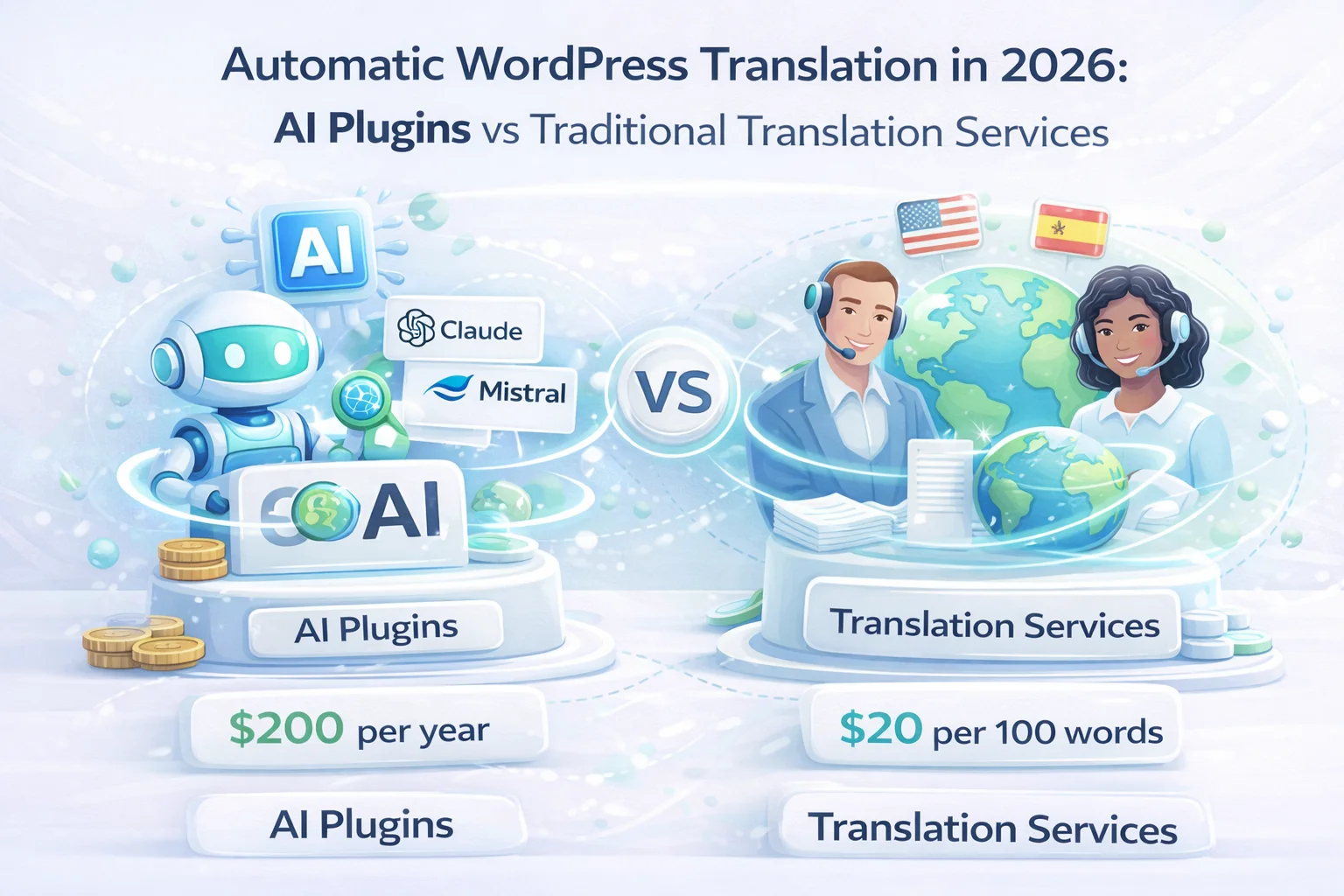
A qualified human translator reads your content and writes the equivalent in the target language. This remains the gold standard for quality, especially for creative content, legal documents, marketing campaigns targeting specific cultures, and any content where a wrong word choice could damage your brand. The cost is $0.08 to $0.20 per word depending on the language pair and specialization. Turnaround time is measured in days rather than seconds.
The hybrid approach: AI translates the content, then a human translator reviews and polishes the output. This combines the speed and cost efficiency of AI with the quality assurance of human eyes. Post-editing costs roughly 30 to 50 percent of full human translation because the editor is refining rather than creating from scratch. This is rapidly becoming the industry standard for professional localization workflows.
These services sit between your server and the visitor, translating page content on the fly. They do not modify your WordPress database or require WPML. The advantage is simplicity: install a JavaScript snippet and your site is instantly multilingual. The disadvantages are ongoing monthly costs that scale with traffic, less control over translation quality and caching, potential performance impacts, and dependency on an external service for your multilingual content. They use a mix of machine translation and optional human review.
The improvement in AI translation quality over the past two years has been dramatic enough that the use cases where AI is the right choice have expanded significantly. Here is where AI translation now produces professional-grade results without human review.
AI models understand narrative structure, maintain consistent tone across long pieces, and handle transitions between ideas naturally. A 2,000-word blog post translated through Claude or GPT-4o reads smoothly in the target language. Informational content, how-to guides, news articles, and opinion pieces all translate well. This covers the majority of content on most WordPress sites.
Product titles, feature lists, specifications, and marketing descriptions translate accurately. AI models correctly handle technical terminology, measurements, and persuasive language. For WooCommerce stores translating product catalogs into multiple languages, AI translation delivers results that are indistinguishable from human work for standard products.
Step-by-step instructions, API documentation, troubleshooting guides, and FAQ content translate cleanly. AI models handle code examples, technical terms, and procedural language well. GPT-4o is particularly strong here, likely due to its extensive training on technical content.
Meta titles, descriptions, button labels, navigation items, and short UI strings translate accurately and concisely. AI models respect character limits and produce output that works within the constraints of search result snippets and interface elements.
Honesty about limitations is important. AI translation is not perfect for everything, and pretending otherwise helps no one. Here are the areas where human translation or at minimum human post-editing remains the better choice.
Poetry, wordplay, humor that depends on linguistic tricks, and prose where the style is as important as the content. AI can approximate creative writing but it cannot replicate the deliberate choices a skilled writer makes when crafting prose that sings in a specific language. If your brand voice is a key differentiator and your content is literary in nature, human translation preserves that voice better.
Terms of service, privacy policies, compliance documentation, and any content with legal implications. A subtle translation error in a legal document can change its meaning in ways that create liability. AI translation of legal content should always be reviewed by a qualified translator or legal professional in the target jurisdiction.
Marketing that targets a specific cultural context, uses local references, or relies on emotional triggers that vary by culture. A marketing campaign for Ramadan targeting Middle Eastern audiences requires cultural understanding that goes beyond linguistic translation. AI can translate the words but may miss cultural nuances that a native marketing professional would catch.
AI models perform best for languages with abundant training data. Major world languages (English, French, Spanish, German, Chinese, Japanese, Arabic, Portuguese) all translate well. Less common languages or regional dialects may produce lower quality output. If you are translating into languages like Welsh, Basque, or smaller Southeast Asian languages, test the output carefully and consider human translation if the quality is insufficient.
The emerging standard for WordPress multilingual sites in 2026 is not “AI or human” but “AI for most things, human review for critical things.” This hybrid approach captures 90 percent of the cost savings from AI automation while maintaining quality standards for the content that matters most.
The workflow looks like this: install WPML and an AI translation addon. Translate your entire site automatically through the AI pipeline. Then identify your highest-value pages, the ones that directly drive revenue or represent your brand to new visitors, and have a human translator review those specific translations. For most WordPress sites, this means AI handles 95 percent of the content and a human reviews 5 percent.
The pages that typically warrant human review are your homepage, your main product or service pages, your about page, and any landing pages tied to paid advertising campaigns. Everything else, blog posts, archive descriptions, secondary product pages, documentation, FAQ content, can run on AI translation without review and produce perfectly acceptable results.
If you decide to use AI translation for your WordPress site, the practical question is how to connect AI models to your content management workflow. For WPML users, this means an addon plugin that bridges WPML’s translation job system with AI provider APIs. For non-WPML setups, there are standalone solutions.
These plugins integrate with WPML’s translation management system. You keep WPML for multilingual structure, URL management, and language switching. The addon handles the translation itself through AI APIs instead of WPML’s credit system. The advantage is that your translations live in WPML’s database structure, which means all WPML features (hreflang, sitemaps, language switcher) work normally. NEXU AI Auto Translator for WPML is the most feature-complete option in this category, supporting four AI providers, Elementor translation, content chunking, and bulk tools.
Weglot is the most popular option here. It translates your site through a proxy layer without modifying your WordPress database. Setup is fast and it works with any WordPress site regardless of theme or page builder. The trade-offs are monthly pricing that scales with page count and traffic (starting around $15/month for small sites, going up to hundreds for large sites), less granular control over translations, and dependency on an external service. Weglot uses a mix of machine translation and allows human editing through its dashboard.
TranslatePress takes a different approach from WPML: it stores translations directly in the database alongside the original content and provides a visual frontend editor for translation. It has added AI translation support through DeepL and Google Translate integrations. The visual editing experience is intuitive but the AI provider options are more limited compared to WPML-based solutions.
Rather than abstract quality claims, here is a concrete example. We took a single paragraph from a WooCommerce product description and translated it into French using each method. The original English text described a leather messenger bag with details about materials, dimensions, and use cases.
Grammatically correct but reads as translated text. The word order follows English patterns in places where French would naturally structure the sentence differently. Product-specific terms were handled literally rather than using the terms French shoppers would actually search for. Our French reviewer rated it 3.2 out of 5: usable but noticeably machine-generated.
Natural French sentence structure. Used the product terminology that French e-commerce sites actually use. Maintained the persuasive tone of the original without translating it literally. Our reviewer rated it 4.6 out of 5 and said it read like it was written by a French copywriter. The only issue was a slightly formal register that could have been a touch more casual for this product category.
Perfect. Natural, persuasive, culturally appropriate. The translator adapted certain product descriptions to match what French consumers expect rather than translating literally. Our reviewer rated it 4.9 out of 5. The 0.3-point gap between this and Claude’s output was in cultural adaptation, not linguistic quality. For standard product descriptions, this gap is arguably not worth the 100x cost difference.
This single example illustrates the broader pattern. Traditional MT produces functional but recognizably translated output. AI produces natural output that closely approaches human quality. Human translation remains the best but at a cost that is viable only for the most important content. For a WordPress site with hundreds or thousands of pages, the economics overwhelmingly favor AI translation for the majority of content.
If you are running a WordPress site in 2026 and you need multilingual content, AI translation through modern LLMs is the practical default for most of your content. It is not the answer for everything. Legal documents need human eyes. Brand campaigns targeting specific cultures need human creativity. But for the 90 to 95 percent of WordPress content that consists of blog posts, product pages, documentation, and general web copy, AI translation delivers professional results at a fraction of traditional costs.
The practical implementation for WPML users is straightforward: keep WPML for your multilingual infrastructure, add an AI translation addon that connects your own API keys, and let the automated workflow handle the translation. Use human review selectively for your highest-value pages. This gives you full multilingual coverage with quality that serves your visitors well and costs that do not strain your budget.
The gap between AI and human translation quality continues to narrow with every model update. What was clearly distinguishable two years ago now requires careful side-by-side comparison by native speakers to identify. For most WordPress site owners, the question is no longer whether to use AI translation. It is which AI model to use, and how to set up the automation to make it effortless.
Four AI providers. WPML integration. Elementor support. WooCommerce. Yoast SEO meta. Content chunking with resume. Background processing. From $39/year.



Hey everyone, just had to share how much this plugin saved my hide. I was totally stressing over translating my friend's entire blog as a surprise for her birthday, but this thing knocked out all the posts in seconds flat. no awkward robot speak or clunky phrasing just smooth, natural sounding text like a real person wrote it. Such a relief not to scramble for expensive last minute translators! If you're ever in a tight spot like I was, it's absolutely worth it
Translation quality is solid, but setup took longer
Hey everyone! I just had to share my experience with this translation plugin. As a single parent trying to keep up with a small blog on the side, I don't have the time or the budget for professional translators. I decided to give this a try, and honestly? I'm really impressed
Got this for a client's WooCommerce store and the setup was stupid easy just pasted the JS snippet in the header and boom, instant Spanish/French versions of all product pages. No manual entry, no CSV uploads, nothing. The translations for specs and feature lists were spot on, which honestly surprised me. Only downside? Took 10 extra minutes, but still way faster than hiring translators for 300+ SKUs. worth it if you're in a rush
Hey, just tried this for my college club's website and wow the translations actually sound natural? Used to pay $0.30/word for humans, so saving a bit here is nice. Only bummer is the setup guide was kinda buried in settings (took me 10 mins to find it). still, way better than Google Translate's robot talk. worth it if you're on a budget but need decent quality.