
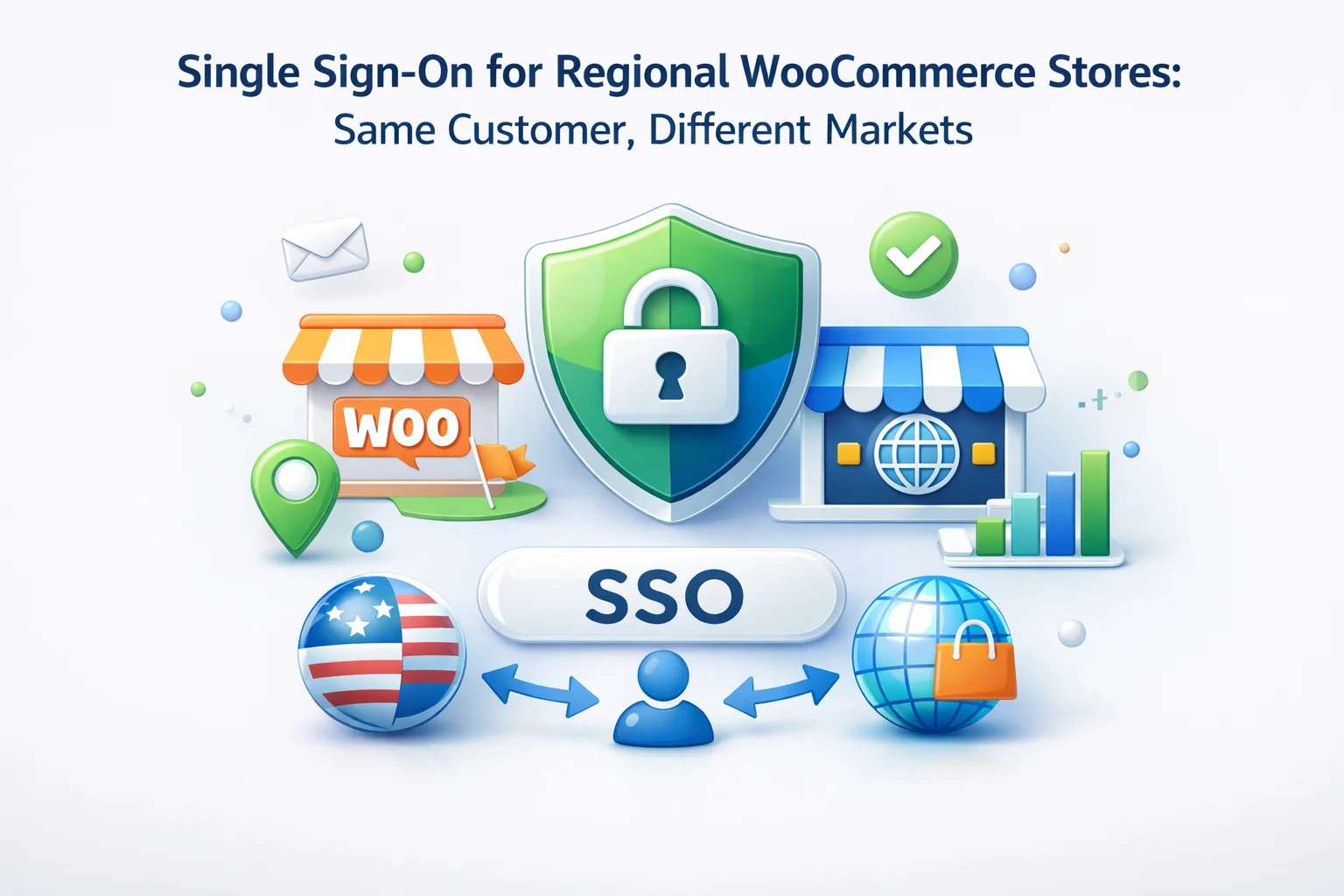
Running separate WooCommerce stores for different regional markets is a common and often well-reasoned architecture decision. You need different currencies, different tax frameworks, different product catalogs tuned for local preferences, different shipping integrations, and sometimes different regulatory compliance layers. A single global WooCommerce installation can technically handle much of this through plugins, but the resulting complexity often exceeds the management overhead of separate regional installations. Many businesses with genuine multi-market operations find that separate stores, clearly scoped to their markets, are simply easier to manage and easier to get right.
The problem that emerges from this architecture is a customer identity problem. Your customer who shops at your UK store does not exist in your US store’s database. They are unknown to your German store. If they travel and try to use their account on a regional site that was not their original registration site, they are a stranger. If you run a loyalty program that is meant to work across your global brand, their points and status are siloed in the market where they first registered. If you run marketing campaigns that should reach your entire customer base regardless of which regional store they use, your segmentation is fragmented across separate databases with no unified view.
The solution is not to collapse your regional stores into a single global WooCommerce installation — the architectural reasons for keeping them separate remain valid. The solution is to connect them through a cross-regional WooCommerce SSO and customer identity sync layer that unifies the customer experience across markets while preserving the market-specific configurations that make each regional store work correctly for its context.
This guide is for e-commerce businesses that have built or are building a multi-regional WooCommerce architecture and want to understand what unifying the customer experience across those regions actually requires — technically, architecturally, and operationally. We cover the specific challenges that regional WooCommerce networks create for SSO and user sync that single-market deployments do not face, and how to solve them without undermining your regional market configuration.
Why regional WooCommerce creates unique SSO challenges
Most documentation on WordPress SSO assumes that connected sites serve the same user base in essentially the same way — the same language, the same currency, the same product catalog, the same access rules. Regional WooCommerce stores break every one of these assumptions. The same user who is a “customer” in your UK store with a billing address in London and an order history in GBP is also, from your US store’s perspective, a potential customer who has never interacted with that store in any way. Unifying these two identities without inadvertently importing the UK customer’s billing details (in the wrong currency and the wrong address format) into the US store requires deliberate configuration decisions that a standard multi-site sync guide does not address.
A WooCommerce customer’s profile carries currency-specific metadata: _order_total, _money_spent, and customer value metrics are denominated in the store’s currency. Syncing these fields across regional stores would produce nonsensical data — a customer who spent £3,000 in the UK store should not arrive on the US store with a $3,000 spending record. Regional customer-value metadata is site-specific and must be excluded from cross-regional sync.
A customer’s stored billing and shipping address is region-specific. The UK customer’s London address is correct for the UK store. If that address is synced to the US store and the customer places an order without updating their address, the order may process with an international billing address that creates payment processing complications, incorrect tax calculations (UK VAT applied to a transaction on a US store), and shipping label issues. The billing and shipping address sync decision requires careful consideration of whether each regional store should carry global address data or start fresh.
European customers on a UK or EU WooCommerce store may have VAT numbers stored as user meta for B2B tax exemption purposes. Syncing these fields to a US store that does not use VAT creates orphaned data that may interfere with the US store’s tax calculation plugins. Similarly, customer-specific tax exemption certificates, EU-specific compliance fields, and locally-required data collection fields should never propagate across markets where they have no meaning.
A customer on your French regional store will have a locale preference of fr_FR stored in their user meta. If this preference is synced to your English-language US store, it may override the store’s language settings for that customer. Language and locale preferences should either be excluded from cross-regional sync or handled with explicit regional overrides that prevent the home-store locale from being imposed on other regional sites.
The global versus regional data classification: what travels and what stays
The most important configuration decision in a regional WooCommerce SSO and sync deployment is the data classification: which customer data represents the person (universal and should travel across all regional stores), and which data represents their relationship with a specific market (regional and should stay where it belongs). Getting this classification right is what makes the difference between a unified cross-regional customer experience and a data quality disaster.

Designating a global master without forcing all registrations through one region
Standard master-sub sync architecture assumes a clear hierarchy: one master, multiple subs that receive data from the master. Regional WooCommerce networks challenge this assumption because customers register on whichever regional store they first encounter — and that may be any of your regional sites, not a designated global hub. A UK customer who discovers your brand through a Google search will land on your UK store and register there. An Australian customer will register on your AU store. There is no natural single point of first registration.
This does not mean you cannot have a global master — it means you need to think carefully about what the master’s role is in a regional context. There are three workable approaches, each with different tradeoffs.
Most scalable
A dedicated authentication site — not a regional store, just an identity hub — serves as the master for all regional stores. Customers register once on this hub (accessible from any regional store via a seamless redirect). All regional stores authenticate via SSO against this hub. The hub holds only identity data: email, password, name, phone. No order data, no currency-specific data, no regional metadata. Each regional store holds its own market-specific customer records.
Scales to unlimited regional stores
Requires building and maintaining the hub site
Most practical for 2–4 regions
The largest or highest-volume regional store is designated as the master. Customer accounts created on other regional stores are synced back to the master so that the master maintains a complete global customer database. The master pushes identity data (not regional market data) to all regional sub-sites. This approach requires careful metadata scope configuration to ensure only global-classification data travels between the master and regional stores.
Bidirectional sync needed — more complex conflict rules
Master’s regional data may contaminate global sync if not carefully scoped
Lowest risk, limited benefits
Deploy SSO so customers can move between regional stores without re-authenticating, but do not sync profile data between stores at all. Each regional store maintains entirely independent customer records. SSO only unifies the authentication experience. The customer still needs to fill in their billing details on each regional store they use for the first time. This approach is appropriate when regional data isolation requirements are strict and the compliance or operational risk of data transfer between regions outweighs the UX benefit.
New customers must fill billing details on each regional store they first visit
How SSO works across regional domains: the technical reality
Regional WooCommerce stores almost always operate on entirely different domains — not just subdomains of the same parent, but fully independent domain registrations. The UK store might be on brand.co.uk, the US store on brand.com, and the German store on brand.de. These are separate domains with no shared cookie space, no shared session, and no browser mechanism for automatic authentication inheritance.
Token-based SSO is specifically designed for this scenario. When a customer authenticated on brand.co.uk navigates to brand.com via a link — for example, clicking “Visit our US store” — the UK site generates a one-time authentication token tied to that customer’s identity, appends it to the redirect URL to brand.com, and the US site validates the token server-side and creates a local session for that customer. The entire handshake completes in the same request cycle as the page load. The customer arrives on the US site already authenticated.
Token-based cross-domain SSO does not fire automatically for all navigation — it fires when the customer follows a specific link from one regional store to another that has been configured as an SSO-enabled cross-domain navigation event. If a customer types the URL of a regional store directly into their browser, the SSO handshake does not occur — they arrive as an unauthenticated visitor. This is correct behavior: SSO unifies the experience for intentional cross-store navigation, not for arbitrary direct visits. The practical implication is that your “switch region” or “visit our [country] store” navigation elements must be implemented as SSO-aware links, not plain URL links.

Cross-regional loyalty programs: the unified customer identity use case
One of the most compelling business cases for investing in cross-regional customer identity unification is the loyalty program use case. A loyalty program that only recognizes a customer’s activity on the regional store where they first registered is, from the customer’s perspective, a loyalty program that penalizes them for shopping globally with the brand they are loyal to.
A customer who has Gold status on your UK store because of three years of purchase history expects that Gold status to be recognized when they visit your Australian store during a trip. If it is not — if they arrive as an unknown visitor with no status — the loyalty program has actively communicated that their relationship with the brand is not valued globally. This is a retention risk, not a minor UX inconvenience.
Implementing cross-regional loyalty recognition requires that the customer’s membership tier or loyalty status — stored as a WordPress role or as loyalty-plugin-specific user meta — be synchronized across regional stores as part of the global-classification data that travels. The loyalty tier is a property of the person, not of their relationship with a specific regional market. It belongs in the global identity layer and should be available to every regional store.
The customer’s loyalty tier or membership role must be a global-classification field in your sync configuration. If your loyalty program stores tier as a WordPress role (Gold, Silver, Basic), that role must be reflected on all regional stores via role mapping. If it stores tier as a user meta key (common for plugins like WooCommerce Points and Rewards, or Sumo Rewards), that meta key must be included in your sync scope and excluded from the regional-only list.
Points balances are typically regional. A customer’s accumulated points denominated in GBP equivalents cannot be meaningfully transferred to a USD-denominated regional store’s points system without a conversion mechanism. Syncing raw points balances across regions without a defined conversion policy would create accounting problems. The tier status should sync. The specific points balance accrued in each region should stay regional unless your loyalty program has explicit cross-regional points pooling.
GDPR, data residency, and cross-border data transfer considerations
Synchronizing customer data between regional WordPress stores that operate in different legal jurisdictions raises data protection questions that are specific to cross-border data transfer. This is not a theoretical concern — the General Data Protection Regulation (GDPR) in the EU, the UK GDPR post-Brexit, and similar frameworks in other jurisdictions impose specific requirements on the transfer of personal data across borders.
For businesses operating WooCommerce stores in the EU and transferring customer data to servers in non-EU countries (including the US), the data transfer must be covered by an appropriate transfer mechanism under GDPR Article 46 — such as Standard Contractual Clauses (SCCs), a recognized adequacy decision for the destination country, or another approved mechanism. Businesses transferring EU customer data to the UK must similarly have a transfer basis in place, as the UK is no longer covered by EU adequacy for future reviews.
Cross-border data transfer compliance is a complex and jurisdiction-specific legal question. The considerations described here are intended to prompt the right questions and ensure you engage appropriate legal counsel before deploying cross-regional customer data sync. Data protection obligations vary significantly by jurisdiction and business context. Always consult a qualified data protection professional for advice specific to your operations.
From a practical configuration standpoint, the data classification table above becomes directly relevant to compliance planning. Limiting the cross-regional sync scope to global-identity data (email, name, password hash, phone) while keeping all regulatory-specific fields (VAT numbers, GDPR consent records, tax exemption certificates) regional simplifies the compliance picture significantly. The less personal data that crosses jurisdictional boundaries, the less complex the transfer mechanism requirements.
Equally important is ensuring your privacy policy is updated to disclose that customer data is shared between regional stores, with which stores, for what purpose, and under what legal basis. A customer who registers on your UK store should be informed that their identity data may be accessible to your US and AU stores via your unified customer platform. This disclosure is a GDPR Article 13 requirement and must be present in your UK store’s privacy notice before cross-regional sync is activated.

The customer experience before and after: what changes in practice
The business case for investing in cross-regional customer identity unification is clearest when you describe the concrete experience changes at the customer level. These are not abstract improvements — they are moments in the customer journey that either build trust or undermine it.
The unified regional WooCommerce customer experience does not require you to abandon the market-specific configurations that make each regional store effective. It requires that you make a deliberate, documented decision about which customer data is universal and which is market-specific, implement a sync configuration that respects that decision, and deploy SSO so that cross-store navigation is transparent to the customer. The technical infrastructure for all of this is the same infrastructure used for any multi-site WordPress user sync — the regional context simply adds the data classification layer that determines the scope.
Nexu User Sync’s WooCommerce multi-regional customer identity sync and cross-domain SSO provides the granular metadata field control, the token-based cross-domain SSO that works across fully independent TLDs, the encrypted connection keys for GDPR-aware cross-border data handling, and the event log that gives you visibility into exactly what customer data is moving between your regional stores and when. The data classification decisions are yours to make. The infrastructure to execute them is ready.
Your customers are global. Your stores can be regional. Their experience should be unified.
Nexu User Sync connects your regional WooCommerce stores through token-based SSO that works across fully independent domains, with granular field control to keep global identity data unified and regional market data isolated.


The SSO works fine, but syncing passwords across regions seems a bit risky
Hey just a heads up the VAT field sync can cause issues with US tax plugins
As a family doctor running a small online supplement shop across three regions, I was so done with patients emailing me every time they traveled because they couldn't log in. this guide finally showed me how to link their accounts without merging my stores huge win. Only minor gripe: the user sync took about 12 hours to push password updates everywhere during testing. not a huge issue, but if your customers are as impatient as mine, just give them a heads up