
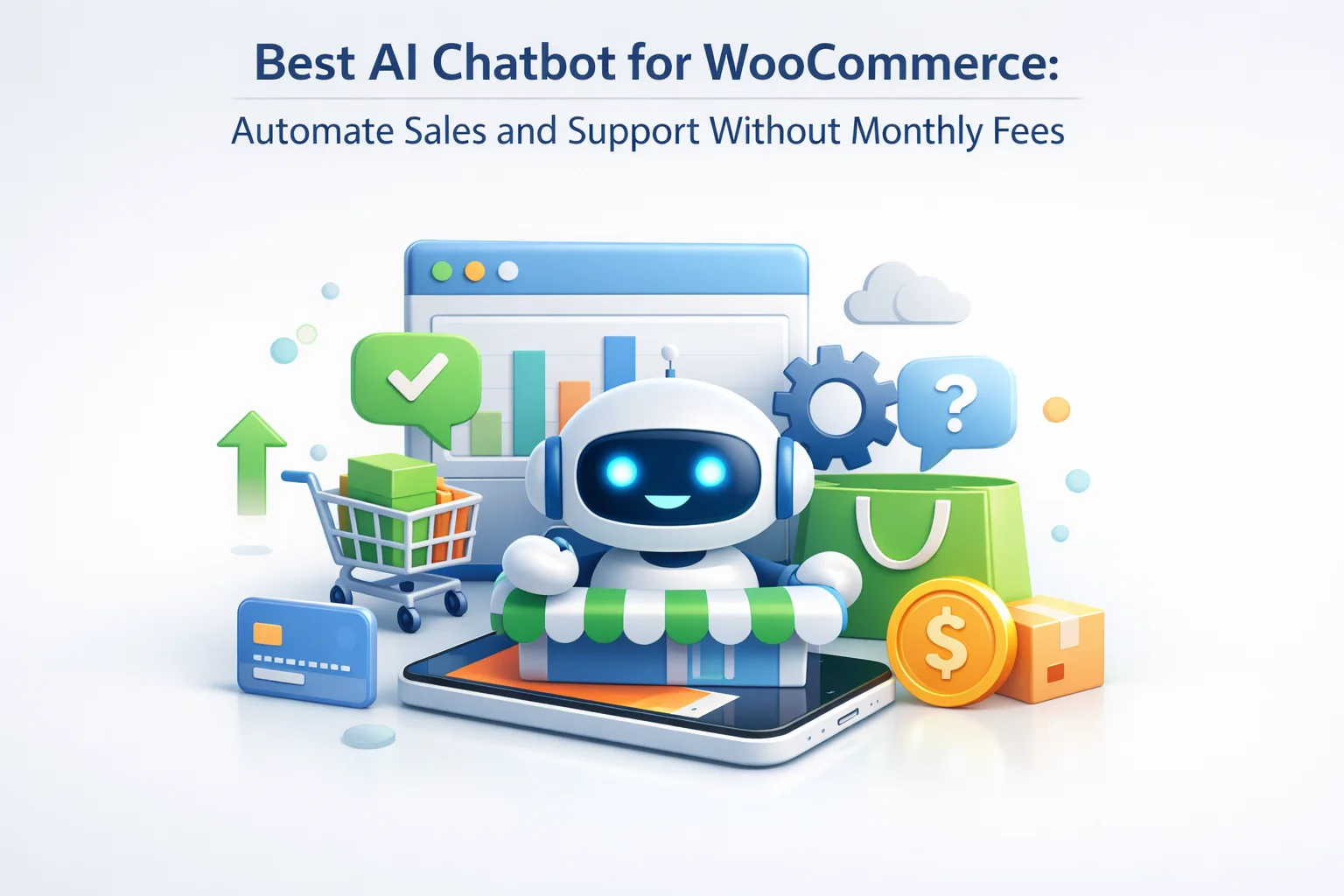
If you have spent any time searching for an AI chatbot for your WooCommerce store, you have probably noticed a pattern. Almost every solution out there operates on a subscription model. Tidio, Zendesk, Intercom, Drift: they all want your credit card on file and a recurring payment that scales with your usage. For a small store doing $5,000 a month in revenue, spending $100 or more on a chatbot subscription can be hard to justify. For a larger store, those costs can balloon into thousands of dollars annually just for automated chat.
But here is the thing most guides will not tell you: there is a fundamentally different architecture for AI chatbots that eliminates those monthly fees entirely. Instead of renting someone else’s AI infrastructure, you can run a self-hosted chatbot plugin that connects directly to the AI provider of your choice. You pay only for the API tokens you actually use. No middleman markup. No subscription tiers. No feature gates.
This guide covers the best approach to AI-powered WooCommerce customer support automation that gives you complete control over your data, your costs, and your customer experience. We will look at what makes a chatbot genuinely useful for e-commerce, why most generic AI bots fail at product recommendations, and how to set up a system that actually understands your specific catalog.
The hidden cost structure of SaaS chatbot platforms
When you sign up for a chatbot service like Tidio, Zendesk Chat, or Intercom, you are not just paying for AI. You are paying for their infrastructure, their support team, their marketing budget, and their profit margin. The AI component, which is usually OpenAI or a similar provider under the hood, is a small fraction of what you are actually billed. This is why a service that charges you $99 per month might be using $3 worth of actual AI compute to handle your conversations.
The subscription model also creates misaligned incentives. These platforms want you to use more features so they can justify higher tiers. They want you to send more messages so they can charge overage fees. They want you dependent on their ecosystem so switching costs feel prohibitive. None of this is necessarily malicious, but it is worth understanding when you evaluate your options.
Most SaaS chatbot platforms start at $29 to $49 for basic tiers with limited features. The moment you need AI responses, conversation history, multiple operators, or advanced customization, you are looking at $99 to $199 monthly. Enterprise features like custom branding removal or priority support push costs to $299 or higher. And these prices apply whether you get 10 conversations or 1,000.
With a self-hosted WordPress plugin that connects directly to OpenAI, Anthropic Claude, or Google Gemini, you pay per token used. A typical customer support conversation uses about 2,000 to 4,000 tokens. At current OpenAI pricing, that is roughly $0.01 to $0.04 per conversation. Even with 500 conversations per month, your total AI cost might be $10 to $20. No subscription markup. No feature tiers.
Why generic AI chatbots fail at WooCommerce
Here is a scenario that plays out thousands of times every day on e-commerce sites using generic AI chatbots. A customer asks: “Do you have this jacket in medium?” The chatbot, which is just a wrapper around ChatGPT with no knowledge of your actual inventory, responds with something like: “I’d be happy to help you check! Could you provide me with the product name or link?” The customer already told you which jacket. Now they are frustrated. They close the chat and leave.
The problem is that most AI chatbots have no idea what products you sell, what sizes are in stock, what your shipping policies are, or what your return window looks like. They are general-purpose language models pretending to be customer service agents. The result is conversations that feel hollow and unhelpful.

A chatbot that genuinely helps WooCommerce customers needs to be able to search your product database, check current stock levels, and respond with specific product information. When someone asks about a jacket, the chatbot should pull up that exact jacket, show the available sizes, display the current price, and offer a direct add-to-cart button. This is what RAG-based WooCommerce chatbot plugins are designed to do.
RAG stands for Retrieval-Augmented Generation. Instead of relying solely on the AI model’s training data, RAG systems first search your specific content (products, pages, policies) and then use that retrieved information to generate accurate responses. This is how a chatbot can tell a customer that the blue version of a product is in stock while the red version is sold out. The AI is not guessing. It is reading your actual database.
Auto-indexing: the feature that makes everything work
The traditional approach to training a chatbot involves manually entering question-and-answer pairs. “What is your return policy?” maps to a pre-written answer. “How long does shipping take?” maps to another. This works until your policies change, at which point every manual entry becomes a liability. Outdated answers erode customer trust quickly.
Auto-indexing solves this by automatically scanning your WordPress content and WooCommerce products, then creating a searchable knowledge base that the AI can query in real time. When you update a product description, change a price, or modify your shipping policy page, the chatbot’s knowledge updates automatically. No manual intervention required.

Choose which post types the chatbot should learn from. For a typical WooCommerce store, this means products, pages (for policies and FAQs), and possibly blog posts if you publish helpful content. The plugin scans these sources and breaks them into searchable chunks.
The plugin converts your content into vector embeddings, which are numerical representations that allow the AI to find semantically related content. When a customer asks about waterproof jackets, the system finds products tagged with waterproof features even if the exact word was not used in the query.
Whenever you publish a new product or update an existing page, the chatbot’s knowledge base updates automatically. There is no manual retraining required. Your chatbot always reflects the current state of your store.
Choosing your AI provider: OpenAI, Claude, or Gemini
One of the major advantages of a self-hosted chatbot solution is provider flexibility. You are not locked into whatever AI engine the SaaS platform uses. You can choose the provider that best fits your needs, switch whenever you want, and take advantage of competitive pricing.

Protecting your API budget from abuse
The biggest fear store owners have about pay-per-use AI is runaway costs. What if a bot or malicious user sends thousands of requests? What if someone writes a script to drain your API credits overnight? These are legitimate concerns, and any serious chatbot solution needs to address them.

Effective protection comes from multiple layers. Rate limiting restricts how many messages any single visitor can send within a time window. Token caps prevent any single conversation from consuming more than a defined amount of AI compute. IP blocking lets you ban specific addresses that show abusive patterns. And role-based access means you can give logged-in customers more generous limits than anonymous visitors.
Setting up your WooCommerce AI chatbot in 15 minutes
The setup process for a modern WordPress chatbot plugin is surprisingly straightforward. Most store owners can have a working chatbot live on their site within 15 to 20 minutes of installation. Here is what the process looks like.

Upload the plugin through WordPress, activate it, and the setup wizard launches automatically. No hunting through settings menus to find where to start.
Enter your API key from OpenAI, Anthropic, or Google. The wizard validates the connection immediately and shows you the available models. Most store owners choose GPT-4o for the balance of capability and cost.
Select WooCommerce products, pages, and any other content types you want the chatbot to know about. Click start and the plugin creates your knowledge base. For a store with 500 products, this takes about 5 to 10 minutes.
Adjust colors to match your brand, set your chatbot’s greeting message, and configure where and when the widget appears. Preview everything in real time, then go live with one click.
Monitoring conversations and measuring impact
Deploying a chatbot is not a set-and-forget operation. You need to understand what customers are asking, how well the bot is answering, and where it might be falling short. This feedback loop is what turns a basic chatbot into a genuine asset for your business.

The conversation history panel lets you review every interaction. You can see exactly what questions customers asked and how the bot responded. When you notice recurring questions that the bot handles poorly, you know exactly what content to add to your site. When you see high satisfaction ratings on product recommendation conversations, you know the system is working.

The bottom line: ownership versus rental
The choice between a SaaS chatbot subscription and a self-hosted plugin comes down to a fundamental question: do you want to rent someone else’s AI infrastructure, or do you want to own your chatbot and pay only for what you use?
For most WooCommerce stores, the self-hosted approach makes more financial sense. You avoid monthly subscriptions that add up to hundreds or thousands of dollars annually. You maintain complete control over your customer data. You can switch AI providers whenever better or cheaper options emerge. And with auto-indexing, your chatbot always stays current with your inventory and policies.
The Nexu SmartChat plugin for WooCommerce stores represents this self-hosted approach done right: one-time purchase, direct API connections to multiple providers, automatic product indexing, rich product card displays in chat, and the security controls you need to protect your API budget. It is the AI chatbot architecture that makes sense for store owners who think long-term.
The WooCommerce chatbot that knows your products and respects your budget
Nexu SmartChat auto-indexes your catalog, displays rich product cards in conversations, connects to OpenAI, Claude, or Gemini, and costs only what you actually use in API calls.


Just wanted to say how refreshing it is to finally find a chatbot that doesn't hit you with monthly fees
Costs add up way too fast.
we've been running this for our store's customer support automation. The self hosted setup cuts out all the extra fluff no hidden fees, just straightforward pay per API call pricing