
The comparison that most WordPress site owners make when choosing a chatbot goes something like this: they look at Tidio’s $29 per month starter plan, compare it against a self-hosted plugin, and figure the SaaS option is in the same ballpark. It is not. By the time a real WordPress business actually needs AI-powered responses, branding that does not say “Powered by Tidio,” and enough conversation volume to serve a modestly busy site, that $29 plan has become $150 to $200 per month, and it climbs further from there.
This article is a genuine cost breakdown. We are going to use real pricing numbers from the actual platforms, build honest year-one, year-two, and year-three cost scenarios for comparable setups, and identify every hidden cost category that the marketing pages do not lead with. The goal is not to make SaaS look bad or self-hosted look good. It is to give you accurate numbers so you can make an informed decision for your specific situation.
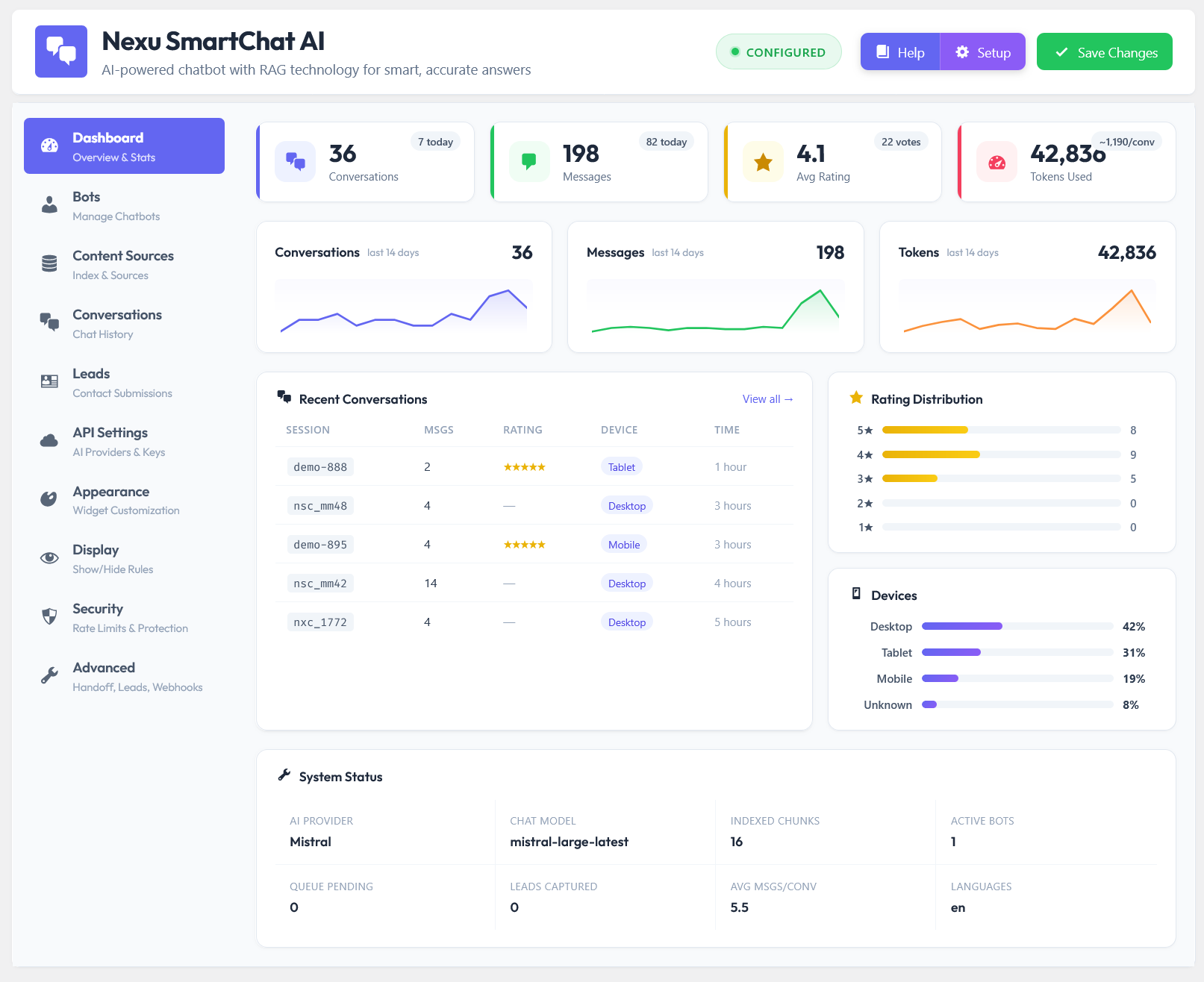
We reference Nexu SmartChat as a self-hosted WordPress AI chatbot plugin with RAG throughout, because it represents the self-hosted model well. The principles apply equally to other native WordPress plugins covered in the market.
Let’s start with the cost structure of each model, then build the scenarios.
How SaaS chatbot pricing actually works: the layered billing model
SaaS chatbot platforms typically present a simple per-month number on their pricing page. What that number actually covers is a carefully limited baseline, and the features that make a chatbot genuinely useful are distributed across multiple separate billing layers. Understanding the layer structure is the key to reading SaaS pricing accurately.
This covers the platform infrastructure, the widget, and a limited number of conversations per month. On Tidio, the Growth plan at $59 per month gives you 2,000 conversations per month and up to 10 agents. This sounds adequate until you realize that “conversations” in Tidio’s billing means any chat session, not just AI-handled ones. Human and bot conversations both count. A site with 200 daily visitors and a 5% chat rate runs through 300 conversations in a month, which sits inside the Growth limit. But add any meaningful traffic or AI-heavy responses and you are looking at overage charges or a forced upgrade.
On Tidio, the AI chatbot capability (Lyro) is a separate add-on starting at $39 per month for 50 AI conversations. These AI conversations are billed independently from your base plan conversations, so you are tracking and paying for two separate usage meters simultaneously. When Lyro hits its monthly limit, the AI simply stops responding, leaving visitors to get no answer at all until you add more credits. Intercom’s AI resolution fee is charged per successful AI resolution at $0.99 each. At 500 resolved conversations per month, that is $495 in AI fees alone on top of your seat costs. The AI capability is almost never included in the base plan price you see advertised.
Most SaaS chatbot platforms include their own branding in the widget on every plan below the top tiers. On Tidio, removing the “Powered by Tidio” label costs $20 per month on the Growth plan and is only included from Plus ($749 per month) upward. If you are deploying a chatbot as part of a professional branded experience, you are paying an extra $20 per month for what feels like a baseline expectation. Intercom and Drift do not publish branding removal as a discrete line item because they expect you to be paying at enterprise tier levels where it is simply included.
Tidio charges separately for its automation builder (Flows), starting at $29 per month. Flows are billed per reached visitor, meaning even visitors who see the automated greeting but do not interact count against your limit. A high-traffic WordPress site can burn through flow visitor credits quickly without generating a single useful conversation. This billing model penalizes traffic growth directly, which is the opposite of what a business scaling its site wants.
Tidio’s self-service plans cap at 10 agents maximum, and the 11th seat forces an upgrade to Plus at $749 per month. Intercom charges per seat, with costs that reach $74 or more per seat per month at scale. For a small WooCommerce store with one or two people handling support, seat pricing is not an issue. For any business with a growing team, seat costs can become the dominant line item in the SaaS chatbot budget with remarkable speed.
A mid-sized WooCommerce store on Tidio Growth ($59/month) that adds Lyro AI for 200 conversations ($79/month), Flows ($29/month), and branding removal ($20/month) is paying $187 per month before any overages. That is $2,244 per year for a tool whose pricing page leads with $59. This is not a theoretical edge case. It is the realistic cost for any serious deployment. And it compounds: Tidio doubled prices for existing customers in December 2024 without adequate advance notice, as documented by reviews on Capterra and G2. Multi-year planning with SaaS pricing requires factoring in the real probability of unilateral price increases.
How enterprise SaaS pricing works: Intercom and Drift
Intercom and Drift operate at a different level of the market, but understanding their pricing is useful for WordPress site owners who are evaluating their options and may have encountered these platforms in comparisons.
Intercom’s seat-based pricing means a team of 5 agents reaches $680 or more per month in seat costs alone before counting AI usage fees. Their Fin AI agent is billed at $0.99 per resolved conversation. At 500 resolutions per month, that adds $495 to the monthly bill. A realistic Intercom setup for a growing ecommerce business with a 5-person support team comes in at well over $1,200 per month. This is a real platform with real capabilities at that price point, but it is a fundamentally different investment level than a WordPress plugin.
Drift starts at around $2,500 per month and is positioned explicitly as an enterprise sales acceleration platform. Enterprise plans can exceed $5,000 to $10,000 per month depending on features and seat count. Drift does not publish pricing publicly. For any WordPress site owner reading this, Drift is worth understanding as a market data point that tells you how the high end of this market prices itself. It is not a realistic comparison for most WordPress deployments.
How self-hosted WordPress plugin pricing actually works
Self-hosted WordPress chatbot plugins have a fundamentally different cost structure. Instead of paying a SaaS vendor for platform access, you pay once for the plugin license (or a modest annual fee), and then you pay the AI API provider directly for the actual intelligence. There is no intermediary margin, no per-conversation fee to the plugin developer, and no artificial limits that force upgrades.
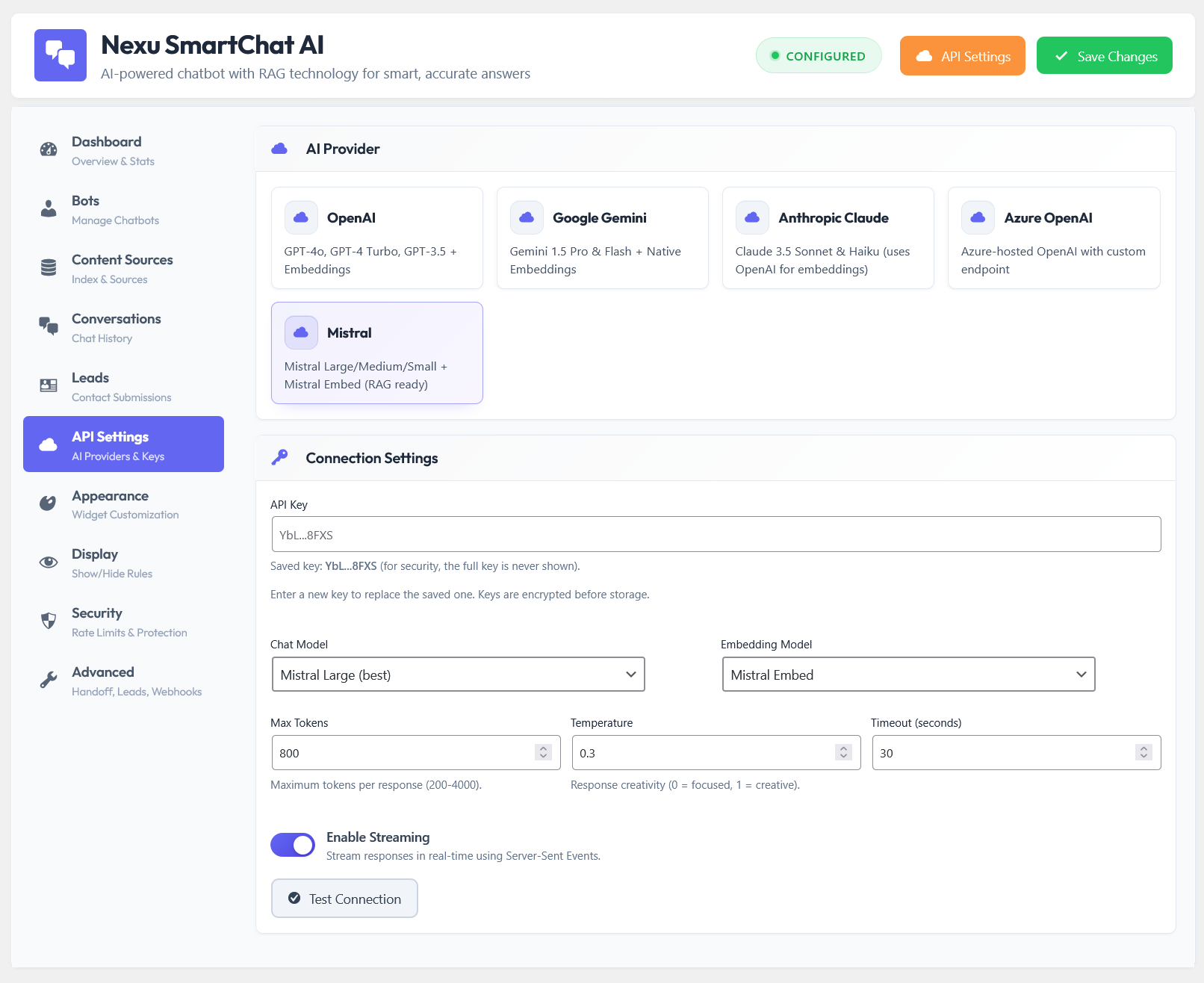
The two-component cost structure of a self-hosted WordPress chatbot looks like this. First, the plugin license: either a one-time payment (like MxChat Pro at around $70) or a modest annual fee. This covers the software, RAG architecture, interface, security controls, and ongoing updates. Second, the API cost: you connect your own OpenAI, Anthropic, or Google API key. The plugin sends queries directly to the provider. You pay the provider at their published per-token rate with zero markup from the plugin.
The variable cost is the API usage, and it is directly controlled by the rate limiting, caching, and context window settings in the plugin. A well-configured self-hosted chatbot on a busy WooCommerce store, using GPT-4o mini at roughly $0.15 per million input tokens and $0.60 per million output tokens, can serve 1,000 conversations per month for $3 to $8 in API costs, depending on conversation complexity and length. With simple questions and effective caching, even that number comes down.
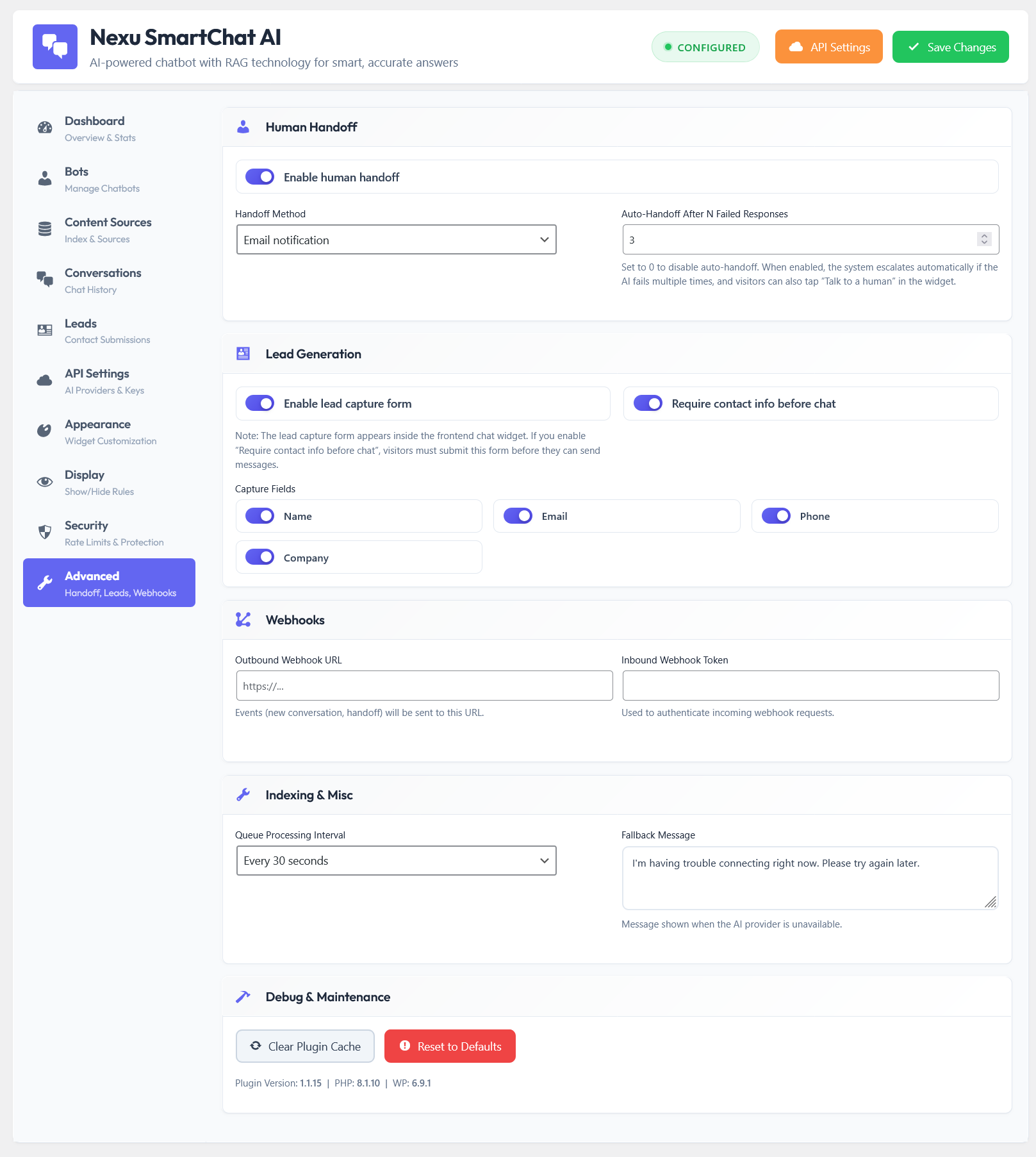
A self-hosted plugin without rate limiting, IP blocking, and context controls is not actually cheaper than SaaS in practice. If a bot abuser sends 500 messages in a session, or if a spider crawls your site and triggers the chatbot on every page, your direct API costs can spike dramatically and unexpectedly. The difference between a well-configured self-hosted setup and a poorly configured one is the security controls. This is why those controls matter so much: they are what makes the “low and predictable API cost” promise actually true. Nexu SmartChat’s security and rate limiting settings exist specifically to make those API costs controllable.
Three real-world cost scenarios over 36 months
Abstract pricing comparisons are hard to act on. The scenarios below are based on realistic WordPress site profiles with realistic traffic and chatbot usage. Each scenario compares Tidio (as the benchmark mid-market SaaS platform) against a self-hosted WordPress RAG plugin setup.
Hidden cost categories that the headline numbers miss entirely
Even the scenario comparisons above do not capture every cost dimension. There are several categories of cost that are harder to quantify but genuinely real when you are making a multi-year deployment decision.
SaaS platforms own your conversation history, your training data, and your chatbot configuration. If you want to migrate away, you are rebuilding from scratch. Industry estimates for enterprise-level chatbot migration put the cost at $3,500 to $17,000 depending on data volume and integration complexity. Self-hosted plugins store all data in your own WordPress database. You own it, you control it, and migrating to a different plugin is a matter of exporting and re-importing, not a multi-thousand-dollar project.
Tidio doubled prices for existing customers in December 2024, as extensively documented in user reviews. Intercom has raised prices repeatedly. Drift moved to sales-only pricing, effectively pricing out smaller customers entirely. With a SaaS subscription, you have no contractual protection against future price increases. Your only leverage is the cost of switching, which is high. Self-hosted plugins have no subscription to increase. A lifetime license stays at its purchase price forever. Annual license renewals are published and predictable.
When your chatbot conversations are stored on a SaaS vendor’s servers, your compliance obligations extend to that vendor’s data handling practices, server locations, and sub-processor agreements. Tidio stores data within the EEA and is DPF-certified, which helps for European businesses, but you are still dependent on their compliance posture. With a self-hosted WordPress plugin, conversation data stays in your own database on your own hosting infrastructure. You control where it is stored, how long it is retained, and who has access. For businesses in regulated industries or those serving European customers, this is a meaningful compliance simplification.
SaaS platforms integrate with WordPress via a JavaScript snippet. This means they operate as an external overlay on your site, not as a native WordPress component. Native WordPress plugins have direct access to your post database, WooCommerce product catalog, user data, and page metadata without API calls to an external server. For RAG indexing, this means a self-hosted plugin can index your entire site content directly and re-index automatically when content changes, while a SaaS platform has to crawl your site or accept manual uploads. The integration depth translates directly to chatbot accuracy for site-specific questions.
When SaaS genuinely wins: the honest case for the subscription model
A balanced cost analysis has to acknowledge the scenarios where SaaS genuinely makes more sense, not just the ones where it is obviously expensive.
SaaS is the right choice when you need live human chat alongside AI automation as a unified product. Platforms like Tidio, Intercom, and Freshchat are designed for teams where human agents and AI bots share a single inbox, with escalation workflows, SLA management, and agent performance analytics. A self-hosted WordPress plugin does not replace a helpdesk platform. If your chatbot strategy is primarily about deflecting tickets to a shared human support queue, a SaaS platform that unifies those workflows is genuinely providing value for its cost.
SaaS also wins when your chatbot needs to operate across multiple non-WordPress channels simultaneously: WhatsApp, Instagram, Messenger, email, and your website widget all unified in one dashboard. Self-hosted WordPress plugins are, by definition, WordPress-first. If your customer service strategy requires channel unification that includes social messaging platforms, a SaaS platform is the practical choice.
For a pure WordPress website chatbot where the primary job is answering visitor questions accurately from your site content, with no live chat queue, no multi-channel inbox, and no SLA management: self-hosted wins on cost, data ownership, and WordPress integration depth by a wide margin.
The clearest framing for this decision: if you are running a WordPress site and your chatbot’s primary job is to answer visitor questions from your content, you are paying for a lot of live-agent infrastructure you do not need when you subscribe to a SaaS chatbot platform. The RAG-powered answer quality and the branding control are what you actually need, and a self-hosted plugin provides both at a fraction of the cost.
If the true cost comparison in this article does nothing else, it should recalibrate what feels like an “affordable” entry price. $29 per month is not an entry price for a seriously deployed chatbot on a growing WordPress site. The real number is closer to three to five times that once the features you actually need are added. Self-hosted plugins make that real number very transparent from the start, which is ultimately a more honest starting point for a multi-year technology investment.
A WordPress chatbot with predictable costs that do not compound year after year
Nexu SmartChat stores everything in your WordPress database, connects directly to your API provider with no markup, and gives you full rate limiting controls so your cost stays predictable as your traffic grows.


This breakdown finally puts real numbers to what I've suspected for a while now. I've tried three different SaaS chatbots over the past year, and every single one hooked me with a "low monthly fee" that somehow tripled once I actually needed AI responses and wanted to remove their branding. The worst part?
Hey everyone, just wanted to drop my two cents as someone who's been stung by sneaky SaaS pricing in the past. this cost breakdown is exactly what I wish I'd had last year when I was shopping around for my company's website.
Man, this breakdown saved me so much stress. I was about to pull the trigger on that $29 Tidio plan for my coaching site, thinking it'd cover everything I needed. Then I saw how fast AI responses, white labeling, and even decent visitor limits can suddenly jack the price up to $200 or more. Nexu's self hosted option looks way more predictable now no nasty surprises when my traffic spikes or I need to tweak my chat flows.