Next-Level Code. Nexuvibe Style ...
Hrs
Min
Sec

The application management phase of an affiliate program is where most programs lose the most value — not through fraud, not through poor tracking, but through administrative friction and slow response times that bleed enthusiasm from applicants before they ever make their first post. An affiliate who applies on a Tuesday and receives their approval email with their link and a clear brief by Thursday morning is in a fundamentally different psychological state than one who waits nine days to receive a notification that the approval email is in their spam folder.
Beyond speed, the application management workflow shapes your affiliate list’s quality. Every approval decision is an opportunity to keep the program clean — to admit affiliates with genuine promotional potential and decline those who are unlikely to contribute meaningfully. Over time, a list of 40 carefully vetted and well-onboarded affiliates consistently outperforms a list of 200 who were approved without review and left to figure out the program on their own.
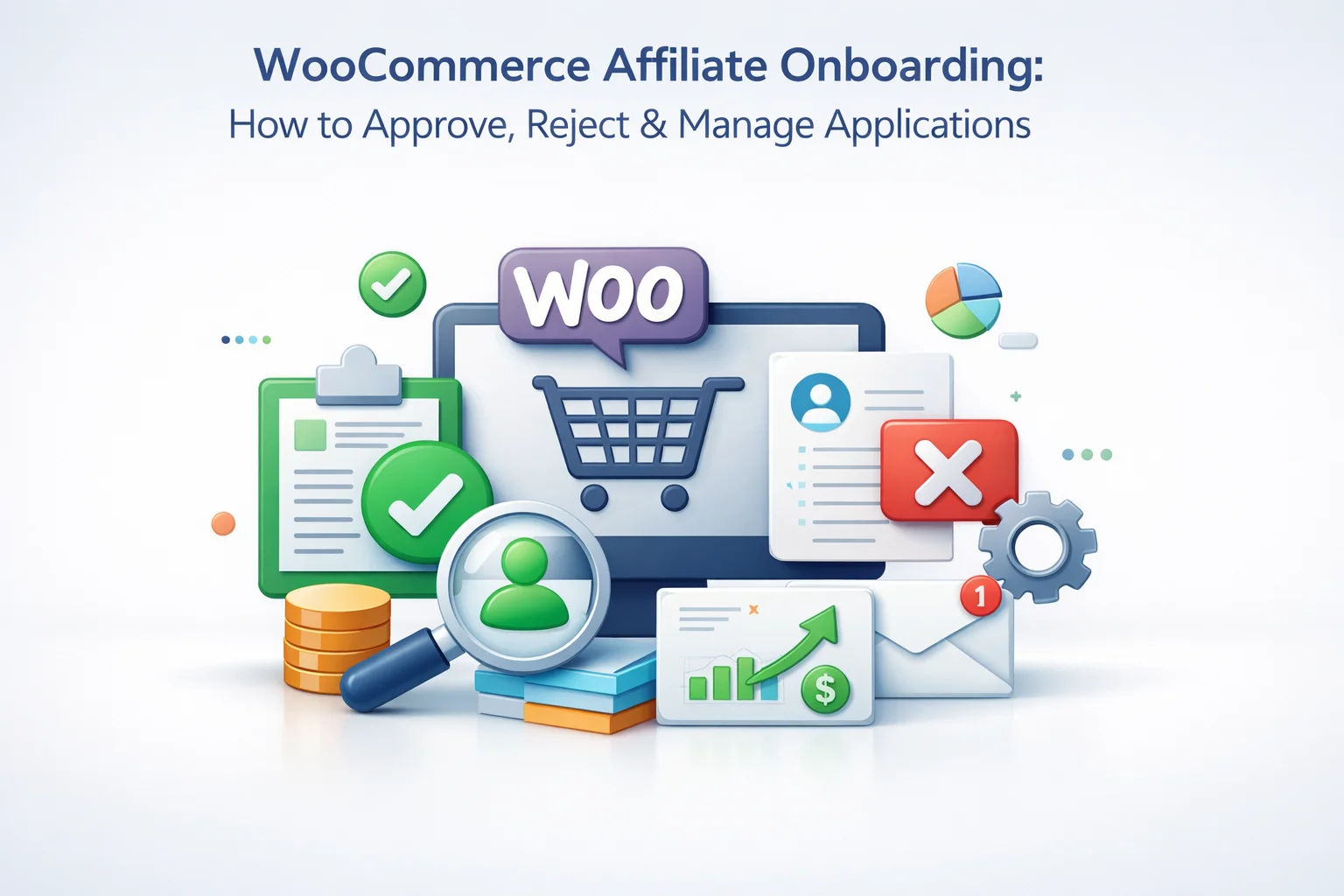
This guide covers the complete application management workflow using Affiliate Engine, a WooCommerce affiliate management and application review plugin — the Requests dashboard, the review criteria that distinguish quality applications from noise, the approval and rejection email content that maximizes activation rates, and the ongoing account management tasks that keep your affiliate list healthy.
Every application submitted through your affiliate registration page appears in the Requests tab in the Affiliate Engine admin dashboard. This tab is the operational center of your application management workflow — it shows you who has applied, when they applied, and the information they provided in their custom registration fields.
Each entry in the Requests tab shows the applicant’s name and email, the date of submission, and the data from any custom fields you included in the registration form — website URL, social media profile link, audience description, promotion channel, and any other information you configured. This data is what your review decision is based on.
A systematic review process reduces decision time and makes approval decisions consistent. Rather than evaluating each application from scratch, run every application through the same four questions. The answers either point clearly toward approval, clearly toward rejection, or toward a case that warrants a brief pause for investigation.
Open the website or social profile they submitted. Does it reach an audience that would plausibly buy your products? A fitness blogger reviewing a sports nutrition store’s application: yes, relevant. A general lifestyle Instagram account with 400 followers reviewing the same application: marginal. An account with no discernible content or audience: no. If no website or social profile was provided, that itself is information — most legitimate affiliates have somewhere they promote things.
If you asked for an audience description or promotion plan, does the response indicate genuine thought about how this person would promote your products? “I will share on my social media” is generic and tells you nothing. “I run a weekly newsletter for home bakers with 3,200 subscribers and I regularly recommend kitchen equipment — your baking tools range is exactly what my readers ask me about” is specific, credible, and actionable. The effort put into the response correlates strongly with how seriously someone intends to promote.
Does the application information suggest the person is joining primarily to self-refer? Signs include: an email address that matches an existing customer account, no online presence at all, application text that focuses on personal discounts rather than audience promotion, or an application from someone who has made multiple recent purchases from your store with no apparent promotional platform. These are not automatic declinations — some genuine customer-affiliates have no social presence and just want to refer friends. But they warrant closer attention.
Affiliates who promote your products become public associations with your brand. A quick scan of their content confirms whether the way they communicate, the topics they discuss, and the audiences they reach align with how you want your store represented. This is particularly important for brand-sensitive product categories or programs where you care about how your products are contextualized in promotional content. An affiliate promoting your products alongside content you would not want your brand associated with is a problem worth heading off at the application stage.
The approval email is the most important communication your program sends. It reaches the affiliate at the moment their motivation is highest — they just received confirmation that they are in. What you put in that email determines whether they share their link within the first week or file the email and never return to it.
The approval email must contain seven specific elements to maximize activation. Sending an approval notification that merely says “Congratulations, you have been approved” and links to the dashboard is a missed opportunity — it makes affiliates take additional steps before they can do anything, and every step is an opportunity to get distracted and delay.
Declining an application is not a neutral act. Done poorly, it creates a negative brand impression that the declined applicant may express publicly. Done well, it can actually leave a positive impression — someone who receives a respectful, specific rejection email is far less likely to feel slighted than someone who receives a generic automated response or, worse, no response at all.
A thank you for the application, a brief and honest reason for the decline (without being harsh), and — when genuinely true — an invitation to reapply in the future if circumstances change. “We are currently focusing our program on content creators with an established audience in [your niche] — if that changes, we would love to hear from you again” is honest, specific, and leaves the door open. The email should be short — three to five sentences is enough. Length does not make a decline more palatable.
Avoid vague reasons like “we don’t feel it’s a good fit right now” without any specificity — this sounds dismissive. Avoid suggesting the applicant does not meet a standard without explaining what standard. And avoid delay — a decline sent promptly is received very differently from one sent three weeks after application, which implies you simply forgot about them. If you decline, do it within the same 48-hour window as approvals.
For applications that are not clear approvals but not clear declines either — someone who has a small but relevant audience, or whose application is borderline on Q3 fraud indicators — use the pending status as a holding pattern rather than making an immediate decision. Review these after your initial batch review is complete and they have more context. But set a maximum hold time: if a pending application has not been resolved within seven days, make a decision. Indefinite pending is effectively a slow decline with no communication.
Approval is not activation. A significant proportion of approved affiliates — in most programs, 30 to 50% — never publish their first piece of promotional content. They got approved, received the email, and either intended to promote “when they have time” or were excited initially but lost motivation before following through. The 30-day activation window is the strategy that converts more approvals into actual activity.
All seven elements from the approval email framework above. The referral link, the coupon code, the commission reminder, payout schedule, dashboard link, creatives link, and a named contact. Nothing left out.
A short email (5–6 sentences) checking in, asking if they have any questions, and highlighting one specific promotional angle you think suits their content style based on their application. Something specific to their audience, not a generic “just checking in.” This message signals that you are paying attention and are genuinely invested in their success, not just running an automated program.
If you have recently added new creatives or have an upcoming campaign, mention it here. This message gives affiliates who have not yet posted a concrete, time-relevant reason to start now rather than later. Even a minor hook — “we just added new product images to your creatives section” — can trigger action from someone who was waiting for a reason to get started.
Check the Visits and Referrals tab filtered to this affiliate. Zero visits after 30 days means their link has never been clicked — they have not shared it. An affiliate who has been approved for 30 days with no activity is an inactive affiliate. At this point, you either send a final personal nudge or accept that this particular approval is unlikely to convert to activity and mark it accordingly for list management purposes.
Affiliate account management does not end with the approval email. Active programs require ongoing list hygiene — regular reviews of who is performing, who has gone inactive, who has changed their terms of participation, and who needs to be suspended or removed. A clean, accurate affiliate list makes every program management decision easier.
Every quarter, run through your affiliate list in the Affiliates tab and identify three groups: active affiliates who have generated referrals in the period (keep and nurture), inactive affiliates who have had zero visits in the period (send a re-engagement message or mark for removal), and suspended or problematic accounts (review for permanent removal). This quarterly review takes under an hour for most programs and keeps the affiliate list from silently accumulating years of inactive accounts that distort your performance metrics.
When an affiliate requests removal from the program, or when you need to suspend an account due to terms violations, act promptly. Suspend the account in the Affiliates tab, which disables their tracking and prevents new commissions from being attributed. Any approved commissions that are legitimately owed should still be paid out according to your normal payout schedule — commission obligations do not expire because the affiliate relationship has ended. Document the reason for the suspension or removal in your records.
Before removing inactive affiliates, send a simple re-engagement message: “We noticed you haven’t shared your affiliate link recently — we’ve added [new products/new creatives/an upcoming promotion] and wanted to let you know in case it’s useful for your audience. Your link and code are still active.” This message costs nothing to send, occasionally re-activates genuinely interested affiliates who simply got busy, and gives you clear information: affiliates who do not respond to a re-engagement message within two to three weeks can be removed without concern.
The quality of your affiliate program’s output is largely determined by the quality of your onboarding process. Not by the size of your commission rate, not by the sophistication of your tracking, but by how deliberately and specifically you welcome new affiliates and then follow up to ensure they actually start. A program that treats onboarding as a deliberate process — not just an automated email — converts a meaningfully higher proportion of approvals into active, ongoing promotion.
Affiliate Engine’s WooCommerce affiliate application management and onboarding plugin provides the Requests dashboard for reviewing applications, the notification settings for configuring approval and decline emails, the Affiliates management tab for ongoing list management, and the per-affiliate activity data that supports every decision in the 30-day activation workflow and quarterly review process.
Affiliate Engine gives you the Requests dashboard, configurable notification emails, affiliate management tools, and per-affiliate activity data — everything needed to run a deliberate, high-quality affiliate onboarding and management process.







This guide keeps talking about speed and quality, but it totally misses the biggest waste of time accounts with zero actual audience. I just wasted 20 minutes reviewing some applicant with a random lifestyle Instagram: 400 followers, no engagement, and posts that don't even match my niche. the guide says five minutes per application is plenty, but it doesn't help you quickly spot these low effort signups that just clutter everything up. Now I've got a bunch of "approved" affiliates who'll probably never promote a single thing. So annoying
Got this guide hoping to speed things up, but I'm still stuck spending 10+ minutes per application not
Hey! Saves me hours every week