
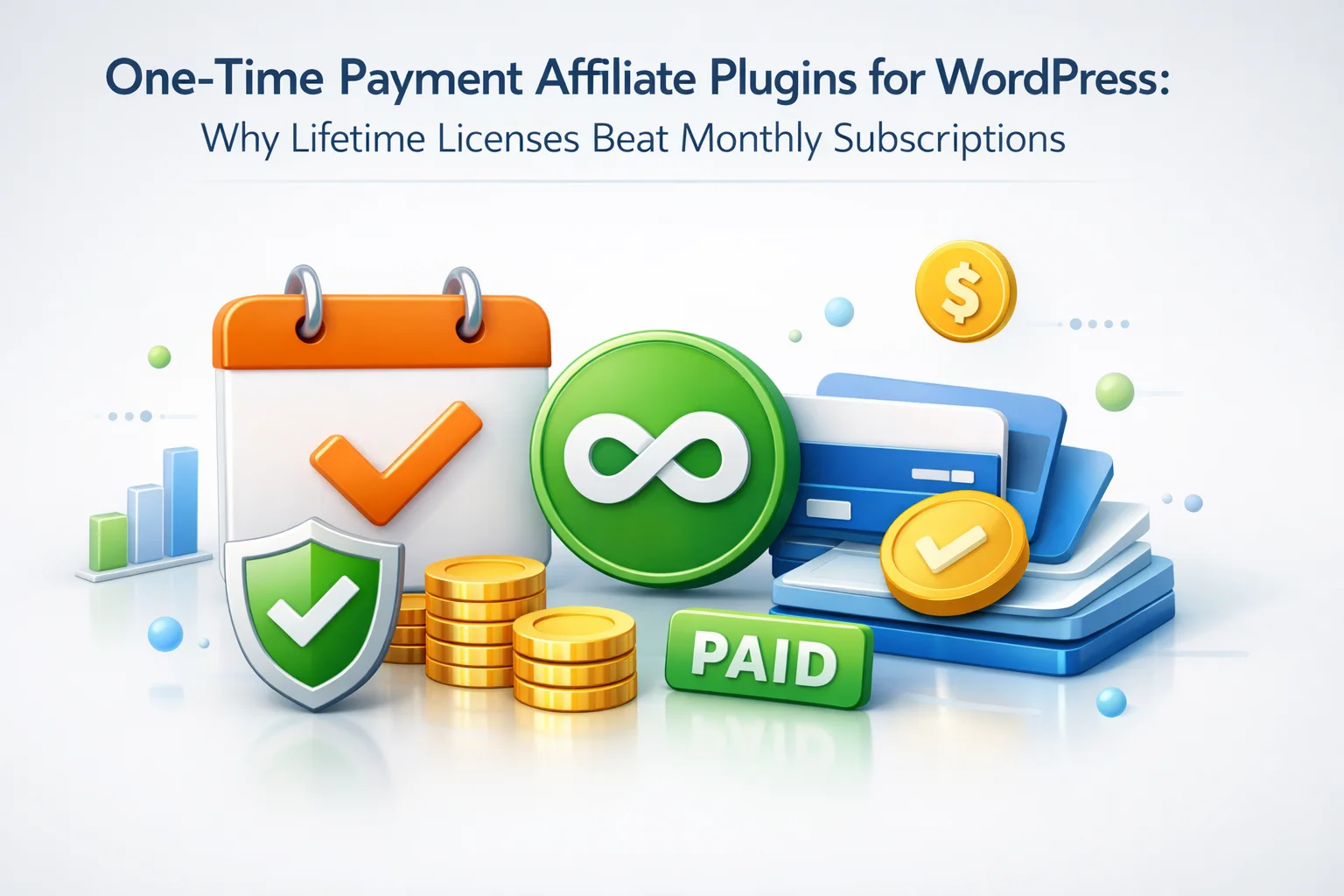
When you search for a WordPress affiliate plugin in 2026, the pricing models you encounter fall into two categories: plugins that charge a monthly or annual recurring fee, and plugins available for a one-time lifetime purchase. On the surface, the monthly model often looks cheaper — $29/month feels more manageable than $299 upfront. But this framing is precisely how the recurring model is designed to look: it hides the actual long-term cost behind a low entry number.
The real calculation is different. A plugin at $29/month costs $348 in year one and $348 every year after that — for as long as you use it. A plugin with a lifetime license at $299 costs $299 once, period. By month eleven you have already paid less for the lifetime license. Every month after that, the recurring cost continues to compound while the lifetime cost stays fixed. Over three years, the difference in total cost is nearly $750 in favor of the one-time purchase.
This guide makes the complete financial case with real numbers, examines the non-financial advantages of lifetime-licensed WordPress plugins that are rarely discussed, addresses the legitimate questions about what you actually own and what happens to support and updates, and shows how Affiliate Engine’s one-time payment WooCommerce affiliate program plugin fits into this framework.
The compounding cost math: what monthly subscriptions really cost
The most useful way to compare affiliate plugin pricing models is to calculate the actual total cost of ownership at different time horizons. Most WordPress store owners keep a functional plugin running for at least two to three years — often much longer. The longer the time horizon, the more decisively the lifetime license wins.
The breakeven point for a $299 lifetime license versus a $29/month subscription is just under 10 months — not three years, not two years, but ten months. After that, every month the subscription runs, the cumulative cost gap widens permanently. The breakeven against a $49/month subscription arrives even faster, at about six months.
Lifetime license price ÷ Monthly subscription cost = Breakeven month. Example: $299 lifetime ÷ $29/month = 10.3 months. If you expect to use the plugin for longer than 10 months — which is almost certain for any serious affiliate program — the lifetime license is the better financial decision. Run this calculation for any plugin comparison, regardless of the specific prices involved. The result is nearly always striking.
The hidden costs of SaaS affiliate platforms
The cost comparison above uses the stated subscription price of WordPress plugins. SaaS affiliate platforms — platforms that host the entire affiliate tracking infrastructure externally — add multiple layers of cost that make the comparison even more one-sided. Understanding these hidden costs is important because SaaS platforms are often the default recommendation in affiliate marketing guides, despite having the least favorable economics for most WooCommerce store owners.
Several SaaS affiliate platforms charge a percentage of every commission you pay out — typically 1% to 9% of the commission amount. For a program paying $2,000/month in affiliate commissions, that is $20 to $180 per month in platform fees on top of the subscription. This fee structure means the more successful your affiliate program becomes, the more the platform costs. A program paying $10,000/month in commissions on a 5% platform fee is spending $500/month — $6,000/year — in fees alone on a service that a WordPress plugin handles for a fixed one-time cost.
Most SaaS affiliate platforms structure their pricing in tiers based on the number of affiliates, the number of conversions tracked, or the commission volume processed. The entry tier is priced to be accessible; the tier you will actually need once your program is active is substantially more expensive. A program with 50 affiliates and 200 conversions per month may launch on a $49/month entry tier and find itself on a $149/month or $299/month tier within a year. The entry price is a marketing decision, not a realistic cost estimate.
SaaS platforms hold your affiliate data — your affiliate list, their commission history, payout records, referral tracking data — on their servers. If you want to migrate to a different solution, the data export tools are typically limited and the migration is time-consuming and often incomplete. The practical switching cost creates a lock-in that most store owners do not consider when choosing a platform. A WordPress plugin stores all data in your own database, accessible and exportable at any time with no platform dependency.
Non-financial advantages of a lifetime-licensed WordPress plugin
The financial case is compelling enough on its own. But lifetime-licensed WordPress affiliate plugins have several non-financial advantages over subscription-based platforms that are worth stating explicitly, because they affect operational independence in ways that compound over time.
Every affiliate, every referral, every commission record, every payout — all stored in your WordPress database on your hosting. You own the data completely. You can query it, export it, back it up, and take it with you if you ever move platforms. There is no external service that could restrict your access to your own program’s historical data, no export limitations, and no risk of losing years of program records if a third-party platform changes its policies or ceases to operate.
A WordPress affiliate plugin running on your own hosting does not cost more to run as your program grows. Growing from 10 affiliates to 100, or from 50 monthly referrals to 500, has no cost implication for the plugin license. The infrastructure cost of more program activity is absorbed by your existing hosting plan — which you are already paying for. A SaaS platform or a subscription plugin that tiers by affiliate count or conversion volume charges you more for exactly the success you were working toward.
A plugin that you have purchased as a lifetime license remains functional regardless of what the developer does with their pricing, regardless of whether the plugin’s SaaS competitors become cheaper or more expensive, and regardless of external payment disruptions. A subscription service that becomes unaffordable, is acquired by a company with different pricing policies, or experiences a payment failure represents a real operational risk. Ownership eliminates this category of risk entirely.
SaaS affiliate platforms require outbound calls from your store to external tracking servers on every page load that involves affiliate tracking. These external calls add latency, introduce a third-party dependency into your store’s performance chain, and mean that your affiliate tracking data flows through a third-party server with its own data retention policies. A WordPress plugin that runs entirely within your installation has none of these issues — tracking is handled server-side within your own infrastructure.
Legitimate concerns about lifetime licenses — and honest answers
The case for lifetime-licensed WordPress plugins is strong, but it is not without legitimate questions. Anyone considering a lifetime purchase should get satisfactory answers to these concerns before committing — and any reputable plugin developer should be able to answer them clearly.
Honest answer: This depends entirely on the developer’s licensing terms and should be clearly stated before purchase. Many lifetime licenses include updates for a defined period (one year is common for WordPress plugins sold through marketplaces), after which the installed version continues to function but automatic updates are not included. Some lifetime licenses include indefinite updates. The installed version of a plugin never stops working because the license expired — only automatic update access may be affected. Ask the developer directly: “What does this lifetime license include for updates, and for how long?”
Honest answer: This is a real risk that applies equally to subscription plugins and lifetime-licensed plugins. A subscription does not make a plugin developer more likely to maintain their product — in fact, financially stable developers with consistent lifetime license sales often have more runway than developers dependent on monthly recurring revenue from a small subscriber base. Evaluate the developer’s track record, the plugin’s review history, and how long the plugin has been actively maintained. Longevity and active development history are stronger signals of ongoing support than pricing model.
Honest answer: No. A WordPress plugin runs on your server. The developer’s website being unavailable affects automatic update delivery and license validation (if required), but the installed plugin continues to function on your hosting regardless. This is fundamentally different from a SaaS platform, where the service going down takes your affiliate tracking with it. The worst case for a WordPress plugin is losing access to updates — not losing access to the functionality you are currently using.
Honest answer: A developer who offers a lifetime license at a reasonable price is betting on the long-term value of their product rather than relying on customers staying subscribed because switching is painful. This alignment of incentives — where the developer succeeds when the product is genuinely good rather than when cancellation friction is high — tends to produce better products over time. Many of the most respected WordPress plugins in history have been lifetime-licensed. The pricing model does not predict product quality, but it does shape the developer’s incentive structure in ways that often benefit the customer.
When a subscription model is genuinely the better choice
The case for lifetime licenses is strong, but intellectual honesty requires acknowledging the scenarios where a subscription model is genuinely the right choice. There are real situations where the recurring model serves store owners better, and pretending otherwise would undermine the credibility of the broader argument.
If you are running a time-limited campaign — a product launch with a 90-day affiliate window, for example — and have no intention of maintaining an ongoing affiliate program, the monthly subscription model may cost less for the short time period involved. The breakeven calculation works both directions: a $29/month subscription costs less than a $299 lifetime license if you only need it for seven months or fewer.
Very large programs with hundreds of affiliates, complex multi-tier structures across multiple stores, or enterprise-specific compliance requirements may genuinely need the infrastructure and dedicated support that only a large SaaS platform provides. The economics are less favorable, but the capability may be worth it. This is a small minority of WooCommerce stores and is not the scenario this guide addresses.
Feature evaluation should precede pricing evaluation. If a subscription-only plugin has a specific capability that is genuinely necessary for your program and unavailable in lifetime-licensed alternatives, the feature requirement overrides the pricing preference. Pricing is a tiebreaker for comparable functionality, not an absolute rule that ignores capability differences.
What to evaluate when comparing WordPress affiliate plugins
Pricing model matters, but it is the last thing you should evaluate — not the first. A well-priced plugin that does not have the features your program needs is not a good purchase at any price. Evaluate functionality first, then run the cost comparison for the plugins that meet your requirements.
The conclusion of this analysis is straightforward: for the vast majority of WooCommerce store owners running affiliate programs with the intention of using them for more than ten months, a lifetime-licensed WordPress affiliate plugin is the financially and operationally superior choice. The compounding cost of subscriptions, the hidden fees of SaaS platforms, the data ownership advantages, and the scaling economics all point the same direction.
Affiliate Engine’s one-time payment WooCommerce affiliate program plugin covers the full feature checklist above — cookie and coupon tracking, per-category commission overrides, fraud detection, configurable registration, payout management, performance tiers, My Account dashboard, creatives management, and notification automation — for a fixed license cost that does not increase as your program grows, your affiliate count increases, or your commission volume compounds.
Pay once. Run your affiliate program forever. Keep every dollar your affiliates generate.
Affiliate Engine is a one-time purchase WooCommerce affiliate plugin with the complete feature set — tracking, commissions, fraud protection, tiers, payout management, notifications, and creatives — for a fixed cost that never increases as your program grows.

Just grabbed this after a friend swore by it. The lifetime license totally makes sense money wise I'd already spent more than this in yearly subscriptions with my old setup. If you're growing fast and sick of fees chipping away at your profits, it's a no brainer.
Ran the numbers on this compared to that $49/month plugin. hits the break even point at six months, and after that, it's all savings. no sneaky fees, no worrying about renewals just does what it's supposed to.
Got this during the summer sale and the math just makes sense. that $29 a month adds up fast by year three you're out almost a grand, but the one time fee stays the same. no surprise charges, no renewal headaches. set it up in an afternoon using their guide without any issues. If you're running a site long term, skip the subscriptions and just go for this