Next-Level Code. Nexuvibe Style ...
Hrs
Min
Sec

Spreadsheet-led credit programmes usually begin innocently: someone exports refunds from the gateway, adds a column for “internal credit,” and emails updates Friday afternoon. That workflow survives until concurrency arrives. Two agents edit the same row; a macro breaks when CSV headers shift; a macro-free junior duplicates a customer email with a typo and silently forks liability. Each incident is survivable alone. Together they teach finance that your customer balances are optimism dressed as arithmetic.
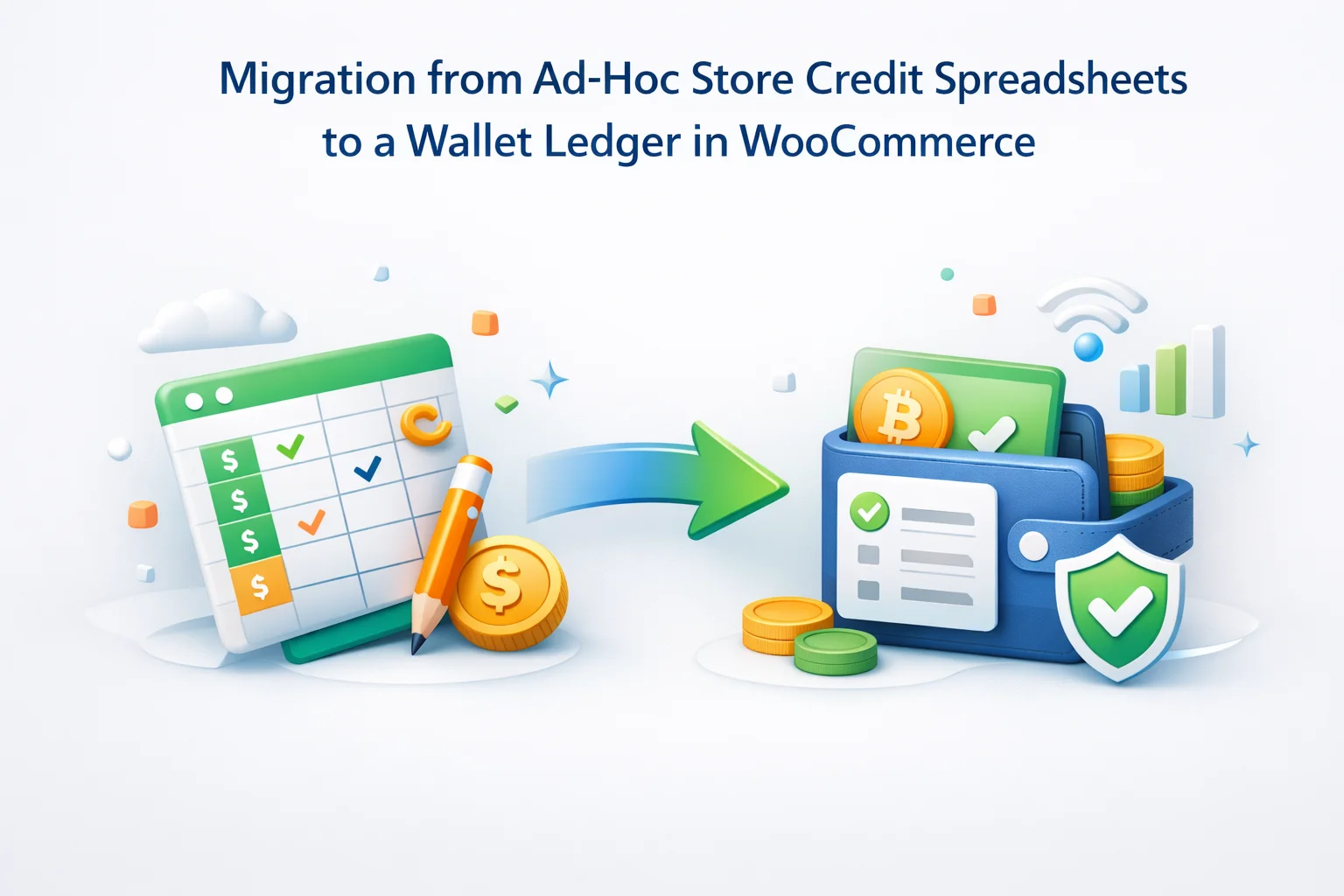
WooCommerce already owns orders, taxes, gateways, and customer records. Parking credit beside commerce in a ledger that understands debits, credits, adjustments, and descriptions aligned to order IDs closes the reconciliation gap spreadsheets exaggerate. The migration is cultural as much as technical: you stop treating credit as a memo field and start treating it as programmable balance state that participates in checkout rules your marketing already promised publicly.
When leadership agrees that liability deserves infrastructure rather than folklore, standardising on a WooCommerce wallet plugin with ledger-backed balances and admin wallet dashboards gives operators a daily surface that spreadsheets never matched: searchable histories, filters, and narratives customers can read without filing tickets. Treat that visibility as the operational backbone for every downstream promise about cashback, prepayment, or loyalty—not as an optional cosmetic upgrade for administrators who already tolerated chaos.
Credit stops being a benign memo the moment shoppers spend it like cash at checkout. Money-like behaviour implies reversibility rules, partial captures, taxation notes in some jurisdictions, and customer expectations that balances update immediately after refunds clear. Spreadsheets rarely encode event ordering; they record outcomes someone typed. When outcomes disagree with WooCommerce order totals, your team improvises reconciliation stories that consume senior hours.
Concurrency is the silent killer. Two support agents granting goodwill credit during the same incident double-count unless your tool enforces atomic updates. Spreadsheet merges do not qualify. Version history helps investigators after damage; it does not prevent damage when neither editor noticed the collision until Monday’s finance sync.
Shared workbooks feel collaborative while quietly tolerating contradictory truths until someone totals balances for month-end.
Cells seldom carry immutable references to orders; narrative debt accumulates in side emails instead of structured metadata.
Outstanding liability forecasts become optimistic when formulas omit pending refunds awaiting warehouse confirmation.
Official WooCommerce documentation emphasises orders as commerce primitives with lifecycle states your stack already interprets; stretching credit outside that model increases reconciliation labour rather than removing it. Review WooCommerce guidance on managing orders when aligning ledger entries with statuses your wallet rules trigger against.
Ledger migration reframes success: not “fewer tabs,” but fewer unexplained deltas between gateway exports, Woo totals, and customer-visible balances. That outcome requires discipline more than hype.
Inventory analogies clarify the psychology: spreadsheets behave like handwritten stock counts—fine for a stall, brittle for a warehouse with forklifts and scanners. WooCommerce wallets behave like perpetual inventory tied to receipts: each movement expects a stable identifier, which is precisely why auditors stop sighing during reviews. Migration stress often peaks when departments realise spreadsheet columns never model reversals symmetrically—a refund that lands as a negative cell does not explain how partial shipments or split captures map to ledger lines unless someone narrates offline.
Training matters before cutover day. Operators who mastered colour legends in Excel must relearn authoritative filters inside wp-admin—and that learning curve fuels temporary nostalgia for sheets. Compress the curve by pairing each legacy column with its wallet analogue in a cheat sheet taped beside monitors: “manual goodwill” maps to labelled adjustments, “promo buckets” map to campaigns, “pending gateway” maps to provisional states your plugin exposes. Naming consistency prevents muscle memory from reopening archived files during panic.
Pick a freeze window when new manual credit rows stop landing in the sheet. Pre-announce it to support so goodwill gestures funnel through a controlled channel—temporary adjustment queue or tagged tickets—rather than rogue cells. Take an authoritative CSV snapshot with hashes stored outside the workbook; argument-ending arguments shrink when everyone references the same frozen artifact.
Customer communications should describe behaviour, not database poetry. Explain that balances will appear inside My Account, that histories will list plain-language reasons, and that complex legacy adjustments may appear as labelled lines rather than mysterious deltas. Avoid promising instantaneous perfection; migrations surface edge cases precisely because humans previously papered them over quietly.
Transparent documentation also pairs with Google’s helpful content expectations: publish migration FAQs that match what support actually tells callers, not aspirational fantasy copy.
Stakeholders outside operations—legal, CX leadership, occasionally investor relations—will ask for parity proofs between old totals and imported balances. Prepare a reconciliation pack: hashed snapshot CSV, Woo export after import, variance table with explanatory rows for rounding or intentional exclusions. Meetings shorten when sceptics inspect artefacts instead of debating vibes. If variances exceed tolerance, postpone public announcements until forensic passes complete; reputational wounds from retracted balances linger longer than delayed launches.
Timezone clarity deserves explicit scripting: midnight in the merchant’s storefront may differ from headquarters finance systems. Freeze windows anchored to UTC with store-local translations reduce edge-case disputes when international customers fund wallets near boundaries. Document chosen offsets in the migration charter so nobody reopens philosophical debates mid-incident.
Normalise identifiers first. Customer rows keyed by email alone fail when shoppers change addresses or share family accounts. Prefer WooCommerce customer IDs where possible; fall back to verified email plus phone match rules your privacy policy allows. Each imported line should declare amount, currency, originating order if any, effective date, and the human reason support would repeat on a call.
Separate promotional goodwill from structural refunds. Finance reports treat them differently; your ledger descriptions should make that distinction obvious without insider jargon. When historical sheets blended categories into one column, split them during import even if it slows the project—future-you audits faster than present-you apologises.
Teams adopting Nexu WP Smart Wallet cashback rules alongside configurable WooCommerce wallet credits inherit machinery that treats credits as programmable events rather than brittle sums—critical when marketing later stacks cashback atop promotional loads.
Data hygiene extends to duplicate human records: households sharing addresses, wholesale buyers with multiple user accounts, testers who became real customers. Merge strategies belong in scope before import—wallet systems surface duplicates faster than spreadsheets because every login maps to one ledger stream. Decide whether balances consolidate or remain separate with cross-references; ambiguity here creates existential arguments when promotions target “household caps.”
Document currency stance even for single-currency stores: plugins and gateways sometimes display multi-currency preview for staff. If FX ever enters roadmap, ledger lines should carry currency codes now—even as metadata—rather than retrofitting later when historical rows lack denominational clarity.
During migration week, operators need density: sortable balances, quick filters for anomalies, visibility into customers crossing thresholds that trigger finance review. A consolidated admin wallet index replaces scanning rainbow tabs for names spelled creatively. Train staff to record actions inside the wallet UI rather than sticky notes so later investigators inherit coherent causality.
Escalation paths matter: define who may issue manual adjustments above a monetary line, who approves reversals tied to disputed orders, and how quickly IT steps in when imports stall. Ambiguity breeds spreadsheet relapse—someone always reopens the old file “just for comparison.”
Pair operational visibility with WordPress roles and capabilities discipline so wallet powers map to least-privilege reality rather than shared admin passwords.
Daily stand-ups during migration week should review anomaly queues: balances that jumped unexpectedly, duplicate imports, customers contacting support before UI refresh caches propagate. Surface-level calm masks backend retries—logging dashboards alongside wallet screens reduce midnight surprises. Encourage operators to screenshot edge cases into an internal gallery; pattern recognition beats heroic memory when volume spikes.
Coach leadership to resist vanity metrics mid-migration: ticket counts may spike while literacy catches up—that spike signals visibility improvements rather than deterioration if resolution times shrink week over week. Narrate that distinction internally so executives do not throttle training budgets precisely when teams need breathing room.
Email threads explain intent; ledgers prove sequence. When finance asks why March’s liability differs from February, exporting transaction rows beats forwarding screenshots of Outlook conversations. Encourage agents to reference ledger line IDs in tickets—support quality rises when everyone cites the same evidence object.
Filters that isolate adjustments, gateway-funded top-ups, or refund reversals accelerate month-end. Teach finance how to self-serve exports so engineering stops becoming a human CSV button. Document timezone assumptions—UTC versus store local—because midnight boundaries spawn phantom disagreements.
If High-Performance Order Storage is part of your stack, align wallet event timing with order storage expectations using WooCommerce HPOS documentation so asynchronous jobs do not surprise nightly reconciliation scripts.
Retention policies for exports belong in written standards: how long CSV archives live, whether cold storage encrypts customer identifiers, who may request historical pulls when regulators ask. Email attachments rarely carried consistent retention logic; wallet migrations offer a hygiene reset—take it seriously instead of copying chaos forward.
Cross-functional literacy workshops reduce interpretive drift: invite finance to watch support narrate a refund reversal while pointing at ledger lines in real time. Those sessions expose vocabulary mismatches early—finance may say “provision,” support may say “hold,” developers may say “pending job.” Harmonise nouns before customers hear three dialects on successive calls.
Checkout scenarios multiply when wallet balances meet cards mid-authorisation. Document test cases before migration weekend: partial application, remainder capture failures, coupon stacking interactions, and guest versus authenticated rules. Spreadsheets rarely enumerated those permutations; your ledger must survive them without silent rounding.
Scenario tests on staging with cloned payment sandbox keys; explicit rollback checklist if ledger imports skew.
Same-day schema edits plus live traffic without feature flags; “fix forward” culture that skips root-cause notes.
Chargebacks and partial refunds deserve explicit wallet reversal policies. Customers remember balances emotionally; reversing ledger lines without narratives breeds distrust faster than spreadsheet confusion ever did.
Rollback ethics matter: if you must revert imports, communicate proactively, credit inconvenience where appropriate, and preserve forensic copies of erroneous states—regulators and card networks appreciate traceability.
Stress scenarios deserve tabletop exercises: simultaneous flash sale load on wallets, webhook retries from gateways, partially captured authorisations when shoppers abandon sessions mid-checkout. Tabletops expose monitoring gaps—maybe nobody watches queue depth until shoppers tweet. Instrument ahead of embarrassment.
Vendor coordination extends beyond WooCommerce core: caching layers, object caches, reverse proxies occasionally cache My Account fragments aggressively. Balance displays that lag reality spark panic calls even when ledgers remain correct. Cache invalidation rules belong in deployment checklists alongside plugin updates—surface calm depends on invisible plumbing behaving politely.
Write scripts agents read aloud when balances look wrong: verify order ID, verify refund path, verify wallet hold states, escalate when gateway capture still pending. Replace heroics with procedures. Track mean time to explain wallet debits; if duration stays high, your descriptions—not customer intellect—need improvement.
QA samples should include edge identities: wholesale accounts, subscription renewals if applicable, cross-border shoppers with currency display quirks. Spreadsheets often hid those cohorts in rare rows; ledgers surface them democratically.
Smart Wallet partial payment at WooCommerce checkout with ledger audit trails reduces the gap between what agents promise on calls and what checkout actually permits—alignment problems spreadsheets masked via informal overrides.
Macro libraries deserve versioning: canned responses referencing spreadsheet columns expire instantly after migration. Rewrite macros to cite ledger artefacts (“see transaction ID 45821”) rather than nostalgic tab names (“see Summer Promo tab”). Agents adopt faster when snippets align with UI labels they actually click.
Escalation bridges between support tiers should include explicit permission requests: junior agents propose adjustments, seniors approve above thresholds, finance signs monthly summaries. Spreadsheets often collapsed those boundaries because “everyone had edit rights.” Ledger discipline forces healthier governance—expect emotional resistance until wins accumulate.
Victory is not subjective comfort. Track reconciliation variance between gateway exports and wallet totals weekly; aim for predictable drift bands. Monitor average tickets per thousand wallet users; downward slopes validate literacy investments. Survey agents anonymously about trust in admin tools; qualitative panic is an early warning quant dashboards smooth over.
Celebrate retiring the spreadsheet with governance: archive read-only, restrict edit permissions, document the retirement date in your internal wiki. Zombie sheets resurrect unless killed ceremonially.
Long term, marketing can speak confidently about wallet programmes because engineering and finance share vocabulary. That alignment was the hidden prize—software simply forced the conversation.
Consolidate your programme on the Nexu WP WooCommerce Smart Wallet plugin for customer balances cashback and admin ledger oversight so post-migration operations inherit automation instead of nostalgic macros.
Quarterly retrospectives should compare predicted liability from imported sheets against observed wallet velocity; divergence signals either modelling errors or behavioural shifts—both deserve investigation rather than dismissal as noise. Include marketing leadership so promotional calendars align with wallet physics—surprise spikes often trace to campaigns launched without ops awareness.
Finally, celebrate incremental credibility: every week without mysterious balance drift is evidence your migration succeeded more than any keynote slide deck. Ledger migrations reward patient operators who treat finance, support, and engineering as co-authors of one truth instead of rival storytellers armed with incompatible spreadsheets.
NEXU Smart Wallet & Cashback pairs customer-facing wallet experiences with admin lists and transaction histories designed for real commerce volume.








Finally moved our store credits out of that nightmare spreadsheet. No more "who edited last?
Hey y'all this thing saved my sanity. no more arguing over which tab is "the real one" during
Switched our store credit nightmare from spreadsheets to this WooCommerce wallet system last quarter, and honestly? Should've done it years ago. The old way was like playing accounting Jenga every time two reps opened the same file. Now the balances actually match the order logs without some poor intern cross checking tabs for hours. Finance finally stopped giving me the side eye in meetings, so that's a win. the migration guide's "document your offsets" section saved us from at least three arguments about which refunds were "real.