Next-Level Code. Nexuvibe Style ...
Hrs
Min
Sec

Every WooCommerce store owner has been in this situation. A customer sends a support ticket asking whether a product works with a specific device, whether it comes in a particular size, or whether it is suitable for a specific use case. You answer the question. A week later, a different customer asks almost exactly the same thing. You answer again. Over months and years, the same thirty or forty questions come in repeatedly, each time requiring time to answer and each representing a buyer who almost lost confidence in the purchase.
What most store owners do not realize is that those same questions, and their answers, are almost certainly already present in their product reviews. Buyers who wondered whether a product was right for them and decided to purchase it anyway often mention their concerns in their reviews afterward. The answer is there. It has just never been organized into a format that helps the next buyer find it before they abandon the product page.
AI-powered review analysis can extract those recurring questions automatically, generate answers from the review content itself, and present them as a structured FAQ section directly on the product page. The result is a FAQ that is more authentic and more useful than anything written manually, because it reflects what real buyers actually wanted to know before they bought.
This guide explains how that extraction process works, why auto-generated FAQs outperform manually written ones in both conversion and SEO terms, and how to implement it on your WooCommerce store using an AI tool that auto-generates WooCommerce FAQ sections from reviews.
The standard approach to product page FAQs is to have someone on your team write questions based on their best guess of what buyers want to know, then write answers based on product knowledge. This approach has a fundamental problem: it reflects what the store owner thinks buyers want to know, not what buyers actually ask.
The gap between those two things is often significant. Store owners tend to write FAQs about product specifications, shipping policies, and return terms because those are the things they know well and consider important. Real buyers often want to know things that are harder to anticipate from inside the business: whether the product works for an unusual use case, how it compares to a specific alternative they were also considering, what happens after extended use, or whether a particular size chart is reliable.
When a manually written FAQ does not address the specific concern a buyer came to the product page with, the FAQ section provides no value for that buyer. They either send a support ticket or they leave. Neither outcome is good. The FAQ existed but it did not help.
The extraction process is not simply keyword matching or pattern recognition. A large language model reading your reviews is doing something more sophisticated: it is identifying the underlying concerns, uncertainties, and informational needs that buyers expressed, clustering similar concerns across hundreds of reviews, and reformulating them as clear questions with answers drawn from the aggregate of what buyers reported.
The AI reads every review in the corpus and identifies language that signals pre-purchase uncertainty. Phrases like “I was worried about,” “I wondered whether,” “before buying I wanted to know,” and “for anyone considering this” are strong signals. So are questions embedded in review text, mentions of contacting support before purchasing, and comparisons to alternatives the buyer was evaluating. The model identifies these patterns across all reviews and builds a map of recurring concerns.
Fifty buyers expressing concern about sizing in fifty slightly different ways, ranging from “runs small” to “order up a size” to “the sizing chart was off,” are all expressing the same underlying question. The AI clusters these semantically similar concerns and formulates a single, clean FAQ question that captures the concern, rather than generating fifty nearly identical entries. This clustering is what separates a useful FAQ from an overwhelming list of repetitive variations on the same theme.
The answer to each extracted question is generated from what buyers actually reported, not from product specifications or marketing language. When the answer to a sizing question is “most buyers recommend ordering one size up, particularly if you are between sizes,” that reflects genuine buyer experience captured from dozens of relevant reviews. This is more credible and more useful than a size chart because it represents what happened in practice, not what was specified on paper.
From an SEO perspective, FAQ content sourced from real buyer questions has three properties that make it significantly more valuable than manually written FAQs.
Buyers who write reviews and buyers who search Google use the same natural language. When the questions in your FAQ were written by buyers expressing genuine concerns, they are highly likely to match the phrasing of search queries entered by buyers at the same stage of the purchase journey. Manually written FAQs tend to use product-centric or marketing language. Review-sourced FAQs use buyer language. The difference in search query alignment is significant.
A product with a hundred reviews will surface fifteen to twenty distinct recurring questions from the buyer community. Each of those questions, when formatted as FAQ content on the product page, represents a specific long-tail query that the page can now rank for. This long-tail coverage happens automatically as a byproduct of the FAQ extraction, without any keyword research effort. The AI is essentially doing audience-sourced keyword discovery by reading what real buyers asked.
FAQ content encoded as structured FAQ schema is eligible for Google’s FAQ rich result format, which can display question-and-answer pairs directly in the search result. This expands the visual footprint of your listing in the SERP, pushes competitor listings further down the page, and puts the answers to common buyer questions in front of searchers before they even click through. The combination of authentic questions, genuine answers, and valid FAQ schema is a strong formula for capturing that SERP real estate.
The support volume reduction from well-implemented product FAQs is one of the most immediate and measurable benefits of this approach. When the questions that your support team answers repeatedly are now answered directly on the product page before purchase, a meaningful percentage of those support tickets simply never get created.
The quality of the answers matters as much as the presence of the questions. Buyers who consult a FAQ section and find a vague or hedged answer still send the support ticket. Buyers who find a specific, confident answer drawn from genuine buyer experience get what they needed and move forward. Review-sourced answers have this quality because they represent the real-world experience of people who faced the same uncertainty and resolved it.
There is also a compounding benefit over time. As more reviews accumulate, the FAQ extraction runs again and incorporates the latest buyer experience. Questions that your product did not generate enough review data to answer previously may now have enough signal to produce a confident answer. The FAQ section improves automatically as your review corpus grows, without any additional input from your team.
The implementation in Nexu AI Review Analyzer, the WooCommerce review FAQ generator, handles the entire extraction and display workflow. Here is how the deployment process works.
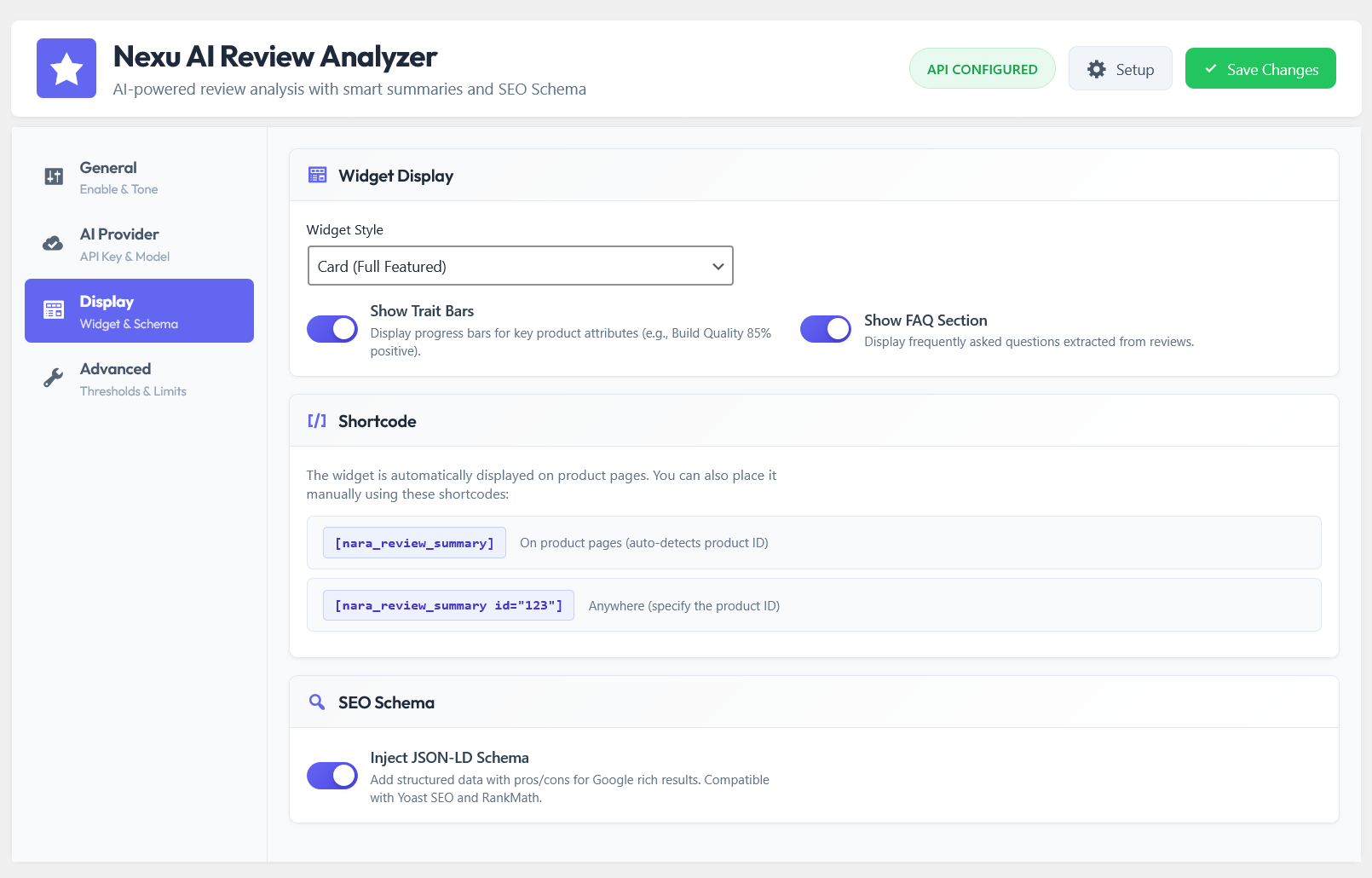
The FAQ extraction is a component within the full review summary output. In the Display tab of the plugin settings, you can enable or disable it independently of the other components. You can deploy the FAQ section on its own, without the full review summary, if you prefer to keep the review section minimal and surface the FAQ content in a different location on the page.
The plugin provides shortcode output for the FAQ section, which means you can place it anywhere on your product page layout without being constrained to the reviews tab. Many store owners find that positioning the FAQ above the fold, near the product description or the add-to-cart button, produces better results than placing it below the review list where it may not be seen by buyers who do not scroll that far. Shortcode placement works with Elementor, Divi, Bricks, and any other page builder or theme.
The generated FAQ entries are editable before they go live. This is worth doing for your highest-traffic products, both to ensure the questions are phrased in a way that matches your store’s voice and to add any context that the AI could not derive from reviews alone. For most products, the AI output will be accurate and usable without editing. But having the ability to refine it is important for cases where the review corpus is unusual or where product-specific nuance matters.
The FAQ extraction runs automatically whenever the plugin re-analyzes a product’s reviews. Configure the re-analysis threshold in your general settings so that when a meaningful number of new reviews have been added, the FAQ is refreshed to incorporate any new questions the latest buyers raised. This keeps the FAQ section relevant without any manual maintenance.
The visual presentation of the FAQ section matters as much as its content. A wall of text organized as questions and answers creates the same scanning problem that unstructured reviews do. A well-formatted FAQ section with clearly delineated questions, concise answers, and visual hierarchy makes the content easy to scan and easy to use.
The Nexu automated WooCommerce product FAQ plugin renders the FAQ section as a visually clean, scannable component that fits naturally within a product page layout. Buyers can scan the question headings to find the concern that is relevant to them, read the concise answer, and continue to checkout. The entire interaction takes seconds rather than the minutes a buyer would spend searching for the same answer in raw review text.
This efficiency is the mechanism of the conversion impact. The buyer had a question. The question is answered clearly and quickly. The uncertainty that was creating hesitation is resolved. The path to purchase becomes clear. That sequence plays out for every buyer whose specific concern happens to be addressed in the FAQ, which, because the FAQ was built from actual buyer questions, covers a far wider range of concerns than any manually written FAQ would.
The business case for automating your WooCommerce FAQ generation from reviews is straightforward. Your review corpus already contains the raw material. The questions are already there, embedded in buyer language. The answers are already there, drawn from the experience of buyers who faced the same uncertainty and reported back. The only thing missing was a system to extract, organize, and present that content in a format that helps the next buyer make their decision.
That is exactly what an AI WooCommerce review analyzer with FAQ extraction provides. The setup takes minutes. The FAQs appear automatically. And every buyer who finds their answer in your FAQ section instead of your support inbox represents a conversion saved and a support cost avoided.
Nexu AI Review Analyzer extracts recurring customer questions from your WooCommerce reviews, generates answers from buyer experience, and deploys them as a structured FAQ section anywhere on your product pages.






I was really hoping the AI would nail pulling FAQs from reviews, but it's mostly just grabbing random stuff. like half the "FAQs" are just people talking about shipping or packaging not even close to actual questions. kinda frustrating
The FAQ feature is clever, pulling real questions from reviews instead of making you guess what buyers want to know. saved me time, but wish it grouped similar questions better. Still useful though
This actually works way better than I expected for pulling real questions out of reviews. i was totally skeptical about AI digging through random customer comments, but it caught stuff like "I wondered if this would fit" and "Before buying I wanted to know" things I'd totally missed
Hey! Love how this pulls real buyer questions from reviews