Next-Level Code. Nexuvibe Style ...
Hrs
Min
Sec

Most WooCommerce store owners searching for an AI review summary plugin are looking for a simple answer: install this, connect your API key, and watch your product pages transform. The reality is a bit more nuanced than that. There are several approaches to AI review summarization available in the WordPress ecosystem right now, they vary significantly in what they actually do, and picking the wrong one means either wasting money on a plugin that underdelivers or deploying something that actively hurts your store’s performance rather than helping it.
This guide is the result of working through the options that are actually available in 2026. We cover what the category looks like, what a genuinely capable plugin needs to do, where most options fall short, and which solution stands out as the clear choice for stores that want to do this properly.
The short answer: Nexu AI Review Analyzer is the most complete AI-powered WooCommerce review summary plugin available right now, and this guide explains exactly why. But we will also be honest about what it does not do, because that matters too.
The market for AI content tools in the WordPress space has exploded over the past two years. A lot of plugins now claim to do something related to AI review summarization, but most of them were built for a different purpose and are being stretched to cover this use case. Before evaluating any specific plugin, it helps to have a clear picture of what a genuinely purpose-built AI review summary tool needs to deliver.
There are six things that separate a tool worth using from one that will waste your time and your API credits. A plugin that gets all six right is genuinely rare. Most options manage two or three of them adequately and miss the others entirely.
Some plugins only analyze the most recent ten or twenty reviews because processing the full set costs more API credits. This produces summaries that reflect recent sentiment but can completely miss issues or praise patterns that are consistent across the product’s entire review history. A proper tool should analyze the full review corpus and produce a summary that genuinely represents the aggregate buyer experience, not just the last few weeks of it.
A single paragraph of summary text is better than nothing but it is not what moves conversion rates in any meaningful way. Buyers scan product pages. They want a quick visual read of the consensus, a clear pros and cons list, and answers to specific questions. Plugins that only produce a text block are delivering a fraction of what the feature can do when implemented properly.
If the pros and cons generated by the plugin are not simultaneously being output as structured JSON-LD schema, you are leaving a significant SEO opportunity completely on the table. Google can read this structured data and display rich snippets in search results. A plugin that generates great on-page content but ignores schema is giving you half the value it should.
Plugins that lock you to a single AI provider and charge a monthly subscription on top of your API costs are a double-spending trap. You should be able to use your own API key from whichever provider you prefer, keep costs under your direct control, and switch models if a better option emerges. Provider lock-in is a vendor convenience, not a user benefit.
A summary generated once and never updated quickly becomes stale. Products evolve, quality can change between production runs, and buyer sentiment shifts over time. A plugin that requires manual re-analysis triggers for every product, at every update, at any meaningful catalog scale is not a workable long-term solution. Automatic re-analysis based on review volume thresholds is a basic operational requirement.
Any store selling internationally is going to accumulate reviews in multiple languages. A plugin that silently ignores non-English reviews is discarding a significant portion of your buyer intelligence. The tool you use should detect review language automatically, include multilingual reviews in the analysis, and produce a summary in your store’s primary output language regardless of the input language mix.
The honest reason most AI plugins fail at review summarization specifically is that they were not designed for it. Review summarization is a distinct problem from general content generation. It requires sentiment analysis across a corpus of unstructured, often contradictory text written by people with varying levels of English proficiency, in multiple tones, about experiences that span months or years. General-purpose AI writing assistants are built to generate content from a prompt, not to extract structured intelligence from a large body of existing opinions.
The other common failure is visual. Generic AI plugins that venture into review summarization typically output plain text. No structured pros and cons. No trait bars. No FAQ extraction. No schema markup. The output is technically a summary in the same way that a single sentence describing a painting is technically art criticism. It covers the basic requirement while missing everything that makes the feature valuable in practice.
Purpose-built tools for WooCommerce review analysis like the Nexu WooCommerce review sentiment analyzer are built from the ground up around the specific requirements of this problem. The difference in output quality is significant enough that it is worth evaluating them separately from the general AI writing plugin category.
Nexu AI Review Analyzer is a WordPress plugin built specifically for WooCommerce that connects to your choice of AI provider and processes your product reviews into a structured, visually rich summary section. Here is what it actually does, feature by feature.
The plugin reads your complete review set for each product, not a sample or the most recent batch. This means the summary reflects the genuine aggregate of everything buyers have said about a product since it went on sale. For products with hundreds of reviews across years, this distinction matters enormously for summary accuracy.
The output is not a paragraph. It is a complete structured section that includes an overview digest, a pros list, a cons list, an auto-extracted FAQ drawn from recurring questions in the reviews, and visual attribute trait bars showing buyer sentiment on dimensions like quality, value, and ease of use. Each component is independently toggleable, so you can configure exactly what displays on your product pages.
Every analysis automatically outputs the pros and cons as structured JSON-LD schema. This happens without any manual configuration and without a separate schema plugin. The structured data is there from the first analysis, ready for Google to index on its next crawl of your product pages.
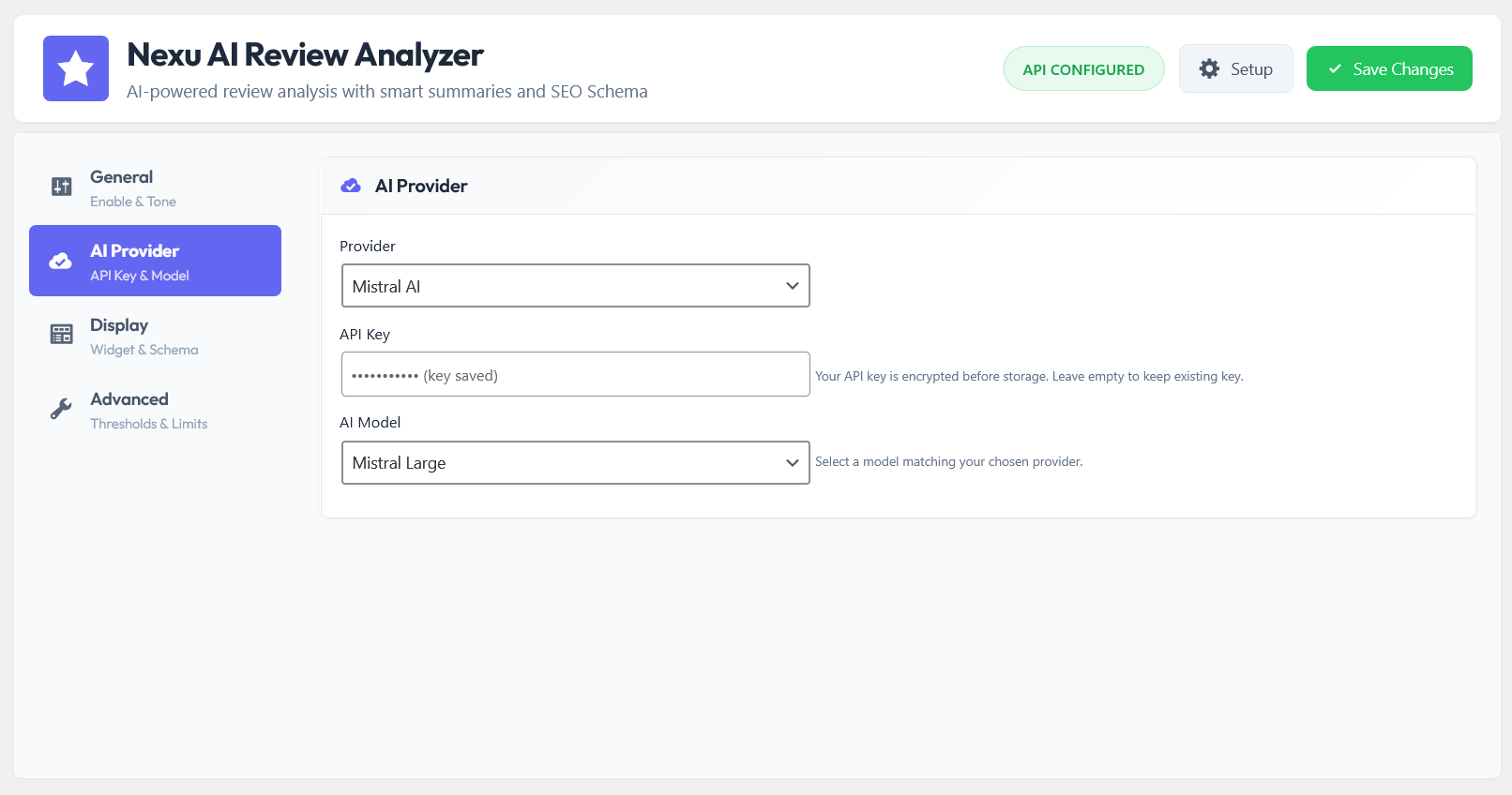
You connect your own API key from OpenAI, Anthropic, or Google. You pay your provider directly at their standard API rates. There is no additional per-analysis fee, no credit system to top up, and no lock-in. When a new model becomes available that produces better output quality, switching to it is a settings change.
The summary section can be placed anywhere on your product page using shortcodes, which means it works with any page builder or theme. You are not limited to a fixed position in the reviews tab. You can surface the summary above the fold, in a sidebar, in a comparison section, or anywhere else that makes sense for your specific product page layout.
To give you a clear picture of where Nexu AI Review Analyzer sits relative to the broader category, here is how purpose-built review intelligence tools compare against the alternatives most WooCommerce store owners consider.
A capable plugin still needs to be configured thoughtfully. The settings available in Nexu AI Review Analyzer are worth examining in some detail because they reveal the level of control you have over the output quality and the data being processed.
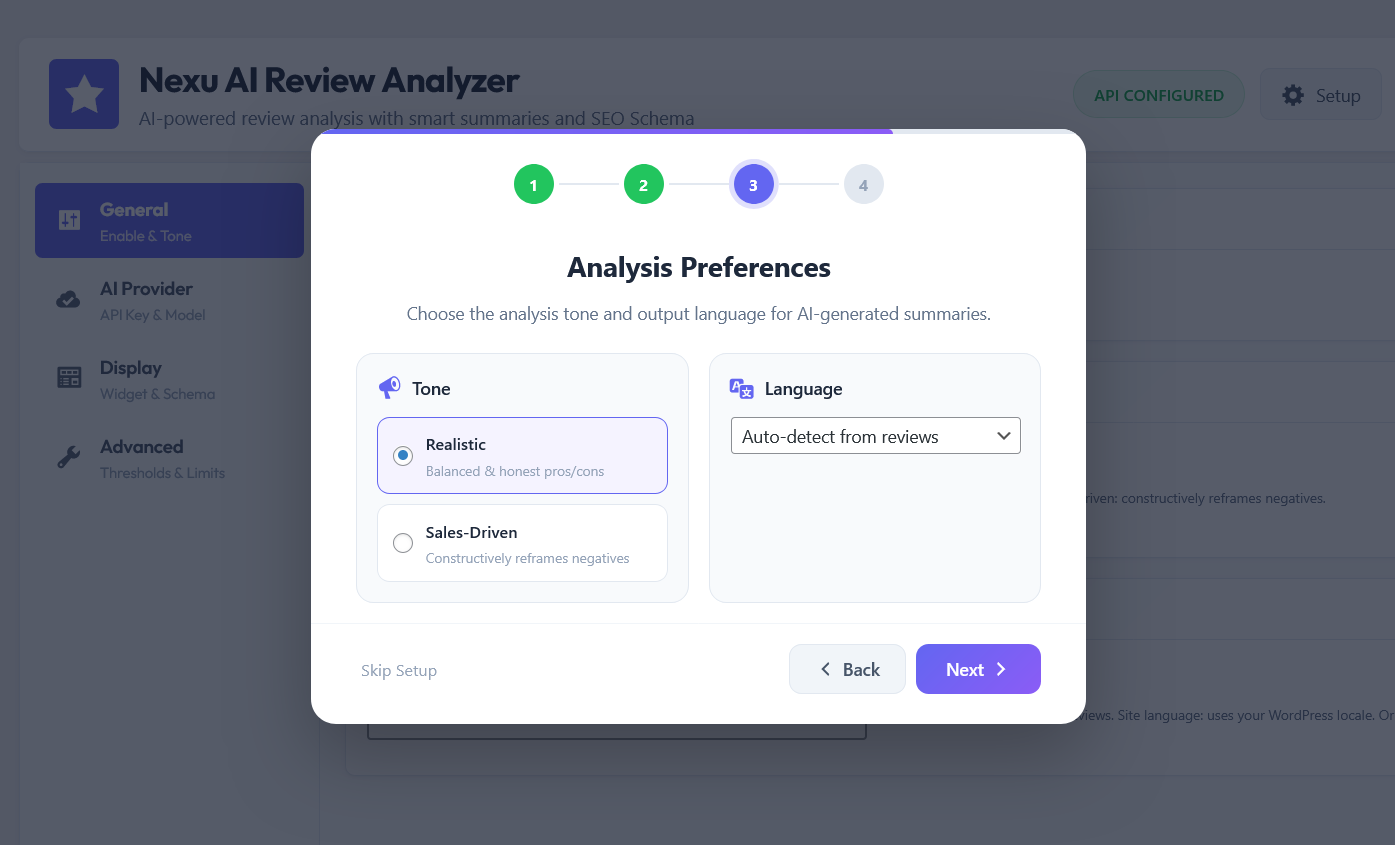
Set how many reviews a product must have before a summary is generated and displayed. This prevents inaccurate summaries from appearing on products with only one or two data points. The general tab also controls language output preferences and the tone of the generated content.
Toggle each output component on or off independently. Choose where the summary section renders on the product page. Control the visual style to match your theme. This level of display granularity means you can deploy the feature in a way that feels native to your store rather than like a plugin bolted on top.
The advanced tab handles schema markup configuration and output caching. Caching is particularly important for performance on larger catalogs since it means the AI output is stored and served immediately rather than being regenerated on every page load. Schema markup is configured here and is enabled by default.
Before committing to any plugin, most store owners have a set of practical concerns that guide their decision. Here are the straightforward answers to the questions that come up most consistently.
The cost depends on the AI provider you choose and the number and length of reviews per product. For a typical product with 50 to 100 reviews, the analysis cost using GPT-4o is usually a few cents per product. For a catalog of 500 products, you are looking at a one-time analysis cost in the range of a few dollars, with ongoing costs only when re-analysis is triggered by new review volume. These are direct API costs that you pay to your provider, not markups charged by the plugin.
Yes, review text is sent to your chosen AI provider’s API for analysis. This is unavoidable for any plugin that uses external AI models. The data sent is the review text itself, not customer personal information like names, emails, or purchase details. If your store operates under data protection requirements, confirm that your AI provider’s data processing terms are compatible with your obligations before deploying.
No. The AI analysis runs once and the output is cached. When a buyer visits your product page, they are seeing stored HTML output, not a live API call. The performance impact is negligible. The only time an API call happens is during analysis or re-analysis, which occurs in the background and does not affect page load times for visitors.
The default placement integrates with standard WooCommerce review sections, which work with essentially all WooCommerce-compatible themes. For custom layouts using Elementor, Divi, Bricks, or similar page builders, the shortcode output lets you place the summary section anywhere on the page without theme or builder conflicts.
Yes. The generated summary can be reviewed and edited before publishing. This is useful for products where the AI output is accurate but the phrasing does not quite match your store’s voice, or for cases where you want to add context that is not present in the reviews themselves. The ability to review and approve output before it goes live is an important quality control mechanism that a good plugin should always provide.
The AI review summary category is still young enough that most options in it are either generic AI writing tools repurposed for this use case or very basic plugins that do one piece of the job without addressing the rest. Nexu AI Review Analyzer is notable precisely because it was built specifically for this problem and covers the full scope of what a well-implemented review intelligence feature needs to do.
The combination of full-corpus analysis, five-component structured output, automatic schema markup, model-agnostic API connectivity, and multilingual support puts it in a different tier from the alternatives. It is not perfect. No plugin is. There will be product categories or edge cases where the AI output needs manual review and adjustment. But as a foundation for adding Amazon-level review intelligence to a WooCommerce store, it is the most complete tool currently available.
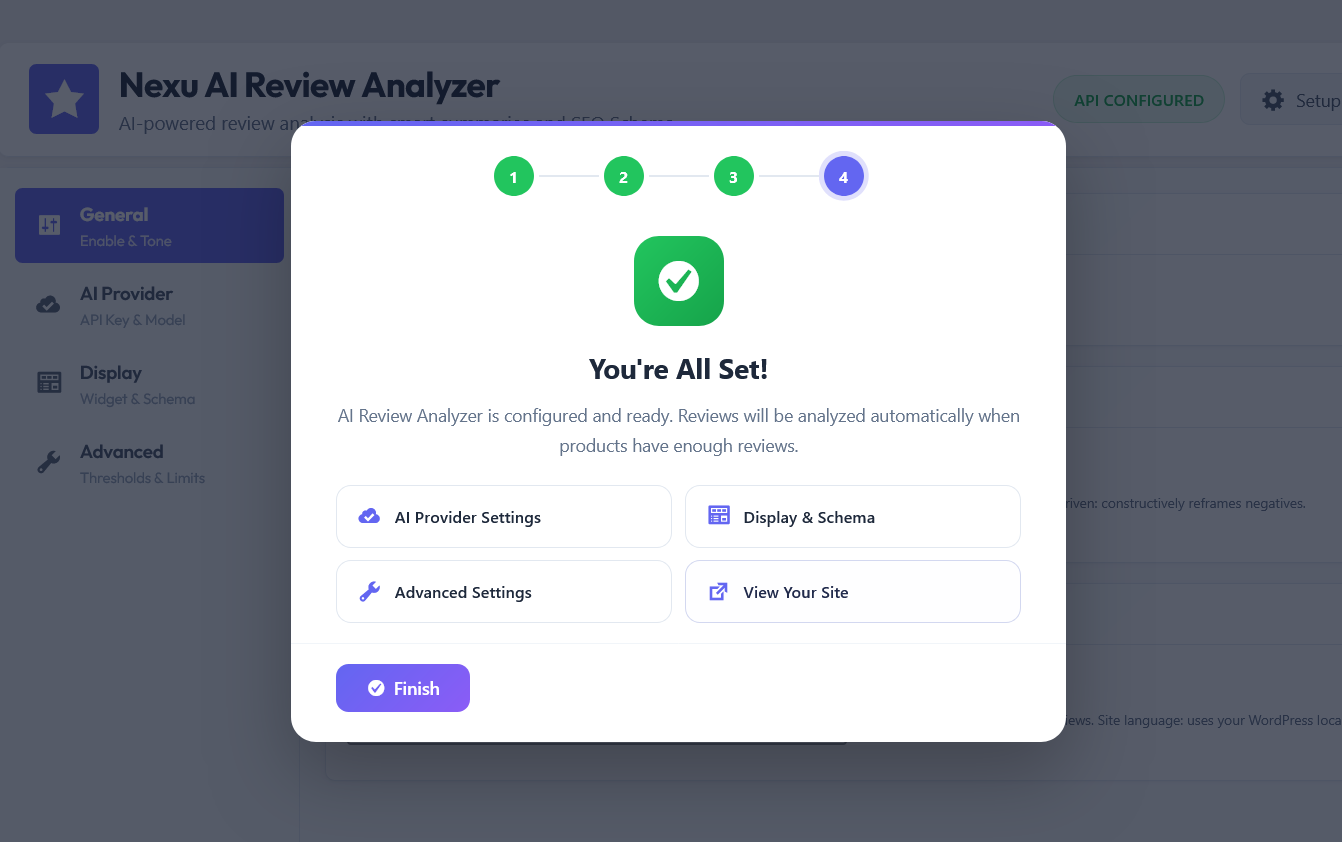
For stores that have accumulated significant review volume and are not yet surfacing that buyer intelligence in a structured, useful way, the Nexu automated WooCommerce review digest plugin is the most straightforward way to close that gap. The setup process is short, the output quality is high, and the SEO and conversion benefits start accruing from the first analysis run.
Five-component structured output, your choice of AI model, automatic JSON-LD schema, multilingual support, and shortcode placement flexibility. Built specifically for WooCommerce.






Picked this up for my nephew's farm supply shop, and wow, the visual summaries it creates actually make sense. Unlike those other plugins that just toss out random word jumbles, this one just works
Does what it claims, for the most part.
Didn't know I needed schema. nice