Next-Level Code. Nexuvibe Style ...
Hrs
Min
Sec

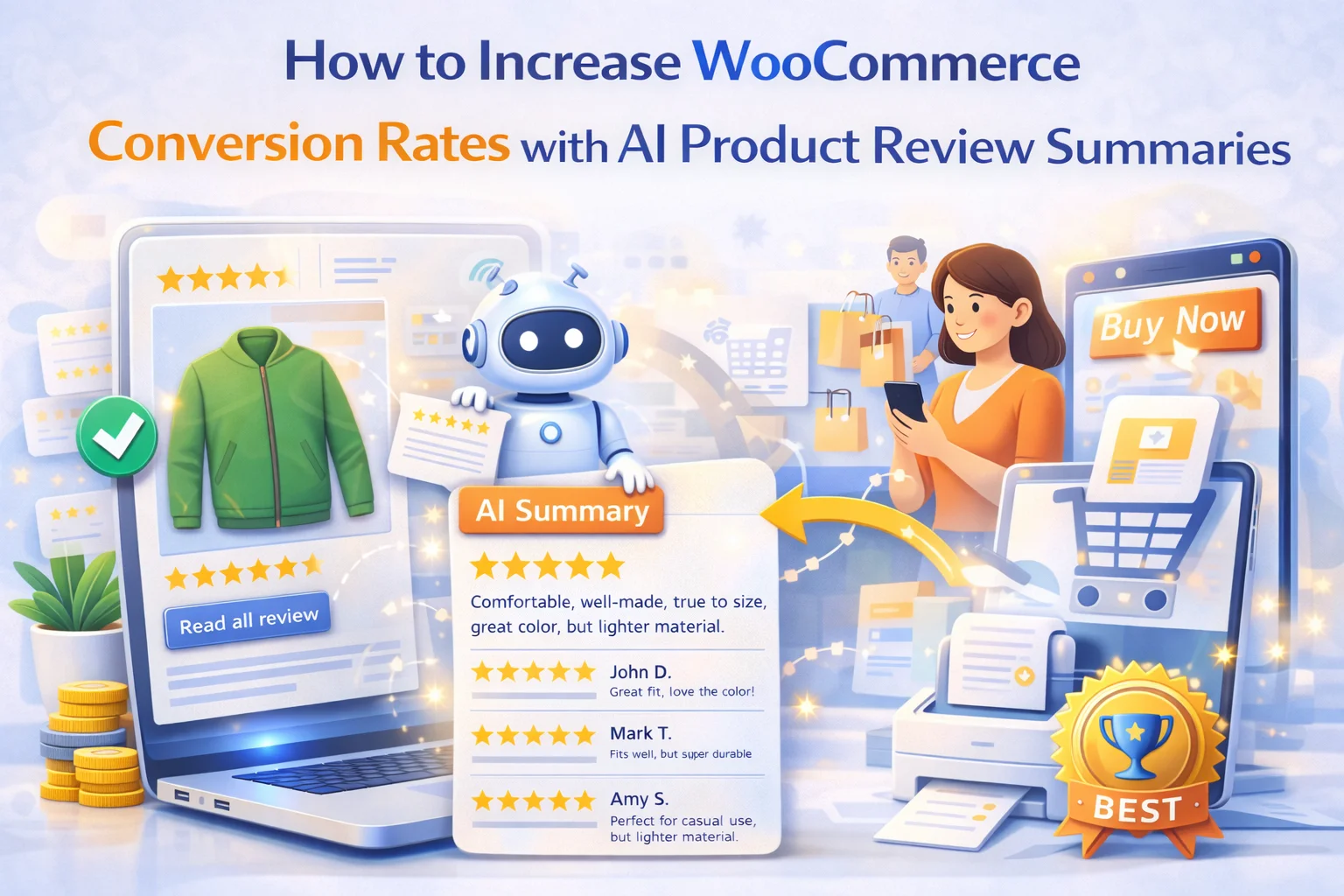
Most WooCommerce store owners trying to improve conversion rates focus on the usual suspects: checkout flow, page speed, trust badges, pricing, free shipping thresholds. These are all valid levers. But there is one conversion problem that sits much earlier in the buyer journey and tends to get overlooked because it does not show up cleanly in a funnel report. It happens on the product page itself, in the moment when a potential buyer encounters your review section and quietly decides the effort of evaluating the product is not worth it.
That moment is the decision fatigue problem. It is not unique to e-commerce, but it is particularly acute on product pages where reviews are the primary trust signal and where the volume and inconsistency of those reviews can make confident decision-making genuinely hard. AI review summaries address this problem at its root, and the conversion impact is measurable.
This guide covers the psychology behind why review-related decision fatigue hurts conversions, how AI summary technology neutralizes it, and how to implement it correctly on your WooCommerce store using an AI-powered WooCommerce review intelligence tool built specifically for this outcome.
Decision fatigue is a well-documented psychological phenomenon. When people are faced with too many options, too much information, or decisions that require sustained cognitive effort, the quality of their decision-making degrades. In consumer contexts, the most common outcome of decision fatigue is not a bad decision. It is no decision at all. The person simply stops and leaves.
On a WooCommerce product page, the review section is often the single largest source of unstructured information a buyer encounters. A product with 200 reviews contains the equivalent of a short novel’s worth of text, written by dozens of different people in different contexts, with different expectations, at different times. Some reviews are contradictory. Some are irrelevant to the specific buyer’s use case. Many are repetitive. The signal-to-noise ratio is low.
Most shoppers do not read more than five or six reviews before making a judgment call. When those five or six reviews happen to include conflicting opinions, or when the buyer finishes reading them and still does not have a clear answer to the key question they came to the reviews with, the path of least resistance is to close the tab and look elsewhere, or simply not buy at all.
The implication for WooCommerce store owners is that improving the clarity and usability of your review section can recover a meaningful portion of these near-conversions. These are buyers who were interested enough to investigate the product, engaged enough to read reviews, and lost at the last step because the information was too hard to process efficiently. They are exactly the kind of visitor who is most likely to convert if the friction is removed.
The mechanism by which AI review summaries improve conversion is not mysterious. It comes down to three factors that operate together: cognitive load reduction, trust calibration, and answer proximity.
When a buyer encounters a well-structured AI summary at the top of your review section, the cognitive effort required to understand what other buyers think about the product drops from “read as many reviews as possible and try to form a judgment” to “read one paragraph and scan a list.” This reduction in effort directly reduces the probability of decision fatigue leading to abandonment. The buyer gets to the point faster. The decision becomes easier to make. Easier decisions get made more often.
Research on consumer trust consistently shows that product pages that acknowledge imperfections convert better than those that present only positive information. When a buyer sees an AI summary that includes both what buyers loved and what they found lacking, it signals that the information is genuine rather than curated. This calibration effect is significant: a buyer who has seen the honest cons and decided the product still meets their needs is a far more committed buyer than one who purchased on the basis of uniformly positive presentation and then discovered the negatives post-purchase.
Most buyers arrive at the review section looking for the answer to a specific question. Does it fit true to size? Is the battery actually good? Does it work for beginners? When those questions are buried in review text across ten pages, finding the answer requires effort that most buyers will not invest. When an AI-generated FAQ section surfaces the most commonly asked questions and answers them directly, the buyer gets the answer immediately. That answer proximity converts hesitation into confidence.
The conversion impact of AI review summaries is not uniform across every product type. Understanding where it is highest helps you prioritize your implementation and set realistic expectations for results.
Products with 50 or more reviews that include a meaningful spread of opinions from 3 to 5 stars are where AI summaries produce the largest measurable conversion gains. These are the products where the raw review list creates the most decision fatigue. The summary collapses a wide range of buyer opinions into an actionable verdict, and buyers who were previously abandoning due to information overload can now make a confident decision quickly.
When a buyer is spending a meaningful amount of money, their due diligence behavior intensifies. They read more reviews, spend more time on the product page, and are more likely to abandon if they cannot achieve confidence. For higher-ticket items in your catalog, an AI summary that quickly answers whether the product is worth the price and what the main trade-offs are does an enormous amount of work toward closing that sale.
Fitness equipment, tech accessories, clothing and footwear, skincare products, and similar categories where buyers have very specific questions about compatibility, fit, or suitability for their situation benefit enormously from auto-generated FAQs. When the summary answers “is this good for beginners?” or “does this run large?” directly and visibly, buyers with those specific concerns can get their answer without hunting through pages of review text.
New products with fewer than ten reviews do not have enough data for the AI to produce a reliable summary. Products that are universally loved or universally criticized see smaller gains because the raw reviews already tell a clear story. The summary is most useful when the underlying data is complex enough that processing it creates genuine value. Set appropriate minimum review thresholds in your plugin settings to avoid deploying summaries in contexts where they do not add much.
Implementation decisions affect outcome quality significantly. The same underlying AI capability deployed with different configurations produces meaningfully different conversion results. Here is how to set up the Nexu WooCommerce AI review summary plugin for the strongest conversion impact.
This is the single most important placement decision. If the summary appears below the review list, many buyers will never see it because they already formed a judgment or abandoned while reading the raw reviews. Placing the summary at the top of the reviews section, before the individual reviews, ensures that every buyer who scrolls to the review section encounters the organized summary first. This is the configuration that produces the strongest conversion uplift.
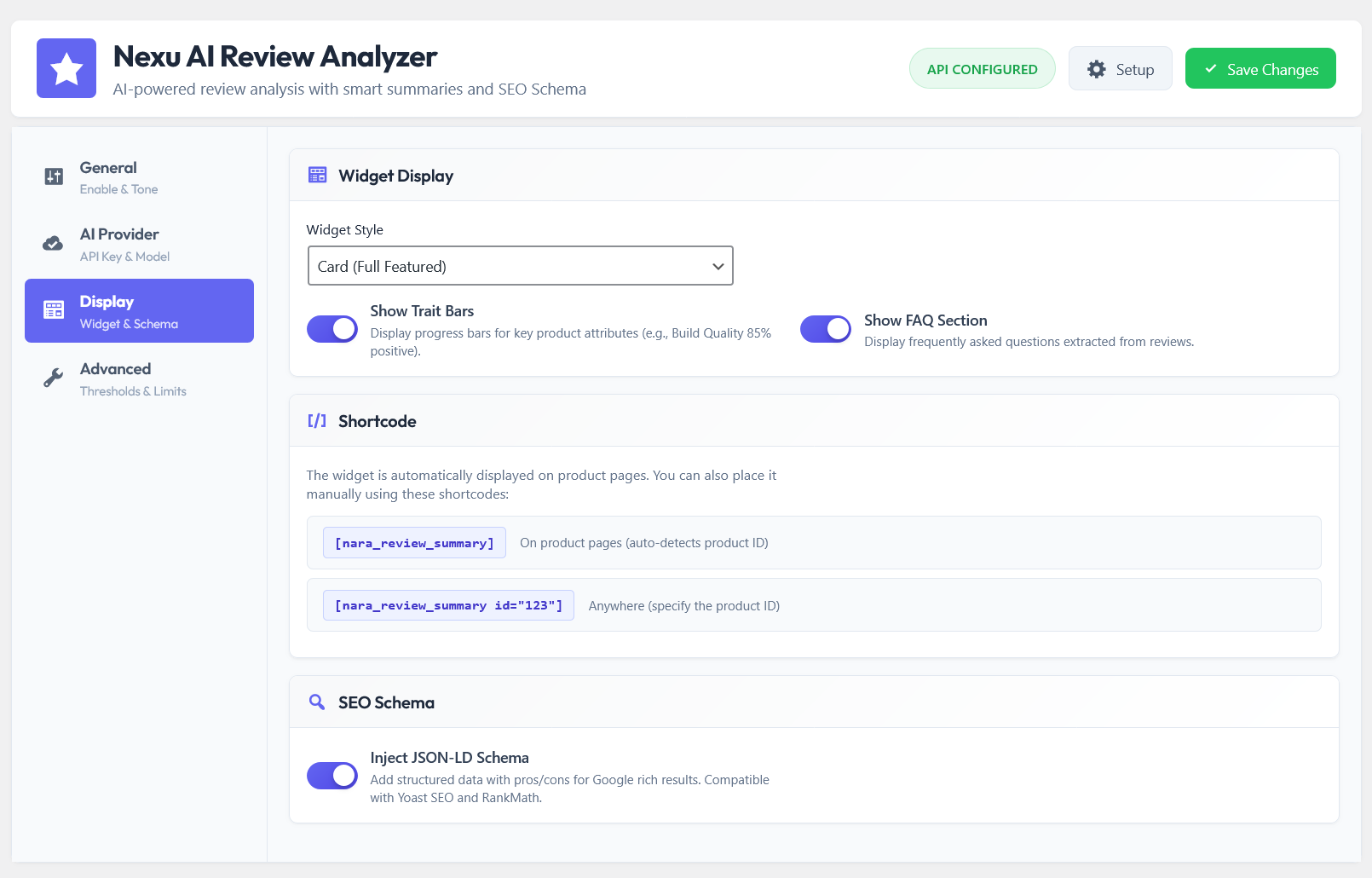
The overview paragraph, pros list, cons list, FAQ section, and trait bars each address a different buyer need and decision style. Some buyers are paragraph readers. Some scan lists. Some are looking for a specific answer. Some want a visual read of overall quality. Enabling all components means you are serving all of those buyer types simultaneously rather than optimizing for one and losing the others. The conversion impact compounds across multiple buyer profiles.
Summaries generated from fewer than ten reviews carry too much noise from individual outlier opinions to be reliably accurate. An inaccurate summary that misrepresents the product experience actively damages conversion by either over-promising to buyers who then return the product, or under-representing the product to buyers who would have been happy with it. The conversion benefit requires accuracy. The minimum threshold protects accuracy.
A summary that was accurate six months ago may no longer reflect the current buyer consensus if the product has changed or if recent reviews have shifted in sentiment. Stale summaries that contradict the current review reality erode trust when buyers scroll past the summary and see reviews that tell a different story. Set re-analysis to trigger after every 20 to 30 new reviews to keep the summary aligned with current sentiment.
Before deploying across your full catalog, manually read the AI output on your ten or twenty highest-traffic products. This is where you will see the most volume of buyer interactions with the summary section, and any quality issues with the output will have the highest impact there. Catching and correcting any tone or accuracy issues on high-traffic pages before they affect large numbers of buyers is a straightforward quality control step that pays off at scale.
Measuring conversion impact accurately requires some care because the effect is not always visible in store-wide metrics right away. The improvement is concentrated on specific products, particularly those with large and mixed review sets, so store-wide conversion rate changes can look modest even when the impact on affected products is significant.
The most reliable measurement approach is to track add-to-cart rates specifically on the products you have deployed summaries on, comparing the four weeks before and four weeks after deployment. This isolates the effect to the pages where the change actually happened rather than diluting it across your whole catalog.
The secondary metric worth tracking is pre-purchase support query volume. One of the more immediate and consistent effects of well-implemented review summaries is a reduction in customer questions about products. When buyers can get their questions answered directly from the FAQ section of the summary, they need to contact your support team less often before purchase. This is a cost reduction benefit that compounds alongside the conversion rate improvement.
Most store owners who measure carefully see meaningful improvement in add-to-cart rates on their target products within the first month. The return rate improvement typically takes slightly longer to surface because it requires a full purchase cycle to complete. Both are genuine, measurable outcomes of removing the decision fatigue that was previously costing conversions, and both are directly attributable to the Nexu AI-powered review intelligence for WooCommerce doing its job correctly.
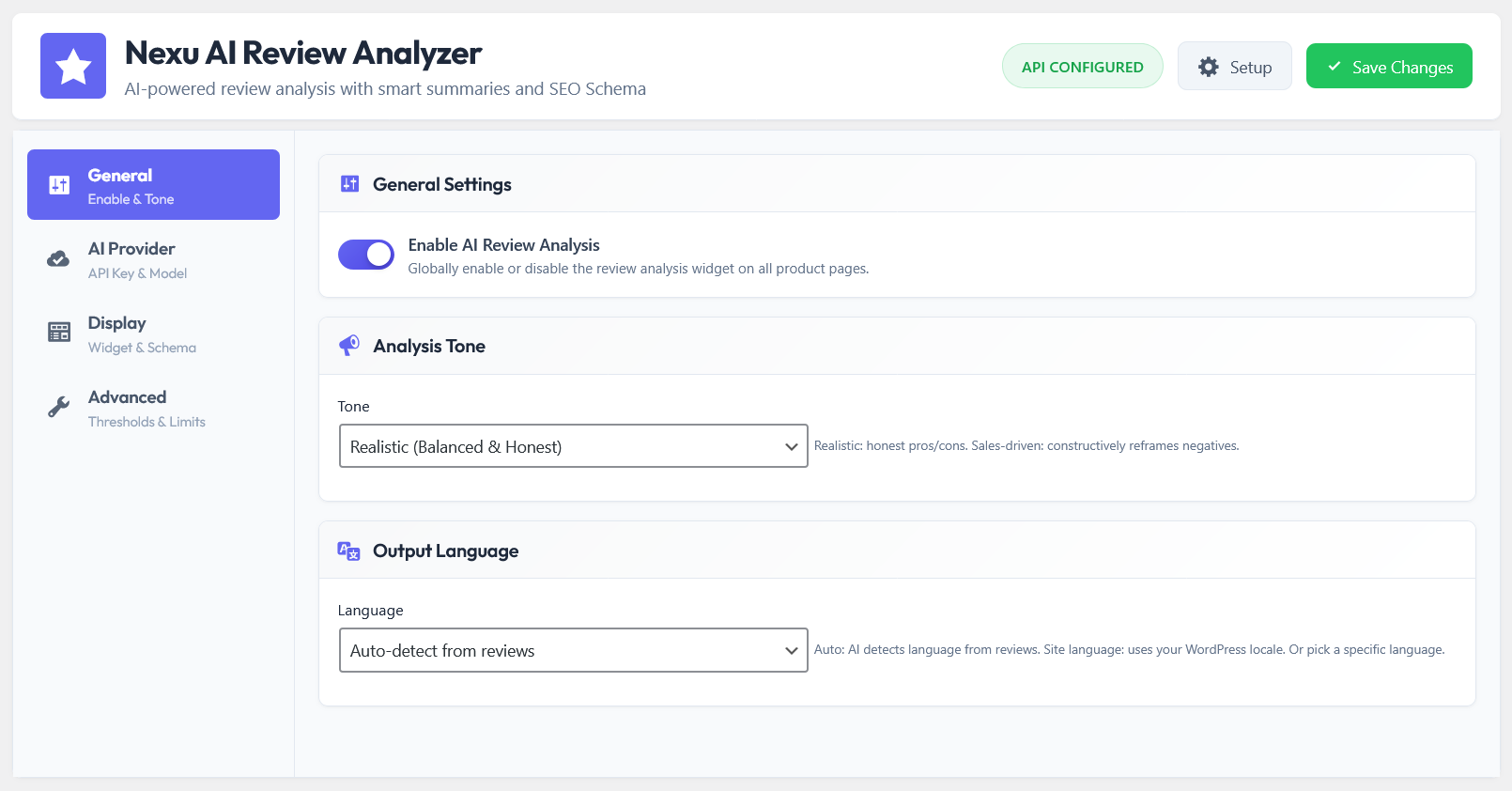
Nexu AI Review Analyzer converts your review volume into structured summaries, honest pros and cons, auto-generated FAQs, and visual trait bars that help buyers decide faster and buy with more confidence.





The part about decision fatigue was spot on I tweaked my checkout flow and my cart rate's already
Snagged this during the Black Friday sale. the AI review summaries are a neat idea definitely saves me from scrolling through endless mixed opinions. But I'm wondering, does it actually help customers decide quicker, or just tidy up the page?
We just set this up for our school's PTA store, and wow what a really helpful. the review summaries make it so easy for parents to cut through the clutter and actually see what matters instead of drowning in 50 different opinions. Now they get the key points right away and can make a decision without that classic "I'll come back to it later" cart abandonment. seriously, it does exactly what it promises!