Next-Level Code. Nexuvibe Style ...
Hrs
Min
Sec

If you have ever searched for a product on Google and seen a result with a structured list of pros and cons appearing directly in the search snippet, you already understand the click-through advantage that structured schema data provides. That kind of visibility stands out from a standard blue link in a way that a meta description never can. Buyers scanning search results see immediately that this listing tells them something useful before they even click. That signal drives clicks.
For most WooCommerce stores, this kind of structured rich snippet has been out of reach for a simple reason: generating accurate pros and cons for every product and then encoding them as valid JSON-LD schema requires either manual effort at scale, which is impractical for any catalog of meaningful size, or a technical implementation that most store owners do not have the resources to build.
AI-powered review analysis changes this entirely. When an AI model reads your product reviews and extracts the consensus pros and cons, and when that output is simultaneously written as valid structured data, the schema is generated automatically as a byproduct of the review summarization. There is nothing to write manually and nothing to configure technically. The rich snippet infrastructure appears as a side effect of improving your product page experience.
This guide covers exactly how that works, what the SEO mechanics behind it are, and how to implement it on your WooCommerce store using an AI WooCommerce review analyzer with automatic schema output.
Schema markup is structured data embedded in a web page that tells search engines what the content means, not just what it says. Standard HTML tells Google that a page has a list of items. Schema markup tells Google that the list is specifically a set of product advantages written by buyers who have used the product. That distinction matters because Google uses it to generate rich results.
For product pages, the most relevant schema types include Product schema, Review schema, and increasingly, structured pros and cons data that Google can surface as part of its AI-generated product summaries and comparison features. As Google’s search results have evolved to include more structured product information directly in the SERP, the value of having that structured data in place has grown substantially.
The JSON-LD format is Google’s preferred method for schema markup. It is a block of structured JavaScript notation embedded in the page that search crawlers read and interpret. A valid JSON-LD pros and cons schema for a product looks something like a structured object containing the product identifier, an array of positive attributes, and an array of negative attributes, each expressed as clean text strings.
The challenge for WooCommerce store owners has always been producing this structured data at scale. Writing accurate pros and cons for every product, encoding them correctly as JSON-LD, and keeping them updated as new reviews come in is not something that can be done manually for a catalog of any real size. It requires automation, and AI review analysis provides exactly that automation.
Consider what it would take to manually create accurate pros and cons schema for a WooCommerce store with 200 products. For each product, you would need to read the reviews, identify the recurring positive and negative themes, write them as clean text strings, encode the JSON-LD correctly, embed it in the page, and repeat the entire process whenever the review sentiment shifts enough to make the original schema inaccurate.
Even at a generous pace, that is several minutes of work per product. For 200 products, you are looking at many hours of initial work and an ongoing maintenance burden that grows with your catalog. Most store owners who attempt this manually either abandon it after a few dozen products, produce schema that is superficial and not genuinely reflective of buyer experience, or let it go stale as reviews accumulate and the content no longer matches.
When a purpose-built tool like Nexu AI Review Analyzer, a WooCommerce pros and cons schema generator, processes your product reviews, it does two things simultaneously. It generates the structured output that buyers see on the page, including the overview paragraph, pros and cons list, FAQ section, and trait bars. And it encodes the pros and cons output as valid JSON-LD schema markup embedded in the page.
The schema generation is automatic. You do not configure it separately, write any JSON manually, or use a separate schema plugin. When the analysis runs, the structured data is produced as part of the same process that creates the visible page content. The first time Google crawls your product page after the analysis, the schema is there and ready to be evaluated for rich snippet eligibility.
The quality of the schema output depends directly on the quality of the AI analysis. Because Nexu AI Review Analyzer reads the full review corpus for each product rather than sampling a subset, the pros and cons it produces reflect genuine aggregate sentiment rather than a partial read of recent reviews. This matters for schema quality because Google evaluates not just whether structured data is technically valid but whether it accurately represents the page content it is describing.
Schema that accurately reflects buyer experience passes that quality check. Schema that was generated from a small sample or that misrepresents the product experience is more likely to be ignored or, in cases of significant inaccuracy, flagged as misleading. The foundation of good rich snippet performance is schema that is both technically valid and genuinely accurate.
Rich snippets are the most visible SEO benefit of structured review data, but they are not the only one. When you deploy AI-generated review summaries with automatic schema, several other SEO signals improve simultaneously.
A product page that previously contained only a product description and a list of star-rated reviews now contains a structured summary section with a detailed overview, multiple categorized text elements, and an FAQ. From Google’s perspective, the page has become substantially more informative. This additional structured content contributes to the page’s authority on queries related to the product and can improve rankings for long-tail searches that the sparse original page was not competing for.
The FAQ section generated from your reviews maps directly to the conversational queries that appear in Google Search, AI Overviews, and voice search results. Questions extracted from actual buyer reviews represent the exact language real buyers use when searching for information about your products. When those questions and answers are encoded as FAQ schema, your product pages become strong candidates for surfacing in response to those specific queries.
When buyers land on a product page and find a structured, useful summary that answers their questions efficiently, they are more likely to stay on the page longer and more likely to proceed to checkout rather than bouncing back to the search results. Google interprets these engagement signals as indicators of page quality and relevance. The conversion benefit and the SEO benefit reinforce each other: a page that serves buyers well earns behavioral signals that support its search rankings.
Google’s AI Overviews draw on structured, well-organized page content to generate their summaries. Product pages with clearly marked structured data, including valid schema and well-organized summary sections, are better candidates for inclusion in AI Overview responses than pages with only unstructured review text. As AI-generated search results become more prominent, having your product pages structured in a way that feeds those systems becomes increasingly important for organic visibility.
The implementation process for getting automatic pros and cons schema on your WooCommerce product pages is simpler than most SEO implementations because the schema generation is a built-in part of the review analysis workflow rather than a separate configuration task.
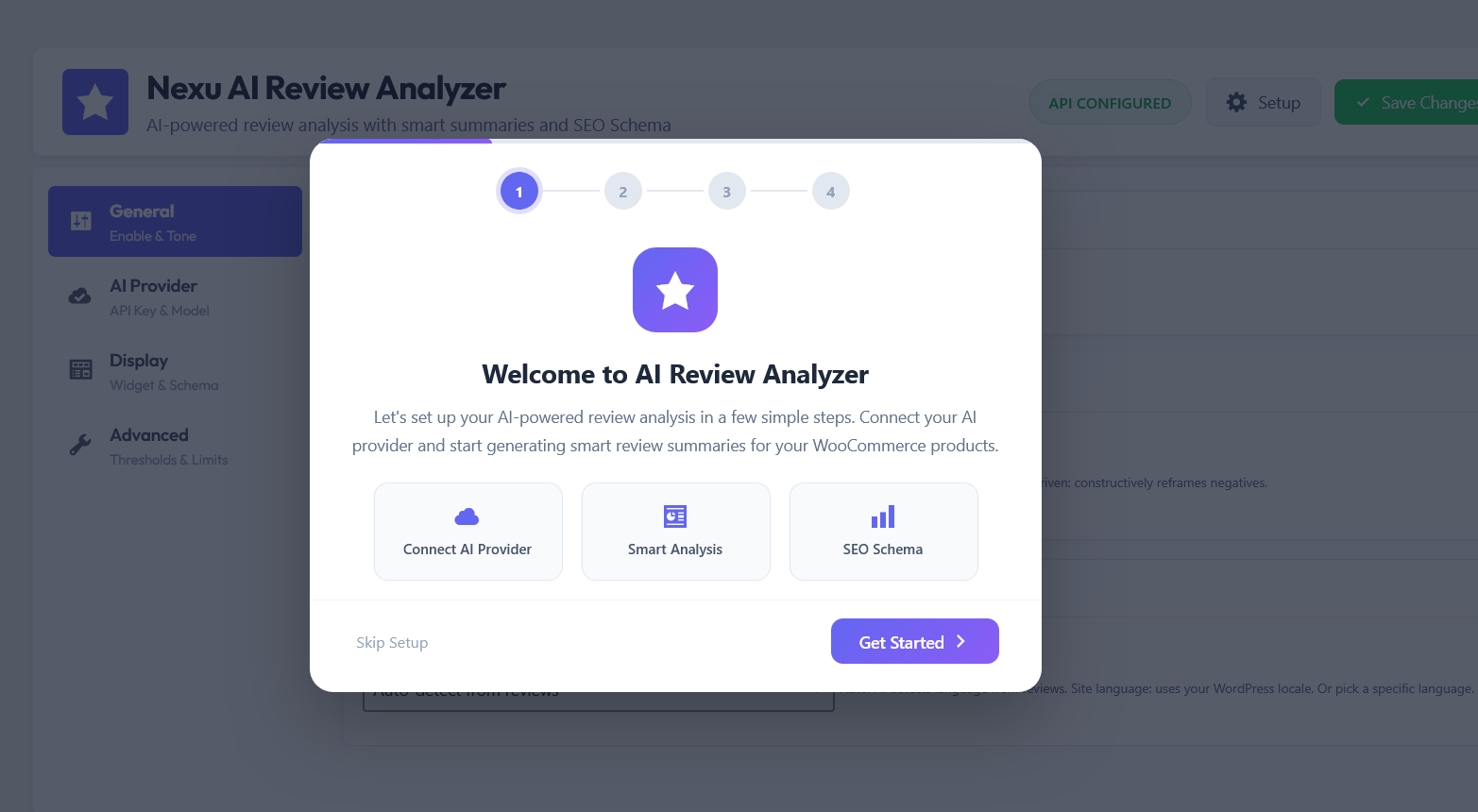
Install Nexu AI Review Analyzer via your WordPress plugin directory and run through the guided setup wizard. The wizard takes under five minutes and walks you through API key configuration, display preferences, and output component settings. Schema markup is enabled by default and does not require a separate configuration step.
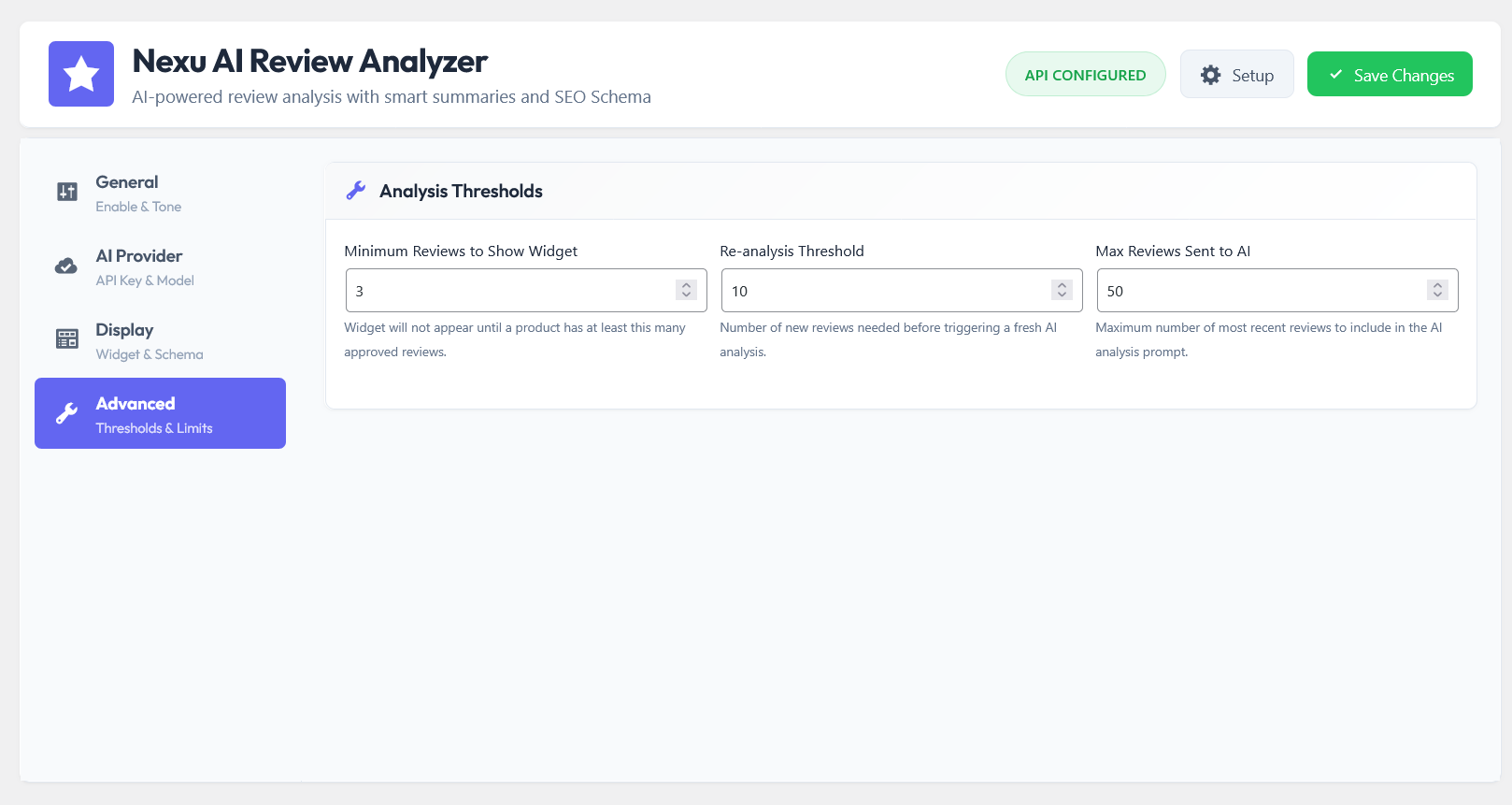
Navigate to the Advanced tab in the plugin settings and confirm that JSON-LD schema output is toggled on. This is the default state, but it is worth checking before you run your first analysis. The advanced settings also control caching behavior, which determines how quickly updated schema appears after re-analysis.
Trigger analysis on your highest-traffic and highest-revenue products before running a bulk analysis across your full catalog. This gets schema onto your most important pages immediately and gives you a chance to review the output quality before it goes live at scale. For SEO purposes, the pages with the most existing traffic are also the ones where improved rich snippets will generate the most incremental clicks.
After running your first analysis, take the URL of the analyzed product page and test it in Google’s Rich Results Test tool at search.google.com/test/rich-results. This tool reads the page as Google would, identifies all structured data present, and tells you whether it is valid and eligible for rich result display. If the schema is present and valid, you will see it listed. If there are any validation issues, the tool surfaces them with enough detail to diagnose the problem.
Once your schema is indexed, Google Search Console’s Enhancements report will show when your pages become eligible for and start receiving rich result impressions. This is the clearest signal that the schema is working as intended and that Google is using it to generate enhanced search listings for your products. Rich result impressions typically begin appearing within two to six weeks of initial indexing.
No. Valid schema markup makes you eligible for rich snippets, but Google decides whether and when to display them based on query context, competitive landscape, and page quality signals. What schema guarantees is that when Google does choose to show a rich result for your product, your page has the structured data in place to support it. Pages without schema are categorically excluded. Pages with valid schema are in contention. The difference matters for long-term SEO trajectory even if rich snippet display is not immediate.
The JSON-LD output from Nexu AI Review Analyzer is scoped to the pros and cons data it generates from reviews. It does not duplicate or override the Product schema, Review aggregate schema, or breadcrumb schema that your existing SEO plugin produces. The two sets of structured data coexist on the page and address different aspects of the product information. If you have a specific concern about schema conflicts for your setup, Google’s Rich Results Test will surface any validation errors that arise from conflicting or duplicate schema types.
Indexing timelines depend on your site’s crawl frequency, which is primarily determined by how often your pages are updated and how much authority your domain has. For most active WooCommerce stores, new schema on a product page will be indexed within a few days to a couple of weeks. For high-traffic products, you can accelerate this by submitting the URL for indexing directly in Google Search Console after the analysis runs and the schema is live on the page.
Yes. Yoast SEO and Rank Math handle Product and Review aggregate schema at the page level. Nexu AI Review Analyzer adds pros and cons structured data that those plugins do not generate. The two schema layers complement each other and together create a richer structured data profile for your product pages than either can produce alone.
The SEO case for automatic pros and cons schema is straightforward: it is a structured data layer that your product pages currently do not have, it requires no manual effort to produce when generated by an AI review analysis tool, it keeps itself accurate as your reviews evolve, and it creates rich snippet eligibility that your competitors who are not doing this do not have. That is a compounding advantage.
The Nexu WooCommerce review schema generator handles the technical implementation entirely, leaving you to focus on the strategic question of which products to prioritize and how to track the impact over time. The schema is there from the first analysis run. Everything after that is refinement.
Nexu AI Review Analyzer generates valid JSON-LD pros and cons schema automatically on every analysis run, no manual writing, no separate schema plugin, no technical configuration required.






Hey everyone, just wanted to share my experience with this. I run a small WooCommerce store on the side, and I've been trying to get those pros and cons snippets to show up in Google forever. The thought of manually writing them for every single product had me ready to throw in the towel ain't nobody got time for that!
Hey, so the SEO boost is nice and all, but 200 products?
I grabbed this hoping it'd handle my SEO busywork, but the AI's "pros and cons" from my reviews were totally off base. Some were just plain wrong like calling out "fast shipping" as a negative for something you download. i had to spend forever fixing it all before Google dinged me for messy schema. The little help section in settings didn't even mention verifying the output first. Honestly, if you're not super tech savvy, this might end up doing more harm than good for your rankings.