Next-Level Code. Nexuvibe Style ...
Hrs
Min
Sec

Most WordPress site owners discover the crawl budget concept the hard way: they publish content consistently for a year, check Google Search Console, and find that a significant portion of their pages are either not indexed or have not been crawled in months. The instinct is to look at technical problems, robots.txt settings, or canonical tags. These are worth checking, but for the majority of sites, the real culprit is much simpler and much more controllable: internal link structure.
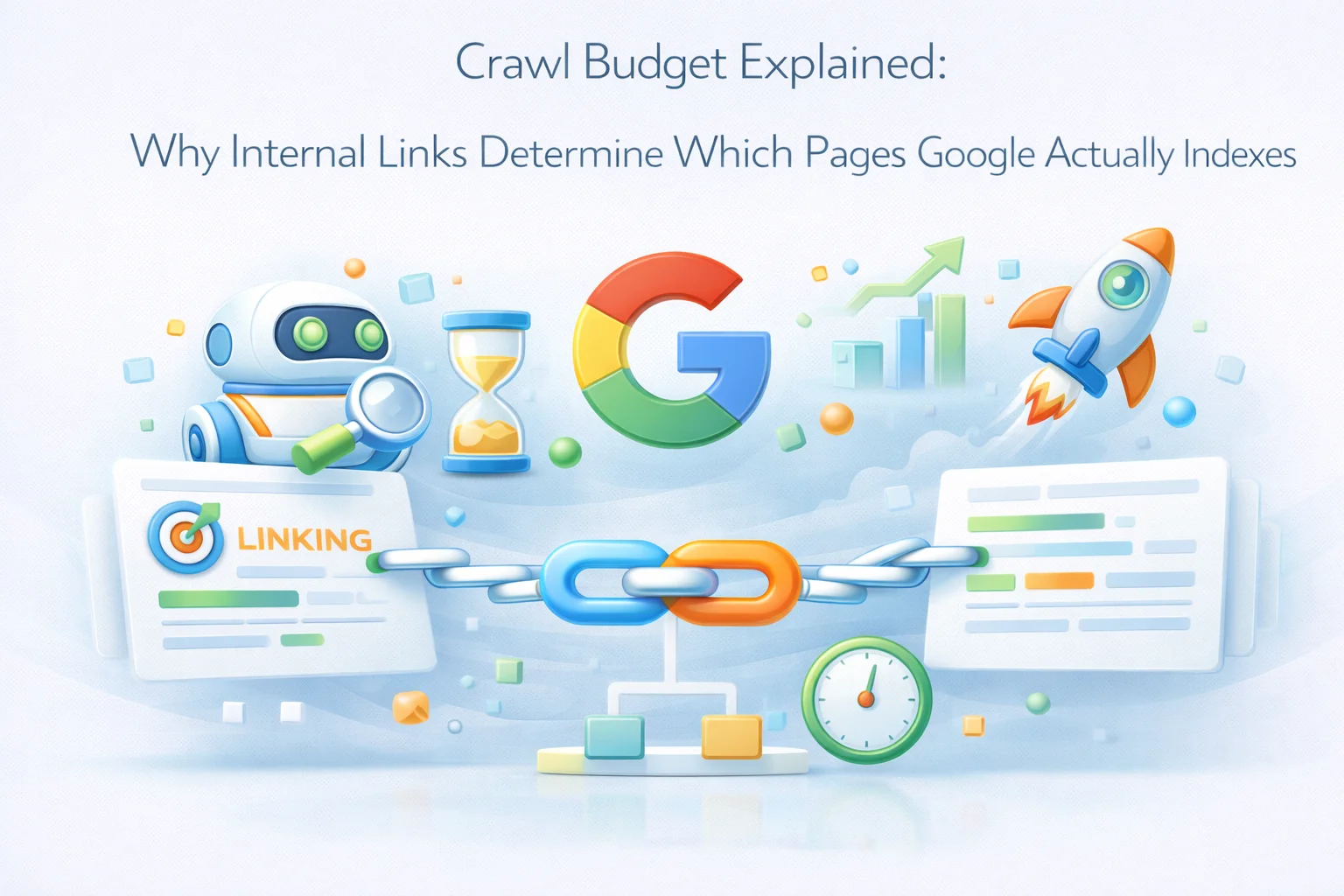
Crawl budget is the number of pages Googlebot will crawl on your site within a given period. It is not infinite. Google makes decisions about which pages to visit, how often to revisit them, and how deep into your site’s architecture to go based on a combination of signals, and the strength and structure of your internal links is one of the most influential of those signals.
This guide covers everything you need to understand about crawl budget: what it is, how Google calculates it, the direct relationship between internal link structure and crawl prioritization, the specific patterns that waste crawl budget, and how to audit and fix your internal linking to ensure Google indexes the pages that matter most to your rankings.
For the practical implementation section, we reference Nexu Link Brain because it provides the tools needed to both visualize and fix crawl budget problems through systematic internal linking.
Google’s own documentation defines crawl budget as the number of URLs Googlebot can and wants to crawl on your site. That phrasing is deliberate: it captures both a technical capacity constraint and a relevance-based prioritization decision that Google makes independently of your preferences.
The concept has two distinct components that operate simultaneously. Understanding both is necessary for understanding why internal linking affects crawl efficiency as directly as it does.
This is the ceiling on how fast Googlebot crawls your site. It is based on your server’s response speed and capacity. If your server responds slowly, Googlebot crawls less aggressively to avoid overwhelming it. If your server is fast and reliable, Googlebot can visit more pages per day. This component is largely a hosting and performance concern. You improve it by improving server response times, not by changing your content or links.
This is how much Google wants to crawl your site, which is based on signals about how valuable and frequently updated your content is. Pages that appear in more search results, that are linked to from many places, and that change frequently generate higher crawl demand. Pages that receive few links and generate little search traffic receive lower crawl demand. This component is directly influenced by your internal link structure, and it is where most sites have the most room for improvement.
For most WordPress content sites, the crawl rate limit is not the binding constraint. Modern hosting handles Googlebot without difficulty. The real issue is crawl demand: Google does not prioritize crawling all your pages equally because your internal link structure has not given it signals to treat all your pages as equally important.
To understand the internal link and crawl budget relationship, you need a mental model of how Googlebot actually navigates your site. It does not crawl randomly, and it does not follow a predetermined schedule. It makes dynamic prioritization decisions based on what it finds.
Googlebot maintains a priority queue of URLs to visit. When it visits a page and finds links to other pages, those linked URLs get added to the queue. The priority at which they are added depends on signals about how important and fresh those pages are likely to be. Pages that are linked from many other pages, pages that have historically provided useful content, and pages that appear to have been recently updated all get higher priority in the queue.
Internal links are the primary mechanism through which pages get repeatedly added to this priority queue. A page that is linked from 20 other pages on your site gets added to the queue every time Googlebot crawls any of those 20 source pages. A page with no internal links pointing to it might only make it into the queue through your sitemap, which Google checks on a much less frequent schedule than it follows links.
The implication is direct: the distribution of internal links across your site is, in effect, the distribution of Googlebot’s attention across your site. Pages with many internal links receive frequent crawl visits. Pages with few or no internal links receive infrequent visits or none at all. If those infrequently visited pages contain content you want to rank, they are operating at a severe crawl disadvantage regardless of their quality.
Click depth, the number of clicks required to reach a page from your homepage, is one of the most reliable predictors of crawl frequency. Pages at click depth 1 or 2 are visited regularly. Pages at click depth 4 or more are visited infrequently. Pages at click depth 6 or deeper may never be crawled at all within a normal crawl cycle.
This matters because content sites naturally accumulate deep pages over time. A post published two years ago that has no recent links from newer content sits at the bottom of a long chain of navigation clicks. It was probably linked from your category page when it was new, but that category page now has 80 posts on it and the older post has been pushed to page 4 of the category pagination. From Googlebot’s perspective, that page now requires multiple clicks to discover through normal navigation, which reduces its crawl priority automatically.
Internal links are the primary mechanism for reducing click depth. A post that is 5 clicks deep through category pagination becomes 2 clicks deep if a recently published, well-linked post references it directly. The internal link creates a shortcut that Googlebot follows, dramatically increasing the crawl priority of the older post without requiring any changes to your navigation structure.
This is one of the most tangible and underappreciated benefits of systematic internal linking: it reduces the effective click depth of your entire content archive, concentrating Googlebot’s attention on pages that might otherwise fall off the crawl map as your site grows.
Not all internal linking problems reduce crawl efficiency directly, but several common patterns actively waste the crawl budget Google allocates to your site, diverting Googlebot away from your valuable content toward URLs that add no ranking value.
When an internal link points to a URL that redirects to another URL, which then redirects to a third URL, Googlebot follows each hop separately. Each redirect in the chain consumes crawl budget without delivering value. Common on sites that have changed their URL structure, moved content, or undergone CMS migrations without cleaning up old redirect chains.
Every internal link that leads to a page returning a 404 Not Found error is a dead end for Googlebot. The crawl budget allocated to following that link is consumed without discovering anything useful. Broken internal links accumulate on sites where content has been deleted, moved, or restructured without updating the links pointing to it.
Pages tagged with a noindex directive are excluded from Google’s index intentionally. But if those pages still have internal links pointing to them, Googlebot will still crawl them to follow the links, consuming budget to visit pages that cannot contribute to your indexation goals. Common on sites that have noindexed tag archives, author pages, or filtered search results while still linking to them heavily from content pages.
Sites that use URL parameters for pagination or filtering (page=1, page=2, sort=price, filter=color) can generate thousands of near-duplicate URLs that Googlebot crawls repeatedly. Each parameterized URL that Googlebot visits consumes crawl budget without adding unique indexable content. Sites with large product catalogs or tag archive systems are particularly vulnerable.
Every page on your site passes its PageRank across all outgoing links equally. A page with 150 links in its navigation menus, sidebar, footer, and content is splitting its authority 150 ways. The amount that flows through each content link is a fraction of what a page with 10 well-placed content links would pass. Bloated navigation structures actively suppress the authority flow that your content internal links should be creating.
Pages with no incoming internal links exist at the fringes of your crawl budget. When Googlebot does find them through the sitemap, it visits and then has no internal link path to follow onward into your valuable content. The crawl terminates at the orphan page rather than continuing through a well-linked content network. Orphan pages are both wasted crawl budget themselves and dead ends that prevent the crawl from efficiently reaching other content.
Before fixing crawl budget problems, you need to understand the extent of your current situation. Several data sources together give you a complete picture.
The Coverage report under Indexing shows you which pages are indexed, which are excluded, and the reasons for exclusion. Pages with “Crawled but not indexed” status are being visited but not added to the index, often because Google has determined they are low-value. Pages with “Discovered but not indexed” status have been found (typically through the sitemap) but not yet crawled, which indicates a crawl demand problem. A large “Discovered but not indexed” count is a clear crawl budget signal.
Use the URL Inspection tool to check the last crawl date for a sample of pages across your site. Check your most recently published posts, your pillar pages, and a random selection of older archive content. If your most important pages were last crawled weeks ago, you have a crawl frequency problem that internal linking can help address. Pages crawled within the last few days are receiving adequate crawl attention.
The internal audit tools in Nexu Link Brain show you your orphan page count, link distribution across your content, and broken internal links, all of which are direct inputs to your crawl budget situation. High orphan counts mean pages that Googlebot rarely reaches. Uneven link distribution means some content is heavily crawled while other content is effectively invisible. Broken links mean crawl budget wasted on dead ends.
Improving crawl budget efficiency through internal linking is not about adding more links everywhere. It is about creating a link architecture that channels Googlebot’s attention toward your most important, most indexation-critical content. The specific changes that produce the most crawl efficiency gain are the following.
Your most-linked pages are crawled most frequently. When those pages link to your new content, they function as efficient entry points for Googlebot to discover and crawl the new pages quickly. Auto-suggest in Nexu Link Brain handles this automatically: every time you publish a new post, it identifies relevant existing pages and suggests backward links from those established pages to your new content.
Orphan rescue is not just an SEO nicety. For crawl budget purposes, it is essential maintenance. Each rescued orphan moves from the unreliable sitemap discovery path to the reliable link-following discovery path. When a high-authority page on your site links to the formerly orphaned page, Googlebot will visit that page every time it crawls the source, which may be multiple times per week rather than once per month.
Pillar pages that receive links from many cluster posts get crawled very frequently, because they appear in the link structure of every page Googlebot visits in the cluster. This concentrated crawl attention means updates to your most important pages are noticed and reindexed faster. When you improve a pillar page’s content, the upgrade is visible to Google within days rather than waiting for the next sitemap check.
Adding new internal links while broken links continue to waste crawl budget is a partial fix at best. Use the Broken Internal Links report to identify and fix every dead-end link in your content. Each broken link you fix converts a crawl budget drain into a productive navigation path. This is the most immediate crawl efficiency improvement available and should be the first step in any crawl optimization project.
Sites that implement systematic internal linking improvements for crawl budget purposes typically see three measurable changes in their Search Console data within four to eight weeks.
Pages move from the discovered queue into the indexed pool as internal links increase their crawl priority and Google finally processes them.
URL Inspection checks on previously neglected pages show more recent crawl dates, confirming that Googlebot is now reaching them through link paths rather than only through sitemap discovery.
Pages that were not being indexed begin appearing in Search Console impression data as Google starts processing and ranking them, often for long-tail queries they are well-suited to answer.
The relationship between internal linking and crawl budget is one of the most concrete and measurable in technical SEO. Unlike topical authority, which builds gradually and is difficult to directly quantify, crawl efficiency improvements show up clearly in Search Console data within weeks of implementation. This makes internal link optimization for crawl purposes one of the highest-confidence interventions available to site owners who can see that their content is not being consistently indexed.
The automated internal linking system for WordPress crawl optimization addresses both dimensions of the crawl budget problem. It increases the internal link coverage of your content archive, reducing orphan pages and effective click depth. And it routes link authority toward your most important pages, generating higher crawl demand for the content that matters most to your organic performance.
Nexu Link Brain builds the internal link architecture that channels Googlebot’s crawl attention toward your most important content, rescues orphan pages from the crawl margins, identifies and fixes broken links, and ensures your entire content archive receives consistent indexation.






Finally found a guide that actually explains crawl budget in plain English! most SEO blogs just throw around buzzwords, but this broke down how Google prioritizes pages based on internal links. saved me hours of trial and error.
Finally, a guide that actually explains crawl budget without all the fluff
Hey everyone, just had to share this crawl budget guide totally changed how I handle SEO. I'd been messing with robots.txt and canonical tags for months, convinced that was the problem. but no, my internal linking was all over the place, and Google was basically skipping half my site.