Viral Growth · Tiered Commissions · WooCommerce 2026
How to Create a Viral Referral Network
with WooCommerce Tiered Commissions
Flat-rate affiliate programs create passive promoters. Tiered commissions create obsessed ones. When the rate goes up every time an affiliate crosses a threshold — and when every affiliate they recruit earns them passive upline income — you stop managing a program and start watching a network grow itself.
15 min read
Updated 2026
WooCommerce Growth
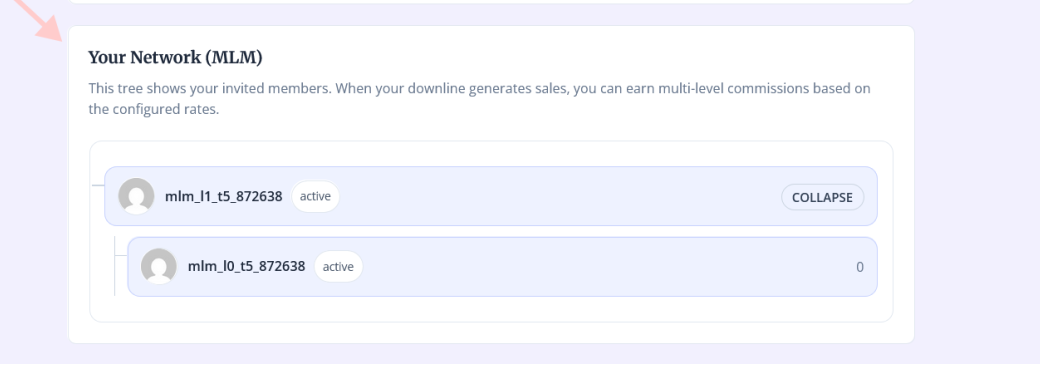
The affiliate network view in
Affiliate Engine — tier status, downline network and upline earnings visible inside WooCommerce My Account. This is what motivates affiliates to recruit and keep selling.
There is a reason the best-performing affiliate programs in any niche are never flat-rate. A flat commission — say, 10% on every sale regardless of volume — tells an affiliate exactly one thing: bring in sales and collect 10%. Once they find a comfortable monthly volume, there is nothing in the structure that says “push harder.” The incentive plateaus the moment the affiliate does.
Tiered commissions change the psychological contract entirely. Instead of a fixed exchange, they create a ladder: every sale moves the affiliate one step closer to a better rate. The closer they get to the next tier, the more valuable each additional sale becomes — both in current earnings and in the rate waiting on the other side. The commission structure becomes a motivation engine that runs in the background of every decision the affiliate makes about how hard to promote.
Layer a multi-level recruitment structure on top of that — where affiliates also earn passive upline income from the sales of affiliates they recruit — and you have the complete formula for a self-sustaining referral network. Affiliates sell to reach higher tiers. They recruit because every sub-affiliate’s sale earns them passive income. Their recruits are motivated by the same two-layer structure. The network feeds itself.
This guide is the practical implementation of that formula inside WooCommerce using Affiliate Engine – Ultimate WooCommerce Referral & Affiliate Marketing Plugin — with the exact configuration decisions that separate a program that goes viral from one that stays mediocre.
The psychology behind viral affiliate growth: why structure matters more than budget
Most store owners approach affiliate growth as a budget problem. Pay higher commissions, attract better affiliates. This is partly true — a competitive rate is the baseline for recruiting anyone worth having. But paying more does not solve the plateau problem; it just makes the plateau more expensive.
The plateau exists because a flat-rate program has no forward momentum. An affiliate who earns the same 12% whether they referred £200 or £2,000 this month has a comfortable equilibrium at whatever volume requires the least effort. The structure does not reward stretching beyond that equilibrium. What breaks the plateau is not more money — it is a structure that makes every incremental sale feel like progress toward something better.
Flat-rate program psychology
- Effort and rate are permanently decoupled
- No financial reason to push volume beyond comfort zone
- No reason to recruit sub-affiliates — does not benefit me
- Program feels like a side gig, not an income strategy
- Affiliate churn is high once initial excitement fades
Tiered + MLM program psychology
- Every sale = progress toward a better rate
- Threshold proximity creates urgency near month-end
- Recruiting sub-affiliates earns passive upline income
- Program feels like building a real income stream
- Top affiliates stay because the structure rewards them more over time
The real driver of viral growth in an affiliate program
A referral network becomes viral when each participant generates more than one new participant on average — and when those new participants are motivated to do the same. A tiered commission structure with upline network earnings creates this by giving every active affiliate two reasons to recruit: first, passive income from the recruits’ sales; second, the social incentive of having helped someone else build the same income stream they are building. Structure drives behaviour. Behaviour drives growth.
The two commission layers: performance tiers and network upline — and why you need both
Affiliate Engine supports two distinct types of commission escalation. They are architecturally separate, configured independently, and address different affiliate behaviours. Understanding the difference is the foundation of building a program that actually goes viral.
Layer 1 — Performance tiers: rewarding sales volume
Performance tiers track each affiliate’s cumulative referred revenue within a period and automatically escalate their commission rate as they cross pre-set thresholds. An affiliate starts at 10%, crosses £500 and moves to 12%, crosses £1,500 and moves to 15%. The upgrade is automatic — no admin action needed. The motivation is continuous: an affiliate is always either at a tier working to maintain it, or approaching the next one working to reach it.
🔗Implementing a WooCommerce MLM plugin setup transforms standard affiliate programs into self-sustaining networks with built-in recruitment incentives. →
What behaviour it drives: Higher individual sales volume. Sustained monthly promotional activity. Loyalty — top-tier affiliates do not leave because they would lose their tier status.
Layer 2 — MLM network commissions: rewarding recruitment
Network commissions (via the free MLM Matrix add-on) pay an affiliate a percentage of the commission base every time an affiliate they recruited makes a sale. Level 1 earns 5% of each sub-affiliate’s sale base; Level 2 earns 3%; Level 3 earns 2%. These are passive earnings — the upline affiliate does not need to do anything extra to earn them beyond having recruited the sub-affiliate in the first place.
What behaviour it drives: Active recruitment. Investment in the success of sub-affiliates. Network-building mentality rather than solo-seller mentality.
Why running both simultaneously is the key
Performance tiers alone motivate sales. Network commissions alone motivate recruitment. Running both simultaneously in Affiliate Engine creates an affiliate who is simultaneously chasing a higher rate for themselves and building a passive income stream from their downline. That is the structural combination that turns a managed program into a self-accelerating network.
Designing tier thresholds that actually motivate: a practical framework
The single most common mistake when setting up a tiered commission program is calibrating thresholds to what feels right to the store owner, not to what a real affiliate can realistically achieve. A tier that no affiliate can reach in a normal month is not a motivator — it is wallpaper. The first threshold upgrade must be achievable for any affiliate who promotes consistently, and achievable within one calendar month.
| Tier name |
Revenue threshold (monthly) |
Rate |
Who reaches it |
| Starter |
£0 – £499 |
10% |
Any new affiliate. Competitive enough to attract serious applicants. |
| Active |
£500 – £1,499 |
12% |
Any affiliate who promotes consistently — 8–10 sales/month at £60 AOV. |
| Champion |
£1,500 – £3,999 |
15% |
Affiliates who have built an audience or run paid traffic. Aspirational but real. |
| Elite |
£4,000+ |
18% |
Your top 5–10% of affiliates. Retention-critical — they generate the majority of revenue. |
Example calibrated for a WooCommerce store with £55–£70 AOV. Adjust thresholds proportionally if your AOV is higher or lower.
Calibration formula
Take your AOV × 8 sales = your first threshold. A moderately active affiliate who sends traffic consistently should hit this in 3–4 weeks of genuine effort. If they cannot, the threshold is too high and will demoralise rather than motivate.
Rate gap rule
The commission increase between tiers should be at least 2 percentage points — enough to feel meaningful on a £300 month. A jump from 10% to 10.5% is noise. A jump from 10% to 12% is a real financial reason to push volume.
Step-by-step: configuring tiered commissions in Affiliate Engine
Here is the exact configuration sequence inside Affiliate Engine to get both commission layers running simultaneously.
1
Set your base commission rate in Commission Settings
This is the Starter tier rate — what every new affiliate earns before reaching any threshold. Configure this first so the tier system knows what rate to escalate from.
2
Open the Tiers tab and add each performance tier
For each tier above Starter: set the minimum referred revenue threshold and the commission rate that applies once crossed. Tiers are tracked per affiliate individually — each affiliate’s progress is independent of every other affiliate’s.
3
Decide reset period: monthly or permanent accumulation
Monthly reset creates a recurring motivation cycle — every affiliate starts fresh each month. Permanent accumulation rewards long-term loyalty — once an affiliate reaches Elite they stay there. Many programs use permanent for the top tier only and monthly for the intermediate tiers. Choose based on whether you prioritise sustained monthly urgency or long-term retention.
4
Activate the MLM Matrix add-on and configure network levels
Enable the free MLM Matrix add-on from Affiliate Engine settings. Set depth (how many upline levels get paid) and the rate for each level. Recommended starting point: Level 1 at 5%, Level 2 at 3%, Level 3 at 2%. Choose Extra mode if margins allow — upline commissions added on top of direct. Choose Deduct mode to redistribute within a fixed commission budget.
5
Verify hold period covers your full refund window
In General Settings, set the commission hold period to at least your store’s refund window plus a buffer. This ensures no tier-escalated or upline commission is paid out before the order is confirmed non-refundable. If an order refunds, both the direct commission and all linked upline commissions are automatically cancelled before payout.
6
Tell your affiliates the structure — explicitly and in writing
Send a program launch email that states the tier names, thresholds, rates, and upline commission structure clearly. Affiliates who do not know the tier structure cannot be motivated by it. Affiliates can see their current tier and threshold progress in their My Account dashboard — but the launch email frames the opportunity before they log in for the first time.

The Tiers tab in
Affiliate Engine — each tier defined by revenue threshold and commission rate, applied automatically as affiliates cross thresholds.
What the numbers look like when both layers run together
Abstract commission structures are hard to internalise. Here is a concrete example of what a four-person affiliate network looks like inside Affiliate Engine with performance tiers and MLM network commissions both active — and what a single £400 order pays out at each level.
Example: £400 order — Champion-tier affiliate, 3-level network
Alice — Direct
Champion tier (15%) → earns £60 on this order. Has referred £2,100 this month — already at Champion tier since day 18.
Bob — L1 upline
Recruited Alice. Earns 5% of £400 commission base → £20. Also building his own direct referral commissions this month at Active tier (12%).
Carol — L2 upline
Recruited Bob. Earns 3% of £400 → £12 passive from this single order. Carol has 6 active sub-affiliates — this kind of passive income accumulates rapidly.
David — L3 upline
Recruited Carol. Earns 2% of £400 → £8. David does zero direct promotion this month — his £400+ in passive earnings comes entirely from network activity three levels below him.
Total payout — Extra mode: £60 + £20 + £12 + £8 = £100 (25% of order)
|
Deduct mode: £60 direct adjusted down, total stays near £80
Always stress-test total payout against your margin before launch
In Extra mode with a Champion-tier affiliate and a full 3-level upline chain: 15% + 5% + 3% + 2% = 25% of order value. Before you go live, calculate this worst-case percentage against your worst-margin product. If a 25% commission payout is unsustainable on that product, adjust level rates down, switch to Deduct mode, or exclude specific products from the MLM calculation. Run the numbers before launch, not after your first payout cycle.
How to communicate the program to maximise adoption velocity
The best commission structure in the world generates zero behaviour change if affiliates do not understand it. Most affiliate programs are launched with a single welcome email that lists the commission rate and a link to the affiliate dashboard. This is enough for a flat-rate program. For a tiered program with network commissions, it is not even close to sufficient.
Affiliates need to understand three things clearly before they log in for the first time: what the tiers are and how to reach them, what the upline commission structure looks like and how to earn from it, and where to find their progress in the dashboard. Affiliates who understand the full opportunity will promote differently from day one — not just sharing links, but actively recruiting.
Welcome email — the full opportunity, not just the rate
State the tier names, thresholds, and rates in a simple table. Below that, explain upline commissions in one paragraph with a concrete example. End with a clear call-to-action: log in, find your affiliate link, and share it — but also: recruit your first sub-affiliate and start earning passive income from their activity. Most programs never say this second part. Say it.
Mid-month tier nudge — use the proximity effect
Research on goal completion consistently shows that motivation spikes as people approach a target. An email sent mid-month to affiliates who are within 20–30% of their next tier threshold — “You are £180 away from Champion tier and a 15% commission rate” — can generate a meaningful spike in promotional activity in the final two weeks. This communication can be sent manually from the Affiliates tab, which shows each affiliate’s current referred revenue total.
End-of-month tier achievement email — recognition that reinforces behaviour
When an affiliate crosses a tier threshold, acknowledge it. A congratulatory email that states the new rate, confirms it is active immediately, and reminds them of the next tier turns a commission change into a social reward. People repeat behaviour that is recognised. This is operationally simple — the Referrals tab shows each affiliate’s current tier, so identifying tier upgrades is straightforward.

The Affiliates tab in
Affiliate Engine — admin view of every affiliate with current tier status, referred revenue, and sponsor assignments for the full network.
Frequently asked questions
Do performance tiers and MLM network commissions interact — does a higher-tier affiliate generate larger upline commissions for their sponsor?
No, and this is worth understanding clearly. Upline network commissions are always calculated as a percentage of the order’s commission base — not as a percentage of the direct affiliate’s commission. Whether Alice is at Starter tier (10%, earning £40 on a £400 order) or Champion tier (15%, earning £60 on that order), her Level 1 sponsor Bob still earns 5% of the £400 commission base — £20 — either way. The performance tier affects only Alice’s own earnings. The upline commission is independent of Alice’s tier.
Can I exclude specific products from the tier calculation without removing them from the affiliate program entirely?
Yes. Affiliate Engine supports product-level and category-level commission overrides. You can set a fixed commission rate on specific products that bypasses the global tier escalation — useful for low-margin products where paying a 15–18% tier rate is unsustainable, or for products you want to promote with a specific incentive rate regardless of the affiliate’s performance tier. The override applies per product, so the rest of the catalogue follows the standard tier logic.
What happens to tier progress if a referred order is refunded?
When an order is refunded and the base referral is cancelled, that order’s revenue is removed from the affiliate’s cumulative tier progress total. If that removal causes the affiliate to drop below a tier threshold — for example, a refund brings their monthly total from £1,550 back to £1,420, below the £1,500 Champion threshold — their commission rate reverts to the lower tier for subsequent commissions in that period. The system recalculates continuously, not just at the time of the original referral.
Is there a limit to how many affiliates a single sponsor can recruit?
No. Affiliate Engine uses a Unilevel MLM structure — any affiliate can recruit an unlimited number of direct sub-affiliates, and each of those sub-affiliates can recruit an unlimited number of their own. Width is unrestricted. Depth is configurable — you set how many upline levels receive commissions on any given sale. An affiliate with 50 direct recruits earns Level 1 upline commissions from all 50 of them. This is intentional: the Unilevel structure rewards prolific recruiters at full rate, rather than capping width as a Forced Matrix model would.
What does the program cost as the network grows — does pricing change with affiliate count?
No. Affiliate Engine uses a flat one-time site licence — the MLM Matrix add-on is included at no extra cost, and there are no per-seat or per-affiliate fees. Whether your network has 12 affiliates or 1,200, the licence cost is the same. This is one of the most important structural advantages over annual-subscription alternatives, where the cost typically scales with the size of the affiliate base. A viral program that grows to hundreds of affiliates should not become exponentially more expensive to run.
A viral referral network is not built by spending more. It is built by designing a structure that makes active promotion, sustained volume, and active recruitment the financially rational choice for every affiliate in the program — at every stage of their tenure. Performance tiers create the sales motivation. Network commissions create the recruitment motivation. Together, inside Affiliate Engine, they are the complete WooCommerce implementation of that formula.
The flat one-time licence means the network can scale without the cost structure working against you. The free MLM Matrix add-on means the network commission layer costs nothing extra to run. The only variable that determines whether your program goes viral is how well you calibrate the thresholds, communicate the structure, and give your best affiliates a reason to keep building.
Performance tiers · MLM network commissions · Flat one-time licence
Affiliate Engine — Build a Viral WooCommerce Referral Network with Tiered Commissions
Configurable performance tiers. Free MLM Matrix add-on (Unilevel, unlimited width). Extra and Deduct payout modes. Refund-safe commission hold. Fraud detection. Flat one-time site licence — no per-seat fees as your network grows from 10 to 1,000 affiliates.
Affiliate Engine by NEXU WP
WooCommerce plugin · Performance tiers · Free MLM Matrix · One-time licence
Get Affiliate Engine







Hey! Quick question do affiliates actually hit those higher tiers just by recruiting, or do they need to
Hey folks, just wrapped up testing this tiered commission setup for WooCommerce and it's got potential. The multi level payouts (5%/3%/2%) do push affiliates to recruit more than a flat rate would, which is nice. but honestly? the real work is getting them to stay active month after month not just hit a tier and coast.
This isn't just another affiliate plugin it actually turns your promoters into recruiters. the tiered setup gets them pushing for the next level instead of just sitting on steady sales. Pretty smart way to grow things naturally.
Finally, a system that actually keeps affiliates hustling.