Next-Level Code. Nexuvibe Style ...
Hrs
Min
Sec

PageRank is one of the most discussed and least understood concepts in SEO. Most practitioners have a vague sense that it has something to do with links and authority, but the practical implications of how it flows through internal link structures, and how you can direct that flow deliberately, remain opaque to the majority of site owners who would benefit most from understanding them.
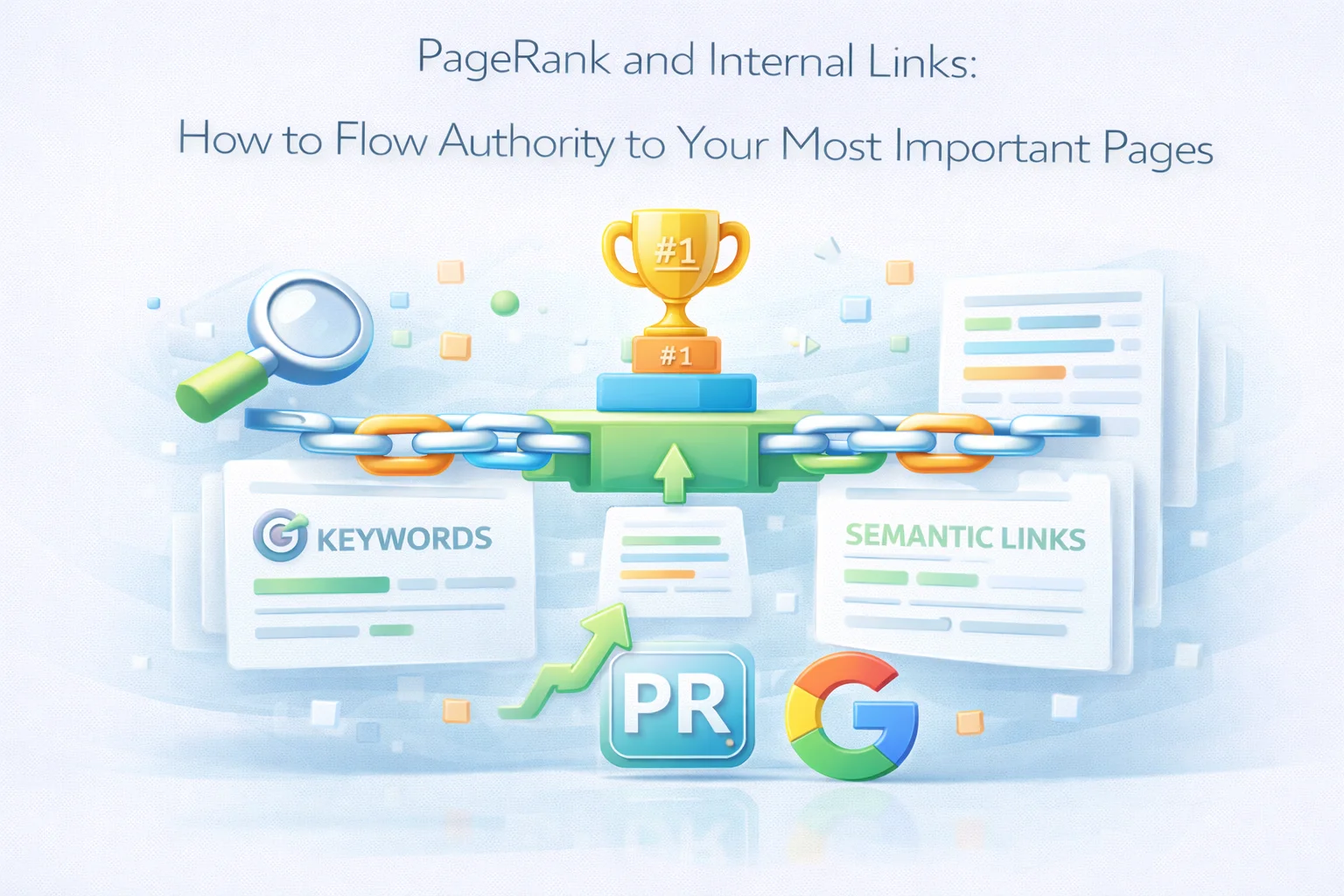
Google confirmed in multiple public statements that PageRank, in evolved forms, remains part of their ranking system. More importantly, internal links are the mechanism through which you actively control how PageRank distributes across your site. Unlike external backlinks, which you can influence but not directly control, internal link structure is entirely within your hands. Every architectural decision you make about which pages link to which is a decision about authority flow.
This guide explains the PageRank mechanism clearly, the practical rules that govern how authority flows through internal links, the specific architectural patterns that concentrate authority on your most important pages, and how tools like Nexu Link Brain implement these principles automatically through pillar page priority routing.
PageRank was invented by Larry Page and Sergey Brin as the foundational algorithm for determining the importance of web pages. The core idea is elegant: a page is important if important pages link to it. The importance of a page is calculated iteratively based on the importance of every page that links to it, weighted by how many links those source pages have outgoing.
The misconception that PageRank no longer matters arose partly from Google discontinuing the public PageRank Toolbar score in 2016, and partly from Google’s messaging around newer ranking factors. Neither of these things means PageRank is gone. They mean the public-facing number is gone and that PageRank is now one signal among many rather than the single dominant one it was in Google’s early years.
The modern version of PageRank is more sophisticated than the original formulation. It operates alongside hundreds of other signals, it is calculated in real time rather than periodically, and it incorporates quality signals that the original algorithm did not consider. But the fundamental principle remains: pages that receive more links from stronger pages rank better than pages that receive fewer links from weaker pages, all else being equal.
The “all else being equal” qualifier is important. PageRank cannot compensate for poor content quality or technical problems. But in the competitive middle of search results, where many sites have similar content quality and similar external link profiles, PageRank distribution through internal links is often the decisive differentiating factor. Sites that manage it deliberately consistently outperform similar sites that leave it to chance.
Understanding these four rules is the prerequisite for making deliberate decisions about internal link architecture. Each rule has a direct implication for how you should structure your site’s linking.
When a page has 10 outgoing links, its PageRank is split 10 ways. When it has 100 outgoing links, its PageRank is split 100 ways. Each individual link receives a tenth of what it would if the page had only 10 links. This is why pages with enormous navigation menus, bloated sidebars, and excessive footer links pass very little PageRank through any individual contextual link, even if the page itself has significant authority.
A page that receives many incoming links accumulates PageRank, and then distributes that accumulated PageRank through its own outgoing links. This creates the cascading effect: a page linked from your homepage, your most shared posts, and several high-traffic category pages has significant PageRank to pass to pages it links to. A page with no incoming links has almost none to pass, regardless of the quality of its content.
The original PageRank formulation includes a damping factor, approximately 0.85, that represents the probability that a theoretical user following random links would continue clicking rather than stopping. At each hop, the PageRank that passes is multiplied by this damping factor. A page three links from the homepage receives significantly less PageRank than a page one link from the homepage, even if the path between them is direct. This is the click depth problem expressed mathematically.
If a page has three different links to the same destination, Google counts the first link and discounts the redundant ones. You are not tripling the PageRank passed to the destination by having three links. You are consuming additional link slots on the source page without multiplying the benefit. This means internal link efficiency requires spreading links across different valuable target pages rather than concentrating multiple links to the same target from the same source.
Most sites are not just failing to direct PageRank effectively. They are actively wasting substantial amounts of it through structural patterns that bleed authority into dead ends or toward pages that do not benefit from it. Understanding these waste patterns is essential before optimizing for deliberate flow.
Category pages with 10 or 20 paginated archive pages, all linked from the main category page, distribute PageRank across those pagination pages rather than concentrating it on the individual post pages that actually rank. The post on page 3 of your blog archive receives a fraction of the PageRank a post linked directly from your homepage would receive.
WordPress sites commonly have internal links to tag pages, date archives, author pages, and category combinations. These pages consume PageRank without generally ranking for anything valuable. They function as authority sinks: PageRank enters them from content pages that link to tags, and then dissipates across hundreds of low-value archive URLs that are crawled and indexed but never contribute to meaningful rankings.
When groups of posts link to each other but are not connected to the rest of your site through links from high-authority pages, the PageRank within that cluster circulates internally but never receives substantial fresh authority from outside. These isolated clusters have low effective PageRank compared to pages connected to your main authority hubs, even if the cluster itself is well-linked internally.
Every page on your site has navigation that typically contains 8 to 20 links. That navigation appears on every page, which means every page is passing PageRank to 8 to 20 fixed destinations through navigation alone, before any contextual content links are considered. On a site with 200 posts and a 15-link navigation, those navigation links collectively consume the majority of the site’s PageRank flow capacity, leaving less for contextual links to high-value target pages.
Now that you understand how PageRank flows and where it is wasted, the architectural patterns that concentrate it productively become clear. There are four distinct patterns worth implementing, each suited to different pages and different competitive objectives.
Identify your three to five most important pages, the pages you most want to rank competitively for valuable keywords. These become your designated authority hubs. The architectural goal is to ensure that as many of your other pages as possible link to these hubs when topically appropriate. Over time, as more pages link to your hubs, those hubs accumulate internal PageRank from across your entire content archive. The effect is amplified if your hubs also appear in navigation, ensuring they receive PageRank from every page on the site.
Some of your most-linked pages are not necessarily the ones you most want to rank competitively. A popular viral post might have many external backlinks, making it highly authoritative internally, but it might not be a commercial page you want to rank. The authority bridge pattern involves linking from these high-authority “connector” pages to your target pages. The connector page bridges external authority into your internal link graph and channels it toward pages you have chosen as priority targets.
In a standard hub-and-spoke cluster, PageRank flows from spokes toward the hub. But spokes can also reinforce each other, amplifying the PageRank effect within the cluster. When cluster posts link to each other as well as to the pillar page, they become intermediate authority nodes. A well-linked cluster post that receives PageRank from multiple sources is now a miniature authority page within the cluster, and when it links to the pillar, it passes that accumulated authority forward.
Pages that are many clicks from your most authoritative pages receive diminished PageRank due to the damping factor. Creating direct links from your high-authority hub pages to important pages that were previously only reachable through deep navigation paths reduces their effective click depth and dramatically increases the PageRank they receive. This is one of the fastest ways to improve rankings for pages that have good content but are buried deep in your site structure.
Strategic PageRank management requires knowing which pages are currently authority-deficient and would benefit most from additional incoming internal links. There are three reliable diagnostic approaches.
In Google Search Console, filter your top keywords by average position and identify pages ranking between 4 and 15 for queries with significant search volume. These pages have demonstrated content quality sufficient to appear in search results, but they are not ranking at their potential. Pages in this range that have few incoming internal links are the most likely candidates to benefit from authority boosting. A page ranking 8 with 2 incoming internal links will often respond to additional internal links differently than a page ranking 8 with 30 incoming internal links.
The Link Distribution report in Nexu Link Brain shows you which pages have the most incoming links and which have the fewest. Pages that are strategically important (your service pages, product pages, or high-value cornerstone content) but appear in the “least linked” segment of the distribution are clear priority targets for internal PageRank investment. The contrast between how important these pages are to your business and how little internal authority they currently receive tells you where the biggest opportunity lies.
For commercial sites, identify the pages that generate the most leads, sales, or sign-ups. Then check how many internal links point to each of those pages. In most cases, you will find that your highest-converting pages are not your most internally linked pages, because internal linking strategy is often managed separately from conversion optimization. Aligning the two by ensuring your highest-converting pages receive substantial internal PageRank is one of the most direct revenue-generating SEO improvements available.
The pillar page priority feature in Nexu Link Brain is, at its core, a PageRank routing tool. When you mark a page as a pillar page, you are telling the AI to apply a scoring bonus to that page when evaluating it as a link target in suggestions. Pages with the pillar flag are more likely to appear as suggested link targets when the relevance threshold is borderline, meaning that when the AI is deciding between two possible link targets with similar relevance scores, the pillar page wins.
Over a full bulk analysis of a 200-post archive, this bias produces meaningful differences in the authority distribution outcome. A pillar page that would have received 18 incoming internal links from a neutral analysis might receive 32 links after pillar designation, because the AI consistently tilted borderline decisions in its favor. Those 14 additional incoming links represent a substantial PageRank increase, especially if they come from posts with their own well-developed incoming link profiles.
The semantic component of the linking engine ensures this authority concentration happens through genuinely relevant connections rather than forced links. A pillar page only receives additional links if the AI can identify source posts with legitimate topical relevance to it. The pillar designation increases priority among relevant candidates; it does not force irrelevant links. This means the PageRank that concentrates on pillar pages is backed by topical relevance signals, not just raw link count, which is exactly the combination that produces the strongest ranking outcomes.
For sites targeting competitive keywords where content quality and external link profiles are similar to competitors, this kind of deliberate internal PageRank architecture is often the differentiating factor. The WordPress AI internal linking tool with pillar page authority routing makes this architecture achievable at scale without the manual analysis that would otherwise be required.
Nexu Link Brain’s pillar page priority system routes internal PageRank toward your most important pages automatically, building the authority concentration that competitive rankings require through semantically relevant connections across your entire content archive.







Hey, finally a clear explanation of PageRank!
Hey everyone, I just had to leave a review for this guide because it completely changed how I think about internal links. As a high school student working on a personal blog for my college applications, I always assumed SEO was just about keywords and backlinks
Hey everyone! As a therapist running my own practice website, I snagged this guide during a sale because SEO honestly feels like trying to solve a Rubik's cube blindfolded. the way it breaks down how internal links actually control authority flow was a really helpful I had no clue my "About Me" page might've been hogging all the link juice just because it's in every menu! That said, some of the technical stuff (like "damping factors" and "iterative calculations") had my eyes glazing over by page 5