Next-Level Code. Nexuvibe Style ...
Hrs
Min
Sec

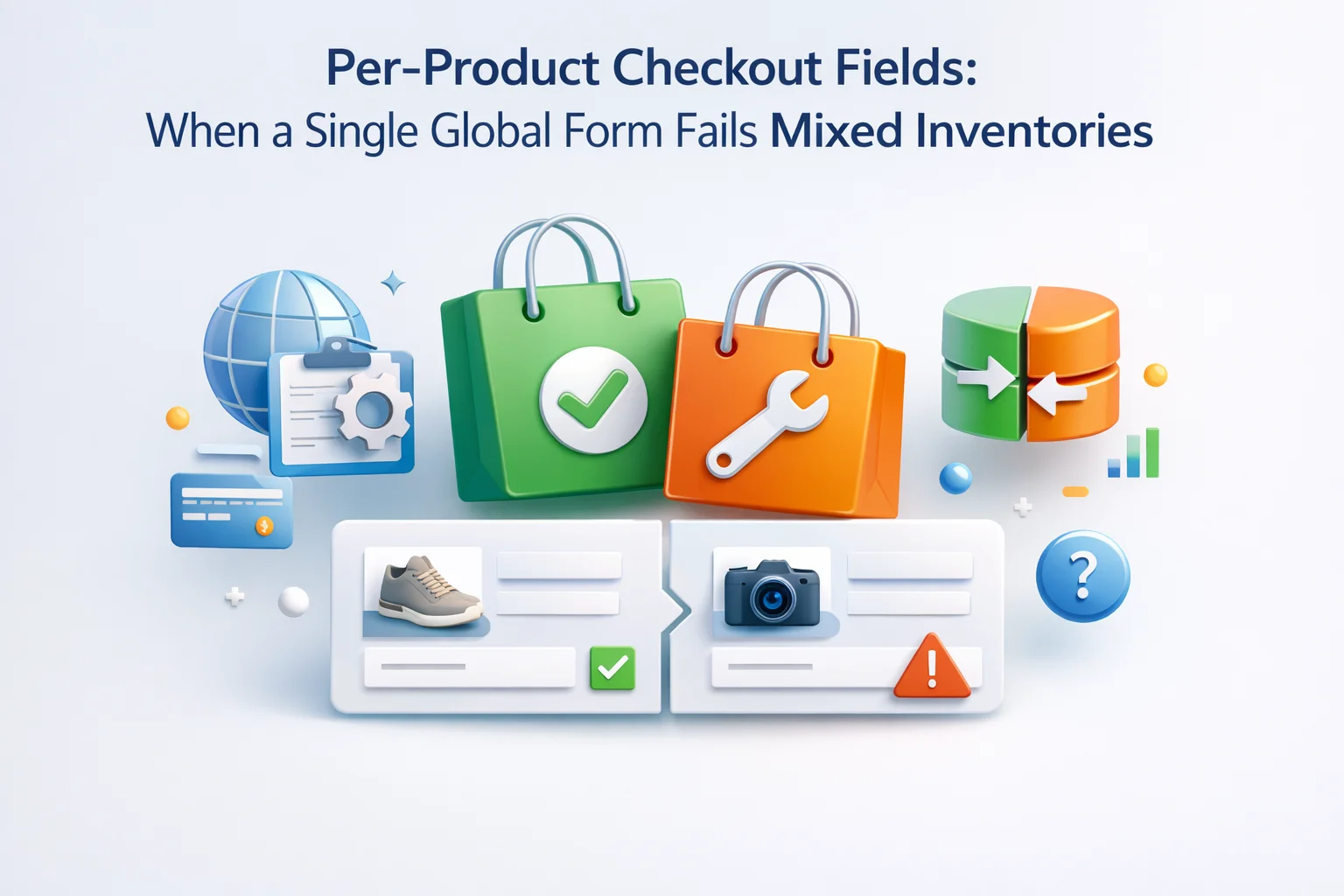
Retailers feel the pain as soon as they add a second product line. The jewelry case needs text for engraving; the candle bundle does not. A single global textarea labeled “special instructions” becomes a dumping ground for unrelated content, and your pickers stop trusting it. Structured, product-scoped prompts fix that by binding questions to the SKUs that actually need answers.
Mixed inventories also break reporting. Free-text blobs do not aggregate into useful dashboards. Per-product fields produce consistent meta keys per line type, which means exports to spreadsheets and ERPs stay interpretable. You trade a slightly more complex admin setup for dramatically cleaner operations data.
Advanced WooCommerce Checkout Field Editor for per-product checkout questions on mixed WooCommerce catalogs ties those prompts to product records so merchandising and fulfillment share one source of truth instead of duplicating instructions in spreadsheets.
The form still “works” technically while failing operationally. Watch for rising post-order emails asking for details you should have captured, increased cart abandonment right after custom prompts appear, and CSAT dips tied to “checkout felt long.” Another tell is internal workaround growth: staff maintaining parallel Google Forms because they no longer trust checkout data.
Analytics can hide the problem. Aggregate conversion may look flat because high-volume simple SKUs mask bleeding on long-tail lines. Segment completion rate by product category or by presence of personalization tags. If personalized goods trail by double digits, your global questions are probably punishing everyone for a subset of inventory.
Customer service transcripts are another signal. When agents repeatedly ask “what name did you want engraved?” after checkout, your capture step failed or was skipped. When they ask “did you upload the template?” the upload field was either invisible, optional when it should be required, or buried below the fold on mobile. Per-product prompts fix visibility by attaching questions to the SKUs that triggered them, so agents can predict what should exist on an order before they open it.
Marketing promos can temporarily distort catalog mix. A flash sale on customizable goods may spike the percentage of carts needing extra inputs. If your checkout was tuned for simple goods, that week will look like a conversion catastrophe unless you scoped fields correctly in advance. Monitor attach rate of personalization SKUs during campaigns and adjust hero landing pages to mention required steps upfront, not only in checkout fine print.
Merchandisers already think in SKUs. Attaching checkout prompts beside pricing and inventory means fewer handoffs between teams. When launch dates slip, field requirements update in the same place buyers already review. That proximity reduces the classic failure mode where marketing promises customization on the storefront but operations never hears about required inputs until launch day.
Field labels should reference the product in plain language customers understand. “Engraving text (max 20 characters)” beats “Line 1 meta.” Tie placeholders to realistic examples that match your brand voice. Remember WordPress internationalization guidance if you translate labels: short, unambiguous strings localize more reliably than clever marketing fragments.
Variations complicate copy. If only the gold variant allows engraving, say so in the label or tie the field to that variation explicitly. Shoppers blame the store when a field appears for a variant that cannot physically be customized, even if the factory knows the constraint. Precision in the admin saves refunds.
Bundle and composite products need explicit decisions: does personalization apply per bundle or per component? Document the answer beside the field definition. Otherwise customer service will interpret bundles differently from what your pick list prints.
Per-product fields should map to stable meta keys your warehouse software already understands. If operations expects `engraving_line1` but marketing creates `engraving_text` on a new SKU, integrations silently drop data. Publish an internal dictionary: human label, meta key, max length, allowed characters, and which pick list layout prints it. Update that dictionary when you launch categories, not when a picker complains.
File uploads deserve special scrutiny. Personalized prints and compliance documents may contain sensitive information. Define retention: how long files live on disk, who may download them, and how you redact them on refund. Per-product scope limits exposure by collecting uploads only when the triggering SKU is present, which is often cleaner than a global upload field every shopper sees.
For B2B lines, separate purchaser identity from ship-to identity explicitly. A product-level “department cost center” field may apply only to negotiated SKUs while retail shoppers never see it. That separation is difficult to express politely in a global form; it is natural when tied to contract catalog items.
When multiple specialized SKUs share a cart, shoppers should see a compact list of prompts grouped by line item or by topic, not a repeating wall of identical boxes. Decide your house style: either one combined section titled “Details for customized items” with sublabels, or clearly separated mini-forms per product. Consistency matters more than novelty; returning customers build muscle memory.
Set hard validation rules so incomplete personalization blocks checkout. Soft warnings create partial orders that production cannot fulfill. If a monogram is optional for some variants but required for others, encode that at the variation level rather than asking humans to remember exceptions during holiday volume.
Consider character limits that match manufacturing constraints. Allowing two hundred characters when your laser cutter accepts twenty invites refunds and redraws. Surface the limit in the label, in the placeholder, and in validation errors. Shoppers blame themselves less when constraints are obvious before they type.
Gift messages and personalization often collide. If both exist, make the distinction explicit: one field is machine-engraved text subject to font rules; the other is a human-readable gift note printed on packing slips. Mixing them in one free-text box produces sentimental messages sent to factory equipment and technical strings read aloud at gift tables.
If three ring sizes use the same engraving workflow, reuse one field definition via product category rules or cloned settings instead of maintaining three divergent copies.
Combine digital, personalized physical, and subscription lines if your store allows. Confirm the longest realistic path still reads finite on mobile.
Verify custom answers appear where warehouse tablets expect them. Beautiful checkout data that never reaches the floor is worthless.
Not every question belongs on the SKU. Age gates, market-wide disclaimers, and universal donation rounding are legitimately global. The art is choosing the smallest global layer that stays legally and operationally true, then pushing everything else down to products or categories. If you invert that stack, you train customers to ignore fields because most rows feel irrelevant.
Loyalty and newsletter opt-ins rarely deserve per-product attachment unless a specific SKU legally requires separate consent. Keep those prompts global and visually distinct from fulfillment questions so shoppers understand why they exist. Mixing marketing checkboxes between required manufacturing inputs erodes trust; people assume everything is mandatory.
Seasonal overlays such as holiday delivery cutoffs may apply storewide even though only some SKUs are gift-oriented. A short global acknowledgement with dates, plus per-product engraving questions, often beats duplicating the holiday text on every toy listing. Think in layers: legal and calendar context global, item specifics local.
Conditional logic based on cart contents can sometimes replace dozens of per-product clones. Use globals for wide rules (“show hazmat acknowledgment when any hazmat SKU is present”) and per-product rows for true one-offs (“upload stadium seating map for this event SKU”). Document the split so future staff do not duplicate logic in both layers.
When category-level rules would work but you lack clean category hygiene, fix taxonomy first. Per-product fields can paper over messy categories temporarily, yet that debt compounds. A quarterly category audit pays down confusion cheaper than hundreds of SKU-level exceptions that should have been one category rule.
Even when specialty prompts attach to products, your global skeleton still needs thoughtful sequencing. Lead with trust and shipping method selection for physical goods; lead with account email for digital-heavy funnels. Drag-and-drop editors let you reshape that skeleton without redeploying code, which matters when merchandising rotates seasonal collections weekly.
Think about tab order and screen reader announcements when you reorder. A visually logical stack that jumps keyboard users between billing and unrelated prompts is still broken. After each reorder session, tab through the form once with your eyes closed, or use your browser’s accessibility inspector, to confirm focus progression matches the story your labels tell.
Pair drag-and-drop changes with screenshot diffing for training docs. Support teams appreciate side-by-side before and after images embedded in the knowledge base. The incremental effort prevents weeks of confusion when a field moves from the second screen to the first.
Block-based checkout renders dynamic sections faster, which is both good and risky: shoppers notice extra prompts sooner. That makes per-product discipline more important, not less. Validate block layouts with realistic mixed carts and pay attention to how product-specific fields anchor relative to express payment buttons. Reference WooCommerce documentation on core shop pages when planning upgrades so cart and checkout endpoints stay aligned with your theme and block choices.
Express wallet buttons can shorten the path to payment. If product-specific fields appear below those buttons, some shoppers may authorize payment before completing required personalization. Test whether your field editor and gateway stack enforce server-side validation that rejects incomplete orders, and whether error copy points shoppers back to the right section without losing cart state.
Mobile block layouts sometimes collapse sections shoppers expect to see together. If engraving fields detach visually from the line item they reference, add helper text that repeats the product name in the field label. Redundancy beats ambiguity at checkout.
Before you announce a new assortment, run a scripted checkout rehearsal. Add the hero SKU, complete personalization, pay with a test gateway, and open the order in admin while someone from fulfillment watches. Misaligned labels or missing meta stick out immediately in that setting. Waiting for the first customer order turns every launch into a fire drill.
Capture screenshots of the checkout path for internal training. Retail staff answering phones should recognize what customers see when they ask “where do I type the jersey number?” If staff only know the old global textarea location, service quality drops the week you migrate.
Schedule a thirty-day review after launch. Real shoppers surface edge cases—emoji in engraving text, all-caps messages that overflow pick lists, file types you forgot to block. Feed those findings back into validation rules and helper copy. Per-product fields make iteration manageable because changes touch only the SKUs in scope.
Test gateway, realistic cart, mobile width, file upload virus scan policy if applicable.
Sample ten orders weekly for data completeness until error rate flatlines.
Franchise and multi-store operators often want eighty percent shared configuration and twenty percent local overrides. Export global field order as JSON, import to new properties, then layer per-product prompts in each catalog. Without exports, every launch repeats manual clicking and introduces subtle drift between regions.
Version control friendly workflows treat JSON like infrastructure. Store exports in git with tickets referencing why the file changed. Rollback becomes a revert, not a panic edit during peak sales.
When cloning to a new region, revisit legal copy and field requirements independently of the JSON. GDPR, age restrictions, or invoice fields may differ even if product photos look identical. Treat exports as a mechanical starting point, not permission to skip localized legal review.
Agencies should package “catalog playbooks” with exports: which product categories receive which field templates, how to duplicate a template safely, and how to remove obsolete prompts when SKUs retire. Without that narrative, clients inherit JSON they do not understand and eventually break it with ad hoc tweaks.
Mixed inventories punish one-size-fits-all checkout. Per-product fields let you keep the default journey lean while still collecting structured data for the SKUs that need it. Pair scoped prompts with sensible global baselines, conditional rules where they reduce duplication, and exports so your configuration scales beyond a single admin session. The payoff is not only conversion; it is also a calmer operations floor where pickers trust what they read on every line.
Advanced WooCommerce Checkout Field Editor as a mixed-catalog WooCommerce checkout field toolkit gives merchandisers product-level control without forcing every shopper through questions meant for someone else’s cart. That alignment is the difference between a catalog that scales and a checkout that buckles under its own SKUs.






Hey! can it handle orders where just a
So if my store sells custom jewelry and regular candles, how do I make the engraving field pop
I've been using this for a few weeks now and it's solved a lot of headaches with our mixed inventory. One thing I'm still figuring out when we run flash sales on customizable items, the extra fields pop up as expected, but is there a way to temporarily suppress them for non custom products in the same cart?
This saved us so many hours on engraving.