Next-Level Code. Nexuvibe Style ...
Hrs
Min
Sec

Imagine two restaurants side by side on the same street. Identical menus, identical prices, similar decor. One has people inside, conversations audible through the window, a small queue at the door. The other is empty. A stranger walking past with no prior knowledge of either place will almost always choose the busy one. Not because they have evaluated the food. Not because anyone recommended it. Simply because people are already there, and that fact alone is a powerful enough signal to follow.
WordPress comment sections work on exactly the same psychology. A page with an active discussion draws participation in a way that a silent page simply does not. The presence of other voices lowers the psychological cost of adding your own. The conversation is already happening. All you have to do is join it. But on a page with no comments at all, you would have to start the conversation yourself, and most people will not do that, even if they have something worth saying.
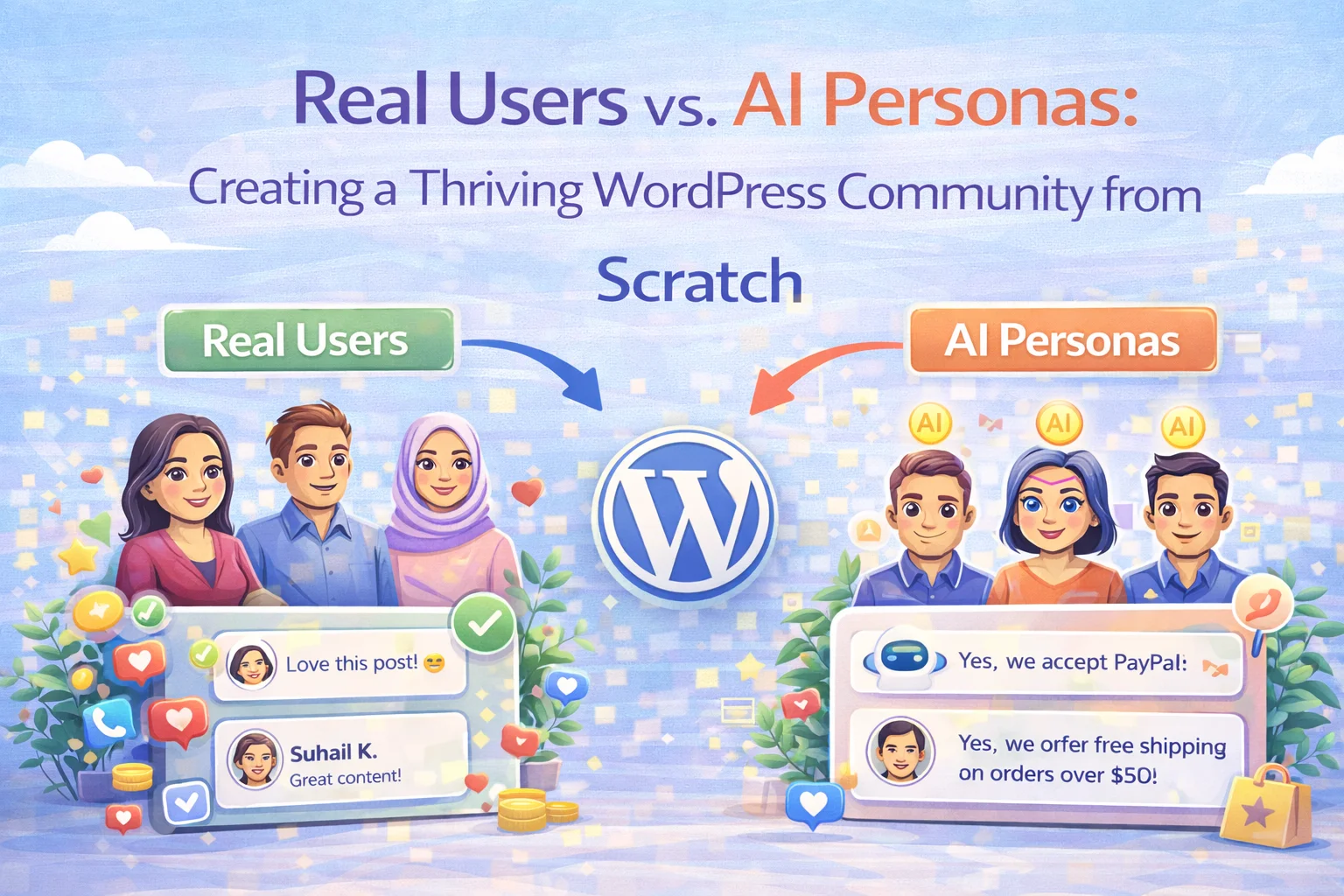
This guide is about understanding that psychology deeply enough to use it strategically. It covers why communities need a spark to start, how AI personas can provide that spark without undermining authenticity, and how the Personas system in Nexu AI Comment Generator for WordPress community building gives you the tools to create discussions that real users genuinely want to join.
Social psychologists have studied the dynamics of group participation for decades, and one finding is remarkably consistent across contexts: people are dramatically more likely to participate in an activity when others are already visibly participating. This is not just about comfort or social proof in the marketing sense. It is a deeper behavioral pattern rooted in how we evaluate risk and relevance.
When you are the first person to speak up in a room, you carry the full weight of initiating. Your comment will be evaluated without any context of what others think. If it lands badly, there is no cover. If the topic turns out to be less interesting than you expected, you have committed visibly. Most people, even when they have a genuine opinion, decide the risk is not worth it and stay silent.
But when a conversation is already underway, the calculus changes entirely. Now you are responding, not initiating. Your comment has context. Other people have already committed, which means the topic is clearly worth engaging with. There are positions on the table that you can agree or disagree with, which makes it easy to know what to say. The activation energy required to participate drops dramatically.
The goal of an AI persona strategy for WordPress community building is to move your pages from the first state to the second as quickly as possible, so that real user participation can carry it naturally to the third. The personas are not the destination. They are the mechanism that gets you past the activation energy barrier that stops communities from forming in the first place.
Not all AI-generated comments trigger real user participation. The ones that sit inert in your comment section, generating no follow-on engagement, share a common flaw: they are bland. They state an opinion without enough specificity or edge to provoke a response. They occupy space in the comment section without creating any conversational gravity.
A well-built AI persona does the opposite. It has a point of view. It expresses that point of view in a way that is recognizable and specific enough that a real reader knows exactly whether they agree or disagree. It uses vocabulary and references that are authentic to the type of person the persona represents. And crucially, it leaves something open. A question, a half-acknowledged counterpoint, an assertion that invites challenge.
The second comment does several things simultaneously. It acknowledges a positive, which makes it credible. It raises a specific frustration, which gives anyone who shares that frustration a reason to respond. It ends with a direct question, which is an explicit invitation to reply. And it introduces the word “workarounds,” which any experienced user of whatever is being discussed will immediately want to either confirm, correct, or add to. That is a comment that generates engagement. The first one is a comment that closes a conversation before it begins.
Of all the persona dynamics you can create in a comment section, the one that most reliably triggers real user participation is the presence of two opposing perspectives on the same subject. A critic and an advocate for the same product, service, or idea, both represented with specificity and genuine reasoning, creates exactly the kind of conversational tension that makes sitting on the sidelines feel genuinely difficult.
When a real visitor arrives at a page and sees that two people have already staked out positions, something compelling happens. They immediately know where they stand. They agree with one side, or they disagree with both, or they think the debate is missing the actual point. Any of these reactions is strong enough to motivate a comment. The barrier is gone because taking a side is easy when sides already exist.
What makes this dynamic work so well is that it mirrors exactly what happens in real communities when people care about a subject. Genuine disagreement, expressed respectfully and with specific reasoning, is the most engaging kind of content. It is what keeps people reading comment threads long after they intended to leave the page. And it is what makes them want to add their own voice, because they have something to say that neither of the people already talking has said yet.
The critic-advocate exchange does not just encourage participation. It creates a permission structure for real users to have the same debate. Once that structure exists in the comment section, a real visitor who has mixed feelings about the product or topic, which is most people, has a natural place to land. They can agree with the critic, agree with the advocate, or introduce a third perspective that both are missing. Any of those is a genuine contribution to the community you are building.
The Personas tab in Nexu AI Comment Generator is where the character of each AI commenter is defined. This is not just a name field and a profile picture. It is a configuration layer that shapes how the AI writes for each persona: the vocabulary it reaches for, the level of technical detail it includes, the emotional register it operates in, and the types of opinions it tends to express.
When building personas for the critic-advocate dynamic specifically, the goal is contrast without caricature. Your critic should not be someone who hates everything. Your advocate should not be someone who is blindly enthusiastic. Both should read as real people with real reasoning behind their positions, because that is what makes real users want to engage with them rather than dismiss them.
Give your critic a background that explains why they have high standards. A software engineer reviewing a plugin. An experienced cook reviewing a kitchen tool. A long-time blogger reviewing a WordPress theme. The specificity of their background makes their criticism land as informed rather than arbitrary. In the persona configuration, define their expertise level as high, their communication style as analytical, and their sentiment tendency as balanced-to-critical rather than negative.
Your advocate needs to be enthusiastic without sounding like a testimonial. Give them a use case that explains why this particular product or article solved a specific problem for them. Their enthusiasm should be grounded in specifics: not “this is great” but “this solved the exact problem I had with X.” In the persona configuration, define them as warm in tone, practical in focus, and inclined toward sharing tips and personal context in their comments.
The most powerful thing you can add to a two-sided debate is a third voice that reframes the conversation. A neutral persona that steps back and says “I think you are both right, but the real question is…” opens a new dimension that makes even more people want to contribute. This persona tends to be curious rather than opinionated, asks broad questions, and often introduces a consideration that neither side has addressed. Real users who find the critic-advocate debate too binary are drawn specifically to this kind of comment.
The order and timing of your persona comments matters as much as their content. A community-building campaign is not a collection of disconnected comments. It is a staged conversation, and the staging determines how much pull it has on real visitors who encounter it at different points.
The goal of the entire persona strategy is to reach a point where real user participation becomes self-sustaining. You will know you are getting close when you start seeing specific patterns in your comment section that are distinct from anything the AI personas would generate on their own.
When visitors start replying to other visitors rather than just to the original post, the community dynamic has shifted from parallel monologues to actual conversation. This is the signal you have been working toward. The AI personas created the conditions. Real people are now doing the work.
Real users bring their own language to a conversation. When you start seeing terminology in the comment section that did not appear in either the original post or any of the AI-generated comments, that is genuine community knowledge being contributed. It is also, from an SEO perspective, exactly the kind of organic vocabulary expansion that makes a page’s topical footprint grow.
When real users start asking questions or raising topics that relate to the page’s subject but were not part of the original discussion, the community has outgrown the scaffolding and is generating its own directions. This is a healthy sign. It means the page has become a genuine destination for the topic, not just a container for your content.
When you reach this point, the role of your AI persona campaigns shifts from seeding to maintenance. You can reduce the volume and frequency of new persona comments and let the real user activity carry the freshness signal. The auto reply feature in Nexu AI Comment Generator handles incoming questions automatically, so no real user comment goes unanswered even when the persona drip campaign is winding down.
The restaurant analogy from the beginning of this guide has a conclusion. Eventually, the restaurant fills up with regulars who come back not because they saw a queue but because they had a great experience the first time and told their friends. The initial queue, the artificial social proof that drew them in that first time, becomes irrelevant. The community sustains itself. That is what you are building toward. And the persona strategy is how you get there without waiting years for organic momentum to do the work on its own.
Create distinct AI personas with real voices and real perspectives. Stage the critic-advocate exchange that lowers every visitor’s participation threshold. Then watch real users take the conversation somewhere you did not plan.







Hey everyone, just had to share how this guide completely changed my approach to getting engagement on my practice's WordPress site. i'd been struggling for months to get patients or really anyone to leave comments on our dental health blog posts. we'd get a few here and there, but mostly just silence
Got this guide after my trucking forum's comment section stayed dead for months. Figured if two identical diners can have one packed and one empty just because of crowd psychology, maybe my site had the same issue. the part about AI personas acting as the "first voice" to break the silence? Nailed it. added a couple bots as regulars one playing devil's advocate, another backing up solid points and real drivers started chiming in within a week. no more crickets. Works like a CB radio: someone's gotta key up first before others join in
As a single parent running a small blog, I was worried no one would engage but the AI personas feature totally changed that. Setup took minutes, and suddenly my comment section looked alive with real readers joining in
This guide talks a big game but mostly just gives vague psychology lessons. I was looking for real, actionable steps to build a community not weird restaurant analogies. felt like a waste of time.