Next-Level Code. Nexuvibe Style ...
Hrs
Min
Sec

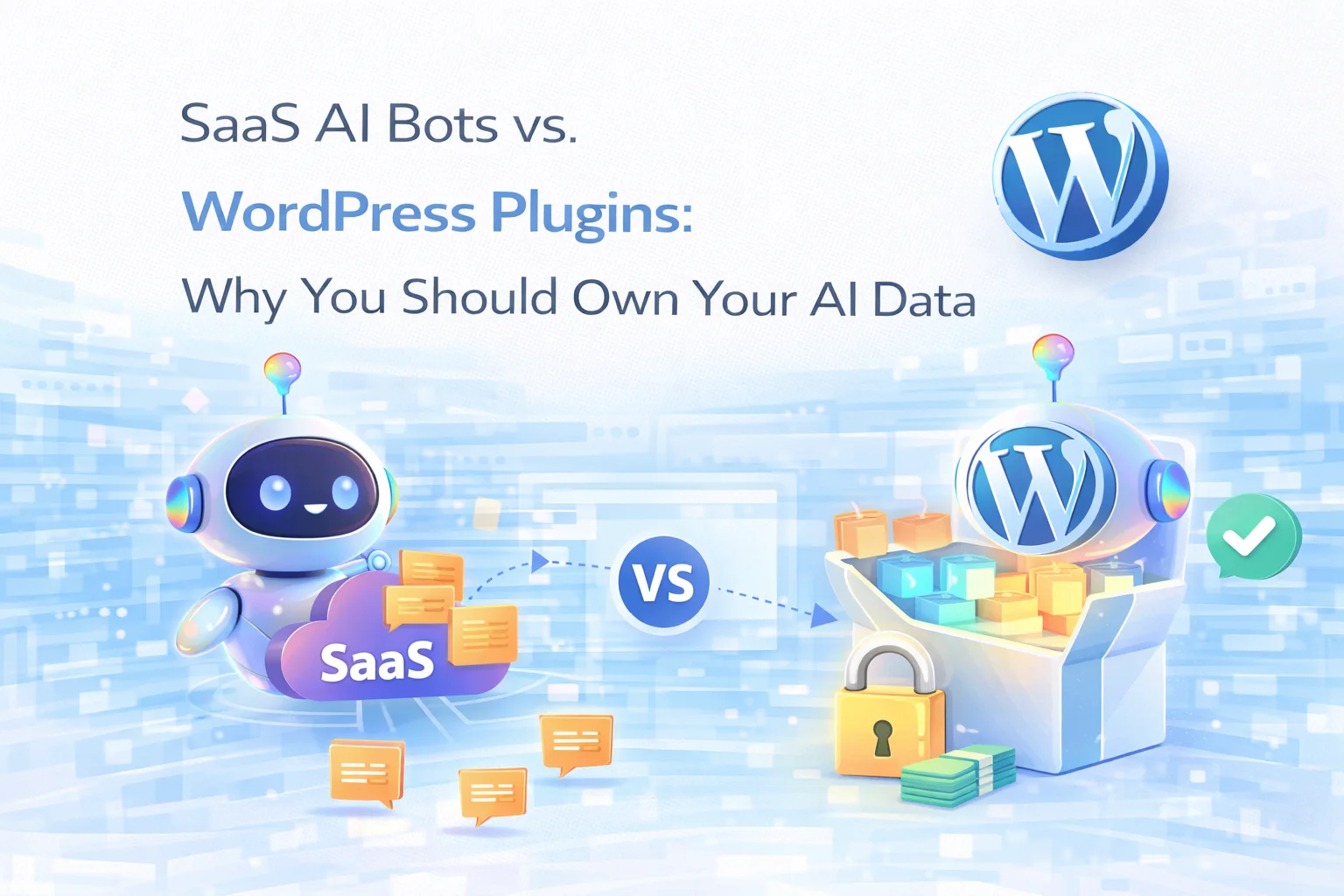
When you sign up for a SaaS AI chatbot service, you are making a decision that goes well beyond which features appear on your pricing tier. You are deciding who owns the memory of every conversation your visitors have ever had with your business. You are deciding where your product knowledge lives. You are deciding what happens to your customer interaction data if you ever stop paying — or if the service raises its prices, changes its terms, or simply shuts down.
Most WordPress business owners do not think about this when they sign up for a chatbot platform. They think about the feature list, the monthly price, and how quickly they can get something live. The data ownership question does not feel urgent until something goes wrong — a price increase that doubles the cost overnight, a company acquisition that changes the privacy policy retroactively, or a shutdown that wipes eighteen months of refined knowledge base work in an afternoon.
This guide is about what a WordPress AI chatbot solution should actually give you in terms of data control — and why the honest answer in 2026 is that a self-hosted WordPress plugin beats a SaaS platform on every dimension that matters for long-term business health.
We will cover what data SaaS platforms take from you, what the real cost comparison looks like, and why Nexu SmartChat Assistant Plugin with Auto-Indexing & RAG is the architecture that keeps your customer intelligence where it belongs — on your own server.
The data ownership issue with SaaS AI platforms is not usually hidden — it is just buried in terms of service that nobody reads before signing up. Let us be specific about what data leaves your control the moment you connect a third-party chatbot to your WordPress site.
The most obvious category is conversation history. Every question your visitors have asked and every answer your bot gave — this is a detailed record of what your customers care about, what confuses them, and what language they use to describe their problems. For a WooCommerce store, this is competitive intelligence you generated through your own traffic. On a SaaS platform, it lives on their servers, subject to their retention policies, accessible to their engineers, and gone the moment you cancel.
Beyond content, there is visitor data. IP addresses, session information, the pages visitors were on when they started a chat, how long conversations lasted. For any business operating under GDPR, this creates a formal data processing relationship with the SaaS provider — one that requires a Data Processing Agreement and subjects your visitors to a third party’s privacy practices alongside your own.
And finally, there is control. On a SaaS platform, the AI model, the guardrails, the safety filters, and the response logic are all determined by the provider. When they update their underlying model, your bot’s behaviour changes — sometimes subtly, sometimes significantly — without any input from you. You are not running an AI system. You are renting time on someone else’s.
Picture this: you have used a SaaS chatbot for eighteen months. You started with a basic knowledge base and refined it over dozens of iterations based on actual visitor conversations. You built a system prompt that reflects your brand voice precisely. You tuned the responses to handle the ten questions your customers ask most often. The bot works well. It handles support load. Your team trusts it.
Then the platform raises its price by 60%. Or gets acquired. Or changes its data policy in a way your legal team cannot accept. You decide to leave.
Conversation history · Knowledge base vectors · Visitor analytics · Refined system prompt
Your conversation history stays on their servers — subject to their deletion schedule, not yours. The knowledge base you built exists as embeddings on their infrastructure and cannot be exported in any useful form. The visitor analytics that showed you which questions were most common is gone. You start from zero, with nothing to show for eighteen months of work except what you can remember and reconstruct.
RAG on your server · Your API key · Your database · No SaaS middleman
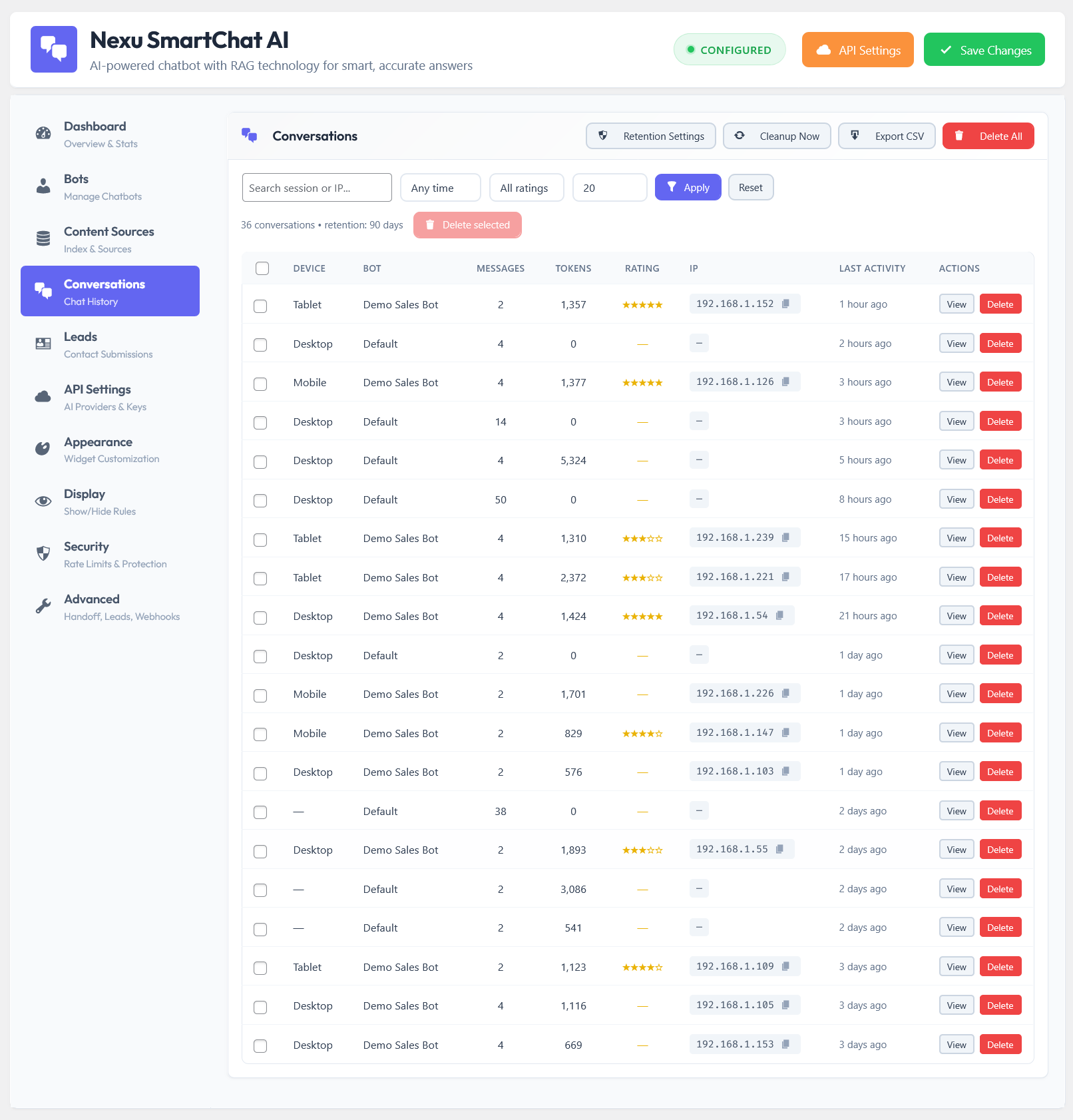
With SmartChat, the vector knowledge base is stored in your WordPress database. The conversation logs are stored in your WordPress database. The configuration, the system prompt, the analytics — all in your WordPress database. The only external connection is the direct API call from your server to your chosen model provider using your own API key. If you ever stop using the plugin, everything stays in your WordPress installation.
The pricing page never tells the full story. It tells you the cost at the conversation volume that makes the entry price look attractive. As your traffic grows — which is supposed to be the goal — the cost grows with it. At scale, the difference between a SaaS chatbot and a self-hosted WordPress AI plugin is not marginal. It is the difference between a growing monthly expense and a fixed one-time cost.
| Monthly conversations | Typical SaaS chatbot | SmartChat + GPT-4o mini API | Annual saving |
|---|---|---|---|
| 500 / month | $49–$79 / mo | ~$1.00 API + $89 one-time | $480–$924 / year |
| 2,000 / month | $99–$199 / mo | ~$4.00 API + licence | $1,140–$2,340 / year |
| 10,000 / month | $299–$599 / mo | ~$20 API + licence | $3,348–$7,068 / year |
API cost estimated at GPT-4o mini rates (~800 tokens per conversation). SaaS pricing based on publicly listed rates across major chatbot platforms in 2026. The plugin licence is a one-time cost not counted again after year one.
Here is what you actually get when you install Nexu SmartChat Assistant Plugin with Auto-Indexing & RAG on your WordPress site — and why each of these features only works the way it does because the architecture is self-hosted.
SmartChat auto-indexes your WordPress content — product pages, WooCommerce products, posts, custom post types, FAQs — and stores the resulting vector embeddings directly in your database. The indexing updates automatically when you publish new content. You own the knowledge base completely, permanently, and independently of any subscription.
Every chat transcript is stored in your WordPress database and visible in the SmartChat admin panel. Read them, search them, export them. They reveal which questions your customers ask most, where they get confused, and what information gaps exist in your content — none of which you can access on a SaaS platform without paying for analytics add-ons.
SmartChat connects to OpenAI, Anthropic Claude, Google Gemini, or Mistral using your own API key. Your requests go directly from your server to the model provider — SmartChat does not proxy them through its own infrastructure. You pay model-provider rates with no SaaS markup. When a better model comes out, you switch by changing a dropdown.
SmartChat loads its admin and indexing functionality in the WordPress backend. The chatbot widget itself loads asynchronously on the frontend with no blocking scripts. Your page speed scores are completely unaffected — unlike third-party SaaS embed scripts that load external JavaScript from foreign servers on every page view.
One licence covers your entire site regardless of conversation volume. The only cost that scales with usage is the direct API cost to your model provider — and at GPT-4o mini rates, that cost is a fraction of what any SaaS platform charges per conversation. As your traffic grows, your chatbot cost stays essentially flat.
| Feature | SmartChat (self-hosted) | SaaS chatbot platforms |
|---|---|---|
| Conversation data | Your WordPress database | Provider’s servers |
| Knowledge base after cancellation | Stays in your database | Provider retains or deletes |
| Pricing model | One-time licence + direct API | Monthly subscription, scales with volume |
| AI model choice | OpenAI, Claude, Gemini, Mistral | Locked to provider’s model |
| GDPR data processing | Your server, your jurisdiction | Third-party DPA required |
| Behaviour changes without notice | Never — you control updates | Yes — model rollouts change responses |
| Frontend page speed impact | Zero | External JS loaded on every page |
| Risk if provider shuts down | None — runs on your server | All data and configuration lost |
The only category where a SaaS platform has a genuine advantage is onboarding speed for non-WordPress sites — where a self-hosted plugin is not an option anyway. For WordPress, the architectural advantages of self-hosting are unambiguous.
The choice between SaaS and self-hosted AI is not a technical decision for most WordPress businesses. It is a question of whether you want to build an asset — a knowledge base and conversation history that belongs to your business and compounds in value over time — or rent access to a service that you have no leverage over and no way to take with you.
Nexu SmartChat Assistant Plugin with Auto-Indexing & RAG is the architecture that treats your AI chatbot as a business asset, not a subscription. Your data on your server, your API key, your knowledge base — permanently. That is what data ownership looks like for a WordPress business in 2026.
RAG knowledge base in your database. Conversation logs on your server. Any AI model via your own API key — OpenAI, Claude, Gemini, Mistral. One-time licence, zero per-conversation fees, zero SaaS dependency. Your chatbot. Your data. Permanently.


I just had to say this article really opened my eyes about data ownership with AI chatbots. I've been using one of those SaaS bots for months and honestly never even thought about who owns the conversation logs or what happens if I cancel my subscription. That part about potentially losing 18 months of refined knowledge base work? Ouch that hit way too close to home. definitely got me seriously reconsidering whether I should self host on WordPress instead of trusting some third party service that could change the rules or disappear anytime.
Hey everyone, I've gotta be honest I'm pretty let down. I bought this expecting full control over my chatbot data, only to find out it's all stored on their servers instead of mine. If they decide to change the terms or jack up prices tomorrow, what happens to years of my customer conversations? It's like I'm just renting my own business knowledge, and that doesn't sit right with me. I really wanted a self hosted option where I actually own the data. You'd think that wouldn't be so hard to come by these days
Hey, quick question how does the bot handle chat history if I switch hosts?