Next-Level Code. Nexuvibe Style ...
Hrs
Min
Sec

For nearly twenty years, internal linking tools worked the same way. You defined a keyword, and the tool found every instance of that keyword across your site and turned it into a link. Simple, mechanical, and fundamentally limited. These tools could not understand that running shoes, jogging footwear, and sneakers for exercise all refer to the same concept. They matched strings of characters, not meanings.
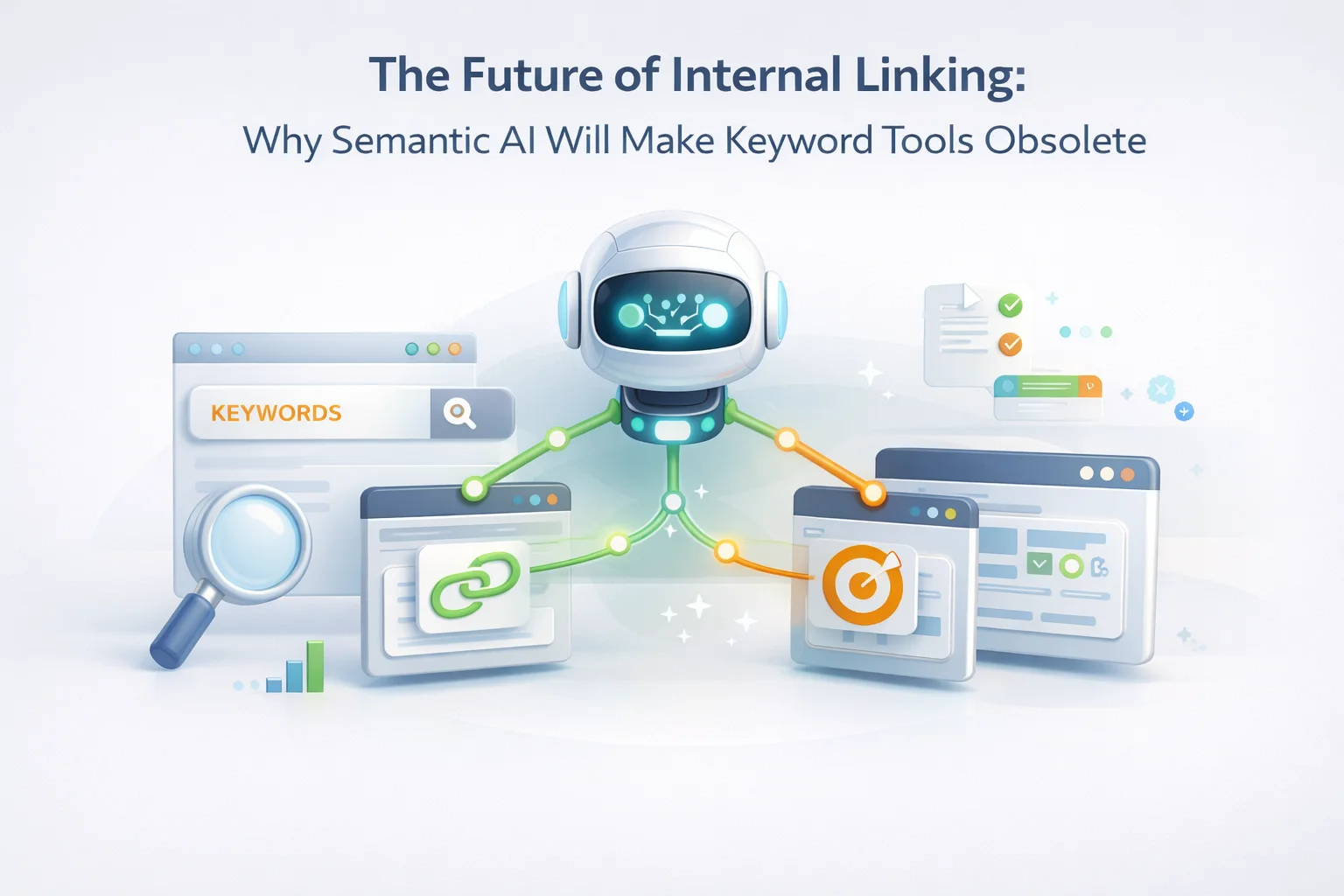
That era is ending. The same AI technology that powers modern search engines, the technology that lets Google understand what you mean rather than just what you type, is now available for internal linking. Semantic AI reads your content the way a human would, understands the concepts and topics each page covers, and identifies relationships that keyword matching would never find.
This shift has profound implications for how WordPress site owners should approach internal linking. The tools that served you adequately for years are becoming obsolete, replaced by systems that understand your content at a conceptual level. This analysis explains exactly how semantic AI differs from keyword matching, why that difference matters for your search rankings, and how to implement semantic AI internal linking on your WordPress site before your competitors do.
Traditional internal linking tools operate on a simple principle: you give them a keyword, they search your content for exact or partial matches of that keyword, and they create links wherever matches are found. This approach is essentially a find-and-replace operation applied at scale.
The limitations become obvious when you think about how language actually works. Consider a site about personal finance. You might have an excellent article about building an emergency fund. A keyword-based tool would link to it when you mention emergency fund elsewhere on your site. But what about when you write about financial safety nets, rainy day savings, or cash reserves for unexpected expenses? These all refer to the same concept, but they use different words. The keyword tool misses all of them.
The problem compounds as your site grows. You might have dozens of pages that should logically connect to each other, but because they were written at different times by different people using different vocabulary, keyword matching never links them. Your site becomes a collection of isolated content clusters instead of an interconnected knowledge base.
Semantic AI approaches content completely differently. Instead of looking for matching strings of text, it builds a mathematical representation of what each page means. This representation, called a vector embedding, captures the concepts, topics, and relationships within the content in a form that allows comparison across your entire site.
Think of it this way: keyword matching asks does this exact word appear? Semantic understanding asks what is this content actually about, and what other content on this site discusses related concepts? The difference is fundamental. One operates on surface-level text patterns. The other operates on meaning.
A vector embedding converts a piece of text into a list of numbers, typically hundreds or thousands of them. Each number represents some aspect of the text’s meaning. When two pieces of content are semantically similar, their vectors will be numerically similar, even if they use completely different words. This is how AI knows that retirement planning and saving for your golden years are related concepts without needing them to share any keywords.
Once every page on your site has been converted to a vector embedding, comparing them becomes a mathematical operation. The AI can instantly calculate how similar any two pages are in terms of meaning. It can rank every page on your site by how topically related it is to any given page. This allows the system to find the most relevant link targets for any piece of content, regardless of vocabulary overlap.
Semantic AI does not just find where links should go. It generates contextually appropriate anchor text that fits naturally within the source content. Because the AI understands both the source page and the target page, it can create anchor text that accurately describes the relationship while varying naturally across different link placements. This eliminates the over-optimization risk that comes with repetitive exact-match anchors.
The difference between keyword matching and semantic understanding becomes concrete when you look at actual examples. These are not theoretical edge cases. They represent the kinds of connections that exist on virtually every content-rich website but remain invisible to keyword-based tools.
A business blog has articles about customer churn, client retention strategies, and reducing subscriber cancellations. These are all the same topic expressed in different industry terminology. A keyword tool would need separate rules for each phrase. Semantic AI recognizes them as the same concept and links them appropriately regardless of vocabulary.
A tech site has an article describing common WordPress security vulnerabilities and another reviewing security plugins. These pages should obviously link to each other, but they share almost no keywords. One discusses problems, the other discusses solutions. Semantic AI understands this relationship and creates the connection that keyword tools cannot see.
A cooking site has a recipe for weeknight chicken dinner and an article about meal planning for busy families. The recipe never mentions meal planning, and the planning article does not include recipes. But the semantic overlap is obvious: both serve readers who need quick, family-friendly food solutions. Semantic AI identifies this shared audience intent and links accordingly.
An e-commerce site sells both standing desks and ergonomic keyboards in different categories. A blog post about preventing repetitive strain injury relates to both product categories conceptually, but shares no keywords with either. Semantic AI understands the health and ergonomics connection and can link from the article to both product categories naturally.
These examples illustrate why semantic internal linking produces fundamentally better results than keyword matching. Every connection that keyword tools miss is a connection that search engines can make. When your internal linking reflects the same semantic understanding that Google uses to interpret your content, you signal topical coherence and expertise that search algorithms reward.
Google has invested billions of dollars in understanding content semantically. Their BERT and MUM models parse the meaning of queries and documents, not just the words they contain. When Google evaluates your site, it understands the topical relationships between your pages. If your internal linking reflects those same relationships, it confirms and reinforces Google’s understanding of your content structure.
Conversely, internal linking that misses obvious semantic connections creates a disconnect. Google sees that your page about retirement planning should connect to your page about investment strategies, but your internal links do not make that connection because neither page uses the exact keywords you configured. This mismatch signals to Google that your site structure is not as coherent as it could be.
The practical implication is straightforward: your internal linking should match how search engines understand your content, not how keyword tools parse your text. Since search engines use semantic understanding, your internal linking needs to be semantic too. Tools that understand meaning outperform tools that match strings.
Moving from keyword-based to semantic internal linking does not require rebuilding your site or discarding your existing content. The transition is primarily about the tools you use to manage internal links and the mindset you bring to content relationships.
Before adding semantic links, understand what you already have. Map your current internal link structure to identify which connections exist and which are missing. Look specifically for pages that should logically connect but currently do not. These gaps represent the immediate opportunity that semantic linking will address.
Replace or supplement your keyword-based linking tools with a WordPress internal linking plugin that uses semantic AI for content analysis. The tool should index your content into vector embeddings, identify semantic relationships, and generate contextually appropriate anchor text. Look for tools that support multiple AI providers so you can choose the model that works best for your content.
Process your entire content library through the semantic analysis. This builds the vector index of your content and allows the AI to identify all the relationship opportunities across your site. The initial bulk analysis will likely surface many connections that your keyword-based approach missed, representing quick wins for your internal linking structure.
Configure your semantic AI tool to automatically analyze new content as you publish it. The AI should suggest links from new content to existing pages and from existing pages to new content. This keeps your internal linking current without requiring manual review of your entire site every time you publish something new.
The differences between keyword matching and semantic understanding affect every aspect of internal linking. This comparison highlights the practical distinctions you will experience when transitioning between approaches.
Semantic AI for internal linking is no longer experimental or theoretical. The technology works, the tools are available, and early adopters are already benefiting from internal link structures that comprehensively connect their content in ways keyword matching never could. The window of competitive advantage from adopting this approach is narrowing as more sites make the transition.
Sites that continue relying on keyword-based internal linking will find themselves at an increasing disadvantage. Their internal link structures will remain incomplete, missing the semantic connections that competitors are making. Their content will appear less coherent to search engines. And the gap will widen as the semantic-enabled sites continue publishing new content that automatically links into their existing semantic web while keyword-dependent sites accumulate more orphan pages and missed connections.
The transition from keyword matching to semantic understanding represents one of the most significant shifts in how internal linking works since the practice began. WordPress site owners who recognize this shift and implement semantic AI-powered internal linking tools position themselves for the future of SEO. Those who continue with outdated keyword-based approaches will find their internal linking strategy increasingly ineffective as search engines and competitors move further into the semantic era.
Nexu AI Internal Linker uses semantic AI to build vector embeddings of your content, identify conceptual relationships, and create the comprehensive internal link structure that search engines reward.






The old keyword tools just don't work anymore. this finally explains why semantic AI actually understands your content not just the words you throw in. took long enough for someone to break it down this clearly
Finally this guide actually explains why my old
Hey folks, just read this deep dive on semantic AI for linking finally someone explaining how vector embeddings actually work in plain terms! As an old school engineer, I've watched keyword tools miss obvious connections for years.