Next-Level Code. Nexuvibe Style ...
Hrs
Min
Sec

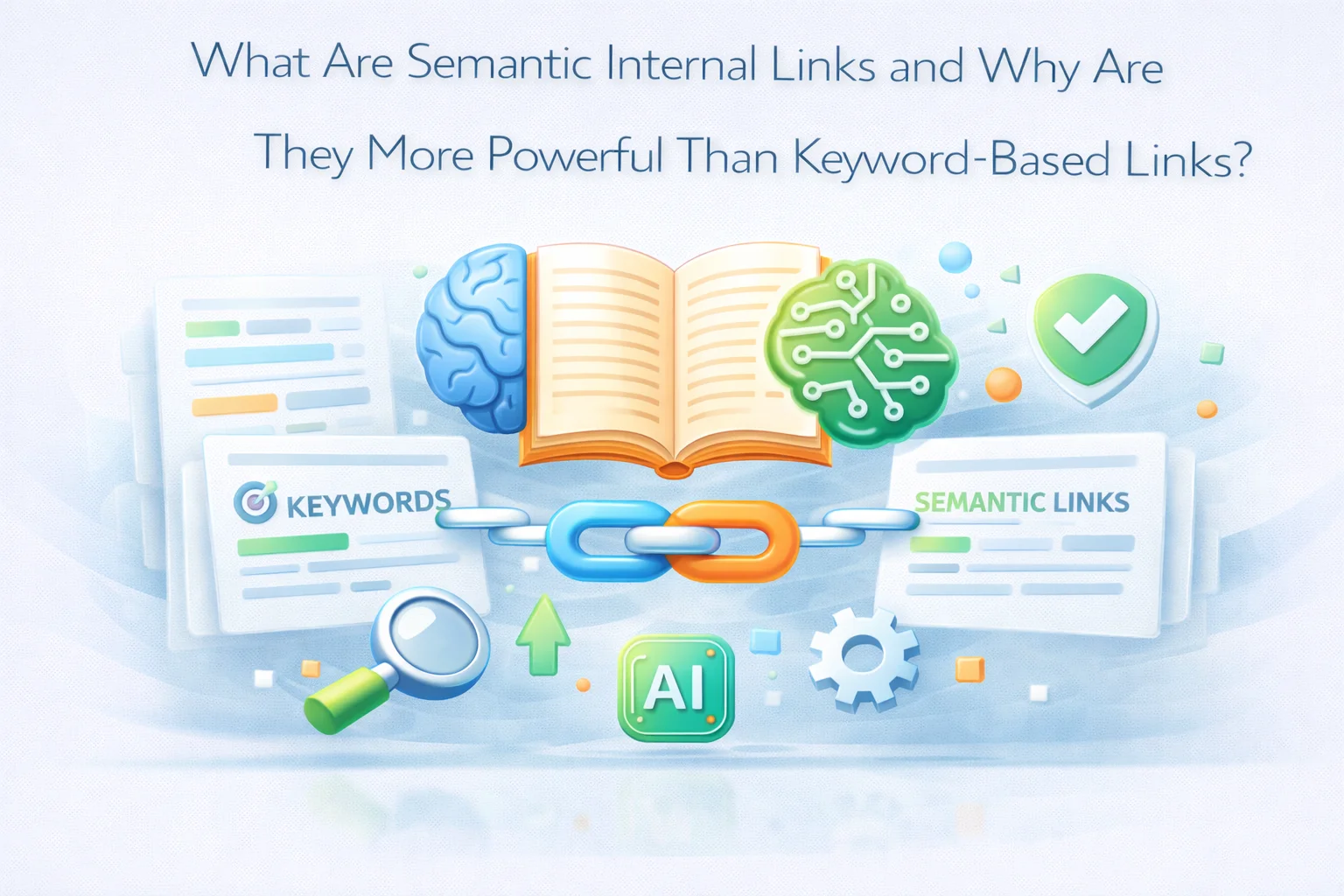
There is a question underneath the question whenever someone asks what semantic internal links are. The surface question is about a technique. The deeper question is about how search engines actually read and interpret the connections between your pages. Answering the surface question without the deeper one produces a definition without understanding. Understanding without the definition produces confusion about what to do differently.
This guide covers both. It explains what semantic internal links actually are at a technical level, why they produce better SEO outcomes than keyword-based links, how the shift from keyword matching to semantic understanding in Google’s core algorithm makes this distinction more consequential than it was five years ago, and what the practical difference looks like on a real WordPress site.
The implementation section covers how Nexu Link Brain creates semantic internal links using AI vector embeddings, and why the quality of connections it discovers reflects the way Google now evaluates content relationships rather than the way it did a decade ago.
Semantics is the study of meaning. In linguistics, it is the branch concerned with what words and sentences mean, as distinct from their form or syntax. In the context of internal links, semantic means that the connection between two pages is based on the meaning of their content rather than on the presence of shared vocabulary.
This distinction seems subtle until you work through what it means in practice. Two posts about the same topic can be written without sharing a single keyword. A post about “managing remote employees” and a post about “keeping distributed teams productive” cover the same subject from different angles using almost entirely different vocabulary. A system based on keyword matching cannot see the relationship between them. A system based on semantic understanding recognizes immediately that they belong to the same topical space.
The technical mechanism behind semantic internal linking is vector embeddings. This concept sounds abstract but the underlying idea is straightforward once you have a clear mental model.
An embedding is a mathematical representation of text as a point in a high-dimensional space. You can think of this space as a vast coordinate system with hundreds of dimensions, each representing some aspect of meaning. When an AI model converts a piece of text into an embedding, it produces a set of coordinates that locates that text in this meaning space. Crucially, texts that are about similar topics end up at similar coordinates, meaning they are close to each other in this space, regardless of the specific words they use.
When an AI semantic linking plugin processes your site, it converts every post into a vector embedding and stores those embeddings in an index. When it needs to find link targets for a given post, it finds the vectors closest to that post’s vector in the meaning space. Those closest vectors represent the most semantically related content on your site, regardless of vocabulary overlap.
This is not a clever trick. It is genuinely how meaning-based search and recommendation systems work, and it is the same class of technology that Google itself uses in its core ranking systems. When you create semantic internal links using the same type of technology Google uses to evaluate content relevance, you are creating connections that speak the language Google’s systems are designed to read.
The semantic linking advantage has grown over time as Google has deployed increasingly sophisticated natural language processing into its core ranking systems. Two updates in particular changed the landscape in ways that make semantic link quality more consequential than it was before.
BERT (Bidirectional Encoder Representations from Transformers) gave Google the ability to understand the context and meaning of words in a sentence rather than treating them as individual tokens. Before BERT, Google would see “bank” and struggle to determine whether the context was financial or geographic. After BERT, Google could read the surrounding words and understand which meaning was intended.
The implication for internal links is significant. Google now reads the text surrounding a link, not just the anchor text itself. When a link’s surrounding context is topically relevant to the destination page, that contextual signal reinforces the quality of the connection. When a link’s surrounding context is topically unrelated to the destination, that mismatch is now detectable in a way it was not before BERT.
MUM (Multitask Unified Model) represents a further step in Google’s ability to understand complex topical relationships. Where BERT improved sentence-level understanding, MUM improves topic-level and cross-topic understanding. It can recognize that a question about preparing for a hiking trip connects to discussions about footwear, nutrition, weather preparation, and trail difficulty, even without direct keyword overlap between these areas.
For internal linking, MUM means Google can now evaluate whether the topical cluster your links suggest your site is building actually makes sense from a subject-matter perspective. A cluster of pages that are genuinely related through semantic meaning forms a coherent topical signal. A cluster of pages connected only through coincidental keyword matches does not form the same coherent signal, even if the individual links look similar on the surface.
The superiority of semantic internal links over keyword-based ones is not a single advantage but three distinct advantages operating simultaneously and reinforcing each other.
Semantic linking finds connections between posts that share no common keywords but are genuinely related through subject matter. These non-obvious connections are often the most valuable ones from a topical authority perspective, because they are precisely the connections that demonstrate comprehensive coverage of a topic. A site that can connect its post about “espresso machine pressure” to its post about “water hardness effects on coffee extraction” without those pages sharing any keywords is demonstrating a depth of subject matter coverage that pure vocabulary analysis cannot capture.
These are the links that a keyword-based tool will never create, no matter how many rules you configure. The connection does not exist at the vocabulary level. It exists at the meaning level. And meaning-based connections are precisely what Google’s modern ranking systems reward as evidence of topical authority.
Because semantic links are created based on topical relevance between entire posts rather than phrase coincidence within posts, the resulting links are placed in contexts where the connection makes genuine editorial sense. The source post is about something related to the destination post. The anchor text, which the AI generates from the source post’s language, describes the destination accurately. The surrounding paragraph context supports the relevance of the link.
This contextual coherence is what BERT is specifically equipped to evaluate. A link that makes contextual sense as Google reads the source page provides a stronger, more trustworthy signal about the destination page than a link inserted mechanically because a rule fired on a matching phrase regardless of context.
Semantic linking generates anchor text from the language of the source post at the moment the link is created. Because each source post approaches the shared topic from a different angle, using different vocabulary and framing, the anchor text for links pointing to the same destination varies naturally across posts. The result is a diverse anchor text profile that mirrors what human editorial writing produces and avoids the exact-match repetition patterns that keyword automation creates.
Each varied anchor phrase also provides Google with a different facet of the destination page’s topical identity. Where a keyword-based tool says “best espresso machine” 40 times, a semantic tool says “best espresso machine,” “top home espresso options,” “espresso maker buying guide,” “choosing an espresso machine for beginners,” and 36 other contextually derived variations. The destination page develops a richer, more multidimensional topical profile in Google’s systems.
To make the practical difference between the two approaches concrete, consider a real content category: personal finance for young adults. A site in this niche might have posts covering budgeting, saving, investing, debt management, credit scores, salary negotiation, housing decisions, and tax basics.
A keyword-based tool links pages when they share common phrases. The budgeting post links to other posts that mention “budget” or “budgeting.” The investing post links to posts that mention “investing” or “investments.” The connections created are mostly within the same narrow vocabulary cluster: budgeting posts linking to budgeting posts, investing posts linking to investing posts.
A semantic tool recognizes relationships that cross vocabulary boundaries. It understands that a post about “building an emergency fund” is meaningfully related to a post about “how to negotiate a higher salary,” because both address the same underlying goal of financial resilience, even though they share no keywords. It connects a post about “understanding compound interest” with a post about “why starting to save in your twenties matters,” because both discuss the time-value dimension of money. It links a post about “improving your credit score” with a post about “what mortgage lenders look at,” because they share a causal relationship even without overlapping vocabulary.
These cross-vocabulary connections are precisely what builds comprehensive topical authority signals. They show Google that your site understands the subject area as a coherent whole, not as a collection of keyword-focused articles that happen to share a category. The difference in topical authority between a site with only keyword-adjacent connections and a site with semantic connections spanning the full subject matter domain is substantial, and it grows more pronounced as your content archive grows.
A legitimate question to ask about AI-generated semantic links is whether they genuinely replicate human editorial judgment or merely approximate it in ways that are sometimes right and sometimes wrong. The honest answer is: they approximate it at a level of quality and consistency that no human process can match at scale, while still being imperfect in edge cases.
Human editors make nuanced judgments about linking that embed tacit knowledge about the topic, the audience, and the editorial context. An AI embedding system captures semantic similarity with high accuracy but lacks that deeper editorial judgment in edge cases. A link between two posts with high semantic similarity might still not be the best editorial choice if, for example, the target post is outdated, off-brand, or addresses a different audience level.
This is precisely why the best semantic linking tools include a human review layer. Nexu Link Brain generates suggestions with relevance scores and explanations, and allows you to review, edit, or reject any suggestion before it is applied. The AI does the scale-intensive work of identifying semantic relationships across thousands of content pairs. The human editor applies contextual judgment to the suggestions that warrant a second look. Neither is adequate alone. Together, they produce a linking structure that is both comprehensive in coverage and editorially sound in individual decisions.
The most direct way to illustrate the practical difference is to show what each approach produces on the same set of content. Consider a WordPress site covering digital marketing, with posts across SEO, content marketing, email marketing, social media, and paid advertising.
In every scenario, the semantic approach creates more connections, creates more relevant connections, and creates connections that cross the vocabulary boundaries that keyword matching cannot cross. These are not marginal differences in link quality. They represent a fundamentally different level of topical coherence in your site’s internal architecture.
The WordPress plugin for semantic internal linking powered by AI uses the same class of embedding technology that Google uses to understand content relationships. When your internal link structure is built on the same semantic understanding as Google’s content evaluation, you are creating the kind of coherent topical architecture that Google’s systems are specifically designed to identify and reward with higher rankings.
Nexu Link Brain uses AI vector embeddings to build semantic internal links based on genuine topical relationships, discovers connections that keyword matching structurally cannot find, and creates the coherent topical architecture that Google’s modern ranking systems reward.





Hey everyone! Just finished reading this guide while prepping for my thesis research, and wow it actually broke down how internal linking has changed in a way that finally made sense to me. i've read so many SEO blogs that just say "semantic links matter now," but this one explained why the old keyword matching approach doesn't work anymore. The part about how search engines now understand context like a multidimensional space instead of just scanning for exact phrases was a total lightbulb moment. saved me hours of digging through vague articles
Didn't expect a guide to actually break down why semantic links work better than just keyword matching. most just tell you "do this" and leave it at that. But the part about how search engines now focus on context instead of just words? That's what finally made it click for me. they even compared two posts on the same topic with zero overlapping keywords never seen that example anywhere else. took me about 14 minutes to get through, but totally worth it for that "aha" moment
Just finished reading the semantic internal links guide, and wow it actually explained why these links work better, not just how to use them. Most guides throw definitions at you without digging into the "why," but this one connected the dots between Google's algorithm shifts and real world WordPress setups. Super helpful for someone like me who's tired of surface level SEO advice. only thing? A quick TL;DR at the top would've been nice for skimmers. Still, saved this for my team!
My friend told me this guide would explain semantic links better than anything else